
LAWU-204 · Lesson 4 of 12 · 23 min
Fees and client property
▶ Video coming soon A video version of this lesson is on the way.
Oyelaran tells the class that in twelve years as disciplinary counsel she disbarred more lawyers for mishandling money than for any other reason. "Not for bad lawyering," she says. "For taking money that was not theirs. Often they meant to put it back. Some of them did put it back. It did not matter." This lesson covers the rules on what lawyers may charge, how fees must be agreed and explained, how fees may be shared, and how lawyers must hold money and property that belongs to clients and others. These rules are technical, but they are enforced more strictly than almost any others in the course.
The reasonableness requirement: Rule 1.5(a)
Rule 1.5(a) forbids a lawyer to make an agreement for, charge or collect an unreasonable fee or an unreasonable amount for expenses. The rule lists eight factors for deciding reasonableness: the time and labor required, the novelty and difficulty of the questions and the skill needed; the likelihood that accepting the matter will preclude other work; the fee customarily charged locally for similar services; the amount involved and the results obtained; time limits imposed by the client or circumstances; the nature and length of the professional relationship; the experience, reputation and ability of the lawyer; and whether the fee is fixed or contingent. No single factor controls, and a fee that is reasonable when agreed can become unreasonable if circumstances change dramatically, such as a contingent fee on a recovery that requires almost no work.
Courts and discipline authorities find fees unreasonable in recurring patterns: billing for work not done, padding hours, charging hourly rates for clerical tasks, charging a client for the lawyer's own learning on a routine matter, and charging a full contingent percentage when liability was never contested and the insurer offered policy limits immediately. ABA Formal Opinion 93-379 condemned billing more than the time actually spent, such as billing two clients for the same hour of travel time, and said a lawyer may not bill for overhead such as ordinary office supplies unless the client agreed. The fee rules for generative AI in Formal Opinion 512, covered in lesson 3, apply the same principles to new tools.
Types of fee arrangements
Lawyers charge in several ways. Hourly billing is the most common in business and litigation work; it rewards time rather than results and creates a temptation to inflate hours. Flat fees, a fixed price for a defined service such as a simple will, an uncontested divorce or a criminal misdemeanor, give clients price certainty. Contingent fees, a percentage of any recovery, are standard in personal injury and some commercial litigation and let people without money pursue claims. Hybrid arrangements combine these, such as a reduced hourly rate plus a smaller contingent percentage. Some lawyers charge for limited scope services by the task, and alternative fee arrangements such as success fees and capped fees are increasingly common in business work.
A retainer in the true sense is a fee paid to secure a lawyer's availability, regardless of whether work is done; it is earned when paid if it is reasonable. Most so-called retainers are really advance fee deposits: money paid in advance against future work, which remains the client's property until earned and must be held in trust. Many states have held that a nonrefundable fee is permissible only if reasonable, and that a lawyer who is discharged before completing the work must refund the unearned portion despite any nonrefundable label, because Rule 1.16(d) requires refunding any advance payment of a fee that has not been earned. Calling a fee nonrefundable does not make it so.
| Arrangement | How it works | Main ethical issues |
|---|---|---|
| Hourly | Client pays for time at agreed rates | Padding, billing for overhead, excessive staffing |
| Flat fee | Fixed price for a defined service | Must refund the unearned portion if the work is not completed |
| Contingent fee | Percentage of recovery | Writing signed by client; banned in criminal and most domestic matters |
| True retainer | Payment for availability | Must be reasonable; rarely appropriate |
| Advance fee deposit | Prepayment against future work | Held in trust until earned; refund on discharge |
| Hybrid or capped | Combinations or limits | Clarity in the writing; reasonableness overall |
Communicating the fee: Rule 1.5(b)
Rule 1.5(b) requires that the scope of the representation and the basis or rate of the fee and expenses for which the client will be responsible be communicated to the client, preferably in writing, before or within a reasonable time after commencing the representation, except when the lawyer will charge a regularly represented client on the same basis as before. Any changes in the basis or rate must also be communicated. Several states require written fee agreements in most or all matters, sometimes above a dollar threshold. A lawyer who fails to explain fees invites disputes, and courts generally construe ambiguous fee agreements against the lawyer who drafted them.
Midstream changes to a fee agreement draw special scrutiny. Once a relationship exists, the lawyer is a fiduciary, and a client may feel unable to refuse a new demand for fear of losing the lawyer. Courts often presume that a fee modification made during a representation is unfair to the client unless the lawyer shows that it was fair and reasonable and that the client understood it, and some apply Rule 1.8(a), the rule on business transactions with clients, to modifications that benefit the lawyer. A raise in hourly rates announced in advance and applied prospectively is usually fine; a demand for a bigger share of a contingent recovery on the eve of trial usually is not.
Contingent fees: Rule 1.5(c) and (d)
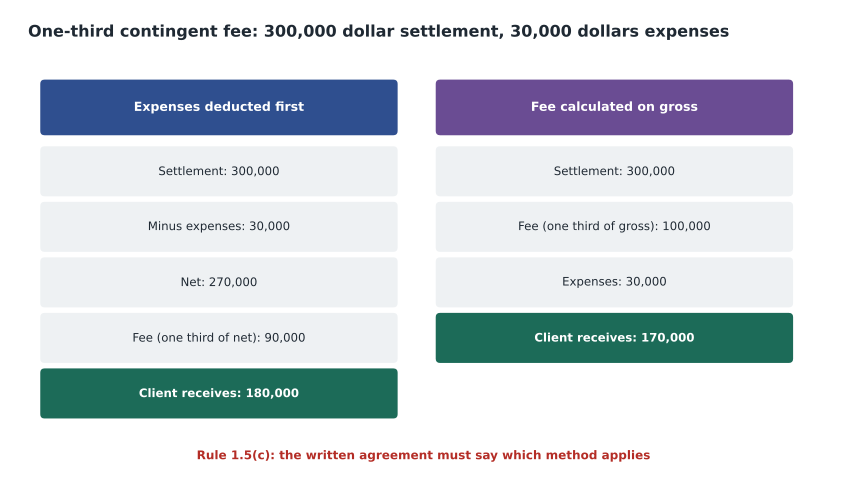
Rule 1.5(c) permits contingent fees except where prohibited by paragraph (d) or other law, but requires a written agreement signed by the client. The writing must state the method by which the fee is to be determined, including the percentage or percentages that go to the lawyer in the event of settlement, trial or appeal; the litigation and other expenses to be deducted from the recovery; whether those expenses are deducted before or after the contingent fee is calculated; and any expenses for which the client will be liable whether or not the client prevails. At the end of the matter, the lawyer must give the client a written statement showing the outcome, the remittance to the client and the method of its determination.
Whether expenses come off before or after the percentage matters a great deal. On a 300,000 dollar settlement with 30,000 dollars in expenses and a one-third fee, deducting expenses first leaves 270,000 dollars, a fee of 90,000 dollars and 180,000 dollars to the client. Calculating the fee on the gross gives the lawyer 100,000 dollars and leaves the client 170,000 dollars. Many states regulate contingent percentages in particular fields, such as medical malpractice and workers' compensation, and federal law does too: the Federal Tort Claims Act caps attorney fees at 20 percent of an administrative settlement and 25 percent of a judgment or of a settlement reached after suit is filed.
Rule 1.5(d) forbids two kinds of contingent fees. A lawyer may not charge a fee in a domestic relations matter contingent on securing a divorce or on the amount of alimony, support or a property settlement, because such fees are thought to discourage reconciliation and to raise special risks of overreaching. Comment 6 explains that the ban does not reach contingent fees for collecting past-due alimony or support. And a lawyer may not charge a contingent fee for representing a defendant in a criminal case, because outcomes such as acquittal or conviction do not produce a fund from which to pay and because the arrangement could tempt the lawyer to put personal interest above the client's.
Dividing fees: Rule 1.5(e) and referral payments
Rule 1.5(e) allows lawyers who are not in the same firm to divide a fee only if three conditions are met: the division is in proportion to the services performed by each lawyer, or each lawyer assumes joint responsibility for the representation; the client agrees to the arrangement, including the share each lawyer will receive, and the agreement is confirmed in writing; and the total fee is reasonable. The joint responsibility option allows referral arrangements in which the referring lawyer does little work but accepts financial and ethical responsibility for the matter as if the lawyers were partners. States vary significantly; some forbid pure referral fees, and others allow them with disclosure.
Rule 7.2(b), covered in lesson 11, generally forbids giving anything of value to a person for recommending the lawyer's services, with exceptions for paying for advertising, paying for a qualified lawyer referral service, buying a law practice, giving nominal gifts as thanks, and reciprocal referral agreements with other lawyers or nonlawyer professionals that are not exclusive and are disclosed to the client. Rule 5.4(a) forbids sharing legal fees with nonlawyers, with narrow exceptions such as paying a deceased lawyer's estate and including nonlawyer employees in a compensation or retirement plan based on profits. As lesson 1 explained, Arizona and the District of Columbia allow some nonlawyer ownership or partnership, and a lawyer must follow the rules of the jurisdiction that governs the conduct.
Client property: the trust account under Rule 1.15
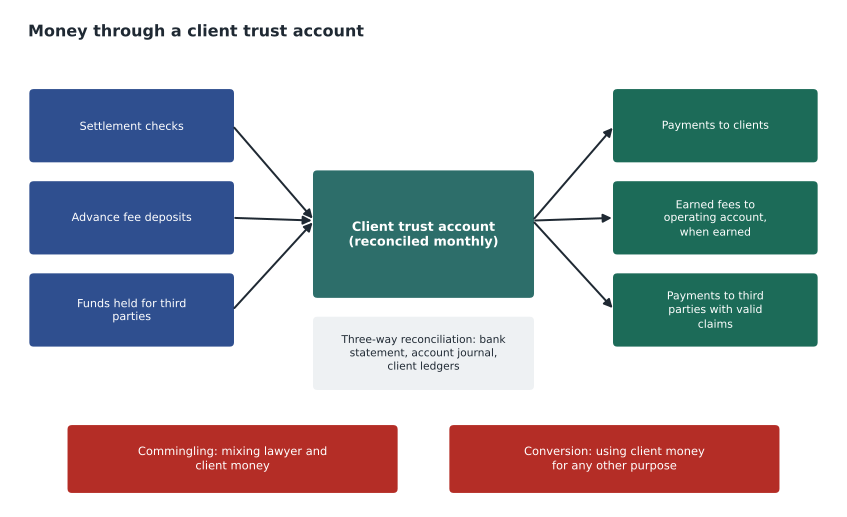
Rule 1.15 requires a lawyer to hold property of clients or third persons that is in the lawyer's possession in connection with a representation separate from the lawyer's own property. Money must be kept in a separate account, usually called a client trust account, maintained in the state where the lawyer's office is situated or elsewhere with the client's consent. Other property must be identified and safeguarded. Complete records of trust account funds must be kept and preserved for five years after the end of the representation, unless the state sets a different period. A lawyer may deposit the lawyer's own funds in a trust account only to pay bank service charges.
Two cardinal sins dominate trust account discipline. Commingling is mixing the lawyer's money with client money, such as leaving earned fees in the trust account indefinitely or depositing client funds in the operating account. Conversion, or misappropriation, is using client money for any purpose other than the client's, even temporarily and even with an intent to repay. Many states, following the New Jersey Supreme Court's decision in In re Wilson (N.J. 1979), impose disbarment almost automatically for knowing misappropriation, regardless of the lawyer's reasons or later repayment. Negligent misappropriation, such as a bookkeeping error that causes a shortfall, is treated less severely but still leads to discipline.
IOLTA and the mechanics of trust accounting
Small or short-term deposits of client funds usually go into a pooled trust account called an IOLTA account, Interest on Lawyers' Trust Accounts. Because the interest on any one client's small deposit would be less than the cost of accounting for it, the interest on the pooled account is paid to a state foundation that funds legal aid. Every state has an IOLTA program, and most make participation mandatory. In Brown v. Legal Foundation of Washington (2003), the Supreme Court held that IOLTA programs do not violate the Takings Clause, because clients whose funds could not have earned net interest for themselves suffer no compensable loss. Large or long-term deposits that could earn net interest for the client must go into a separate interest-bearing account for that client.
Good trust accounting requires a ledger for each client, a running balance for the account, and a monthly three-way reconciliation of the bank statement, the account journal and the total of the client ledgers. A lawyer must not disburse funds against deposits that have not yet cleared, because if the deposit bounces, the lawyer will have paid one client with another client's money. Many states require banks to report overdrafts on trust accounts to disciplinary counsel automatically, and random audits are common. Oyelaran tells the class that the overdraft report is how many of her biggest cases began.
Prompt delivery, accounting and disputed funds
Rule 1.15(d) requires a lawyer, on receiving funds or property in which a client or third person has an interest, to promptly notify the client or third person, promptly deliver any funds or property the client or third person is entitled to receive, and on request promptly render a full accounting. Rule 1.15(e) addresses disputes. When the lawyer and the client both claim part of a fund, such as when the client disputes the fee, the lawyer must keep the disputed portion separate until the dispute is resolved and must promptly distribute all portions not in dispute. A lawyer may not hold the entire fund hostage to force the client to pay a disputed fee.
Third-party claims are common in personal injury work. When a hospital, a health insurer or Medicare has a lien on a settlement, the lawyer may be obligated to protect that interest. Comment 4 explains that a lawyer may have a duty under applicable law to protect third-party claims against wrongful interference by the client, and that when the third party's claim is lawful, the lawyer must not simply hand the money to the client and let the lienholder fend for itself. If the dispute cannot be resolved, the lawyer may file an action to have a court decide it, such as an interpleader.
Worked problem
The Delgado settlement
Assume the Delgado products case settles for 450,000 dollars. Ana Whitcomb's contingent fee agreement with Rosa Delgado, signed before suit, provides a one-third fee calculated after deducting expenses, which total 45,000 dollars. A hospital has a valid lien of 60,000 dollars for Delgado's burn treatment. Delgado tells Whitcomb she thinks the fee is too high because the case settled before trial and asks for the whole settlement now. What must Whitcomb do with the money?
Show solution
- Deposit the settlement check in the trust account and wait until it clears before disbursing anything.
- Calculate the fee as agreed: 450,000 minus 45,000 in expenses leaves 405,000; one third is 135,000 dollars.
- Protect the hospital's lien: hold 60,000 dollars for the hospital or pay it as the lien requires, because Rule 1.15(e) and comment 4 protect lawful third-party claims.
- Handle the fee dispute under Rule 1.15(e): keep the disputed fee in trust, but distribute the undisputed portion to Delgado promptly. Delgado's share before the fee dispute is 405,000 minus 135,000 minus 60,000, or 210,000 dollars, which she should receive now.
- Provide the written closing statement required by Rule 1.5(c) showing the outcome, the expenses, the fee and the remittance, and offer fee arbitration if the state has a program.
Answer: Whitcomb pays Delgado the undisputed 210,000 dollars promptly, pays or holds 60,000 dollars for the hospital, keeps the disputed 135,000 dollar fee in trust until the dispute is resolved by agreement, arbitration or a court, gives Delgado a written settlement statement and never moves the disputed fee into her operating account.
Fee disputes and collection
Most states run voluntary or mandatory fee arbitration programs through the bar, and some require lawyers to tell clients about them before suing to collect a fee. Lawyers may sue clients for unpaid fees, but suing a client often provokes a malpractice counterclaim. A lawyer may reveal confidential information to the extent reasonably necessary to collect a fee, under Rule 1.6(b)(5), but should reveal no more than necessary and should seek protective orders. Lawyers may accept credit cards and may accept payment in property, though accepting an ownership interest in a client's business raises the business transaction rules of Rule 1.8(a), covered in lesson 7. ABA Formal Opinion 00-418 (2000) concluded that a lawyer may take stock in a client as payment for legal services if the lawyer complies with Rule 1.8(a) and the total fee is reasonable.
Summary and key terms
- Rule 1.5(a) forbids unreasonable fees and lists eight factors; billing for time not spent or for overhead without agreement is unreasonable.
- Advance fee deposits belong to the client until earned; nonrefundable labels do not avoid the duty to refund unearned fees.
- Rule 1.5(b) requires communicating the scope and basis of fees, preferably in writing; midstream changes favoring the lawyer are closely scrutinized.
- Contingent fees need a writing signed by the client stating percentages and how expenses are handled; they are banned for criminal defense and for securing a divorce or the amount of support or property.
- Fee division between firms requires proportion to work or joint responsibility, client agreement in writing and a reasonable total.
- Rule 1.15 requires separate trust accounts, complete records kept for five years, prompt delivery and accounting, and separation of disputed funds.
- Knowing misappropriation usually leads to disbarment; IOLTA interest funds legal aid and survived a Takings Clause challenge in Brown v. Legal Foundation of Washington.
Practice problems
Work each problem on paper first, then reveal the answer to check.
May a lawyer charge a contingent fee for collecting past-due child support?
Show answer
Yes. Comment 6 to Rule 1.5 explains that the domestic relations ban does not reach collection of past-due alimony or support.
A client disputes 20,000 dollars of a 50,000 dollar fee taken from a 200,000 dollar settlement. What must the lawyer do?
Show answer
Promptly distribute the undisputed amounts and keep the disputed 20,000 dollars in trust until the dispute is resolved.
What three conditions does Rule 1.5(e) impose on dividing a fee with a lawyer in another firm?
Show answer
Division in proportion to services or with joint responsibility; client agreement, including each lawyer's share, confirmed in writing; and a reasonable total fee.
Why must a lawyer wait for a deposit to clear before disbursing from the trust account?
Show answer
If the deposit fails, the disbursement will have been paid with other clients' money, which is a conversion of their funds.
Lesson quiz · 5 questions
Score 60% or more to complete this lesson.
Create a free account to save your progress, take quizzes and earn a certificate.