
LAWU-204 · Lesson 10 of 12 · 27 min
Duties to the court
▶ Video coming soon A video version of this lesson is on the way.
Oyelaran opens with a question that has divided lawyers for generations: what should a criminal defense lawyer do when the client insists on testifying and the lawyer knows the testimony will be false? Daniel Reyes says the lawyer's job is to defend the client, not to judge him. Priya Natarajan says the lawyer cannot help commit perjury. Marcus Webb asks how the lawyer could ever know for sure. "All three of you have identified the rule," Oyelaran says. "The rule says the lawyer may not offer evidence the lawyer knows is false, that knowing means actual knowledge, and that when it happens the lawyer must take remedial measures, even if that means revealing what the client said. Today we look at why the rules draw the line there, and at the other duties lawyers owe to the courts in which they practice."
The lawyer as officer of the court
The adversary system depends on lawyers pressing their clients' positions vigorously, but it also depends on lawyers telling courts the truth. The Model Rules resolve the tension largely in favor of candor when the two collide in front of a tribunal. The Preamble describes the lawyer as a representative of clients, an officer of the legal system and a public citizen having special responsibility for the quality of justice. Rules 3.1 through 3.9 set out the lawyer's duties as advocate. Rule 1.0(m) defines tribunal broadly to include courts, arbitrators and administrative agencies acting in an adjudicative capacity, and Rule 3.9 applies many of the same duties to lawyers appearing before legislative bodies and agencies in nonadjudicative proceedings.
Meritorious claims: Rule 3.1 and Rule 11
Rule 3.1 forbids a lawyer to bring or defend a proceeding, or assert or controvert an issue, unless there is a basis in law and fact for doing so that is not frivolous, which includes a good faith argument for an extension, modification or reversal of existing law. A criminal defense lawyer may nevertheless defend so as to require that every element of the case be established, because the prosecution bears the burden of proof. A position is not frivolous merely because the facts have not been fully substantiated or because the lawyer expects to develop vital evidence through discovery, but the lawyer must inform themselves about the facts and the law and be able to make a good faith argument.
Courts enforce similar duties directly. Federal Rule of Civil Procedure 11(b) provides that by signing, filing or later advocating a pleading, motion or other paper, a lawyer certifies that, to the best of the lawyer's knowledge, information and belief, formed after an inquiry reasonable under the circumstances, the paper is not being presented for any improper purpose, the legal contentions are warranted by existing law or by a nonfrivolous argument for changing it, and the factual contentions have evidentiary support or are likely to have it after discovery. Since the 1993 amendments, Rule 11(c)(2) gives the opposing party a 21-day safe harbor: a motion for sanctions must be served but not filed until the offending paper has had 21 days to be withdrawn or corrected. Courts may also sanction lawyers under 28 U.S.C. section 1927 for unreasonably and vexatiously multiplying proceedings, and under their inherent power, as in Chambers v. NASCO, Inc. (1991). The AI citation cases discussed in lesson 3 were Rule 11 cases.
Expediting litigation: Rule 3.2
Rule 3.2 requires a lawyer to make reasonable efforts to expedite litigation consistent with the interests of the client. Comment 1 says that delay should not be indulged merely for the convenience of the advocates or for the purpose of frustrating an opposing party's attempt to obtain rightful redress. The question is whether a competent lawyer acting in good faith would regard the course of action as having some substantial purpose other than delay. Realizing financial or other benefit from otherwise improper delay in litigation is not a legitimate interest of the client.
Candor to the tribunal: Rule 3.3
Rule 3.3(a) contains three duties. A lawyer shall not knowingly make a false statement of fact or law to a tribunal or fail to correct a false statement of material fact or law previously made to the tribunal by the lawyer. A lawyer shall not knowingly fail to disclose to the tribunal legal authority in the controlling jurisdiction known to the lawyer to be directly adverse to the position of the client and not disclosed by opposing counsel. And a lawyer shall not knowingly offer evidence that the lawyer knows to be false. If a lawyer, the lawyer's client or a witness called by the lawyer has offered material evidence and the lawyer comes to know of its falsity, the lawyer shall take reasonable remedial measures, including, if necessary, disclosure to the tribunal. A lawyer may refuse to offer evidence, other than the testimony of a defendant in a criminal matter, that the lawyer reasonably believes is false.
The duty to disclose adverse authority surprises students. A lawyer who finds a controlling appellate decision squarely against the client's position, and sees that the other side has missed it, must disclose it. The lawyer may then argue that the case is distinguishable, wrongly decided or should be overruled. The duty reaches only authority in the controlling jurisdiction that is directly adverse. Persuasive authority from other jurisdictions need not be disclosed, although many judges expect lawyers to address significant contrary decisions anyway, and failing to do so damages credibility.
Remedial measures and their duration
Rule 3.3(b) extends the duty beyond false evidence: a lawyer who represents a client in an adjudicative proceeding and who knows that a person intends to engage, is engaging or has engaged in criminal or fraudulent conduct related to the proceeding, such as bribing a juror or destroying evidence, shall take reasonable remedial measures, including, if necessary, disclosure to the tribunal. Rule 3.3(c) provides that the duties in paragraphs (a) and (b) continue to the conclusion of the proceeding, meaning when a final judgment has been affirmed on appeal or the time for review has passed, and apply even if compliance requires disclosure of information otherwise protected by Rule 1.6. This is one of the few places where the Model Rules require a lawyer to reveal client confidences.
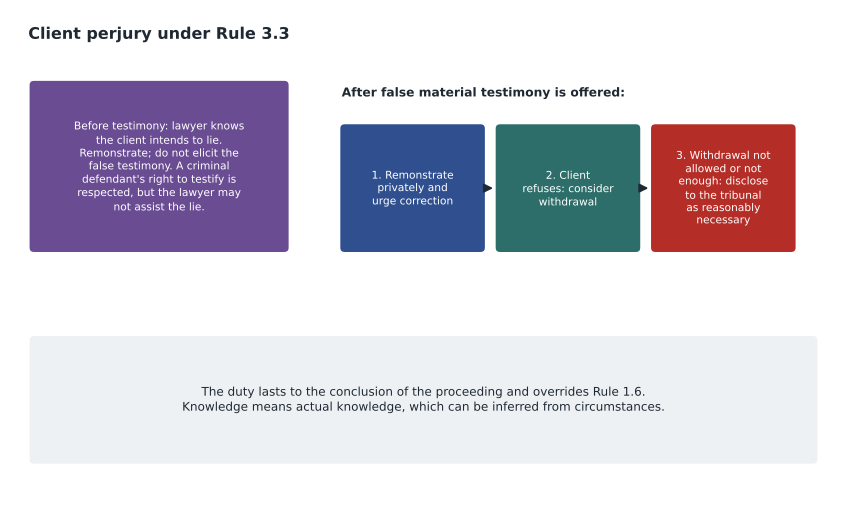
Comment 10 describes the sequence of remedial measures. The lawyer should first remonstrate with the client confidentially, advising of the lawyer's duty of candor and seeking the client's cooperation in withdrawing or correcting the false statement. If that fails, the lawyer must take further remedial action. If withdrawal from the representation is not permitted or will not undo the effect of the false evidence, the lawyer must make such disclosure to the tribunal as is reasonably necessary to remedy the situation, even if doing so requires revealing information that would otherwise be protected by Rule 1.6. It is then for the tribunal to decide what should be done, from making a statement to the trier of fact to ordering a mistrial.
Client perjury in criminal cases: Nix v. Whiteside
The perjury problem is hardest in criminal defense, where the defendant has constitutional rights to testify, to effective assistance of counsel and to keep confidences. In Nix v. Whiteside (1986), a defendant charged with murder told his lawyer that he had not seen a gun in the victim's hand, then later said he would testify that he had seen something metallic, explaining that if he did not say so he would be dead. The lawyer told him that if he testified falsely, the lawyer would advise the court and seek to withdraw. Whiteside testified truthfully and was convicted. The Supreme Court held that the lawyer's conduct did not deprive Whiteside of effective assistance, because a defendant has no right to the assistance of counsel in presenting false testimony.
Nix answered a constitutional question, not an ethics question, but comment 7 to Rule 3.3 now addresses the ethics directly. It notes that some jurisdictions have allowed a defense lawyer whose client insists on testifying falsely to let the client testify in narrative form, without questioning, and then not rely on the false testimony in closing argument. The Model Rules reject the narrative approach unless the jurisdiction's courts require it, and the comment says that in most jurisdictions the duties of Rule 3.3 apply to defense counsel too. The key limit is knowledge. Comment 8 says the prohibition applies only if the lawyer knows the evidence is false; a reasonable belief that evidence is false does not preclude its presentation, though the lawyer may refuse to offer it except for a criminal defendant's own testimony. A lawyer should resolve doubts in the client's favor, but cannot ignore an obvious falsehood.
| Lawyer's state of mind | Civil or prosecution witness | Criminal defendant's own testimony |
|---|---|---|
| Knows the testimony is false | Must not offer it | Must not elicit it; remedial measures if offered |
| Reasonably believes it is false | May refuse to offer it | Must allow the defendant to testify |
| Merely suspects or doubts | May offer it | Must allow; resolve doubts in client's favor |
| Learns of falsity after it is offered | Remedial measures, including disclosure if necessary | Remedial measures, including disclosure if necessary |
Fairness to the opposing party: Rule 3.4
Rule 3.4 forbids conduct that obstructs the fair working of the adversary system. A lawyer shall not unlawfully obstruct another party's access to evidence or unlawfully alter, destroy or conceal a document or other material having potential evidentiary value, or counsel or assist another person to do so; falsify evidence, counsel or assist a witness to testify falsely, or offer an inducement to a witness that is prohibited by law; knowingly disobey an obligation under the rules of a tribunal, except for an open refusal based on an assertion that no valid obligation exists; make a frivolous discovery request or fail to make reasonably diligent efforts to comply with a proper discovery request; at trial, allude to matters the lawyer does not reasonably believe are relevant or supported by admissible evidence, assert personal knowledge of facts in issue except when testifying as a witness, or state a personal opinion as to the justness of a cause, the credibility of a witness, the culpability of a civil litigant or the guilt or innocence of an accused; or request that a person other than a client refrain from voluntarily giving relevant information to another party, with limited exceptions for relatives, employees and agents of the client.
Comment 3 addresses paying witnesses. It is not improper to pay a witness's expenses or to compensate an expert witness on terms permitted by law, but the common law rule in most jurisdictions is that it is improper to pay an occurrence witness any fee for testifying beyond reasonable compensation for lost time and expenses, and that it is improper to pay an expert witness a contingent fee. Witness preparation is legitimate and expected; the line is crossed when a lawyer suggests what the facts should be rather than helping a witness recall and express what the witness actually knows.
Impartiality and decorum, trial publicity and the lawyer as witness
Rule 3.5 forbids seeking to influence a judge, juror or other official by means prohibited by law, communicating ex parte with such a person during the proceeding unless authorized by law or court order, communicating with a juror after discharge when prohibited or when the juror has said they do not want to talk, and engaging in conduct intended to disrupt a tribunal. Rule 3.6 limits trial publicity: a lawyer participating in a matter shall not make an extrajudicial statement that the lawyer knows or reasonably should know will be disseminated by public communication and will have a substantial likelihood of materially prejudicing an adjudicative proceeding. The rule lists safe harbor statements, such as the claim or defense involved, information in the public record and scheduling, and allows a lawyer to make a statement a reasonable lawyer would believe is required to protect a client from the substantial undue prejudicial effect of recent publicity not initiated by the lawyer or client. In Gentile v. State Bar of Nevada (1991), the Supreme Court upheld the substantial likelihood of material prejudice standard but found Nevada's safe harbor provision unconstitutionally vague as applied.
Rule 3.7 forbids a lawyer to act as advocate at a trial in which the lawyer is likely to be a necessary witness, unless the testimony relates to an uncontested issue, concerns the nature and value of legal services, or disqualification would work substantial hardship on the client. The concern is that the trier of fact may be confused about whether a statement by the advocate-witness is proof or argument. The disqualification is personal: other lawyers in the firm may try the case unless a conflict under Rule 1.7 or 1.9 prevents it.
Special responsibilities of prosecutors: Rule 3.8
Prosecutors have powers no private lawyer has, and Rule 3.8 imposes special duties to match. A prosecutor shall refrain from prosecuting a charge the prosecutor knows is not supported by probable cause; make reasonable efforts to assure the accused has been advised of the right to counsel; not seek to obtain from an unrepresented accused a waiver of important pretrial rights; make timely disclosure to the defense of all evidence or information known to the prosecutor that tends to negate the guilt of the accused or mitigates the offense; not subpoena a lawyer to present evidence about a past or present client unless strict conditions are met; and refrain from extrajudicial comments that heighten public condemnation of the accused. Paragraphs (g) and (h), added in 2008, require a prosecutor who learns of new, credible and material evidence creating a reasonable likelihood that a convicted defendant did not commit the offense to disclose it and, in the prosecutor's own jurisdiction, to investigate, and require a prosecutor who knows of clear and convincing evidence that a defendant in the prosecutor's jurisdiction was convicted of an offense the defendant did not commit to seek to remedy the conviction.
The ethics duty of disclosure in Rule 3.8(d) is broader than the constitutional duty under Brady v. Maryland (1963), which requires disclosure of evidence favorable to the accused that is material to guilt or punishment. ABA Formal Opinion 09-454 concluded that Rule 3.8(d) has no materiality limit and requires disclosure as soon as reasonably practicable. In August 2026 the ABA amended comment 3 to Rule 3.8 to make the same point expressly: the ethical duty of disclosure is broader than the constitutional obligation and is not limited to information the prosecutor believes would affect the outcome. Courts are divided on whether to adopt that reading for their own versions of Rule 3.8.
An overview of judicial ethics
Judges have their own ethics code. The ABA Model Code of Judicial Conduct, most recently revised comprehensively in 2007, has been adopted in some form by nearly every state, and federal judges other than Supreme Court justices are bound by the Code of Conduct for United States Judges. The Model Code is built around four canons: a judge shall uphold and promote the independence, integrity and impartiality of the judiciary and avoid impropriety and its appearance; perform the duties of office impartially, competently and diligently; conduct personal and extrajudicial activities to minimize the risk of conflict with judicial obligations; and refrain from political or campaign activity inconsistent with the judiciary's independence, integrity or impartiality. Rule 2.11 requires disqualification in any proceeding in which the judge's impartiality might reasonably be questioned, including when the judge has a personal bias, a financial interest or a close family relationship with a party or lawyer. Federal judges are governed by a similar statute, 28 U.S.C. section 455.
The Supreme Court has set constitutional floors. In Caperton v. A.T. Massey Coal Co. (2009), it held that due process required a West Virginia justice to recuse himself from a case involving a company whose chief executive had spent about three million dollars supporting the justice's election campaign while the case was pending, because the probability of actual bias was too high to be constitutionally tolerable. In Williams v. Pennsylvania (2016), it held that due process was violated when a state supreme court justice who had, as district attorney, personally approved seeking the death penalty against a defendant later participated in deciding the defendant's appeal. In Republican Party of Minnesota v. White (2002), it struck down a rule forbidding judicial candidates from announcing their views on disputed legal issues; in Williams-Yulee v. Florida Bar (2015), it upheld a rule forbidding judicial candidates from personally soliciting campaign contributions.
The justices of the Supreme Court were long bound by no written code. After public criticism of justices' financial disclosures and gifts, the Court issued a Code of Conduct for Justices on November 13, 2023. The code largely tracks the canons that apply to lower federal judges, and it was accompanied by commentary explaining how the justices apply it. Critics noted that it contains no enforcement mechanism and leaves recusal decisions to each justice. Proposals for enforceable ethics rules and for term limits have been introduced in Congress, but none had been enacted as of late 2026.
Worked problem
The surprise in State v. Pike
In the fictional State v. Pike, defense counsel Paul Ostrander, a public defender, prepares Devon Pike to testify. Pike has told Ostrander privately that he did shove the watchman, Lou Abbott, but now says he will testify that he never touched him. Separately, Ostrander has found a recent Westmarch Supreme Court decision on felony murder that hurts Pike's argument and that ADA Helen Moreau has not cited. During a recess, a reporter asks Ostrander whether he thinks the police planted evidence. What are Ostrander's obligations?
Show solution
- Pike's planned testimony: Ostrander knows it is false from Pike's own admission. Under Rule 3.3(a)(3) he may not elicit it. He must remonstrate with Pike, explaining his duty of candor and the risks of perjury, and try to persuade him to testify truthfully or not at all.
- Pike's right to testify: the decision whether to testify belongs to Pike under Rule 1.2(a). If Pike insists, Ostrander must follow the jurisdiction's approach. Under the Model Rules he may not assist the lie, and if Pike testifies falsely he must take remedial measures, including disclosure to the court if necessary. Nix v. Whiteside confirms that refusing to assist perjury does not deny effective assistance.
- Withdrawal: he may seek to withdraw, but a court is unlikely to permit it mid-trial, and withdrawal may not cure the problem.
- The adverse decision: under Rule 3.3(a)(2) he must disclose the controlling, directly adverse authority because the prosecutor has not, and then argue that it is distinguishable.
- The reporter: under Rule 3.6 he should not make a statement suggesting planted evidence that he knows or should know is substantially likely to materially prejudice the proceeding, especially without a factual basis; he may state the defense and information in the public record.
Answer: Ostrander must not elicit testimony he knows is false, must try to dissuade Pike, and must take remedial measures if Pike lies on the stand, including disclosure if necessary. He must disclose the adverse controlling decision and argue around it. And he should decline to speculate to the reporter about planted evidence, confining any comment to the safe harbor information Rule 3.6 allows.
Summary and key terms
- Rule 3.1 and Federal Rule of Civil Procedure 11 require nonfrivolous claims and reasonable inquiry; Rule 11 includes a 21-day safe harbor.
- Rule 3.3 forbids false statements to the tribunal, requires disclosing directly adverse controlling authority, and forbids offering evidence the lawyer knows is false; remedial measures, including disclosure, override Rule 1.6 and continue to the end of the proceeding.
- Nix v. Whiteside held that refusing to assist client perjury does not deny effective assistance; the Model Rules reject narrative testimony unless courts require it and turn on actual knowledge.
- Rule 3.4 forbids destroying evidence, falsifying evidence, improper witness payments and improper trial conduct.
- Rules 3.5 through 3.7 govern ex parte contacts, trial publicity (Gentile) and lawyers as witnesses.
- Rule 3.8 imposes special duties on prosecutors, including disclosure broader than Brady (Formal Opinion 09-454; 2026 comment) and post-conviction duties.
- Judges follow the Model Code of Judicial Conduct; Caperton and Williams set due process recusal floors, and the Supreme Court adopted an unenforced Code of Conduct for Justices in November 2023.
Practice problems
Work each problem on paper first, then reveal the answer to check.
Must a lawyer disclose a directly adverse decision from a court in another state that the opponent did not cite?
Show answer
No. Rule 3.3(a)(2) reaches only directly adverse authority in the controlling jurisdiction, though addressing significant contrary authority is often wise.
How long does the duty to remedy false evidence under Rule 3.3 last?
Show answer
Until the conclusion of the proceeding, when a final judgment has been affirmed on appeal or the time for review has passed.
May a lawyer pay an occurrence witness a fee for favorable testimony?
Show answer
No. A lawyer may reimburse reasonable expenses and lost time, but may not pay a fact witness for testimony or pay an expert a contingent fee.
What did Caperton v. A.T. Massey Coal Co. hold?
Show answer
That due process required recusal of a state justice where a party's CEO had spent about three million dollars supporting the justice's election while the case was pending.
Lesson quiz · 5 questions
Score 60% or more to complete this lesson.
Create a free account to save your progress, take quizzes and earn a certificate.