
LAWU-204 · Lesson 11 of 12 · 23 min
Third parties, advertising and access to justice
▶ Video coming soon A video version of this lesson is on the way.
Oyelaran hands out a settlement letter. In it, a plaintiff's lawyer tells an insurance adjuster that her client has no other insurance available, when the lawyer knows the client has an umbrella policy. "Puffery?" asks Marcus Webb. "Negotiators exaggerate all the time." Oyelaran shakes her head. "They exaggerate about value. This is a statement of fact. Today we leave the courtroom and look at what lawyers owe people who are not their clients, how lawyers may market their services, and what the profession owes to those who cannot afford a lawyer at all."
Truthfulness in statements to others: Rule 4.1
Rule 4.1 provides that in the course of representing a client a lawyer shall not knowingly make a false statement of material fact or law to a third person, or fail to disclose a material fact when disclosure is necessary to avoid assisting a criminal or fraudulent act by a client, unless disclosure is prohibited by Rule 1.6. The rule applies outside the courtroom: in negotiations, in correspondence and in transactional work. Misrepresentation can occur through partially true but misleading statements or omissions that are the equivalent of affirmative false statements.
Comment 2 draws the line Webb was testing. Whether a particular statement should be regarded as one of fact can depend on the circumstances. Under generally accepted conventions in negotiation, certain types of statements ordinarily are not taken as statements of material fact, such as estimates of price or value placed on the subject of a transaction and a party's intentions as to an acceptable settlement of a claim. Saying a client will not take less than a certain amount, when the client would, is conventional negotiating posture. Saying that there is no other insurance, when there is, is a lie about a fact. ABA Formal Opinion 06-439 applies the same distinction to negotiations in mediation, and courts have disciplined and sanctioned lawyers for misstatements of fact in settlement talks.
Represented persons: Rule 4.2
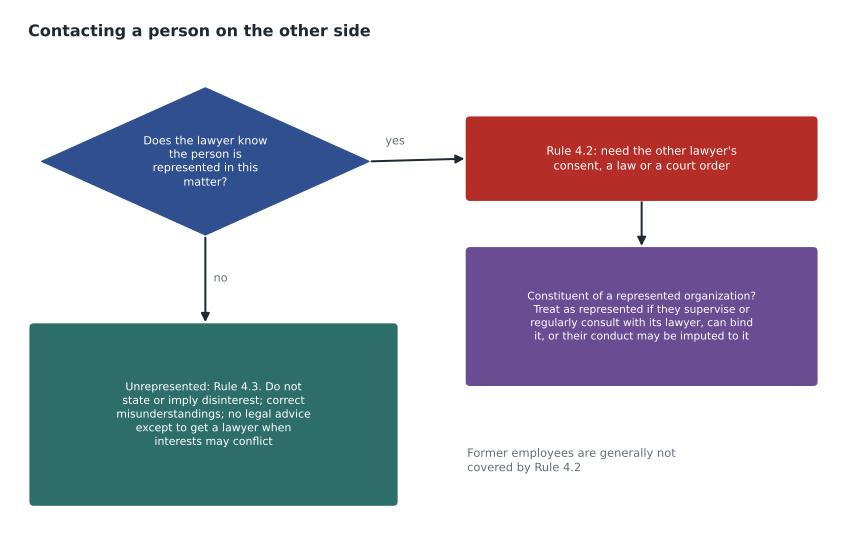
Rule 4.2 provides that in representing a client, a lawyer shall not communicate about the subject of the representation with a person the lawyer knows to be represented by another lawyer in the matter, unless the lawyer has the consent of the other lawyer or is authorized to do so by law or a court order. The rule protects represented persons against overreaching by opposing lawyers, interference with the client-lawyer relationship and the uncounseled disclosure of information. It applies even if the represented person initiates or consents to the communication. Parties themselves may communicate directly with each other, and a lawyer may advise a client about such communications, but a lawyer may not script the client as a conduit to do what the lawyer cannot.
Three applications cause most of the trouble. First, organizations: for a represented organization, comment 7 bars communication with a constituent who supervises, directs or regularly consults with the organization's lawyer concerning the matter, or has authority to obligate the organization, or whose act or omission may be imputed to the organization. Consent of a constituent's own lawyer suffices, and former constituents are generally not covered. Second, government: the authorized by law exception covers communications with government officials about policy, and covert investigative contacts by government lawyers before charges are filed, which many courts allow. Third, electronic communications: a lawyer who replies all to an email that copies the opposing client can violate the rule. In August 2026 the ABA amended the comments to Rule 4.2 to address reply all and similar group communications, building on Formal Opinion 503 (2022), which concluded that a lawyer who copies a client on an email to opposing counsel impliedly consents to opposing counsel replying to all, so that sending lawyers should blind copy or forward separately if they do not want that result.
Unrepresented persons and respect for third parties: Rules 4.3 and 4.4
Rule 4.3 governs dealings with a person who is not represented. The lawyer shall not state or imply that the lawyer is disinterested, and when the lawyer knows or reasonably should know that the unrepresented person misunderstands the lawyer's role, the lawyer shall make reasonable efforts to correct the misunderstanding. The lawyer shall not give legal advice to an unrepresented person, other than the advice to secure counsel, if the lawyer knows or reasonably should know that the interests of such a person are or have a reasonable possibility of being in conflict with the client's. A lawyer may negotiate the terms of a transaction or settlement with an unrepresented person and explain the lawyer's own view of the meaning of a document, so long as the lawyer has explained that the lawyer represents an adverse party and is not representing the person.
Rule 4.4(a) forbids a lawyer to use means that have no substantial purpose other than to embarrass, delay or burden a third person, or methods of obtaining evidence that violate the legal rights of such a person. Rule 4.4(b), amended in 2012 to add electronically stored information, provides that a lawyer who receives a document or electronically stored information relating to the representation of the lawyer's client and knows or reasonably should know that it was inadvertently sent shall promptly notify the sender. The Model Rule requires only notice. Whether the receiving lawyer must return the material without reading it, and whether privilege has been waived, are left to other law, such as Federal Rule of Evidence 502(b) and Federal Rule of Civil Procedure 26(b)(5)(B), discussed in lesson 6. Some states go further and require the receiving lawyer to stop reading and await instructions.
Advertising and the First Amendment
For most of the twentieth century, bar rules forbade lawyer advertising as undignified. That changed in Bates v. State Bar of Arizona (1977), where the Supreme Court held that the First Amendment protects truthful advertising of routine legal services and their prices. Two lawyers who ran a legal clinic had advertised uncontested divorces and other services at very reasonable prices; the Court held that Arizona could not discipline them for it. Bates opened the door. In In re R.M.J. (1982), the Court struck down Missouri rules that limited ads to a list of approved categories of information, holding that states may regulate potentially misleading advertising but may not prohibit truthful information that is not misleading. In Zauderer v. Office of Disciplinary Counsel (1985), it held that Ohio could not discipline a lawyer for a newspaper ad containing accurate legal advice and an illustration of an intrauterine device aimed at women injured by it, but upheld a requirement that contingent fee ads disclose that clients may be liable for costs. In Peel v. Attorney Registration and Disciplinary Commission (1990), it held that a lawyer could truthfully state that he was certified as a civil trial specialist by a bona fide private organization.
The Court has also let states regulate. In Florida Bar v. Went For It, Inc. (1995), it upheld a 30-day ban on targeted direct mail solicitation of accident victims and their families, finding that Florida had a substantial interest in protecting their privacy and the reputation of the profession and that the restriction was narrowly drawn. In Shapero v. Kentucky Bar Association (1988), by contrast, it had held that states may not categorically ban targeted direct mail to people known to face particular legal problems, because a letter, unlike a personal visit, can be put aside.
The Model Rules on advertising after 2018
In 2018 the ABA streamlined the advertising rules. Rule 7.1 remains the core: a lawyer shall not make a false or misleading communication about the lawyer or the lawyer's services. A communication is false or misleading if it contains a material misrepresentation of fact or law, or omits a fact necessary to make the statement considered as a whole not materially misleading. Comment 3 warns that truthful statements about past results can mislead if presented so as to lead a reasonable person to form an unjustified expectation that the same results could be obtained for other clients, and comparisons with other lawyers can mislead if they cannot be substantiated. Rule 7.2 now permits communication through any media and addresses paying for referrals: a lawyer may not give anything of value for recommending the lawyer's services, except for reasonable costs of permitted advertising, the usual charges of a legal service plan or a not-for-profit or qualified lawyer referral service, the purchase of a law practice, nonexclusive reciprocal referral agreements disclosed to the client, and nominal gifts given as an expression of appreciation that are neither intended nor reasonably expected as compensation. Rule 7.2(c) limits claims of certification as a specialist to certifications by an approved organization, clearly identified. The 2018 amendments deleted former Rules 7.4 and 7.5 and folded their content into Rules 7.1 and 7.2 and their comments.
Solicitation: Rule 7.3
Rule 7.3 defines solicitation as a communication initiated by or on behalf of a lawyer or law firm that is directed to a specific person the lawyer knows or reasonably should know needs legal services in a particular matter and that offers to provide legal services for that matter. A lawyer shall not solicit professional employment by live person-to-person contact when a significant motive is the lawyer's pecuniary gain, unless the contact is with a lawyer, a person with a family, close personal or prior business or professional relationship with the lawyer, or a person who routinely uses for business purposes the type of legal services offered. Live person-to-person contact means in-person, face-to-face, live telephone and other real-time visual or auditory communications; it does not include chat rooms, text messages or other written communications that recipients may easily disregard. A lawyer may never solicit, by any means, a person who has made known a desire not to be solicited, or when the solicitation involves coercion, duress or harassment.
The live contact rule rests on Ohralik v. Ohio State Bar Association (1978), where a lawyer visited an 18-year-old accident victim in the hospital and secured a contingent fee agreement. The Court upheld his discipline, reasoning that in-person solicitation for profit is inherently conducive to overreaching and undue influence and that states may prohibit it prophylactically. On the same day, in In re Primus (1978), it held that South Carolina could not discipline an ACLU cooperating lawyer who wrote to a woman offering free representation in a challenge to a sterilization program, because solicitation for political and associational purposes, without pecuniary motive, is protected expression. The pecuniary gain element of Rule 7.3 reflects that line.
| Method | Generally permitted? | Key limits |
|---|---|---|
| Website, social media, television, billboard | Yes | Rule 7.1: not false or misleading; identify a responsible lawyer or firm |
| Targeted letter or email to a known accident victim | Yes under the Model Rules | Rule 7.1; Rule 7.3(c) bars contact if coercive or unwanted; some states impose waiting periods (Went For It) |
| Text message or chat to a prospective client | Yes | Treated as written communication, not live contact |
| In-person or live phone call to a stranger for a fee | No | Rule 7.3(b), unless an exception applies (Ohralik) |
| Free representation offered for a cause | Yes | No pecuniary motive (Primus) |
| Paying someone for referrals | No | Rule 7.2(b) exceptions only |
Access to justice: Rules 6.1 through 6.5
The rules also speak to what the profession owes the public. Rule 6.1 states that every lawyer has a professional responsibility to provide legal services to those unable to pay, and that a lawyer should aspire to render at least 50 hours of pro bono public legal services per year, with a substantial majority of those hours provided without fee or expectation of fee to persons of limited means or to organizations that serve them. The rule uses should, not shall, so it is aspirational and not enforced through discipline. Several states, including Florida, Illinois, Maryland, Nevada and New York in various forms, require lawyers to report pro bono hours or financial contributions on their annual registration, and New York requires 50 hours of qualifying pro bono service for admission. Rule 6.2 provides that a lawyer shall not seek to avoid appointment by a tribunal to represent a person except for good cause, such as that the representation is likely to violate the rules, would impose an unreasonable financial burden, or involves a client or cause so repugnant to the lawyer as to be likely to impair the relationship or the lawyer's ability to represent the client.
Rule 6.5 makes pro bono work easier. A lawyer who, under the auspices of a program sponsored by a nonprofit organization or court, provides short-term limited legal services to a client without expectation by either the lawyer or the client of continuing representation, is subject to the conflict rules in Rules 1.7 and 1.9(a) only if the lawyer knows the representation involves a conflict of interest, and to imputed conflicts only if the lawyer knows that another lawyer in the firm is disqualified. A volunteer at a court help desk or legal advice hotline therefore does not need to run a full conflict check for each person helped. Limited scope representation under Rule 1.2(c), discussed in lesson 2, and the regulatory innovations discussed in lesson 1, such as licensed paralegal practitioners and regulatory sandboxes, are also part of the access to justice picture. Rule 6.3 and Rule 6.4 permit lawyers to serve as directors of legal services organizations and law reform organizations even when the organization's interests may differ from those of the lawyer's clients, subject to limits.
The need is large. The Legal Services Corporation's justice gap studies have reported that low-income Americans receive no or inadequate legal help for the vast majority of their civil legal problems. In most civil matters there is no right to appointed counsel; Gideon v. Wainwright (1963) guaranteed counsel for felony defendants, and Turner v. Rogers (2011) held that due process does not automatically require counsel for an indigent parent facing incarceration for civil contempt in a child support case, though it requires alternative procedural safeguards. Many cities and some states have adopted a right to counsel in eviction cases.
Worked problem
Marketing a new practice
Isabel Kincaid, a fictional law clerk, works part time for a solo practitioner, Renata Wolcott, who has just opened a personal injury practice. Wolcott proposes four ideas: (1) a billboard stating that she has won millions for injured clients; (2) a text message campaign to drivers named in public accident reports; (3) having Kincaid wait in a hospital lobby to hand out cards and talk to families; and (4) paying a tow truck driver a hundred dollars for each client he sends. Advise her.
Show solution
- Billboard: Rule 7.1 forbids misleading communications. If true, a statement of past results is not forbidden, but presented without context it may create unjustified expectations. Wolcott should add context or a statement that results depend on the facts of each case, and check any state-specific disclaimer requirements.
- Texts: under the 2018 Model Rules, texts are written communications that recipients can disregard, so they are not live person-to-person contact. They must be truthful and must stop if a person asks not to be contacted. Some states require a waiting period and a label identifying advertising material, as Went For It permits.
- Hospital visits: having Kincaid approach families is live, in-person solicitation for pecuniary gain, forbidden by Rule 7.3(b). Rule 8.4(a) forbids violating the rules through the acts of another, and Rule 5.3 makes Wolcott responsible for nonlawyer assistants. Ohralik is the paradigm case.
- Tow truck payments: paying for referrals violates Rule 7.2(b). None of the exceptions applies; this is a classic runner arrangement, which may also be a crime in some states.
Answer: Wolcott may advertise on the billboard with care to avoid misleading claims, and may send truthful text messages subject to any state waiting periods and labeling rules. She must abandon the hospital visits and the referral payments, which violate Rules 7.3 and 7.2 and would make her responsible for Kincaid's conduct.
Summary and key terms
- Rule 4.1 forbids knowingly false statements of material fact or law to third persons; estimates of value and settlement intentions are conventionally not statements of fact.
- Rule 4.2 bars communication about the matter with a represented person without the other lawyer's consent; it covers key constituents of organizations and reaches reply all emails, addressed in the 2026 comments and Formal Opinion 503.
- Rule 4.3 requires lawyers to avoid implying disinterest to unrepresented persons and to give no advice other than to get counsel; Rule 4.4(b) requires notice of inadvertently sent documents.
- Bates, R.M.J., Zauderer, Shapero and Peel protect truthful lawyer advertising; Went For It upheld a 30-day ban on targeted mail to accident victims.
- The 2018 Model Rules center on Rule 7.1's ban on misleading communications, Rule 7.2's limits on paying for referrals and Rule 7.3's ban on live solicitation for pecuniary gain (Ohralik; compare Primus).
- Rule 6.1 sets an aspirational 50-hour pro bono goal; Rule 6.5 relaxes conflict checks for short-term limited legal services programs.
Practice problems
Work each problem on paper first, then reveal the answer to check.
Does Rule 4.2 apply if the represented person calls the opposing lawyer?
Show answer
Yes. The rule applies even if the represented person initiates or consents to the communication.
What does the Model Rule require of a lawyer who receives an email the lawyer knows was sent by mistake?
Show answer
Prompt notice to the sender; return and privilege questions are governed by other law.
Why could Ohralik be disciplined while Primus could not?
Show answer
Ohralik solicited in person for pecuniary gain, which is inherently prone to overreaching; Primus offered free representation for political and associational purposes, which is protected expression.
Is the Rule 6.1 pro bono goal enforceable through discipline?
Show answer
No. It is aspirational, although some states require reporting of pro bono hours and New York requires pro bono service for admission.
Lesson quiz · 5 questions
Score 60% or more to complete this lesson.
Create a free account to save your progress, take quizzes and earn a certificate.