
LAWU-203 · Lesson 9 of 12 · 22 min
Eyewitness identification
▶ Video coming soon A video version of this lesson is on the way.
Ambrose begins with a number. Of the people exonerated by DNA evidence in the United States since 1989, eyewitness misidentification played a role in roughly seven in ten of the convictions, according to the Innocence Project's analysis of those cases. "Eyewitnesses are not lying," she tells Section B. "They are honest, confident and wrong. Memory is not a video recording. It is reconstructed every time we recall it, and the police procedures used to test it can change it. This lesson covers what the Constitution requires, which is not much, and what science and some state courts require, which is a great deal more."
The 1967 trilogy: counsel at lineups
In United States v. Wade, 388 U.S. 218 (1967), the Court held that a post-indictment lineup is a critical stage at which the defendant is entitled to counsel. The Court cataloged the dangers of suggestion: placing the suspect among people who look nothing like him, having only the suspect wear distinctive clothing, or telling the witness the police have caught the culprit. Counsel's presence would allow the defense to detect and later reconstruct suggestive procedures. If a lineup violates the right to counsel, testimony about it is excluded, and the witness's in-court identification is admissible only if the prosecution shows by clear and convincing evidence that it rests on an independent source. Gilbert v. California, 388 U.S. 263 (1967), applied the per se exclusion rule to testimony about the lineup itself.
The counsel requirement turned out to be narrow. Kirby v. Illinois, 406 U.S. 682 (1972), held that it applies only after adversary judicial proceedings begin, so a showup or lineup before charges does not require counsel. United States v. Ash, 413 U.S. 300 (1973), held that photographic arrays, at which the defendant is not present, are never critical stages. Because most identifications occur before charges, and most use photographs, the right to counsel rarely applies. Due process does the remaining work.
Due process: suggestiveness and reliability
The third case of the 1967 trilogy, Stovall v. Denno, 388 U.S. 293 (1967), held that an identification procedure may violate due process if it was so unnecessarily suggestive and conducive to irreparable mistaken identification that it denied a fair trial. Police brought a handcuffed Black suspect, the only Black person present, to the hospital bedside of a stabbing victim who was not expected to survive, and she identified him. The Court found this showup suggestive but necessary: no one knew how long the victim would live.
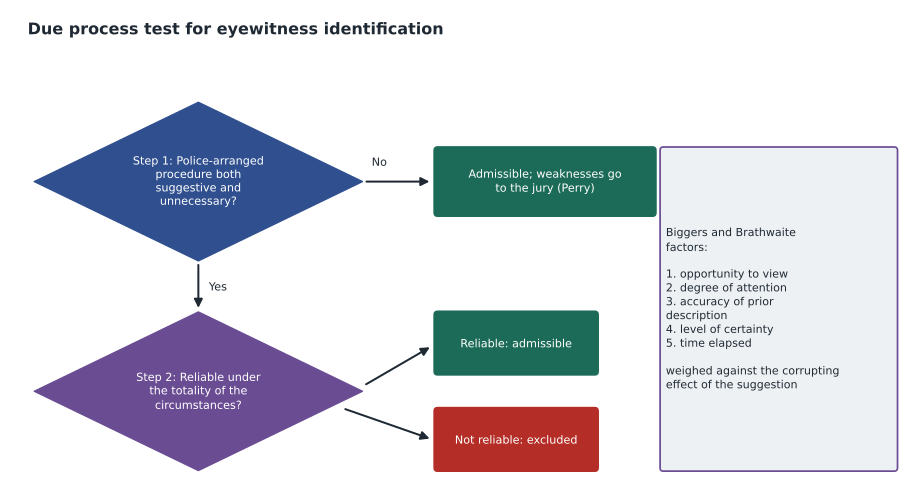
Later cases built a two-step test. First, the defendant must show that the police used an identification procedure that was both suggestive and unnecessary. In Simmons v. United States, 390 U.S. 377 (1968), showing witnesses several group photos including the suspect was not impermissibly suggestive. In Foster v. California, 394 U.S. 440 (1969), it was: the suspect, who was much taller than the others, was the only person in the first lineup wearing a leather jacket like the robber's, the witness was then allowed a one-on-one confrontation, and when he still was not sure, a second lineup included only the suspect from the first.
Second, even a suggestive identification is admissible if it is reliable under the totality of the circumstances. Neil v. Biggers, 409 U.S. 188 (1972), and Manson v. Brathwaite, 432 U.S. 98 (1977), listed five factors: the witness's opportunity to view the culprit at the time of the crime, the witness's degree of attention, the accuracy of the witness's prior description, the witness's level of certainty at the confrontation, and the time between the crime and the confrontation. These are weighed against the corrupting effect of the suggestive procedure. In Brathwaite, an undercover officer who bought heroin through a partly opened door identified a single photograph left on his desk two days later; the Court found the identification reliable because he was a trained observer who had looked at the seller for several minutes and gave a detailed description.
Perry v. New Hampshire, 565 U.S. 228 (2012), limited the due process inquiry to suggestive circumstances arranged by the police. A witness looked out her apartment window and pointed to a man standing in the parking lot next to a police officer. Because police had not arranged the circumstances, there was no due process violation; the Court said that the reliability of identifications made under suggestive circumstances not arranged by police is a question for the jury, tested by cross-examination, jury instructions and the requirement of proof beyond a reasonable doubt.
What science shows
Since the 1970s, psychologists have produced a large body of research on eyewitness memory. A 2014 report by the National Academy of Sciences, Identifying the Culprit, summarized it. Researchers distinguish estimator variables, which affect accuracy but which the justice system cannot control, from system variables, which the police control. Estimator variables include stress, the presence of a weapon (which draws attention away from the face), the distance and lighting, the duration of exposure, the time elapsed before the identification, and whether the witness and the culprit are of different races; witnesses are less accurate at identifying people of another race.
System variables include how the lineup is composed, what instructions the witness receives, whether the administrator knows who the suspect is, how the witness's confidence is recorded, and whether the witness receives feedback. Research shows that an administrator who knows the suspect can unintentionally cue the witness through body language or comments. Confirming feedback, such as telling a witness "Good, you picked the suspect," inflates the witness's confidence and even changes the witness's memory of how good a look they got. Repeated identification procedures with the same suspect contaminate memory, because the witness may recognize the suspect from the earlier procedure rather than the crime.
The research has also complicated one of the Biggers factors. Confidence at trial, often months later and after feedback and repetition, is a poor indicator of accuracy. But confidence expressed at the moment of an initial, properly conducted identification is a much better indicator: a witness who immediately and confidently picks someone from a fair, double-blind lineup is more likely to be correct than one who hesitates. For that reason, experts recommend recording the witness's confidence in the witness's own words immediately after the identification.
| Practice | Purpose |
|---|---|
| Double-blind administration (or a blinded photo method) | Prevent the administrator from cueing the witness |
| Fillers who match the witness's description of the culprit | Ensure the suspect does not stand out |
| One suspect per lineup | Make wrong picks of fillers identifiable as errors |
| Unbiased instructions that the culprit may or may not be present | Reduce pressure to choose someone |
| Immediate confidence statement in the witness's own words | Capture confidence before feedback can inflate it |
| No feedback to the witness | Prevent confidence inflation and memory distortion |
| Recording the procedure | Allow later review of what happened |
| Avoid repeated procedures with the same suspect; use showups only when necessary and promptly | Prevent contamination and suggestion |
Reforms in state courts and police departments
Many jurisdictions have adopted these practices. In January 2017, the US Department of Justice issued procedures for federal agents requiring blind or blinded administration, unbiased instructions, fair fillers and confidence statements. Many states have passed statutes or adopted model policies requiring similar practices.
Several state supreme courts have gone beyond Manson v. Brathwaite under their own constitutions or supervisory powers. In State v. Henderson, 208 N.J. 208 (2011), the New Jersey Supreme Court, after a special master's review of the science, held that the Manson test did not adequately measure reliability. It required a hearing whenever a defendant shows some evidence of suggestiveness, allowed courts to consider both system and estimator variables, and required enhanced jury instructions explaining the factors that affect memory. In State v. Lawson, 352 Or. 724 (2012), the Oregon Supreme Court placed the burden on the state to establish the admissibility of identification evidence under its evidence code and allowed experts and instructions. Massachusetts, in Commonwealth v. Gomes, 470 Mass. 352 (2015), adopted a model jury instruction on eyewitness memory. Other states have rejected changes and continue to apply Manson.
Defendants may also offer expert testimony about eyewitness memory. Most courts now admit such testimony in appropriate cases, though some still exclude it as invading the jury's role, and the decision usually rests in the trial court's discretion. Jury instructions explaining the factors that affect memory are another remedy. Ambrose notes that this area shows how a state court, working with modern science, can protect defendants more fully than federal constitutional law.
Two other problems recur in the cases. Show-ups, in which police present a single suspect to a witness shortly after a crime, are inherently suggestive, but Stovall v. Denno allows them when circumstances make them necessary, and courts generally admit prompt show-ups near the scene because a quick identification can free an innocent person as readily as it can confirm a suspect. Cross-racial identifications are also less accurate on average than same-race identifications, a finding repeated across many studies. In State v. Cromedy, 727 A.2d 457 (N.J. 1999), the New Jersey Supreme Court required a jury instruction on cross-racial identification when identification is a central issue and is not corroborated, and Henderson later folded the point into New Jersey's model instructions. Massachusetts adopted a similar instruction in Commonwealth v. Bastaldo in 2015. These reforms leave the evidence before the jury while giving jurors a better framework for weighing it.
Showups and in-court identifications
A showup, in which police present a single suspect to the witness, is inherently suggestive. Courts generally allow showups conducted promptly near the scene of the crime, because they let police quickly release innocent people and catch suspects while memories are fresh. A showup hours later, without exigency, is more likely to be found unnecessarily suggestive. In-court identifications, in which a witness points to the defendant sitting at counsel table, are highly suggestive too, but federal courts generally treat them as permissible if they rest on an independent source; a few state courts now limit first-time in-court identifications when the witness has not previously made a reliable identification.
The photo array in the Riverside Salvage case
Wendell Fry, owner of Fry's Metal Recovery, told police that the copper seller was a young white man with a shaved head who wore a dark hooded sweatshirt and arrived in a pickup. Three weeks later, Detective Imbert showed Fry six photographs at once. She had chosen them and knew which one was Kellan Shaw. Shaw's photo was a recent jail booking photo showing him in a dark hooded sweatshirt; two of the five fillers had full heads of hair. Imbert did not tell Fry the seller might not be in the array. Fry looked for about a minute and said, "I'm pretty sure that's him," pointing to Shaw. Imbert said, "That's who we thought." At a pretrial hearing two months later, Fry testified he was "absolutely certain."
Worked problem
Challenging Fry's identification
Shaw moves to suppress Fry's identification. Analyze the motion under federal due process, and then explain how a court applying New Jersey's Henderson approach might analyze it.
Show solution
- Counsel: a photo array is never a critical stage under Ash, and charges may not yet have been filed, so Wade does not apply.
- Suggestiveness: the array was non-blind; Shaw was the only one wearing a hooded sweatshirt like the seller's; two fillers had hair despite the description of a shaved head; no unbiased instruction was given. The procedure was suggestive and unnecessary, because nothing prevented a fair array.
- Reliability under Manson: Fry saw the seller for several minutes during a business transaction in daylight (good opportunity), paid enough attention to describe him and his truck (moderate attention), and the prior description matched Shaw (accurate). His initial confidence was "pretty sure"; his later "absolutely certain" reflects feedback from Imbert. Three weeks elapsed.
- Federal result: many courts would find the identification reliable enough to admit, leaving the flaws for cross-examination, because Manson's factors favor the state on opportunity and description.
- Henderson approach: the court would hold a hearing, consider system variables (non-blind administration, biased fillers, no instruction, confirming feedback) and estimator variables (no weapon or stress, a cross-race issue absent), likely admit the identification but give an enhanced jury instruction and bar the state from relying on Fry's inflated later confidence.
Answer: Under federal due process, Fry's identification is probably admissible despite the suggestive procedure, because the Manson reliability factors are reasonably strong. Under a Henderson-style approach, the court would likely admit it with an enhanced jury instruction and limits on confidence evidence. Either way, the defense should cross-examine on the non-blind administration, the clothing, the fillers and the feedback, and may offer an expert on confidence inflation.
Marcus Webb asks why the police do not simply always use double-blind procedures if the science is so clear. Ambrose says many departments now do, especially with computerized photo arrays, but that small departments sometimes lack a second officer, and that some procedures were adopted only after an exoneration made headlines. "Every procedure in that table," she says, "has a wrongful conviction behind it."
Summary and key terms
- Eyewitness misidentification contributed to most DNA exonerations; memory is reconstructive and influenced by procedures.
- Wade requires counsel at post-indictment lineups, but Kirby and Ash limit counsel to post-charge, in-person procedures.
- Due process excludes identifications only if police used an unnecessarily suggestive procedure and the identification is unreliable under the Biggers and Brathwaite factors.
- Perry v. New Hampshire limits due process review to suggestion arranged by police.
- Research distinguishes estimator and system variables and supports double-blind administration, fair fillers, unbiased instructions and immediate confidence statements.
- Some states, notably New Jersey in Henderson, apply a broader reliability analysis with enhanced jury instructions.
Practice problems
Work each problem on paper first, then reveal the answer to check.
Why is the right to counsel rarely available at identifications?
Show answer
Because it applies only after adversary proceedings begin (Kirby) and never to photo arrays (Ash), and most identifications occur before charges and use photographs.
What are the five Biggers and Brathwaite reliability factors?
Show answer
Opportunity to view, degree of attention, accuracy of prior description, level of certainty at the identification, and time between the crime and the identification.
Why was there no due process violation in Perry v. New Hampshire?
Show answer
The suggestive circumstances were not arranged by police; the witness spontaneously pointed out the suspect.
Why should a witness's confidence be recorded immediately after the identification?
Show answer
Initial confidence in a fair procedure is a reasonable indicator of accuracy, while later confidence is often inflated by feedback and repetition.
What did State v. Henderson require that federal law does not?
Show answer
A hearing on some showing of suggestiveness that considers both system and estimator variables, and enhanced jury instructions on the factors affecting memory.
Lesson quiz · 5 questions
Score 60% or more to complete this lesson.
Create a free account to save your progress, take quizzes and earn a certificate.