
LAWU-203 · Lesson 4 of 12 · 24 min
Warrants and exceptions
▶ Video coming soon A video version of this lesson is on the way.
Ambrose begins with a statistic she says no one has measured precisely but every prosecutor knows: most searches that produce evidence in criminal cases are conducted without a warrant. Officers search cars, search people they arrest, search with consent and enter homes in emergencies far more often than they ask a judge for permission. "The Supreme Court says warrantless searches are presumptively unreasonable," she tells Section B. "Then it lists the exceptions. In practice, the exceptions are where you will spend your careers."
Each exception has a rationale that defines its limits. Ambrose tells the class to learn the rationale, not just the name, because the scope of an exception is always tied to the reason for it: officer safety, preventing destruction of evidence, the mobility of vehicles, voluntary waiver or a special need beyond ordinary law enforcement.
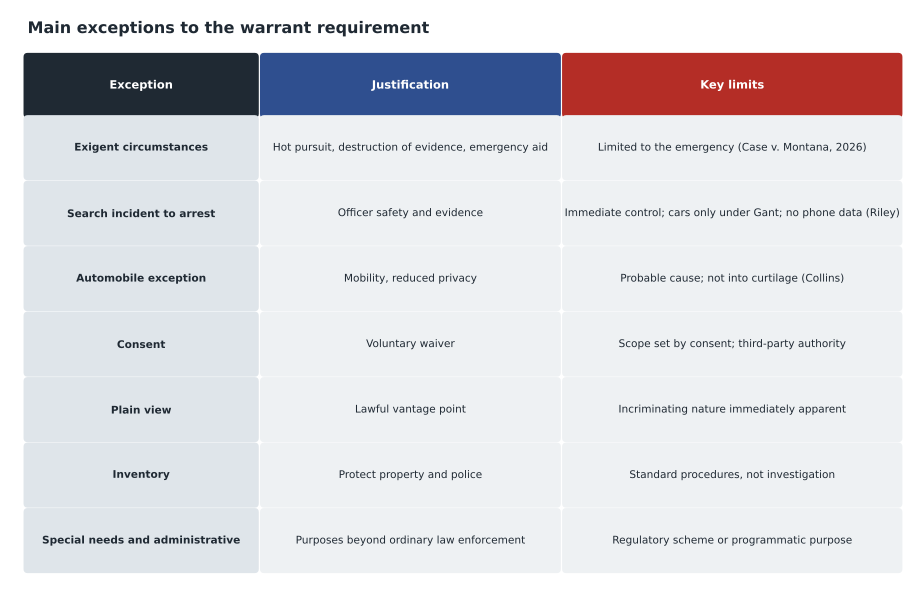
Exigent circumstances
Police may act without a warrant when the needs of law enforcement are so compelling that a warrantless search is objectively reasonable. The main categories are hot pursuit of a fleeing suspect, the imminent destruction of evidence, and the need to render emergency aid or protect someone from harm. Exigency requires probable cause for the search in the evidence and pursuit categories, but the government must also show that there was no time to get a warrant.
Hot pursuit: in Warden v. Hayden, 387 U.S. 294 (1967), officers who followed an armed robber into a house minutes after the crime could search it for him and his weapons. In United States v. Santana, 427 U.S. 38 (1976), a suspect who retreated from her doorway into the house could not defeat an arrest that began in public. But Lange v. California, 594 U.S. 295 (2021), held that pursuit of a fleeing misdemeanor suspect does not categorically justify entering a home; whether exigency exists must be decided case by case. Arthur Lange had driven a short distance home with music blaring and honking his horn, and an officer followed him into his garage.
Destruction of evidence: under Kentucky v. King, 563 U.S. 452 (2011), officers who smelled marijuana, knocked loudly and heard sounds suggesting evidence was being destroyed could enter, because they did not create the exigency by threatening to violate the Fourth Amendment. For blood alcohol, Missouri v. McNeely, 569 U.S. 141 (2013), held that the natural dissipation of alcohol does not create a per se exigency; whether there was time to get a warrant depends on the circumstances. Mitchell v. Wisconsin, 588 U.S. 840 (2019), a plurality opinion, said that when a driver suspected of drunk driving is unconscious and must be taken to a hospital, a warrantless blood test is almost always permitted.
Emergency aid: in Brigham City v. Stuart, 547 U.S. 398 (2006), officers who saw a fight through a window, in which a juvenile punched an adult, could enter to stop it. The Court held that officers may enter a home without a warrant when they have an objectively reasonable basis for believing that an occupant is seriously injured or imminently threatened with such injury. In Case v. Montana, decided unanimously on January 14, 2026, the Court reaffirmed that standard "without further gloss." Officers entered William Case's home after his girlfriend reported that he had threatened suicide and she heard what sounded like a gun being prepared and fired. The Court rejected Case's argument that officers needed probable cause of an emergency, explaining that probable cause is a concept built for criminal investigations and fits emergency aid poorly; the question is whether officers had an objectively reasonable basis to believe someone inside needed immediate help. Caniglia v. Strom, 593 U.S. 194 (2021), separately held that the community caretaking doctrine, which allows certain non-investigative actions involving vehicles, does not extend to warrantless entries into homes.
Search incident to a lawful arrest
When police make a lawful custodial arrest, they may search the arrestee's person and the area within the arrestee's immediate control, from which the arrestee might grab a weapon or destroy evidence. Chimel v. California, 395 U.S. 752 (1969), set that limit after officers arrested a man in his home and searched the entire three-bedroom house; the search beyond the room of arrest was unlawful. United States v. Robinson, 414 U.S. 218 (1973), held that a full search of the person is permitted incident to any custodial arrest, regardless of whether officers fear a weapon or expect to find evidence of the particular offense; the officer in Robinson found heroin in a cigarette package after an arrest for driving with a revoked license.
For vehicles, New York v. Belton, 453 U.S. 454 (1981), had been read to allow searching the passenger compartment after any arrest of an occupant. Arizona v. Gant, 556 U.S. 332 (2009), narrowed that rule. Police may search the passenger compartment incident to arrest only if the arrestee is unsecured and within reaching distance of the compartment at the time of the search, or if it is reasonable to believe that evidence of the offense of arrest might be found in the vehicle. Rodney Gant, handcuffed in a patrol car after an arrest for driving with a suspended license, could not have his car searched on that basis.
Phones are different. In Riley v. California, 573 U.S. 373 (2014), the Court unanimously held that police generally may not search the digital data on a cell phone seized from an arrestee without a warrant. Chief Justice Roberts wrote that phones are not just another technological convenience; with all they contain and all they may reveal, they hold for many Americans "the privacies of life." Neither officer safety nor destruction of evidence justifies a routine search of the data, and police can seize the phone and get a warrant. The Court's answer to what police must do before searching a phone was "simple: get a warrant." Birchfield v. North Dakota, 579 U.S. 438 (2016), held that a breath test, but not a blood test, may be administered without a warrant incident to a drunk-driving arrest.
The automobile exception
Police may search a vehicle without a warrant if they have probable cause to believe it contains contraband or evidence of a crime. Carroll v. United States, 267 U.S. 132 (1925), justified the rule by the mobility of vehicles; later cases add that people have a reduced expectation of privacy in vehicles because they are heavily regulated. Chambers v. Maroney, 399 U.S. 42 (1970), allowed the search even after the car had been towed to the station. The search may extend to any part of the vehicle and any container in it where the object of the search could be found, including passengers' belongings, under United States v. Ross, 456 U.S. 798 (1982), California v. Acevedo, 500 U.S. 565 (1991), and Wyoming v. Houghton, 526 U.S. 295 (1999). The exception does not let officers enter the curtilage of a home to search a vehicle parked there: in Collins v. Virginia, 584 U.S. 586 (2018), an officer could not walk up a private driveway and lift a tarp off a motorcycle parked beside the house.
Inventory searches are a related category. Police who lawfully impound a vehicle may inventory its contents under standardized procedures, to protect the owner's property and the police from false claims and danger, under Colorado v. Bertine, 479 U.S. 367 (1987). An inventory that departs from standard procedures or is a pretext for investigation is not valid, as Florida v. Wells, 495 U.S. 1 (1990), held when police opened a locked suitcase without any policy addressing closed containers.
Consent
A person may waive Fourth Amendment protection by consenting to a search. The consent must be voluntary under the totality of the circumstances, but the person need not know of the right to refuse, under Schneckloth v. Bustamonte, 412 U.S. 218 (1973). Officers are not required to warn people that they may say no. Consent obtained by a false claim of a warrant is not voluntary, as Bumper v. North Carolina, 391 U.S. 543 (1968), held. The scope of consent is what a reasonable person would have understood from the exchange; consent to search a car for drugs includes a closed paper bag on the floor, under Florida v. Jimeno, 500 U.S. 248 (1991). A person may limit or withdraw consent.
Third parties with common authority over premises may consent, under United States v. Matlock, 415 U.S. 164 (1974). Under Illinois v. Rodriguez, 497 U.S. 177 (1990), a search is valid if officers reasonably believed that the person consenting had authority, even if the belief turns out to be wrong. But when two occupants are present and one objects, the objector's refusal controls as to him, under Georgia v. Randolph, 547 U.S. 103 (2006). Fernandez v. California, 571 U.S. 292 (2014), limited Randolph: once police lawfully remove the objecting occupant, for example by arresting him, the remaining occupant may consent.
Plain view
Officers may seize an item in plain view without a warrant if they are lawfully in the position from which they see it, the item's incriminating character is immediately apparent, which means there is probable cause to believe it is contraband or evidence, and they have a lawful right of access to it. Horton v. California, 496 U.S. 128 (1990), held that the discovery need not be inadvertent. In Arizona v. Hicks, 480 U.S. 321 (1987), officers lawfully inside an apartment after a shooting moved stereo equipment to read its serial numbers; moving it was a new search not justified by plain view, because they lacked probable cause that it was stolen until they did so. Plain view is a seizure doctrine; it never justifies entering a place in the first place.
Special needs and administrative searches
Some searches serve purposes beyond ordinary crime control and are judged by balancing the government's need against the intrusion, often without individualized suspicion. These include border searches, checkpoint stops for drunk driving under Michigan Department of State Police v. Sitz, 496 U.S. 444 (1990), drug testing of certain employees and students, and inspections of closely regulated businesses. A checkpoint whose primary purpose is general crime control is not permitted, under City of Indianapolis v. Edmond, 531 U.S. 32 (2000).
New York v. Burger, 482 U.S. 691 (1987), is directly relevant to the Riverside Salvage case. Police in Brooklyn, without a warrant, inspected a junkyard's records and inventory under a statute regulating vehicle dismantlers, and found stolen car parts. The Court held that junkyards are closely regulated businesses; warrantless inspections are reasonable if there is a substantial government interest, inspections are necessary to further the regulatory scheme, and the statute provides a constitutionally adequate substitute for a warrant by limiting the time, place and scope of inspections. In City of Los Angeles v. Patel, 576 U.S. 409 (2015), by contrast, a law requiring hotels to hand over guest registries to police on demand was facially unconstitutional because it gave operators no opportunity for neutral review before compliance; hotels were not closely regulated.
| Exception | Required justification | Scope and limits |
|---|---|---|
| Exigency: hot pursuit, evidence, emergency aid | Probable cause plus urgency; for aid, objectively reasonable basis to believe someone needs help (Brigham City; Case v. Montana) | Only what the emergency requires; no categorical misdemeanor pursuit rule (Lange) |
| Search incident to arrest | Lawful custodial arrest | Person and area of immediate control; vehicles only under Gant; no phone data (Riley) |
| Automobile | Probable cause the vehicle contains evidence | Anywhere in the vehicle the item could be, including containers; not into curtilage (Collins) |
| Consent | Voluntary consent by a person with actual or apparent authority | Scope of consent; present objector controls (Randolph) |
| Plain view | Lawful vantage, immediately apparent incriminating nature, lawful access | Seizure only; no further search (Hicks) |
| Inventory | Lawful impoundment and standard procedures | Not a pretext for investigation (Wells) |
| Administrative inspection | Closely regulated business and adequate statutory scheme (Burger) | Limited by the statute's time, place and scope |
Applying the exceptions in the Riverside Salvage case
Three days after the shove, an officer at Fry's Metal Recovery, acting under the Westmarch scrap metal statute, which requires dealers to record sellers' identification and make records available to police during business hours, asked to see the week's purchase log. The log showed a cash purchase of 340 pounds of stripped copper with no identification recorded. Wendell Fry, the owner, said the seller was a young man who arrived in a pickup. A week later, an officer stopped Kellan Shaw's car for a broken taillight, saw bolt cutters on the back seat with the initials "K.S." scratched into the handle, arrested Shaw on a warrant for an unrelated unpaid fine, and searched the car. On the day Devon Pike was arrested at home on a warrant, officers seized his phone from his pocket and looked through the group chat before applying for the warrant described in lesson 3.
Worked problem
Which exception applies?
Analyze the lawfulness of (a) the inspection of Fry's purchase log, (b) the seizure of the bolt cutters and the search of Shaw's car, and (c) the officers' look through Pike's group chat at the time of his arrest.
Show solution
- (a) Scrap metal dealers, like the junkyard in Burger, are plausibly closely regulated. The statute limits inspections to business hours and to required records, serving the substantial interest in stopping metal theft. The inspection is likely valid without a warrant, and Fry, not Shaw or Pike, is the one whose rights it affected.
- (b) The stop for a broken taillight is lawful if the officer had probable cause of the equipment violation (lesson 5). The bolt cutters were in plain view from outside the car; their incriminating nature was immediately apparent only if the officer connected them to the burglary, for example from a bulletin describing a cut padlock. The arrest on the unrelated fine warrant allows a search incident to arrest only under Gant: Shaw was secured, and the fine offense would not produce evidence in the car, so Gant does not authorize the search. But if the officer had probable cause that the car contained evidence of the burglary, the automobile exception would.
- (c) Riley requires a warrant to search the data on a phone seized incident to arrest. The officers could seize the phone but not look through the chat. That look was unlawful; the question becomes whether later evidence derived from it must be suppressed, or whether the independent source doctrine saves the warrant-based search (lesson 6).
Answer: The log inspection is likely a valid administrative inspection; the bolt cutters are admissible against Shaw if the officer had probable cause to connect them to the burglary, through plain view or the automobile exception, but not through search incident to arrest; and the warrantless look at Pike's group chat violated Riley, though the later warrant may save the evidence if it was not prompted by what officers saw.
Daniel Reyes says the officers in part (c) must have known Riley. Ambrose says the more charitable explanation is that they wanted to make sure the phone was really Pike's, which still does not justify reading the chat. She adds a practical lesson: a single impatient look at a phone can turn an airtight case into a contested independent-source hearing.
Summary and key terms
- Warrantless searches are presumptively unreasonable, but most searches fall within exceptions defined by their rationales.
- Exigent circumstances include hot pursuit (limited by Lange), destruction of evidence (King, McNeely) and emergency aid, governed by an objectively reasonable basis standard reaffirmed in Case v. Montana (2026).
- Search incident to arrest covers the person and immediate area; Gant limits vehicle searches and Riley requires a warrant for phone data.
- The automobile exception permits searching a vehicle and its containers on probable cause, but not inside a home's curtilage (Collins).
- Consent must be voluntary but need not be informed; third parties with actual or apparent authority may consent, subject to a present objector's refusal.
- Plain view allows seizure, not further searching; closely regulated businesses may be inspected under adequate statutes (Burger).
Practice problems
Work each problem on paper first, then reveal the answer to check.
What standard did Case v. Montana (2026) apply to warrantless entries to render emergency aid?
Show answer
An objectively reasonable basis for believing that an occupant is seriously injured or imminently threatened with serious injury, without requiring probable cause.
When may police search a car's passenger compartment incident to an occupant's arrest after Gant?
Show answer
When the arrestee is unsecured and within reaching distance of the compartment, or when it is reasonable to believe evidence of the offense of arrest is in the car.
Why did the Court require a warrant for phone data in Riley?
Show answer
Phones hold vast amounts of private information, and neither officer safety nor evidence preservation justifies routinely searching their data; police can seize the phone and get a warrant.
Does a person need to know of the right to refuse for consent to be valid?
Show answer
No. Under Schneckloth, consent must be voluntary under the totality of circumstances, but knowledge of the right to refuse is only one factor.
Why was moving the stereo in Arizona v. Hicks unlawful?
Show answer
Moving it to see the serial numbers was a new search, and officers lacked probable cause that it was stolen, so plain view did not apply.
Lesson quiz · 5 questions
Score 60% or more to complete this lesson.
Create a free account to save your progress, take quizzes and earn a certificate.