
LAWU-203 · Lesson 5 of 12 · 22 min
Stops, frisks, arrests and police force
▶ Video coming soon A video version of this lesson is on the way.
Ambrose plays a sixty-second clip from a patrol car's dashboard camera, recorded on a summer evening in Brennan Falls. An officer pulls behind a gray sedan with a dark left taillight, activates his lights and approaches the driver's window. The driver is Kellan Shaw. The clip ends as the officer shines his flashlight into the back seat. "Everything in that minute is governed by the Fourth Amendment," Ambrose says. "When was Shaw seized? What justified it? How long could the officer hold him? What could the officer look at, and could he have frisked him? And if this had gone badly, what force could the officer lawfully have used?"
What is a seizure?
A person is seized when an officer, by means of physical force or a show of authority, restrains the person's liberty. Under United States v. Mendenhall, 446 U.S. 544 (1980), a show of authority is a seizure if, in view of all the circumstances, a reasonable person would have believed that he was not free to leave. Florida v. Bostick, 501 U.S. 429 (1991), refined the test for encounters where a person would not want to leave anyway, such as a passenger on a bus: the question is whether a reasonable person would feel free to decline the officers' requests or otherwise terminate the encounter. Police may approach people in public, ask questions and request consent without any suspicion; these consensual encounters are not seizures.
A show of authority is not a seizure until the person submits. In California v. Hodari D., 499 U.S. 621 (1991), a youth who ran from police and threw away crack cocaine while being chased was not seized until he was tackled, so the drugs were abandoned, not the fruit of a seizure. But physical force is different. Torres v. Madrid, 592 U.S. 306 (2021), held that applying physical force to the body with intent to restrain is a seizure even if the person does not submit and escapes; officers who shot Roxanne Torres as she drove away seized her at the moment the bullets struck. When police stop a car, both the driver and passengers are seized, under Brendlin v. California, 551 U.S. 249 (2007), so passengers may challenge the stop.
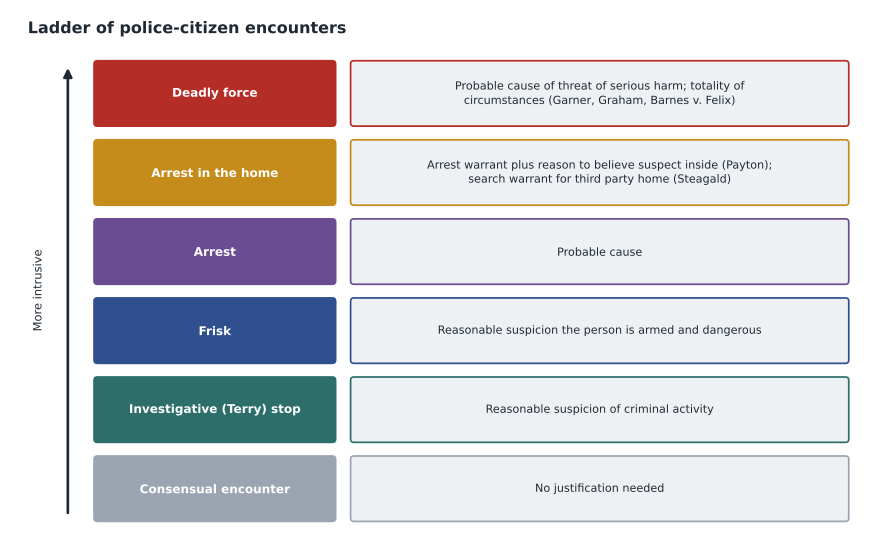
Terry stops and reasonable suspicion
In Terry v. Ohio, 392 U.S. 1 (1968), a Cleveland detective with 39 years of experience watched two men take turns walking past a store window and peering in about two dozen times, then confer with a third man. Suspecting a robbery was being planned, he approached, identified himself, and when the men mumbled something, patted down their outer clothing and found two guns. The Court held that police may briefly stop a person when they have reasonable suspicion, based on specific and articulable facts, that criminal activity is afoot, and may frisk the person's outer clothing for weapons if they reasonably suspect the person is armed and dangerous.
Reasonable suspicion is less than probable cause and considerably less than a preponderance, but more than an inchoate hunch. Courts consider the totality of the circumstances, including the officer's training and experience, under United States v. Sokolow, 490 U.S. 1 (1989), and United States v. Arvizu, 534 U.S. 266 (2002). Presence in a high-crime area alone is not enough, but combined with unprovoked headlong flight on seeing police, it supplied reasonable suspicion in Illinois v. Wardlow, 528 U.S. 119 (2000). An anonymous tip that a young man at a bus stop in a plaid shirt was carrying a gun was not enough in Florida v. J.L., 529 U.S. 266 (2000), because it described only readily observable facts and gave no basis for believing the tipster knew of concealed criminal activity. In Navarette v. California, 572 U.S. 393 (2014), a 911 call reporting that a specific pickup truck had just run the caller off the road was enough, given the eyewitness basis, the contemporaneous report and the use of the 911 system. Kansas v. Glover, 589 U.S. 376 (2020), held that an officer who learns that a vehicle's registered owner has a revoked license may reasonably infer, absent contrary information, that the owner is driving.
A frisk is limited to a pat-down of outer clothing for weapons. Under Minnesota v. Dickerson, 508 U.S. 366 (1993), an officer may seize an item whose identity as contraband is immediately apparent by touch, the plain feel doctrine, but may not manipulate an object after determining it is not a weapon. In Michigan v. Long, 463 U.S. 1032 (1983), the Court extended the protective frisk to the passenger compartment of a car when officers reasonably believe the suspect is dangerous and may gain access to a weapon.
Traffic stops
A traffic stop is a seizure that requires reasonable suspicion of a traffic violation or other offense; in practice officers usually have probable cause of a violation. Whren v. United States, 517 U.S. 806 (1996), held that the officer's actual motive is irrelevant: a stop supported by probable cause of a traffic violation is reasonable even if the officer's real purpose was to investigate drugs. Critics argue that Whren licenses racial profiling; the Court said such claims belong under the Equal Protection Clause, not the Fourth Amendment. Heien v. North Carolina, 574 U.S. 54 (2014), held that a reasonable mistake of law can supply reasonable suspicion: an officer stopped a car with one working brake light, reasonably but wrongly believing state law required two.
During a lawful stop, an officer may order the driver out of the car, under Pennsylvania v. Mimms, 434 U.S. 106 (1977), and passengers too, under Maryland v. Wilson, 519 U.S. 408 (1997), and may frisk an occupant reasonably suspected of being armed and dangerous, under Arizona v. Johnson, 555 U.S. 323 (2009). But a stop may last no longer than needed to complete its mission: addressing the violation and attending to related safety concerns, such as checking the license, registration and insurance and running warrant checks. Rodriguez v. United States, 575 U.S. 348 (2015), held that an officer who completed a traffic stop and then held the driver for seven or eight minutes until a drug dog arrived violated the Fourth Amendment, absent independent reasonable suspicion. Unrelated inquiries are permitted only if they do not measurably extend the stop.
Arrests
An arrest requires probable cause. A warrantless arrest in a public place for a felony is permitted even if officers had time to get a warrant, under United States v. Watson, 423 U.S. 411 (1976). For misdemeanors, Atwater v. City of Lago Vista, 532 U.S. 318 (2001), held that officers may make a custodial arrest even for a fine-only offense: Gail Atwater was handcuffed and jailed for driving without her children's seatbelts fastened. Virginia v. Moore, 553 U.S. 164 (2008), held that an arrest supported by probable cause is constitutional even if state law did not authorize it.
The home is different. Payton v. New York, 445 U.S. 573 (1980), held that police need an arrest warrant to enter a suspect's home to arrest him, absent exigency or consent, and an arrest warrant carries limited authority to enter the suspect's dwelling when there is reason to believe he is inside. To enter a third party's home to arrest someone who is visiting, police need a search warrant for that home, under Steagald v. United States, 451 U.S. 204 (1981), protecting the third party's rights. New York v. Harris, 495 U.S. 14 (1990), held that a statement made at the station after a Payton violation need not be suppressed if police had probable cause, because the illegality was the entry, not the custody. After a warrantless arrest, the arrestee must receive a prompt judicial probable cause determination, under Gerstein v. Pugh, 420 U.S. 103 (1975), generally within 48 hours.
| Action | Required justification | Key cases |
|---|---|---|
| Approach and question in public | None (consensual encounter) | Bostick (1991) |
| Investigative stop | Reasonable suspicion of criminal activity | Terry (1968); Wardlow (2000); Navarette (2014) |
| Frisk | Reasonable suspicion of being armed and dangerous | Terry; Dickerson (1993) |
| Extend a traffic stop beyond its mission | Independent reasonable suspicion | Rodriguez (2015) |
| Public arrest | Probable cause, even for a fine-only offense | Watson (1976); Atwater (2001) |
| Arrest in the suspect's home | Arrest warrant and reason to believe the suspect is inside, or exigency | Payton (1980) |
| Arrest in a third party's home | Search warrant for that home, or exigency or consent | Steagald (1981) |
Use of force
Every arrest involves the threat of force, and the Fourth Amendment governs how much force officers may use in making a seizure. Tennessee v. Garner, 471 U.S. 1 (1985), held that deadly force may not be used to stop a fleeing felon unless the officer has probable cause to believe the suspect poses a significant threat of death or serious physical injury to the officer or others; an officer had shot an unarmed fifteen-year-old fleeing a burglary. Graham v. Connor, 490 U.S. 386 (1989), held that all excessive force claims arising from arrests and stops are judged under the Fourth Amendment's objective reasonableness standard, considering the severity of the crime, whether the suspect poses an immediate threat, and whether the suspect is actively resisting or trying to flee, judged from the perspective of a reasonable officer on the scene, "rather than with the 20/20 vision of hindsight." Scott v. Harris, 550 U.S. 372 (2007), held that ramming a car to end a dangerous high-speed chase was reasonable.
In Barnes v. Felix (2025), the Court unanimously rejected the moment-of-threat doctrine that the Fifth Circuit and some other courts had used. Officer Roberto Felix stopped Ashtian Barnes on a Houston-area tollway for unpaid tolls; when Barnes began driving away, Felix jumped onto the car's doorsill and fired two shots within seconds, killing him. The Fifth Circuit had looked only at the two seconds when Felix was on the moving car. Justice Kagan's opinion held that excessive force claims must be judged under the totality of the circumstances, which includes events leading up to the shooting, not just the final moment. The Court sent the case back and did not decide whether or how an officer's own creation of the danger affects the analysis. Excessive force claims are usually litigated in civil suits under 42 U.S.C. section 1983, where qualified immunity often protects officers unless the law was clearly established, rather than through suppression of evidence.
The stop of Kellan Shaw
The dashboard video shows what happened. Officer Nell Corliss stopped Shaw for the broken taillight. She took his license and registration, returned to her car, and ran the checks, which revealed an outstanding warrant for an unpaid fine. Before she returned, she radioed for a drug dog because Shaw seemed nervous; the dog arrived nine minutes after she had finished writing the warning. Meanwhile, she had seen the bolt cutters on the back seat. Ambrose changes the facts in several hypotheticals to show how each rule works.
Worked problem
Analyzing the Shaw stop
Evaluate (a) the initial stop; (b) Corliss's arrest of Shaw on the fine warrant; (c) a hypothetical in which there was no warrant and Corliss held Shaw for the dog after completing the warning; and (d) a hypothetical in which Corliss frisked Shaw because he "seemed nervous."
Show solution
- (a) A broken taillight gives probable cause of an equipment violation; under Whren, the stop is valid even if Corliss also hoped to investigate the burglary.
- (b) An outstanding warrant gives authority to arrest; under Atwater and Watson, even a fine-related arrest is constitutional, and the arrest itself does not depend on the burglary.
- (c) Under Rodriguez, once the mission of the stop was complete, holding Shaw nine minutes for a dog required independent reasonable suspicion. Nervousness alone is weak. Seeing bolt cutters, in a town where a padlock had just been cut in a homicide burglary, might supply reasonable suspicion of involvement if Corliss knew of the burglary bulletin, which would justify a brief extension to investigate it, though not necessarily a dog sniff for drugs.
- (d) A frisk requires reasonable suspicion that Shaw was armed and dangerous. Nervousness alone does not supply it; anything found in an unlawful frisk would be suppressed as against Shaw.
Answer: The stop and the arrest on the warrant are lawful. Without the warrant, prolonging the stop for a drug dog would violate Rodriguez unless Corliss had independent reasonable suspicion connecting Shaw and the bolt cutters to the burglary, and a frisk based only on nervousness would be unlawful.
The arrest of Devon Pike
Three weeks after the shove, detectives obtained an arrest warrant for Pike on charges of burglary and murder. They went to the apartment he shared with his wife, Simone Pike, knocked, announced themselves, and when Simone opened the door and said Devon was in the shower, they entered and arrested him. Under Payton, the arrest warrant plus reason to believe he was inside authorized entry into his own home. Ambrose asks how the analysis would change if Pike had been staying at his cousin's apartment; Hannah Lindqvist answers that Steagald would require a search warrant for the cousin's home, though Pike himself, as a visitor, might not have standing to complain if police violated only the cousin's rights.
Summary and key terms
- A seizure occurs through physical force with intent to restrain (Torres) or a show of authority to which the person submits (Hodari D.); passengers in a stopped car are seized (Brendlin).
- Terry stops require reasonable suspicion; frisks require reasonable suspicion that the person is armed and dangerous.
- Traffic stops may be pretextual (Whren) but may not be extended beyond their mission without independent reasonable suspicion (Rodriguez).
- Public arrests require probable cause, even for fine-only offenses; home arrests require an arrest warrant (Payton) or, in a third party's home, a search warrant (Steagald).
- Force is judged by objective reasonableness under the totality of the circumstances (Graham), including events before the use of force (Barnes v. Felix).
Practice problems
Work each problem on paper first, then reveal the answer to check.
When was the youth in California v. Hodari D. seized, and why did it matter?
Show answer
When he was tackled; the cocaine he threw away during the chase was abandoned before any seizure, so it was not the fruit of an unlawful seizure.
Why was the tip insufficient in Florida v. J.L. but sufficient in Navarette?
Show answer
J.L.'s anonymous tip described only observable facts and showed no basis for knowing about concealed crime; Navarette's 911 caller reported eyewitness knowledge of dangerous driving contemporaneously, through a traceable system.
What did Rodriguez v. United States hold about dog sniffs?
Show answer
Police may not extend a completed traffic stop to conduct a dog sniff without independent reasonable suspicion.
What does Payton v. New York require?
Show answer
An arrest warrant (and reason to believe the suspect is inside) to enter a suspect's home to arrest him, absent exigency or consent.
What did Barnes v. Felix decide?
Show answer
That excessive force claims are judged under the totality of the circumstances, including events leading up to the use of force, rejecting the moment-of-threat rule.
Lesson quiz · 5 questions
Score 60% or more to complete this lesson.
Create a free account to save your progress, take quizzes and earn a certificate.