
LAWU-203 · Lesson 1 of 12 · 23 min
Sources of criminal procedure and incorporation
▶ Video coming soon A video version of this lesson is on the way.
Professor Celeste Ambrose begins Criminal Procedure by holding up two sheets of paper. One is a Brennan Falls police incident report from last summer. The other is a page from the trial transcript in State v. Pike. "Last spring, Professor Mendenhall taught you what Devon Pike, Kellan Shaw and Tara Quinn may have done wrong at Riverside Salvage," she tells Section B, now in its second year. "This fall, Professor Hartigan is teaching you what evidence the jury may hear. In this course we ask how the government got that evidence, what it was allowed to do to get it, and what happens when it broke the rules on the way."
Ambrose spent seven years as an appellate public defender, briefing search and confession issues in hundreds of appeals, and then five years as chief of the criminal appeals division in a state attorney general's office, defending the same kinds of police conduct she had once attacked. She tells the class that the experience left her with one conviction: both sides of a suppression hearing are trying to answer a fair question, and the answer usually depends on facts that someone failed to write down. She will teach the course through the investigation of the Riverside Salvage case, told from the police side, and through hypotheticals she will label as hypotheticals. The people, the City of Brennan Falls and the State of Westmarch are all fictional; the constitutional rules are real.
What criminal procedure covers
Criminal procedure is usually divided into two courses. Investigative criminal procedure, the focus of this course, governs what police and prosecutors may do before charges are filed: searches and seizures, stops and arrests, interrogation, identification procedures and the right to counsel during investigation. Adjudicative criminal procedure governs the process after charging: bail, the grand jury, discovery, plea bargaining, trial and appeal. This course covers investigation in depth and gives an overview of adjudication in lessons 10 and 11, because the two halves constantly affect each other. A confession obtained in violation of Miranda matters only because of what happens at trial, and most cases end in a guilty plea negotiated in the shadow of a suppression motion.
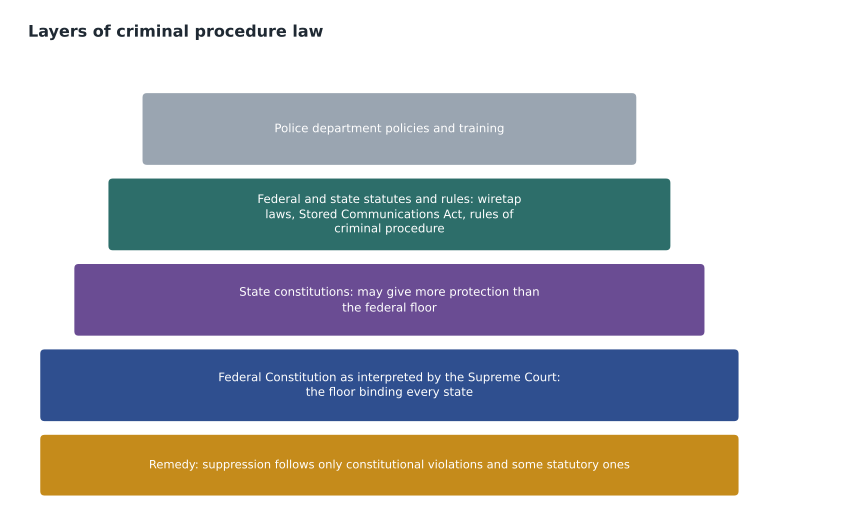
The law in this field comes from several layers. The most important is the federal Constitution, especially the Fourth, Fifth, Sixth and Fourteenth Amendments, as interpreted by the Supreme Court. State constitutions provide a second layer, and state courts may read their own constitutions to give more protection than the federal floor. Statutes add a third layer: federal and state wiretap laws, the Stored Communications Act, rules of criminal procedure, and statutes on bail, speedy trial and discovery. Police department policies add a fourth, often stricter, layer, but violating a policy is not itself a constitutional violation and usually does not lead to suppression.
The Bill of Rights provisions that matter
The Fourth Amendment protects "the right of the people to be secure in their persons, houses, papers, and effects, against unreasonable searches and seizures," and provides that "no Warrants shall issue, but upon probable cause, supported by Oath or affirmation, and particularly describing the place to be searched, and the persons or things to be seized." Much of the course is an effort to explain how those two clauses relate: whether every search requires a warrant, or whether the core requirement is simply reasonableness, with warrants required only in some settings.
The Fifth Amendment provides that no person "shall be compelled in any criminal case to be a witness against himself," the privilege against self-incrimination that underlies Miranda v. Arizona. It also contains the grand jury requirement for federal felonies, the Double Jeopardy Clause and the federal Due Process Clause. The Sixth Amendment guarantees, "in all criminal prosecutions," a speedy and public trial by an impartial jury, notice of the charges, confrontation of witnesses, compulsory process and "the Assistance of Counsel for his defense." The Eighth Amendment bars excessive bail and cruel and unusual punishments. The Fourteenth Amendment forbids any state to "deprive any person of life, liberty, or property, without due process of law."
Incorporation: how the Bill of Rights came to bind the states
The Bill of Rights originally restrained only the federal government, as the Supreme Court held in Barron v. Baltimore, 32 U.S. 243 (1833). After the Fourteenth Amendment was ratified in 1868, defendants argued that its Due Process Clause made the protections of the Bill of Rights applicable to the states. For decades the Court resisted. In Palko v. Connecticut, 302 U.S. 319 (1937), it asked whether a right was "implicit in the concept of ordered liberty" and held that the double jeopardy protection at issue did not meet that test. In Wolf v. Colorado, 338 U.S. 25 (1949), it held that the core of the Fourth Amendment applied to the states but that the exclusionary rule did not.
The decisive shift came under Chief Justice Earl Warren. Through selective incorporation, the Court held one right at a time that a Bill of Rights guarantee was fundamental and therefore applied against the states through the Fourteenth Amendment, with the same content as against the federal government. Mapp v. Ohio, 367 U.S. 643 (1961), applied the exclusionary rule to the states. Gideon v. Wainwright, 372 U.S. 335 (1963), applied the right to counsel. Malloy v. Hogan, 378 U.S. 1 (1964), applied the privilege against self-incrimination. Pointer v. Texas, 380 U.S. 400 (1965), applied the Confrontation Clause. Duncan v. Louisiana, 391 U.S. 145 (1968), applied the right to jury trial for serious offenses, and Benton v. Maryland, 395 U.S. 784 (1969), overruled Palko and applied the Double Jeopardy Clause.
The process continued into recent years. Timbs v. Indiana, 586 U.S. 146 (2019), applied the Excessive Fines Clause to the states, and Ramos v. Louisiana, 590 U.S. 83 (2020), held that the incorporated jury right requires a unanimous verdict in state as well as federal trials for serious offenses. Nearly every criminal procedure guarantee in the Bill of Rights now applies to the states. The main exception is the Fifth Amendment requirement of grand jury indictment, which Hurtado v. California, 110 U.S. 516 (1884), held does not bind the states. About half the states still use grand juries for serious felonies; the rest permit charging by information after a preliminary hearing.
| Right | Amendment | Case applying it to the states |
|---|---|---|
| Freedom from unreasonable searches; exclusionary rule | Fourth | Wolf v. Colorado (1949); Mapp v. Ohio (1961) |
| Right to counsel at trial | Sixth | Gideon v. Wainwright (1963) |
| Privilege against self-incrimination | Fifth | Malloy v. Hogan (1964) |
| Confrontation of witnesses | Sixth | Pointer v. Texas (1965) |
| Speedy trial | Sixth | Klopfer v. North Carolina (1967) |
| Jury trial for serious offenses | Sixth | Duncan v. Louisiana (1968) |
| Double jeopardy | Fifth | Benton v. Maryland (1969) |
| Unanimous jury verdict | Sixth | Ramos v. Louisiana (2020) |
| Grand jury indictment | Fifth | Not incorporated: Hurtado v. California (1884) |
Why the Warren Court revolution happened, and what followed
Ambrose asks the class why the Supreme Court took control of state criminal justice in the 1960s. Hannah Lindqvist, the former history teacher, points to the civil rights era: the cases arose against a background of segregation, coerced confessions from Black suspects in the South and wide variation in how states treated poor defendants. Ambrose agrees and adds that the Court also faced a practical problem. Case-by-case review of whether a particular confession was voluntary or a particular search fair produced inconsistent results, so the Court increasingly adopted bright-line rules, like Miranda's warnings, that police could apply in advance.
Later Courts kept most of the Warren Court's rules but narrowed their remedies. The Burger and Rehnquist Courts created exceptions to the exclusionary rule, such as good faith and inevitable discovery, and limited federal habeas review of Fourth Amendment claims in Stone v. Powell, 428 U.S. 465 (1976). The Roberts Court has continued to narrow remedies while sometimes expanding the substance of rights in the digital age, as in Riley v. California, 573 U.S. 373 (2014), and Carpenter v. United States, 585 U.S. 296 (2018). In June 2026, in Chatrie v. United States, the Court held 6 to 3 that obtaining a person's Google location history through a geofence warrant is a Fourth Amendment search, a decision lesson 2 examines. Ambrose tells the class to watch for this pattern: broad rights, narrow remedies.
State constitutions and the federal floor
The federal Constitution sets a minimum. State courts may interpret their own constitutions to provide greater protection, and many do. Several state courts have rejected the federal good-faith exception, some require warrants for searches of garbage left for collection, and some give suspects broader rights during interrogation. When a state court rests its decision on an adequate and independent state ground, the Supreme Court cannot review it, as Michigan v. Long, 463 U.S. 1032 (1983), explained; a state court that wants to insulate a decision must say plainly that it rests on state law. Federal agents in a state, however, are bound only by federal law, so evidence a state officer could not use may sometimes be usable in federal court.
Ambrose tells the class that in Westmarch, the fictional state of this course, the state supreme court follows federal law in most respects but has held, as a matter of state constitutional law, that the good-faith exception does not apply to warrants issued without probable cause. She will flag every place where Westmarch departs from the federal rule, and she warns that in real practice a defense lawyer who argues only the federal Constitution may be leaving the client's best argument unmade.
The life of a criminal case
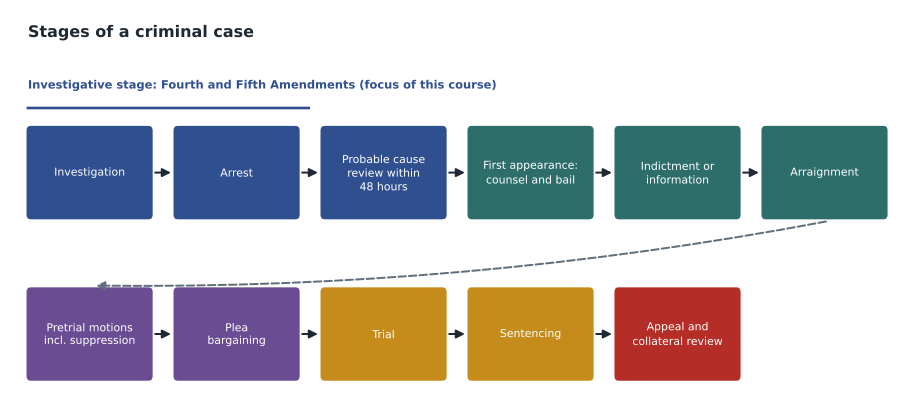
Every criminal case follows a recognizable path, though most cases leave it early. Police investigate, often before any suspect is known. They may make an arrest with or without a warrant. A person arrested without a warrant must receive a prompt judicial determination of probable cause, generally within 48 hours under County of Riverside v. McLaughlin, 500 U.S. 44 (1991). At the first appearance, a judge informs the defendant of the charges, appoints counsel if the defendant cannot afford a lawyer, and decides pretrial release. The prosecutor files charges by complaint, then by indictment after a grand jury or by information after a preliminary hearing. The defendant is arraigned and enters a plea.
Pretrial motions follow, including the motion to suppress, which is where most of the law in this course is litigated. Discovery and plea negotiations proceed at the same time. More than nine in ten convictions in both state and federal courts come from guilty pleas. Cases that go to trial produce a verdict; a conviction leads to sentencing, then to direct appeal, then to collateral review through state post-conviction proceedings and federal habeas corpus. The rules at each stage differ, and the remedies for a constitutional violation differ too.
The Riverside Salvage investigation
Ambrose hands out the police file. Late on a summer night, three people cut the padlock at Riverside Salvage in Brennan Falls to steal copper. The night watchman, Lou Abbott, confronted them with a flashlight; one of them shoved him onto concrete; he died at the hospital about two hours later. A passing truck driver, Ray Dunleavy, found Abbott about forty minutes after the shove and called 911. Abbott told Dunleavy that three people had been there and that "the big one, Devon" had shoved him. Detective Rachel Imbert of the Brennan Falls Police Department led the investigation.
Over the following weeks the police assembled their case. They pulled the yard's camera footage. They sought location data from Google and from cell carriers. They inspected the records of Fry's Metal Recovery, where 340 pounds of stripped copper were sold two days later. An officer stopped Kellan Shaw's car for a broken taillight and found bolt cutters with initials on the handle. Tara Quinn, on parole, spoke to police the night after. Devon Pike was arrested and interviewed and told police that Abbott swung his flashlight first. A public defender, Paul Ostrander, was appointed, and the prosecutor, Assistant District Attorney Helen Moreau, eventually tried Pike alone. Each of those steps raised questions this course will answer. Ambrose adds that, for teaching purposes, she has filled in investigative details that earlier professors left open, and that the investigation itself is entirely fictional.
Daniel Reyes, who spent three years as a paralegal at a plaintiffs' firm, asks why a defendant who may well be guilty should benefit from police mistakes. Ambrose says that is the question at the heart of the exclusionary rule and that the class will come back to it in lesson 6. For now, she asks them to notice something else: every rule they study was written for cases in which the police had a suspect who might be innocent, and the same rules protect the innocent and the guilty alike.
Worked problem
Locating the issues in the police file
From the summary of the Riverside Salvage investigation, list the main constitutional questions a defense lawyer for Devon Pike would investigate before trial, and name the amendment that governs each.
Show solution
- The geofence and cell-location requests: were they searches, and were the warrants valid? (Fourth Amendment.)
- The camera footage and scrapyard records: does anyone have a privacy interest in them, and was the records inspection lawful? (Fourth Amendment, third-party and administrative search doctrines.)
- The traffic stop of Shaw and the bolt cutters: was the stop and any search lawful, and can Pike even object? (Fourth Amendment and standing.)
- Pike's statements to police: was he in custody, was he warned, and did he waive or invoke his rights? (Fifth Amendment and Miranda.)
- Any contact with Pike after charges were filed or counsel appointed: did the police or an informant deliberately elicit statements? (Sixth Amendment.)
- Identifications by witnesses: were the procedures unnecessarily suggestive? (Due process.)
- Pretrial: release conditions, disclosure of favorable evidence and the jury's composition. (Eighth Amendment, due process and the Sixth Amendment.)
Answer: The file raises Fourth Amendment questions about the location data, records, stop and searches; Fifth Amendment questions about Pike's statements; Sixth Amendment questions about counsel and the jury; and due process questions about identification and disclosure. Each turns on facts the defense will need to develop at a suppression hearing.
How the course is organized
Lessons 2 through 6 cover the Fourth Amendment: what counts as a search, probable cause and warrants, the exceptions to the warrant requirement, stops, arrests and police force, and the exclusionary rule. Lessons 7 and 8 cover interrogation and the right to counsel. Lesson 9 covers eyewitness identification. Lessons 10 and 11 survey pretrial process and trial rights, including bail, charging, discovery, plea bargaining, the jury and double jeopardy. Lesson 12 is a capstone problem. Criminal procedure is tested on the bar exam's Multistate Bar Examination as part of criminal law and procedure, and on the NextGen exam, so Ambrose will flag the rules most often tested.
Summary and key terms
- Investigative criminal procedure governs searches, seizures, interrogation, identification and counsel before charging; adjudicative procedure governs the process after charging.
- The main sources are the Fourth, Fifth, Sixth and Fourteenth Amendments, state constitutions, statutes and rules; police policies add another layer but rarely lead to suppression.
- Through selective incorporation, nearly every criminal procedure right now binds the states; grand jury indictment is the main exception.
- The Warren Court adopted bright-line rules; later Courts kept most rights but narrowed remedies, while expanding digital privacy in Riley, Carpenter and Chatrie.
- State constitutions may give more protection than the federal floor.
- Most convictions come from guilty pleas, often negotiated in the shadow of suppression motions.
Practice problems
Work each problem on paper first, then reveal the answer to check.
Which Fifth Amendment guarantee has not been incorporated against the states, and what case so held?
Show answer
Grand jury indictment, held not to bind the states in Hurtado v. California (1884).
What did Ramos v. Louisiana add to the incorporated jury trial right?
Show answer
It held that the Sixth Amendment requires a unanimous verdict for serious offenses in state as well as federal trials.
How soon must a person arrested without a warrant receive a judicial determination of probable cause?
Show answer
Generally within 48 hours, under County of Riverside v. McLaughlin (1991).
Why might a defense lawyer in Westmarch argue the state constitution as well as the federal one?
Show answer
Because Westmarch, like many real states, gives more protection in some areas, such as rejecting the good-faith exception for warrants lacking probable cause.
Does violating a police department policy require suppression of evidence?
Show answer
Generally no; suppression is a remedy for constitutional and some statutory violations, not for breaches of internal policy.
Lesson quiz · 5 questions
Score 60% or more to complete this lesson.
Create a free account to save your progress, take quizzes and earn a certificate.