
LAWU-203 · Lesson 6 of 12 · 22 min
The exclusionary rule
▶ Video coming soon A video version of this lesson is on the way.
Ambrose opens with a sentence from Judge Benjamin Cardozo, then of the New York Court of Appeals, written in People v. Defore in 1926: "The criminal is to go free because the constable has blundered." Then she reads Justice Clark's reply in Mapp v. Ohio thirty-five years later: "The criminal goes free, if he must, but it is the law that sets him free. Nothing can destroy a government more quickly than its failure to observe its own laws." She tells Section B that the whole of exclusionary rule doctrine is an argument between those two sentences, and that the Supreme Court has spent the last half century siding more and more with Cardozo.
Origins and purpose
Weeks v. United States, 232 U.S. 383 (1914), created the exclusionary rule for federal prosecutions: papers seized from Fremont Weeks's home without a warrant could not be used against him. Silverthorne Lumber Co. v. United States, 251 U.S. 385 (1920), extended it to evidence derived from an illegal search. Wolf v. Colorado (1949) refused to impose the rule on the states, but Mapp v. Ohio, 367 U.S. 643 (1961), did, after police forced their way into Dollree Mapp's home waving a paper they claimed was a warrant and found obscene materials.
Early cases treated exclusion as part of the Fourth Amendment right itself, or as necessary to protect judicial integrity. Modern cases describe it differently: as a judicially created remedy whose sole purpose is to deter future police misconduct, applied only where its deterrence benefits outweigh its substantial social costs. United States v. Calandra, 414 U.S. 338 (1974), refused to apply it in grand jury proceedings; United States v. Janis, 428 U.S. 433 (1976), in civil tax proceedings; and Pennsylvania Board of Probation and Parole v. Scott, 524 U.S. 357 (1998), in parole revocation hearings. The rule applies chiefly in the prosecution's case in chief at a criminal trial.
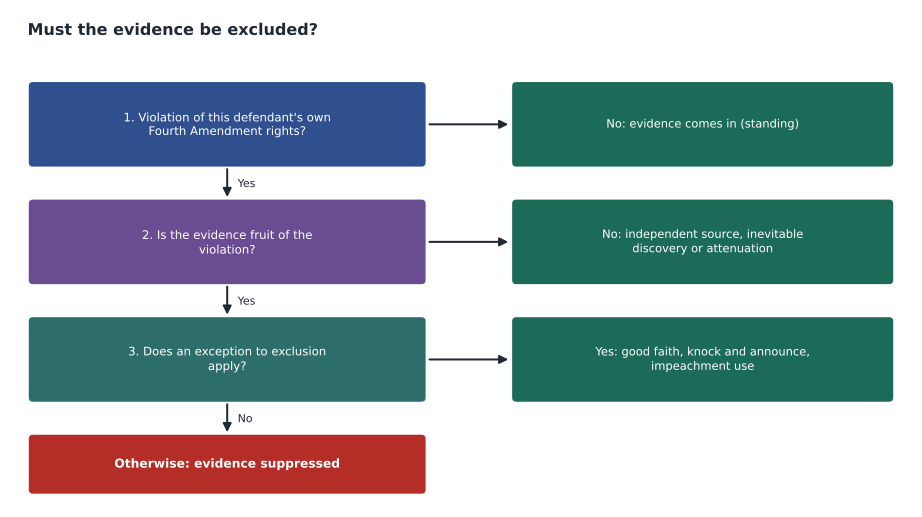
The good-faith exception
United States v. Leon, 468 U.S. 897 (1984), held that evidence obtained by officers acting in objectively reasonable reliance on a search warrant later found invalid need not be excluded. Excluding the evidence would not deter police misconduct, because the mistake was the magistrate's. Leon identified four situations in which reliance is not reasonable: the affiant misled the magistrate with information the affiant knew was false or would have known was false but for reckless disregard of the truth; the magistrate wholly abandoned the judicial role; the affidavit was so lacking in indicia of probable cause that belief in its existence was entirely unreasonable (a bare-bones affidavit); or the warrant was so facially deficient, failing to particularize the place or things, that officers could not reasonably presume it valid. Massachusetts v. Sheppard, 468 U.S. 981 (1984), applied Leon where a judge used the wrong form and assured officers he would correct it.
The Court has extended the exception beyond warrants. Illinois v. Krull, 480 U.S. 340 (1987), covered reliance on a statute later held unconstitutional. Arizona v. Evans, 514 U.S. 1 (1995), covered reliance on a court clerk's erroneous computer record of a warrant. Herring v. United States, 555 U.S. 135 (2009), went further: when police relied on a neighboring county's database that wrongly showed an active warrant because of a negligent bookkeeping error by police staff, exclusion was not required. Chief Justice Roberts wrote that the exclusionary rule serves to deter deliberate, reckless or grossly negligent conduct, or in some circumstances recurring or systemic negligence; isolated negligence attenuated from the arrest does not justify the costs of exclusion. Davis v. United States, 564 U.S. 229 (2011), held that searches conducted in objectively reasonable reliance on binding appellate precedent later overruled are not subject to exclusion, as in vehicle searches before Gant.
Some states reject or limit the good-faith exception under their own constitutions. As lesson 1 noted, Westmarch's supreme court has held that its constitution does not permit good-faith reliance on a warrant issued without probable cause, though it has not decided whether the exception applies to other defects.
Knock-and-announce: Hudson v. Michigan
In Hudson v. Michigan, 547 U.S. 586 (2006), police with a warrant to search for drugs and guns announced their presence and waited only three to five seconds before entering. The state conceded a knock-and-announce violation. Justice Scalia, for a 5 to 4 majority, held that exclusion was not an appropriate remedy. The interests protected by the knock-and-announce rule, preventing violence, property damage and intrusion on privacy and dignity, have nothing to do with seizing evidence described in a warrant, and the police would have found the evidence anyway. Civil suits and police discipline are the remedies. Justice Kennedy, concurring, stressed that the decision did not cast doubt on the exclusionary rule's continued operation in other contexts.
The fruit of the poisonous tree
Exclusion reaches not only evidence obtained directly from a violation but also derivative evidence, the fruit of the poisonous tree. In Wong Sun v. United States, 371 U.S. 471 (1963), federal agents illegally broke into a laundry and arrested James Wah Toy, whose statements led them to drugs held by another man, Johnny Yee, and to Wong Sun. The statements and drugs were the fruit of the illegal entry as to Toy. But Wong Sun himself, who was released and returned voluntarily several days later to make a statement, was in a different position: his statement was so attenuated from the illegality as to dissipate the taint. The question is "whether, granting establishment of the primary illegality, the evidence has been come at by exploitation of that illegality or instead by means sufficiently distinguishable to be purged of the primary taint."
Three doctrines limit the fruit principle.
Independent source: evidence obtained through a source genuinely independent of the illegality is admissible. In Murray v. United States, 487 U.S. 533 (1988), agents illegally entered a warehouse and saw bales of marijuana, then left, obtained a warrant without mentioning the entry, and returned to seize the bales. The Court held the evidence admissible if the agents' decision to seek the warrant was not prompted by what they saw during the illegal entry and the information from the entry did not affect the magistrate's decision to issue it. The case was remanded for findings on those questions.
Inevitable discovery: evidence is admissible if the prosecution proves by a preponderance that it would inevitably have been discovered by lawful means. In Nix v. Williams, 467 U.S. 431 (1984), a murder suspect led police to a child's body after an unconstitutional interrogation; because a large search party was about two and a half miles away and would have found the body in essentially the same condition, it was admissible.
Attenuation: evidence is admissible if the connection to the illegality is so attenuated, or interrupted by intervening circumstances, that exclusion would not serve deterrence. Brown v. Illinois, 422 U.S. 590 (1975), held that Miranda warnings alone do not purge the taint of an illegal arrest, and identified three factors: the temporal proximity of the illegality and the evidence, the presence of intervening circumstances, and especially the purpose and flagrancy of the official misconduct. In Utah v. Strieff, 579 U.S. 232 (2016), an officer stopped Edward Strieff without reasonable suspicion as he left a house suspected of drug activity, ran his name, discovered an outstanding warrant for a traffic violation, arrested him and found methamphetamine. The Court held 5 to 3 that the discovery of a valid, preexisting and untainted warrant was an intervening circumstance, and the officer's conduct was at most negligent, so the drugs were admissible. Justice Sotomayor's dissent warned that the decision tells officers they may stop anyone without suspicion and hope a warrant turns up.
| Doctrine | Rule | Key case |
|---|---|---|
| Good faith | Objectively reasonable reliance on a warrant, statute, database or binding precedent | Leon (1984); Krull; Evans; Herring (2009); Davis (2011) |
| Knock-and-announce | Violations do not require exclusion | Hudson (2006) |
| Independent source | Evidence obtained through a source independent of the illegality | Murray (1988) |
| Inevitable discovery | Evidence that would inevitably have been found lawfully (preponderance) | Nix v. Williams (1984) |
| Attenuation | Time, intervening circumstances and flagrancy dissipate the taint | Brown v. Illinois (1975); Strieff (2016) |
| Impeachment | Illegally obtained evidence may impeach a testifying defendant | Walder (1954); Havens (1980) |
| Standing | Only a person whose own rights were violated may seek exclusion | Rakas (1978) |
Impeachment and other limited uses
Illegally obtained evidence that cannot be used in the prosecution's case in chief may still be used to impeach a defendant who testifies inconsistently. Walder v. United States, 347 U.S. 62 (1954), allowed impeachment of a defendant who testified he had never possessed drugs with evidence of heroin illegally seized years earlier. United States v. Havens, 446 U.S. 620 (1980), extended this to statements made on cross-examination reasonably suggested by direct examination. But James v. Illinois, 493 U.S. 307 (1990), refused to allow impeachment of defense witnesses other than the defendant, because that would deter defendants from presenting any defense. Illegally seized evidence may also be considered at sentencing in many jurisdictions.
The debate over exclusion
Ambrose asks whether the rule should exist. Supporters argue that without it, the Fourth Amendment would be a form of words: civil suits rarely succeed because of qualified immunity and sympathetic juries, and police departments rarely discipline officers for unlawful searches that produce evidence. They point to studies suggesting that Mapp led departments to train officers and adopt warrant procedures. Critics argue that the rule frees guilty people, gives no remedy to innocent people who are searched and found with nothing, encourages police to lie at suppression hearings, and does little to deter officers who care more about arrests than convictions. Some propose replacing exclusion with administrative remedies or civil damages. The Court has not abandoned the rule, but Herring and Strieff suggest it will be confined to deliberate or systemic misconduct.
Two further limits shape where the exclusionary rule bites. First, under Stone v. Powell, 428 U.S. 465 (1976), a state prisoner who had a full and fair opportunity to litigate a Fourth Amendment claim in state court may not raise it again in federal habeas corpus, so suppression arguments are won or lost in the state courts and on direct review. Miranda and Sixth Amendment claims are not limited in this way. Second, state courts applying their own constitutions may adopt broader exclusionary rules. The Pennsylvania Supreme Court in Commonwealth v. Edmunds, 586 A.2d 887 (Pa. 1991), and the Connecticut Supreme Court in State v. Marsala, 579 A.2d 58 (Conn. 1990), rejected a good-faith exception under their state constitutions, reasoning that the state exclusionary rule protects privacy and judicial integrity, not only deterrence. Ambrose's Westmarch follows a similar path for warrants lacking probable cause, which is why Pike's lawyer frames his warrant challenges under both constitutions.
Exclusion in the Riverside Salvage case
Ambrose returns to the officers' warrantless look at Pike's group chat when they arrested him, discussed in lesson 4. They saw the messages "watchman's old, takes his walk at 11, we go at 11:30" and "we never talk about last night." That afternoon Detective Imbert applied for the warrant described in lesson 3. Her affidavit did not mention the look at the phone. It relied on Abbott's dying statement, the camera footage, Pike's association with Shaw and the tower dump. She testified at the suppression hearing that she had decided to seek a phone warrant the day before the arrest, and her emails to the prosecutor confirmed it.
Worked problem
Saving the group chat?
Pike moves to suppress the group chat messages, arguing they are the fruit of the warrantless look in violation of Riley. Analyze the motion under the independent source doctrine, inevitable discovery and good faith, and explain whether Westmarch law changes the result.
Show solution
- Violation: under Riley, the warrantless look at the phone's data was unlawful, and it violated Pike's own rights, so he has standing.
- Independent source (Murray): the warrant is an independent source if (1) the decision to seek it was not prompted by the illegal look and (2) the information from the look did not affect the magistrate. Imbert's emails show she decided to seek the warrant the day before, and her affidavit omitted anything learned from the look. Both prongs appear satisfied.
- Inevitable discovery (Nix): the state could also argue the messages would inevitably have been found through the warrant already being prepared, though courts are cautious about using inevitable discovery to excuse a failure to get a warrant before searching.
- Good faith: Leon does not apply to the warrantless look itself, which was not reliance on a warrant; it applies only to the later warrant, whose validity is the separate particularity question in lesson 3.
- Westmarch law: its rejection of good faith for warrants lacking probable cause does not affect independent source, which asks whether the evidence came from a lawful source at all.
Answer: The messages are likely admissible under the independent source doctrine because the warrant decision predated the illegal look and the affidavit did not use it. The illegal look still matters: it supports the defense's theme that the investigation cut corners and could be used to impeach Imbert. Any data beyond the warrant's lawful scope remains vulnerable on particularity grounds.
Priya Natarajan points out that the result means the illegal look cost the state nothing. Ambrose agrees that Murray's critics make exactly that point, and that the doctrine works only if judges carefully test the officer's claim that the warrant decision came first. "In this case," she says, "the emails saved the state. In many cases there are no emails, and the judge has to decide whom to believe."
Summary and key terms
- The exclusionary rule began in Weeks (1914) and was applied to the states in Mapp (1961); modern cases treat it as a deterrence remedy applied only when benefits outweigh costs.
- The good-faith exception (Leon) covers reasonable reliance on warrants, and later cases extend it to statutes, records errors, negligent police database errors (Herring) and binding precedent (Davis).
- Knock-and-announce violations do not require exclusion (Hudson).
- Derivative evidence is excluded unless an independent source, inevitable discovery or attenuation applies; Strieff treated a valid outstanding warrant as an intervening circumstance.
- Illegally obtained evidence may impeach a testifying defendant but not other defense witnesses.
- State constitutions may reject the good-faith exception, as Westmarch does for warrants lacking probable cause.
Practice problems
Work each problem on paper first, then reveal the answer to check.
Name the four situations in which Leon's good-faith exception does not apply.
Show answer
A knowingly or recklessly false affidavit; a magistrate who abandoned the judicial role; a bare-bones affidavit so lacking in probable cause that reliance is unreasonable; and a facially deficient warrant.
What kind of police error did Herring hold does not require exclusion?
Show answer
Isolated negligence, such as a database bookkeeping error, attenuated from the arrest; exclusion is reserved for deliberate, reckless or grossly negligent conduct, or recurring systemic negligence.
What two questions decide independent source under Murray?
Show answer
Whether the decision to seek the warrant was prompted by what officers saw during the illegal search, and whether information from the illegal search affected the magistrate's decision.
Why were the drugs admissible in Utah v. Strieff?
Show answer
The discovery of a valid, preexisting warrant was an intervening circumstance, and the unlawful stop was at most negligent, so the taint was attenuated.
May illegally seized evidence be used to impeach a defense witness other than the defendant?
Show answer
No. James v. Illinois limits the impeachment exception to the defendant's own testimony.
Lesson quiz · 5 questions
Score 60% or more to complete this lesson.
Create a free account to save your progress, take quizzes and earn a certificate.