
LAWU-203 · Lesson 10 of 12 · 23 min
Pretrial process: bail, charging, discovery and pleas
▶ Video coming soon A video version of this lesson is on the way.
Ambrose tells Section B that if they become criminal lawyers, they will spend far more time on what happens between arrest and trial than on trials themselves. Bail decisions determine whether a defendant spends months in jail before anyone decides guilt. Charging decisions determine what a defendant faces. Discovery determines what the defense knows. And plea bargaining determines how almost every case ends. "The Supreme Court has written far less about these stages than about searches," she says, "but they shape outcomes far more."
Pretrial release and detention
The Eighth Amendment provides that "excessive bail shall not be required." In Stack v. Boyle, 342 U.S. 1 (1951), the Court held that bail set higher than an amount reasonably calculated to assure the defendant's appearance at trial is excessive; bail for twelve defendants charged under the Smith Act had been fixed uniformly at 50,000 dollars each without individual inquiry. The Amendment does not guarantee a right to bail in every case.
The Bail Reform Act of 1984 authorized federal judges to detain defendants before trial if no conditions of release would reasonably assure the safety of any other person and the community. United States v. Salerno, 481 U.S. 739 (1987), upheld the statute against due process and Eighth Amendment challenges. Chief Justice Rehnquist wrote that pretrial detention under the Act is regulatory, not punitive, and that the government's interest in preventing crime by arrestees can justify detention after an adversary hearing with procedural protections, including a finding by clear and convincing evidence of dangerousness. "In our society liberty is the norm," he wrote, "and detention prior to trial or without trial is the carefully limited exception."
In many state courts, release has long depended on money bail: a defendant who can post the amount, often through a commercial bail bond, goes home, while a defendant who cannot stays in jail, sometimes for months, for want of a few hundred dollars. Research has linked pretrial detention to higher rates of guilty pleas and conviction and to lost jobs and housing. Since 2017, several states have reformed their systems. New Jersey largely replaced money bail with risk assessment and preventive detention hearings in 2017. Illinois's SAFE-T Act made it the first state to abolish cash bail entirely, effective September 18, 2023, after the Illinois Supreme Court upheld the law. Other jurisdictions have moved in the opposite direction, expanding detention or restricting release for certain offenses. Ambrose tells the class that bail policy is one of the most contested areas of criminal justice and that empirical claims on both sides deserve careful scrutiny.
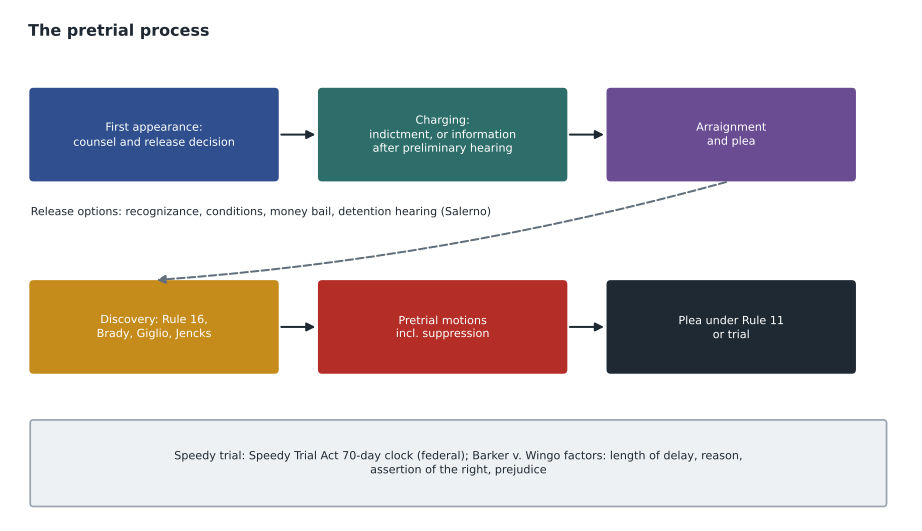
Charging and prosecutorial discretion
Prosecutors have broad discretion to decide whether to charge, what charges to bring and whom to prosecute. Courts rarely review those decisions, because they involve judgments about the strength of the case, priorities and resources that courts are poorly placed to second-guess. Two constitutional limits exist. Selective prosecution based on race, religion or another arbitrary classification violates equal protection, but the defendant must show both discriminatory effect and discriminatory purpose, under Wayte v. United States, 470 U.S. 598 (1985). United States v. Armstrong, 517 U.S. 456 (1996), set a demanding threshold even for discovery on such a claim: the defendant must produce some evidence that similarly situated people of other races were not prosecuted.
Vindictive prosecution, punishing a defendant for exercising a legal right, violates due process. In Blackledge v. Perry, 417 U.S. 21 (1974), a prosecutor who responded to a defendant's appeal of a misdemeanor conviction by bringing a felony charge for the same conduct created a presumption of vindictiveness. But in Bordenkircher v. Hayes, 434 U.S. 357 (1978), the Court held that a prosecutor may threaten more serious charges during plea negotiations and carry out the threat if the defendant refuses to plead. Paul Hayes, charged with passing a forged check for about 88 dollars, rejected a five-year offer and was then indicted under a habitual offender law and sentenced to life. The Court reasoned that in the give-and-take of plea bargaining, there is no element of punishment so long as the defendant is free to accept or reject the offer.
Federal felonies must be charged by grand jury indictment. The grand jury, usually 16 to 23 citizens, hears evidence in secret, with no judge or defense lawyer present, and decides whether there is probable cause. Grand juries may consider evidence that would be inadmissible at trial, including hearsay, under Costello v. United States, 350 U.S. 359 (1956), and evidence obtained in violation of the Fourth Amendment, under Calandra. United States v. Williams, 504 U.S. 36 (1992), held that federal courts may not require prosecutors to present exculpatory evidence to the grand jury. Grand juries almost always indict when a prosecutor asks. As lesson 1 explained, the grand jury requirement does not bind the states; in states that charge by information, a preliminary hearing before a judge serves a similar screening function, and unlike the grand jury it is adversarial.
Speedy trial
The Sixth Amendment guarantees a speedy trial. Barker v. Wingo, 407 U.S. 514 (1972), adopted a balancing test with four factors: the length of the delay, the reason for it, whether the defendant asserted the right, and prejudice to the defendant, including oppressive pretrial incarceration, anxiety and impairment of the defense. Willie Barker's trial was delayed more than five years while prosecutors tried his codefendant six times, but Barker had not wanted a speedy trial and suffered little prejudice, so his claim failed. The remedy for a violation is dismissal with prejudice, which makes courts reluctant to find one. Most speedy trial disputes are governed by statute. The federal Speedy Trial Act of 1974 generally requires trial within 70 days of indictment or first appearance, but excludes many periods, such as time for pretrial motions and continuances granted in the interest of justice.
Discovery and the duty to disclose
Criminal discovery is narrower than civil discovery. Federal Rule of Criminal Procedure 16 requires the government, on request, to disclose the defendant's own statements, prior record, documents and objects material to the defense, examination and test results, and summaries of expert testimony. The Jencks Act, 18 U.S.C. section 3500, requires the government to produce a witness's prior statements, but only after the witness testifies on direct examination. Many states provide broader discovery, and some, such as New York after its 2020 reforms, require early and extensive disclosure.
The Constitution adds a duty that no rule can reduce. Brady v. Maryland, 373 U.S. 83 (1963), held that the prosecution's suppression of evidence favorable to the accused violates due process where the evidence is material to guilt or punishment, irrespective of the prosecutor's good or bad faith. John Brady's lawyer had asked for his companion's statements; the prosecution withheld one in which the companion admitted to the actual killing. Giglio v. United States, 405 U.S. 150 (1972), extended Brady to impeachment evidence, such as a promise of leniency to a key witness. Evidence is material if there is a reasonable probability that disclosure would have produced a different result, under United States v. Bagley, 473 U.S. 667 (1985). Kyles v. Whitley, 514 U.S. 419 (1995), held that materiality is judged cumulatively and that the prosecutor is responsible for favorable evidence known to the police even if the prosecutor did not know of it. Turner v. United States, 582 U.S. 313 (2017), found withheld evidence not material in light of the overall case.
A related due process rule forbids prosecutors from knowingly presenting false testimony or failing to correct it, under Napue v. Illinois, 360 U.S. 264 (1959). In Glossip v. Oklahoma, decided February 25, 2025, Justice Sotomayor's majority opinion held that prosecutors violated Napue when they let their key witness, Justin Sneed, testify falsely that he had never seen a psychiatrist and was given lithium only by mistake, when they knew he had been treated by a jail psychiatrist for bipolar disorder. Because the false testimony could have affected the jury's judgment of Sneed's credibility, on which the case depended, Richard Glossip was entitled to a new trial. Brady disclosure is required before trial, but United States v. Ruiz, 536 U.S. 622 (2002), held that the Constitution does not require prosecutors to disclose impeachment information before a defendant pleads guilty.
| Source | What must be disclosed | When |
|---|---|---|
| Rule 16 (federal) | Defendant's statements, record, material documents and objects, tests, expert summaries | On request, before trial |
| Jencks Act | Prior statements of government witnesses | After the witness testifies on direct (often earlier by practice) |
| Brady | Favorable evidence material to guilt or punishment, including evidence known only to police (Kyles) | In time for effective use at trial |
| Giglio | Impeachment evidence, such as deals with witnesses | In time for effective use at trial; not required before a guilty plea (Ruiz) |
| Napue | Duty not to present, and to correct, false testimony | Whenever it arises (Glossip, 2025) |
Plea bargaining
Plea bargaining resolves more than nine in ten convictions. The Supreme Court has accepted it as an essential part of the system. Brady v. United States, 397 U.S. 742 (1970), held that a guilty plea is not invalid merely because it was entered to avoid a possible death sentence. Santobello v. New York, 404 U.S. 257 (1971), held that when a plea rests on a prosecutor's promise, the promise must be fulfilled; a new prosecutor who recommended the maximum sentence despite his predecessor's promise to make no recommendation breached the agreement. Missouri v. Frye and Lafler v. Cooper, discussed in lesson 8, recognized that the right to effective counsel extends to plea bargaining, because "criminal justice today is for the most part a system of pleas, not a system of trials."
A guilty plea waives the rights to trial, to confront witnesses and against self-incrimination, so it must be knowing and voluntary, and the record must show that the defendant understood what he was giving up, under Boykin v. Alabama, 395 U.S. 238 (1969). Federal Rule of Criminal Procedure 11 requires the judge to address the defendant personally and confirm his understanding of the charges, penalties and rights, that the plea is voluntary, and that there is a factual basis. North Carolina v. Alford, 400 U.S. 25 (1970), allowed a defendant to plead guilty while protesting his innocence when the record contained strong evidence of guilt.
Plea agreements commonly include waivers of the right to appeal. In Hunter v. United States, decided June 18, 2026, the Court held 8 to 1 that an appeal waiver does not bar appellate review when enforcing it would produce a miscarriage of justice. The defendant had waived his appeal rights, and the district court then imposed a supervised release condition, over his objection, requiring him to take all prescribed mental health medications. The Court rejected the government's position that knowing and voluntary waivers are always enforceable, describing the exception as covering errors that are obvious and of a type that would undermine public confidence in the judiciary, and left lower courts to define its boundaries. Ambrose notes that Justice Gorsuch's concurrence criticized modern plea bargaining more broadly.
Critics argue that plea bargaining coerces innocent people to plead guilty, especially when they are detained before trial, and that the gap between the sentence offered and the sentence threatened after trial, sometimes called the trial penalty, punishes defendants for exercising their rights. Defenders argue that bargaining gives defendants certainty and leniency and lets the system process cases it could never try. Ambrose asks the class to keep both views in mind when they read Bordenkircher.
Pretrial in the Riverside Salvage case
At Pike's first appearance, the prosecution asked for detention, and after a hearing the judge found by clear and convincing evidence that no conditions would protect the community, citing the violence of the offense and Pike's prior assault conviction. A grand jury indicted Pike for burglary and felony murder. ADA Helen Moreau offered to let Pike plead to manslaughter with a recommended sentence of eight years, warning that if he refused she would add a charge of conspiracy and seek the maximum on the murder count. Tara Quinn pleaded guilty to burglary with a recommendation of probation in exchange for her cooperation. Two weeks before trial, Ostrander learned that a patrol officer's notes from the first night contained an interview with Gus Farrell, a former yard employee, who said Abbott had once swung his heavy flashlight at teenagers he caught in the yard. The notes had never been sent to the prosecutor.
Worked problem
Pretrial issues for Pike
Analyze (a) Pike's detention, (b) Moreau's threat to add charges, and (c) the late-discovered Farrell notes and the Quinn plea under Brady and Giglio.
Show solution
- (a) Under Salerno, preventive detention after an adversary hearing with a clear and convincing evidence finding of dangerousness is constitutional; Westmarch's statute appears to follow the federal model. The detention is likely valid, though Pike could seek review if the trial is delayed, invoking Barker v. Wingo.
- (b) Under Bordenkircher, a prosecutor may threaten to add charges supported by probable cause if a defendant refuses a plea offer, and may carry out the threat. No vindictiveness presumption arises in the plea context.
- (c) The Farrell notes are favorable: they support Pike's claim that Abbott swung first. Under Kyles, the prosecution is responsible for evidence known to the police even if the prosecutor did not know. Because they were disclosed two weeks before trial, there may be no Brady violation if Ostrander can still use them effectively; he can seek a continuance to locate Farrell.
- Quinn's plea agreement is Giglio material: the promise of probation in exchange for cooperation bears on her credibility and must be disclosed, with the full terms.
Answer: Pike's detention and the prosecutor's charge threat are constitutional under Salerno and Bordenkircher. The Farrell notes are Brady material imputed to the prosecution under Kyles; their late disclosure is likely cured if the defense has time to use them, which may justify a continuance. Quinn's plea terms must be disclosed under Giglio, and if Moreau lets Quinn testify that she received no benefit, Napue and Glossip require correction.
Daniel Reyes asks whether the patrol officer could be disciplined for not sending the notes. Ambrose says many offices now require police to certify that they have turned over their entire file, and that some prosecutors maintain lists of officers with credibility problems for Giglio purposes. "Brady is the prosecutor's duty," she says, "but it depends entirely on what the police put in the file."
Summary and key terms
- The Eighth Amendment forbids excessive bail (Stack v. Boyle); Salerno upheld preventive detention after an adversary hearing; states are reforming money bail in different directions.
- Prosecutors have broad charging discretion limited by selective and vindictive prosecution doctrines; Bordenkircher permits charge threats in plea bargaining.
- Grand juries indict on probable cause in secret, with no duty to hear exculpatory evidence (Williams); states may charge by information instead.
- Speedy trial claims are judged by Barker v. Wingo's four factors and, more often, by statutes like the Speedy Trial Act.
- Brady and Giglio require disclosure of material favorable and impeachment evidence, including evidence known only to police (Kyles); Napue forbids false testimony, as enforced in Glossip (2025).
- Pleas must be knowing and voluntary (Boykin, Rule 11); promises must be kept (Santobello); appeal waivers yield to miscarriages of justice (Hunter, 2026).
Practice problems
Work each problem on paper first, then reveal the answer to check.
What did United States v. Salerno uphold?
Show answer
The Bail Reform Act's provision for pretrial detention of dangerous defendants after an adversary hearing with a clear and convincing evidence finding.
Why did Bordenkircher v. Hayes reject the vindictiveness claim?
Show answer
Because in plea bargaining, a prosecutor may threaten and bring additional charges supported by probable cause so long as the defendant is free to accept or reject the offer.
What did Kyles v. Whitley add to Brady?
Show answer
Materiality is judged cumulatively, and the prosecutor is responsible for favorable evidence known to police even if the prosecutor did not know of it.
Why did Richard Glossip receive a new trial?
Show answer
Prosecutors knowingly allowed their key witness to testify falsely about his psychiatric treatment and failed to correct it, and the falsehood could have affected the jury's judgment.
What did Hunter v. United States (2026) hold about appeal waivers?
Show answer
An appeal waiver in a plea agreement does not bar review when enforcing it would produce a miscarriage of justice, such as an obvious error that would undermine public confidence in the judiciary.
Lesson quiz · 5 questions
Score 60% or more to complete this lesson.
Create a free account to save your progress, take quizzes and earn a certificate.