
LAWU-203 · Lesson 11 of 12 · 22 min
Trial rights and double jeopardy
▶ Video coming soon A video version of this lesson is on the way.
On the first morning of State v. Pike, ninety residents of Merrin County filled the jury assembly room. By the afternoon, twelve jurors and two alternates sat in the box. Ambrose tells Section B that jury selection is where the Sixth Amendment, the Equal Protection Clause and the realities of a courtroom meet. "The Evidence course taught you what the jury may hear," she says. "Today we look at the trial rights themselves: who decides, what they must find, what happens when race enters the jury room, and when the government gets a second chance."
The right to a jury
The Sixth Amendment guarantees an impartial jury in all criminal prosecutions, and Duncan v. Louisiana (1968) applied that right to the states for serious offenses. Petty offenses, generally those punishable by no more than six months' imprisonment, carry no jury right, under Baldwin v. New York, 399 U.S. 66 (1970), and Blanton v. City of North Las Vegas, 489 U.S. 538 (1989). A jury need not have twelve members: Williams v. Florida, 399 U.S. 78 (1970), upheld six-person juries, but Ballew v. Georgia, 435 U.S. 223 (1978), held five too few.
For decades, Apodaca v. Oregon (1972) permitted non-unanimous verdicts in state courts, and Louisiana and Oregon allowed convictions by votes of 10 to 2 or 11 to 1. Ramos v. Louisiana, 590 U.S. 83 (2020), overruled Apodaca and held that the Sixth Amendment requires a unanimous verdict to convict of a serious offense in state as well as federal court. Justice Gorsuch traced Louisiana's non-unanimity rule to an 1898 constitutional convention that sought to dilute the votes of Black jurors. Edwards v. Vannoy, 593 U.S. 255 (2021), held that Ramos does not apply retroactively on federal collateral review.
The jury must be drawn from a fair cross-section of the community. Taylor v. Louisiana, 419 U.S. 522 (1975), struck down a system that excluded women unless they volunteered. Duren v. Missouri, 439 U.S. 357 (1979), set the test: the defendant must show that a distinctive group was underrepresented in venires relative to its share of the community, and that the underrepresentation resulted from systematic exclusion in the selection process. The cross-section requirement applies to the pool, not to the jury actually selected.
Jury selection and Batson
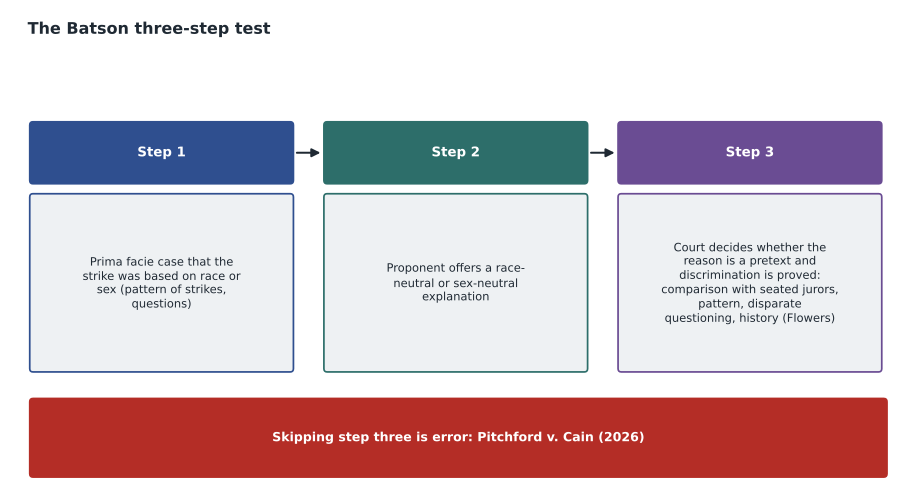
During voir dire, lawyers question prospective jurors and may challenge them for cause, without limit, or by peremptory challenges, a limited number of strikes for which no reason need be given. Swain v. Alabama (1965) made it nearly impossible to prove that a prosecutor used peremptory strikes to exclude Black jurors. Batson v. Kentucky, 476 U.S. 79 (1986), replaced Swain with a three-step test. First, the opponent of the strike must make a prima facie showing that it was based on race. Second, the proponent must offer a race-neutral explanation. Third, the trial court must decide whether the opponent has proved purposeful discrimination, assessing whether the stated reason is a pretext. J.E.B. v. Alabama ex rel. T.B., 511 U.S. 127 (1994), extended Batson to sex. Defendants are bound too: Georgia v. McCollum, 505 U.S. 42 (1992), applied Batson to defense strikes.
The third step is where most Batson claims are decided. Courts compare the reasons given for striking minority jurors with the treatment of similar white jurors who were not struck, look at the pattern of strikes and questioning, and consider the prosecutor's history. In Flowers v. Mississippi, 588 U.S. 284 (2019), the same prosecutor tried Curtis Flowers six times for the same murders and struck 41 of the 42 Black prospective jurors across the trials; the Court reversed the sixth conviction, relying on that history, the disparate questioning of Black and white jurors, and the comparison of struck and seated jurors.
In Pitchford v. Cain, decided May 28, 2026, the Court reinforced the third step. Terry Pitchford, a Black teenager, was tried capitally in Mississippi for a 2004 grocery store murder. The prosecutor struck four of the five Black prospective jurors. When the defense raised a Batson objection, the trial judge accepted the prosecutor's race-neutral reasons without letting defense counsel argue they were pretexts and without deciding whether they were, while assuring the defense that the objection was preserved. The Mississippi Supreme Court later held that Pitchford had waived the pretext argument. Writing for a 5 to 4 majority, Justice Kavanaugh held that the trial court had omitted Batson's third step and that, given the court's assurance, the state court's waiver ruling was an unreasonable application of clearly established federal law under the federal habeas statute. Justice Gorsuch dissented, joined by Justices Thomas, Alito and Barrett.
Race can also enter the jury room after selection. Peña-Rodriguez v. Colorado, 580 U.S. 206 (2017), created an exception to the rule that jurors may not testify about deliberations: when a juror makes a clear statement indicating reliance on racial stereotypes or animus to convict, the Sixth Amendment requires the court to consider the evidence. A juror had said the defendant was guilty "because he's Mexican and Mexican men take whatever they want."
What the jury must find
Due process requires proof beyond a reasonable doubt of every fact necessary to constitute the crime charged, under In re Winship, 397 U.S. 358 (1970). Apprendi v. New Jersey, 530 U.S. 466 (2000), held that any fact, other than a prior conviction, that increases the penalty beyond the statutory maximum must be submitted to a jury and proved beyond a reasonable doubt. Blakely v. Washington, 542 U.S. 296 (2004), applied Apprendi to state sentencing guidelines, and United States v. Booker, 543 U.S. 220 (2005), made the federal Sentencing Guidelines advisory to cure the same problem. Alleyne v. United States, 570 U.S. 99 (2013), extended the rule to facts that increase a mandatory minimum.
Erlinger v. United States, 602 U.S. 821 (2024), applied Apprendi to the Armed Career Criminal Act, which imposes a fifteen-year minimum on a person with three prior violent felonies or serious drug offenses "committed on occasions different from one another." The Court held that whether the prior offenses occurred on different occasions must be decided by a jury unanimously and beyond a reasonable doubt, or admitted by the defendant in a guilty plea, not found by a judge. The prior-conviction exception covers only the fact of a conviction.
Other trial rights
The Sixth Amendment guarantees a public trial. A courtroom may be closed only if there is an overriding interest likely to be prejudiced, the closure is no broader than necessary, the court considers reasonable alternatives and makes adequate findings, under Waller v. Georgia, 467 U.S. 39 (1984); this applies to jury selection too, under Presley v. Georgia, 558 U.S. 209 (2010). Weaver v. Massachusetts, 582 U.S. 286 (2017), held that when a public trial violation is raised only through an ineffective assistance claim, the defendant must show prejudice.
The Confrontation Clause, covered in depth in the Evidence course, bars testimonial hearsay from absent witnesses unless the witness is unavailable and the defendant had a prior opportunity for cross-examination, under Crawford v. Washington, 541 U.S. 36 (2004); Smith v. Arizona (2024) applied it to substitute forensic experts who relay an absent analyst's statements. The Compulsory Process Clause guarantees the right to obtain witnesses in the defendant's favor. The Fifth Amendment protects the defendant's right not to testify, and the prosecutor may not comment on a defendant's silence at trial, under Griffin v. California, 380 U.S. 609 (1965). Due process also forbids introducing evidence so unduly prejudicial that it renders the trial fundamentally unfair; in Andrew v. White (2025), a per curiam decision, the Court held that this principle was clearly established federal law and sent back a capital case in which prosecutors had introduced extensive evidence about the defendant's sex life and parenting.
Double jeopardy
The Fifth Amendment provides that no person shall "be subject for the same offense to be twice put in jeopardy of life or limb." It protects against a second prosecution for the same offense after acquittal, a second prosecution after conviction, and multiple punishments for the same offense. Jeopardy attaches when the jury is sworn, or in a bench trial when the first witness is sworn, under Crist v. Bretz, 437 U.S. 28 (1978).
Offenses are the same if they have the same elements. Under the test of Blockburger v. United States, 284 U.S. 299 (1932), two offenses are different if each requires proof of a fact the other does not. A lesser included offense, whose elements are all contained in the greater, is the same offense, so a conviction for joyriding barred a later prosecution for auto theft of the same car in Brown v. Ohio, 432 U.S. 161 (1977). For multiple punishments in a single trial, the question is legislative intent: Congress may authorize cumulative punishments if it does so clearly. In Barrett v. United States, decided unanimously on January 14, 2026, the Court held that Congress had not clearly authorized convictions under two firearms subsections for a single act, and reversed one of the convictions.
The doctrine of collateral estoppel, incorporated into double jeopardy by Ashe v. Swenson, 397 U.S. 436 (1970), bars relitigating an issue of ultimate fact that a jury necessarily decided in the defendant's favor. A man acquitted of robbing one of six poker players, where the only contested issue was whether he was one of the robbers, could not be tried for robbing another.
A mistrial declared at the defendant's request generally permits retrial unless the prosecutor goaded the defendant into seeking it, under Oregon v. Kennedy, 456 U.S. 667 (1982). A mistrial declared over the defendant's objection permits retrial only if there was manifest necessity, such as a hung jury. An acquittal, even one based on an egregious legal error by the judge, bars retrial, under Evans v. Michigan, 568 U.S. 313 (2013). A defendant whose conviction is reversed on appeal may be retried, unless the reversal was for insufficient evidence, under Burks v. United States, 437 U.S. 1 (1978).
Under the dual sovereignty doctrine, the same conduct may be prosecuted by different sovereigns, because each prosecutes its own offense. Gamble v. United States, 587 U.S. 678 (2019), reaffirmed the doctrine, allowing a federal felon-in-possession prosecution after a state conviction for the same possession. States and the federal government are separate sovereigns; a state and its cities are not, under Waller v. Florida, 397 U.S. 387 (1970). The Justice Department's Petite policy generally discourages federal prosecution after a state prosecution for the same conduct, but it is not enforceable by defendants.
| Question | Rule | Key case |
|---|---|---|
| When does jeopardy attach? | When the jury is sworn (or the first witness in a bench trial) | Crist v. Bretz (1978) |
| Same offense? | Same elements test: each offense must require a fact the other does not | Blockburger (1932); Brown v. Ohio (1977) |
| Multiple punishments in one trial? | Permitted only if the legislature clearly authorizes them | Barrett v. United States (2026) |
| Issue preclusion? | An issue of ultimate fact decided by acquittal may not be relitigated | Ashe v. Swenson (1970) |
| Retrial after mistrial? | Allowed if the defendant requested it (absent goading) or manifest necessity | Oregon v. Kennedy (1982) |
| Retrial after acquittal? | Barred, even if based on legal error | Evans v. Michigan (2013) |
| Different sovereigns? | Separate prosecutions allowed | Gamble (2019) |
The trial of Devon Pike
During jury selection, ADA Moreau used peremptory strikes on two of the three Black prospective jurors, explaining that one had a cousin who had been prosecuted by her office and the other seemed "uninterested" and had answered questions briefly. Ostrander objected under Batson and pointed out that a white prospective juror whose brother had been prosecuted by the same office was seated. The judge listened to both sides, asked Moreau about the white juror, and found her reasons for the first strike pretextual and for the second genuine. Kellan Shaw, called by the defense, invoked his Fifth Amendment privilege. Meanwhile, Shaw had pleaded guilty in state court to burglary, and a federal prosecutor was considering charges for theft of goods from interstate commerce based on the same copper. Ambrose adds a hypothetical: suppose the jury acquits Pike of murder but convicts him of burglary, and the state later wants to try him for manslaughter.
Worked problem
Trial issues in State v. Pike
Analyze (a) the Batson ruling, (b) whether the federal government may prosecute Shaw after his state guilty plea, and (c) whether the state may try Pike for manslaughter after the hypothetical murder acquittal.
Show solution
- (a) The judge properly conducted all three steps: a prima facie case from strikes of two of three Black jurors, race-neutral explanations, and a step-three finding comparing the struck juror with the seated white juror whose brother had been prosecuted. The comparison supports the pretext finding for the first strike. The remedy is to seat the juror or restart selection. The judge's finding on the second strike is reviewed deferentially. Unlike in Pitchford, the defense was allowed to argue pretext.
- (b) Under Gamble's dual sovereignty doctrine, the federal government may prosecute Shaw for a federal offense based on the same conduct, though the Petite policy may discourage it.
- (c) Manslaughter is a lesser included offense of murder, so under Brown v. Ohio, after a jury verdict acquitting Pike of murder in a trial where it could have convicted him of manslaughter, a later manslaughter prosecution is barred. Even apart from Blockburger, if the acquittal necessarily rested on a finding, such as self-defense, Ashe would bar relitigating it.
Answer: The trial court handled the Batson objection correctly, finding the first strike pretextual. A federal prosecution of Shaw would not violate double jeopardy under Gamble. A later manslaughter prosecution of Pike after a murder acquittal would be barred because manslaughter is a lesser included offense of murder.
Priya Natarajan asks whether jurors ever learn about Batson rulings. Ambrose says they usually do not, since the hearing occurs at sidebar or outside their presence, and that the seated juror may never know that she was almost struck. "The juror doesn't know," she says, "but the defendant, the community and the record all do."
Summary and key terms
- The jury right applies to serious offenses; juries may have six members but not five, and Ramos (2020) requires unanimity in state courts.
- Batson's three steps govern challenges to discriminatory strikes; Flowers (2019) and Pitchford v. Cain (2026) emphasize the trial court's duty at step three.
- Peña-Rodriguez allows inquiry into a juror's racial animus during deliberations.
- Apprendi and Erlinger (2024) require jury findings beyond a reasonable doubt for facts that raise penalties, including whether prior offenses occurred on different occasions.
- Double jeopardy attaches when the jury is sworn; offenses are the same under Blockburger; acquittals bar retrial; Barrett (2026) requires clear legislative authorization for cumulative punishments; separate sovereigns may each prosecute (Gamble).
Practice problems
Work each problem on paper first, then reveal the answer to check.
What did Ramos v. Louisiana hold, and is it retroactive?
Show answer
It held that the Sixth Amendment requires unanimous verdicts for serious offenses in state courts; Edwards v. Vannoy held it is not retroactive on federal collateral review.
What error did the trial court commit in Pitchford v. Cain?
Show answer
It accepted the prosecutor's race-neutral reasons without letting the defense argue pretext or deciding whether the reasons were pretextual, omitting Batson's third step.
What must a jury find under Erlinger v. United States?
Show answer
Whether a defendant's prior offenses were committed on different occasions for purposes of the Armed Career Criminal Act, unanimously and beyond a reasonable doubt.
When does jeopardy attach in a jury trial?
Show answer
When the jury is empaneled and sworn.
Why could the federal government prosecute Gamble after his state conviction?
Show answer
Under the dual sovereignty doctrine, the state and federal governments are separate sovereigns, each prosecuting its own offense.
Lesson quiz · 5 questions
Score 60% or more to complete this lesson.
Create a free account to save your progress, take quizzes and earn a certificate.