
LAWU-203 · Lesson 8 of 12 · 22 min
Right to counsel
▶ Video coming soon A video version of this lesson is on the way.
Paul Ostrander is a fictional public defender, but Ambrose tells the class that his caseload is drawn from real reports. When Devon Pike was charged with murder, Ostrander was already carrying more than a hundred open felony files in the Merrin County public defender's office. "Gideon promised every poor defendant a lawyer," she says. "It did not promise a lawyer with time. Today we study what the Sixth Amendment guarantees, when it begins, what it forbids the police to do once it attaches, and what happens when the lawyer who shows up is not good enough."
From Powell to Gideon
The Sixth Amendment guarantees the accused "the Assistance of Counsel for his defense." Originally it meant that a defendant could hire a lawyer, not that the government must supply one. In Powell v. Alabama, 287 U.S. 45 (1932), the Scottsboro case, nine Black teenagers were tried for rape in Alabama days after their arrest without meaningful assistance of counsel, and eight were sentenced to death. The Court held that due process required appointed counsel in a capital case where the defendants were incapable of making their own defense. Johnson v. Zerbst, 304 U.S. 458 (1938), required appointed counsel in all federal felony cases. But Betts v. Brady, 316 U.S. 455 (1942), held that states need appoint counsel only when special circumstances made it necessary for a fair trial.
Gideon v. Wainwright, 372 U.S. 335 (1963), overruled Betts. Clarence Earl Gideon, charged with breaking into a Florida pool hall, asked for a lawyer and was refused; he defended himself and was convicted. From prison he sent a handwritten petition to the Supreme Court. Justice Black's opinion held that "in our adversary system of criminal justice, any person haled into court, who is too poor to hire a lawyer, cannot be assured a fair trial unless counsel is provided for him." On retrial with a lawyer, Gideon was acquitted.
The right extends to misdemeanors in which the defendant is actually imprisoned. Argersinger v. Hamlin, 407 U.S. 25 (1972), held that no one may be imprisoned for any offense without counsel unless he waives it. Scott v. Illinois, 440 U.S. 367 (1979), held that actual imprisonment, not merely authorized imprisonment, is the line: a defendant fined for shoplifting had no right to appointed counsel. Alabama v. Shelton, 535 U.S. 654 (2002), held that a suspended sentence that may lead to imprisonment if probation is revoked also requires counsel. The right applies on a first appeal as of right, under Douglas v. California, 372 U.S. 353 (1963), but not to discretionary appeals or collateral review, under Ross v. Moffitt, 417 U.S. 600 (1974).
When the right attaches and what counts as a critical stage
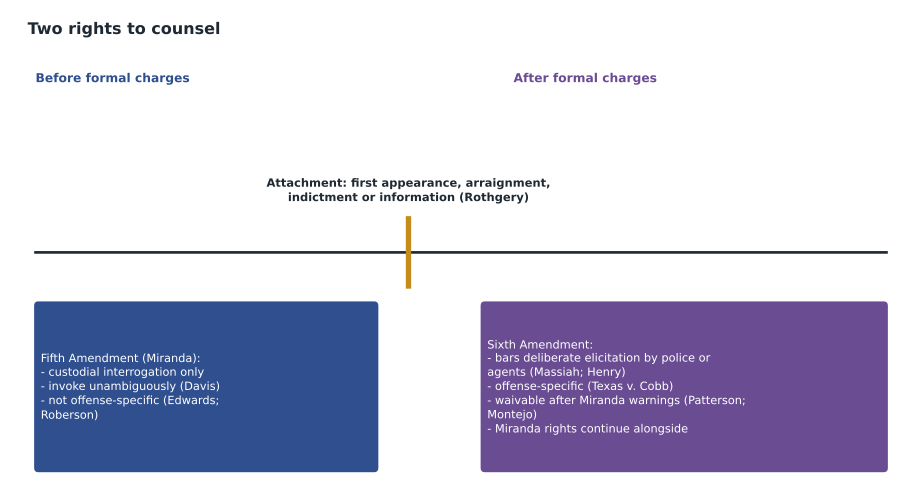
The Sixth Amendment right attaches at the initiation of adversary judicial proceedings, "whether by way of formal charge, preliminary hearing, indictment, information, or arraignment," as Kirby v. Illinois, 406 U.S. 682 (1972), put it. Rothgery v. Gillespie County, 554 U.S. 191 (2008), held that it attaches at a defendant's first appearance before a judicial officer, where he learns the charge and his liberty is subject to restriction, whether or not a prosecutor is involved. Once it attaches, the defendant is entitled to counsel at every critical stage, meaning any stage where the defendant's rights may be lost or the outcome affected. Critical stages include post-indictment lineups, under United States v. Wade, 388 U.S. 218 (1967); preliminary hearings, under Coleman v. Alabama, 399 U.S. 1 (1970); plea negotiations; trial; and sentencing. Photographic arrays without the defendant present are not critical stages, under United States v. Ash, 413 U.S. 300 (1973).
Deliberate elicitation: Massiah and its progeny
Once the right attaches, the government may not deliberately elicit incriminating statements from the defendant about the charged offense in the absence of counsel, unless he waives the right. In Massiah v. United States, 377 U.S. 201 (1964), after Winston Massiah was indicted for narcotics offenses and released on bail, his codefendant agreed to cooperate and allowed agents to install a radio transmitter in his car; their conversation was recorded. The Court held the statements inadmissible. Unlike Miranda, Massiah does not require custody or interrogation in the usual sense. It applies to undercover agents and informants as well as uniformed officers.
Brewer v. Williams, 430 U.S. 387 (1977), applied Massiah to the "Christian burial speech." Robert Williams, arraigned in Davenport, Iowa, for the abduction of a ten-year-old girl in Des Moines, had been told by his lawyers not to talk and police had promised not to question him during the drive back. A detective, knowing Williams was deeply religious, told him the girl's parents deserved a Christian burial for her before an expected snowfall covered her body. Williams led them to the body. The Court held this was deliberate elicitation in violation of his right to counsel; on retrial, the body was admitted under the inevitable discovery doctrine in Nix v. Williams, discussed in lesson 6.
The government violates Massiah only by deliberate elicitation. In Kuhlmann v. Wilson, 477 U.S. 436 (1986), an informant placed in a cell who only listened, without prompting the defendant, did not violate the right. In United States v. Henry, 447 U.S. 264 (1980), by contrast, a paid informant told to be alert to statements who engaged the defendant in conversation did violate it. In Maine v. Moulton, 474 U.S. 159 (1985), the government could not use a codefendant wired to record a meeting about trial strategy, even though police had a legitimate interest in investigating threats to witnesses, as to the charged crimes.
Offense-specific and waivable
The Sixth Amendment right is offense-specific. In Texas v. Cobb, 532 U.S. 162 (2001), a man charged with a burglary confessed to murders committed during the same burglary; because the murders were different offenses under the Blockburger same-elements test, the right had not attached as to them, so police could question him about the murders after Miranda warnings. The Fifth Amendment Edwards rule, by contrast, is not offense-specific: once a suspect in custody asks for a lawyer, police may not question him about any crime.
The right can be waived. Patterson v. Illinois, 487 U.S. 285 (1988), held that Miranda warnings and a waiver are sufficient to waive the Sixth Amendment right for purposes of post-indictment questioning. Montejo v. Louisiana, 556 U.S. 778 (2009), overruled Michigan v. Jackson, which had forbidden police to initiate interrogation of a defendant who had asserted the right at arraignment. Now, a represented defendant may be approached by police and may waive the right after Miranda warnings, unless he has invoked his rights during custodial interrogation under Edwards. Massiah still bars covert deliberate elicitation, because a defendant cannot waive a right he does not know is being exercised against him.
| Feature | Miranda right to counsel (Fifth) | Sixth Amendment right to counsel |
|---|---|---|
| When it applies | Custodial interrogation, before or after charges | After formal charges or first appearance (Rothgery) |
| Undercover agents | Not covered (Perkins) | Covered if they deliberately elicit statements (Massiah, Henry) |
| Scope | Not offense-specific (Edwards) | Offense-specific (Cobb) |
| How it is invoked | Unambiguous request during custodial interrogation (Davis) | Attaches automatically; covert elicitation barred |
| Waiver | Knowing, intelligent and voluntary after warnings | Miranda waiver suffices for questioning (Patterson, Montejo) |
Effective assistance
The right to counsel is the right to effective counsel. Strickland v. Washington, 466 U.S. 668 (1984), set a two-part test for ineffective assistance claims. The defendant must show deficient performance, meaning counsel's representation fell below an objective standard of reasonableness under prevailing professional norms, and prejudice, meaning a reasonable probability that, but for counsel's errors, the result would have been different. Judicial scrutiny of performance is highly deferential; strategic choices made after thorough investigation are virtually unchallengeable. In United States v. Cronic, 466 U.S. 648 (1984), the Court recognized narrow situations where prejudice is presumed, such as a complete denial of counsel or counsel who entirely fails to subject the prosecution's case to adversarial testing.
Later cases applied Strickland in many settings. Hinton v. Alabama, 571 U.S. 263 (2014), found deficient performance where counsel failed to request additional funds for a qualified firearms expert because he mistakenly believed the funding was capped. Padilla v. Kentucky, 559 U.S. 356 (2010), held that counsel must advise a noncitizen client that a guilty plea carries a risk of deportation. Missouri v. Frye, 566 U.S. 134 (2012), held that counsel must communicate formal plea offers, and Lafler v. Cooper, 566 U.S. 156 (2012), held that a defendant who rejected a favorable plea offer because of counsel's bad advice and was convicted at trial may obtain relief. Garza v. Idaho, 586 U.S. 232 (2019), held that prejudice is presumed when counsel fails to file a notice of appeal the defendant requested, even if the plea agreement included an appeal waiver. McCoy v. Louisiana, 584 U.S. 414 (2018), held that counsel may not concede the defendant's guilt over the defendant's express objection, a structural error.
Choice of counsel, self-representation and consultation
A defendant who can afford a lawyer has a right to counsel of choice; wrongful denial is structural error requiring reversal without a showing of prejudice, under United States v. Gonzalez-Lopez, 548 U.S. 140 (2006). The government may freeze tainted assets but not untainted assets needed to retain counsel, under Luis v. United States, 578 U.S. 5 (2016). A defendant also has the right to represent himself if he knowingly and intelligently waives counsel, under Faretta v. California, 422 U.S. 806 (1975), though a state may require counsel for a defendant competent to stand trial but not competent to conduct trial proceedings alone, under Indiana v. Edwards, 554 U.S. 164 (2008).
The right includes consultation during trial. Geders v. United States, 425 U.S. 80 (1976), held that a judge may not bar a defendant from consulting counsel during an overnight recess, but Perry v. Leeke, 488 U.S. 272 (1989), allowed a bar on consultation during a short recess while the defendant was testifying. In Villarreal v. Texas, decided unanimously on February 25, 2026, Justice Jackson's opinion upheld a qualified order that barred defense counsel from discussing the defendant's ongoing testimony during an overnight recess while allowing other consultation. The Court held that the order permissibly balanced the right to counsel against the interest in obtaining unaltered testimony.
Gideon's unfinished business
Ambrose tells the class that every major study of public defense in the past two decades has found caseloads far above recommended levels. In 2023, the American Bar Association and the RAND Corporation published new national workload standards suggesting that a public defender could competently handle far fewer cases per year than many offices assign. Some public defender offices have refused new appointments, and lawsuits in several states have challenged systemic underfunding. Ambrose points out that Strickland makes these problems hard to remedy case by case, because a defendant must show that a particular lawyer's particular errors probably changed the outcome.
Counsel in the Riverside Salvage case
Pike was arrested on a Monday and taken before a magistrate on Tuesday morning, where he was told of the charges and bail was set; Ostrander was appointed that afternoon. On Thursday, jail officials moved Pike into a cell with Lyle Branson, who had been arrested for check fraud. Branson had told a detective the week before that he would "listen for anything useful" in exchange for leniency, and the detective told him, "Get him talking about the old man." Branson asked Pike several times what happened at the salvage yard, and Pike eventually said he "knocked the old guy down." Separately, Tara Quinn's lawyer received a written plea offer in August to plead to burglary with a recommendation of probation if she accepted within two weeks. Her lawyer, overwhelmed, did not tell her about it until it had lapsed. The prosecutor later made a similar offer, which she accepted.
Worked problem
The jailhouse informant and the lapsed offer
Analyze (a) whether Pike's statement to Branson is admissible, and (b) whether Quinn has a claim based on the lapsed offer.
Show solution
- (a) Attachment: under Rothgery, Pike's right attached at Tuesday's first appearance, before he was placed with Branson on Thursday.
- Government agent: Branson was acting on the detective's instructions in hope of leniency, so he was a government agent.
- Deliberate elicitation: Branson was told to "get him talking about the old man" and repeatedly asked about it, so this is Henry, not Kuhlmann's passive listener. The statement concerns the charged offense, so Cobb's offense-specific limit does not help the state.
- Waiver: Pike could not waive a right he did not know was being invoked, so Patterson and Montejo do not apply. The statement is inadmissible in the case in chief, though it might be usable for impeachment if Pike testifies inconsistently, under Kansas v. Ventris (2009).
- (b) Under Missouri v. Frye, failing to communicate a formal plea offer is deficient performance. Prejudice requires a reasonable probability that Quinn would have accepted, that the prosecution would not have withdrawn it, and that the court would have accepted it. Because the later offer was similar and she accepted it, she suffered little or no prejudice.
Answer: Pike's statement to Branson violates Massiah and Henry and must be excluded from the case in chief. Quinn's lawyer performed deficiently under Frye, but because she later accepted a similar offer, she likely cannot show prejudice.
Hannah Lindqvist asks whether the detective's instruction would have mattered if Branson had volunteered the conversation without being asked. Ambrose says it would: without an agreement with the government, Branson would have been a private citizen, and the Sixth Amendment restrains only government action. "Informant cases," she says, "turn on what the detective said to the informant, and that is usually the one conversation nobody recorded."
Summary and key terms
- Gideon (1963) requires appointed counsel for indigent felony defendants; Argersinger and Scott extend the right to misdemeanors resulting in actual imprisonment.
- The Sixth Amendment right attaches at the start of adversary judicial proceedings, including a first appearance (Rothgery), and applies at critical stages.
- Massiah bars deliberate elicitation of statements about the charged offense by police or their agents; passive listening is permitted (Kuhlmann).
- The right is offense-specific (Cobb) and may be waived after Miranda warnings (Patterson, Montejo).
- Ineffective assistance requires deficient performance and prejudice (Strickland), including failures in plea bargaining (Frye, Lafler) and advice on deportation (Padilla).
- Villarreal v. Texas (2026) upheld an order barring discussion of ongoing testimony during an overnight recess while allowing other consultation.
Practice problems
Work each problem on paper first, then reveal the answer to check.
When does the Sixth Amendment right to counsel attach under Rothgery?
Show answer
At the defendant's first appearance before a judicial officer, where he learns the charge and his liberty is subject to restriction.
How does Massiah differ from Miranda?
Show answer
Massiah applies after charges attach and bars deliberate elicitation by any government agent, including undercover informants, without requiring custody; Miranda governs custodial interrogation and does not apply to undercover agents.
Why could police question the defendant in Texas v. Cobb about the murders?
Show answer
The Sixth Amendment right is offense-specific, and the murders were different offenses from the charged burglary under the Blockburger test.
What two showings does Strickland require?
Show answer
Deficient performance below an objective standard of reasonableness, and prejudice: a reasonable probability of a different result but for the errors.
What did Villarreal v. Texas (2026) hold?
Show answer
A trial court may bar defense counsel from discussing the defendant's ongoing testimony during an overnight recess, while allowing other consultation, without violating the right to counsel.
Lesson quiz · 5 questions
Score 60% or more to complete this lesson.
Create a free account to save your progress, take quizzes and earn a certificate.