
LAWU-203 · Lesson 2 of 12 · 23 min
The Fourth Amendment
▶ Video coming soon A video version of this lesson is on the way.
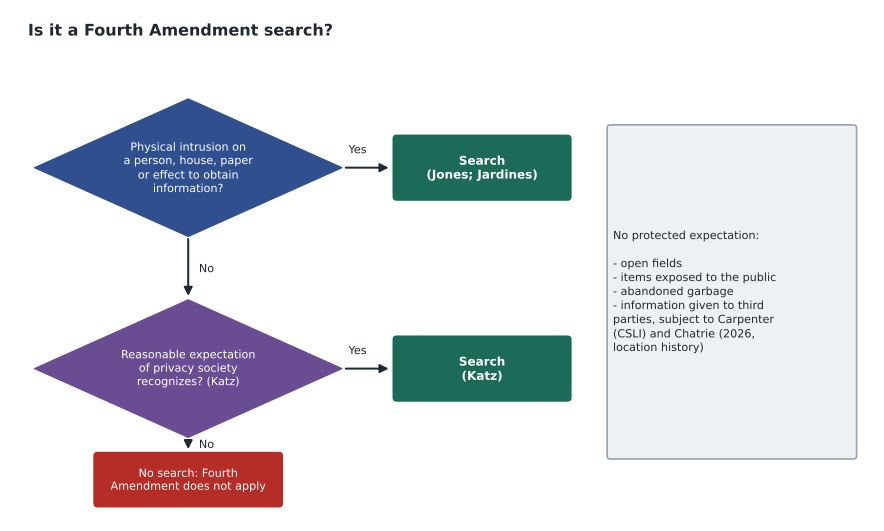
Ambrose writes a single question on the board: "Was it a search?" She tells Section B that this is the first question in every Fourth Amendment problem and the one students most often skip. The Fourth Amendment does not regulate everything police do. It regulates searches and seizures. If police conduct is neither, the amendment simply does not apply, and the police need no warrant, no probable cause and no justification at all. Watching a person walk down a public street, looking at what anyone could see from a public sidewalk, reading a newspaper post: none of these is a search. This lesson asks where the line falls, and how the digital age has moved it.
Two tests for a search
For most of American history, a search meant a physical intrusion into a constitutionally protected area. In Olmstead v. United States, 277 U.S. 438 (1928), the Court held that wiretapping telephone lines outside a home was not a search because the officers never entered the property. Justice Brandeis dissented, warning that the right to be let alone would be lost if the Constitution protected only against physical trespass.
Katz v. United States, 389 U.S. 347 (1967), adopted Brandeis's view. FBI agents attached a listening device to the outside of a public telephone booth and recorded Charles Katz's side of calls about illegal gambling. The Court held that this was a search, declaring that "the Fourth Amendment protects people, not places." Justice Harlan's concurrence supplied the test that later cases adopted: a search occurs when the government intrudes on an expectation of privacy that the person actually holds and that society is prepared to recognize as reasonable. This reasonable expectation of privacy test governed for decades.
In United States v. Jones, 565 U.S. 400 (2012), the Court revived the older trespass test alongside Katz. Agents attached a GPS tracker to the underside of a suspect's car and followed its movements for 28 days. Justice Scalia's majority held that physically occupying private property to obtain information is a search, without needing to ask about privacy expectations. Five justices in concurrences also suggested that long-term GPS monitoring would violate reasonable expectations of privacy even without a trespass. Florida v. Jardines, 569 U.S. 1 (2013), applied the trespass test to a drug-sniffing dog brought onto a home's front porch: officers may approach a front door as any visitor might, but bringing a trained dog to explore the porch exceeded that implied license. Today a search occurs under either test.
What is not a search
Applying Katz, the Court has held many kinds of observation are not searches. Under the open fields doctrine of Oliver v. United States, 466 U.S. 170 (1984), land beyond the curtilage of a home is not protected even if it is fenced and posted with no-trespassing signs. The curtilage, the area immediately surrounding a home and associated with its private life, is protected; United States v. Dunn, 480 U.S. 294 (1987), lists four factors for identifying it: proximity to the home, whether it is within an enclosure, how it is used, and steps taken to protect it from observation. Aerial observation from public airspace is not a search, even of a fenced backyard, under California v. Ciraolo, 476 U.S. 207 (1986), and Florida v. Riley, 488 U.S. 445 (1989).
Things a person knowingly exposes to the public are not protected. California v. Greenwood, 486 U.S. 35 (1988), held that garbage left at the curb for collection has no Fourth Amendment protection, because it is readily accessible to animals, children, scavengers and the trash collector. A dog sniff of luggage in an airport, United States v. Place, 462 U.S. 696 (1983), or of a car during a lawful traffic stop, Illinois v. Caballes, 543 U.S. 405 (2005), is not a search because it reveals only the presence or absence of contraband, in which no one has a legitimate privacy interest. Following a car on public roads with a radio beeper was not a search in United States v. Knotts, 460 U.S. 276 (1983), but monitoring a beeper inside a private home was a search in United States v. Karo, 468 U.S. 705 (1984).
The home receives the strongest protection. Kyllo v. United States, 533 U.S. 27 (2001), held that pointing a thermal imaging device at a house to detect heat from grow lamps was a search, because it used technology not in general public use to obtain information about the interior of the home that could not otherwise have been obtained without physical intrusion. Kyllo shows that the Katz test protects against new technologies even without a trespass.
The third-party doctrine
In United States v. Miller, 425 U.S. 435 (1976), the Court held that a bank customer has no reasonable expectation of privacy in records the bank keeps of the customer's transactions. In Smith v. Maryland, 442 U.S. 735 (1979), it held that installing a pen register at the phone company to record the numbers dialed from a home phone was not a search. The reasoning, known as the third-party doctrine, is that a person who voluntarily conveys information to a third party assumes the risk that the third party will turn it over to the government. Congress responded to Miller with the Right to Financial Privacy Act of 1978 and to Smith with the pen register statute, illustrating the statutory layer described in lesson 1.
The third-party doctrine made sense for a few bank records and dialed numbers. It sits uneasily with a world in which nearly every activity leaves a digital record held by a company: email, location, searches, purchases and contacts. The Court confronted that problem directly in 2018.
Carpenter and the digital age
In Carpenter v. United States, 585 U.S. 296 (2018), the FBI obtained 127 days of historical cell-site location information for Timothy Carpenter, a robbery suspect, from his wireless carriers under the Stored Communications Act, which required only reasonable grounds, a standard below probable cause. The records placed his phone near several robberies. Chief Justice Roberts, writing for a 5 to 4 majority, held that obtaining at least seven days of such records was a search. Cell-site records give the government a detailed, comprehensive and effortlessly compiled chronicle of a person's movements, reaching back years, about nearly everyone who carries a phone. The Court declined to extend Smith and Miller to this "qualitatively different category" of records and held that the government generally needs a warrant supported by probable cause.
Carpenter described itself as narrow. It did not address real-time location tracking, tower dumps (records of every phone that connected to a particular tower during a period of time), conventional surveillance tools like security cameras, or business records that might incidentally reveal location. Lower courts divided on how far its reasoning reaches, especially for geofence warrants, which ask a company to identify every device in a defined area during a defined window of time.
Chatrie: geofence warrants reach the Supreme Court
In 2019, after a bank robbery in Midlothian, Virginia, police obtained a geofence warrant directing Google to identify devices whose Location History placed them within 150 meters of the bank during the hour around the robbery. Google produced anonymized data in steps, and police eventually obtained identifying information for Okello Chatrie. The district court found the warrant lacked particularized probable cause but declined to suppress the evidence under the good-faith exception. A Fourth Circuit panel held that obtaining two hours of Location History was not a search at all, and the en banc Fourth Circuit affirmed in 2025 in a fractured decision without a majority rationale. Meanwhile, the Fifth Circuit held in United States v. Smith (2024) that geofence warrants are modern general warrants categorically forbidden by the Fourth Amendment.
The Supreme Court granted review and decided Chatrie v. United States on June 29, 2026. Justice Kagan, writing for a 6 to 3 majority, held that obtaining a person's Google Location History through a geofence warrant is a Fourth Amendment search. The Court applied Carpenter's reasoning: Location History can reveal the privacies of life with precision, and users do not meaningfully surrender their privacy by enabling a setting on their phones. The majority expressly declined to decide whether geofence warrants are categorically unconstitutional or whether the warrant in Chatrie's case was reasonable. It vacated the Fourth Circuit's judgment and remanded for the lower courts to consider probable cause, particularity and the step-by-step disclosure process. Justice Alito's dissent questioned whether the Court should have taken a case in which the good-faith exception was likely to defeat suppression anyway.
Ambrose tells the class to read Chatrie carefully for what it did not decide. It establishes that a geofence request is a search, so the government needs a valid warrant. It leaves open how such a warrant must be drafted, whether a warrant covering many innocent people can ever be particular enough, and how the rule applies to other bulk requests, such as tower dumps and keyword-search warrants. Those questions will be litigated for years. She adds that the technology has also moved: Google announced in late 2023 that it would store Location History on users' devices rather than its servers, which makes the classic geofence warrant to Google much harder to obtain, while other companies still hold location data.
| Government conduct | Search? | Case |
|---|---|---|
| Recording a call from a phone booth | Yes | Katz (1967) |
| Attaching a GPS tracker to a car | Yes (trespass) | Jones (2012) |
| Drug dog on the front porch | Yes (trespass) | Jardines (2013) |
| Thermal imaging of a home | Yes | Kyllo (2001) |
| Seven or more days of historical cell-site records | Yes | Carpenter (2018) |
| Geofence request for Google Location History | Yes | Chatrie (2026) |
| Fenced, posted open field | No | Oliver (1984) |
| Garbage at the curb | No | Greenwood (1988) |
| Aerial view of a backyard from public airspace | No | Ciraolo (1986) |
| Dog sniff of a car at a lawful stop | No | Caballes (2005) |
| Bank records; dialed phone numbers | No | Miller (1976); Smith (1979) |
Whose rights? Standing to object
Fourth Amendment rights are personal. A defendant may seek suppression only if the defendant's own rights were violated. In Rakas v. Illinois, 439 U.S. 128 (1978), passengers who claimed no interest in a car or in the rifle and shells found in its glove compartment could not challenge the search. The Court folded standing into the substantive question: did this defendant have a reasonable expectation of privacy in the place searched? An overnight guest has one in the host's home, under Minnesota v. Olson, 495 U.S. 91 (1990), but people present briefly to bag cocaine for a commercial transaction did not, under Minnesota v. Carter, 525 U.S. 83 (1998). Byrd v. United States, 584 U.S. 395 (2018), held that a driver in sole possession of a rental car may have a reasonable expectation of privacy even if the rental agreement does not list him as an authorized driver.
Standing matters in the Riverside Salvage case. When police stopped Kellan Shaw's car and found bolt cutters, Shaw may challenge the stop and search, but Devon Pike, who was not in the car and had no interest in it, may not. If Pike's statements or location records are obtained unlawfully, only Pike may object. Ambrose warns that co-defendants often assume they can all ride on the strongest motion, and they cannot.
The location data in the Riverside Salvage file
Ambrose returns to the police file. In the days after the shove, Detective Imbert sought two kinds of location data. First, she obtained a court order under the Stored Communications Act for a tower dump: records from the carriers of every phone that connected to the two cell towers nearest Riverside Salvage between 11:00 and 11:50 p.m. on the night of the shove. Several hundred numbers came back, including one registered to Devon Pike. Second, after a review of the group chat suggested Pike's involvement, she obtained a search warrant for 30 days of Pike's historical cell-site location information. Ambrose adds a hypothetical: suppose Imbert had also asked a technology company to identify every device within 100 meters of the yard during that window.
Worked problem
Was it a search?
For each investigative step in the Riverside Salvage file, decide whether it was a Fourth Amendment search and what justification the police needed: (a) watching the yard's own security camera footage, provided by the yard's owner; (b) the tower dump obtained by court order on less than probable cause; (c) 30 days of Pike's historical cell-site records obtained by warrant; (d) the hypothetical request to a technology company for every device within 100 meters of the yard.
Show solution
- (a) The footage belongs to the yard and records an area the intruders entered unlawfully. The intruders have no reasonable expectation of privacy in being filmed by the owner's camera, and the owner consented. Not a search as to Pike.
- (b) A tower dump is not squarely covered by Carpenter, which reserved it, or by Chatrie, which involved account-based Location History. Lower courts are divided. A defense lawyer would argue that Chatrie's reasoning reaches a request that sweeps in hundreds of people's locations; the state would argue that a brief snapshot at two towers is closer to conventional records.
- (c) Thirty days of historical cell-site records is a search under Carpenter. Because the police obtained a warrant, the question becomes whether the warrant was supported by probable cause and sufficiently particular (lesson 3).
- (d) Under Chatrie, a geofence request for account-based location history is a search requiring a valid warrant; whether such a warrant can be particular enough remains open.
Answer: The camera footage is not a search; the 30-day cell-site records are a search that the warrant must justify; the hypothetical geofence request is a search after Chatrie; and the tower dump falls into an open area that the defense should litigate, arguing Chatrie's reasoning, while the state relies on Carpenter's narrowness and, if needed, the good-faith exception.
Priya Natarajan asks whether it matters that the tower dump turned up hundreds of innocent people. Ambrose says that is exactly the concern the Fifth Circuit raised in Smith and that the Chatrie majority left open: a search that sweeps in everyone in an area looks like the general warrants the Fourth Amendment was written to forbid. Marcus Webb, who worked at a battery startup, points out that the precision of location data varies widely by method, and Ambrose says that defense lawyers increasingly hire experts to explain exactly that to judges.
Summary and key terms
- The Fourth Amendment applies only to searches and seizures; the first question is always whether there was a search.
- A search occurs under the trespass test (Jones, Jardines) or the reasonable expectation of privacy test (Katz).
- Open fields, garbage at the curb, aerial observation and dog sniffs at lawful stops are not searches; the home and its curtilage receive the strongest protection.
- The third-party doctrine of Miller and Smith was limited by Carpenter (2018), which requires a warrant for seven or more days of historical cell-site records.
- Chatrie v. United States (2026) held that a geofence request for Google Location History is a search, but left open whether such warrants can be valid.
- Fourth Amendment rights are personal; a defendant must have a reasonable expectation of privacy in the place searched to seek suppression.
Practice problems
Work each problem on paper first, then reveal the answer to check.
What two tests determine whether government conduct is a search?
Show answer
The trespass test from Jones (physical intrusion on a protected area to obtain information) and the reasonable expectation of privacy test from Katz.
Why was the thermal imaging in Kyllo a search even without a trespass?
Show answer
Police used technology not in general public use to learn details of the home's interior that they could not otherwise have obtained without entering.
What did Carpenter hold, and what did it leave open?
Show answer
Obtaining seven or more days of historical cell-site records is a search requiring a warrant; it left open real-time tracking, tower dumps and conventional surveillance tools.
What did the Court decide and leave undecided in Chatrie?
Show answer
It held that a geofence request for Google Location History is a search, but did not decide whether geofence warrants are categorically unconstitutional or whether the warrant there was reasonable; it remanded.
Can Devon Pike challenge the search of Kellan Shaw's car?
Show answer
No. He had no possessory interest or reasonable expectation of privacy in Shaw's car, and Fourth Amendment rights are personal.
Lesson quiz · 5 questions
Score 60% or more to complete this lesson.
Create a free account to save your progress, take quizzes and earn a certificate.