
LAWU-203 · Lesson 3 of 12 · 23 min
Probable cause and the warrant process
▶ Video coming soon A video version of this lesson is on the way.
Ambrose projects a four-page document on the screen: Detective Rachel Imbert's affidavit in support of a warrant to search Devon Pike's phone and obtain his historical cell-site records. "A warrant is only as good as the affidavit behind it," she tells the class. "Judges sign these at kitchen tables at two in the morning. Your job at a suppression hearing is to read every sentence and ask three questions. Does it establish probable cause? Does it describe what may be searched with particularity? And is it true?"
Why warrants matter
The Warrant Clause reflects the founders' hostility to general warrants and writs of assistance, which let British officers search wherever they pleased for smuggled goods. A warrant interposes a neutral judicial officer between the police and the citizen, so that the decision to invade privacy is made by someone not engaged in what Justice Jackson called "the often competitive enterprise of ferreting out crime," in Johnson v. United States, 333 U.S. 10 (1948). The Court has repeatedly said that searches without warrants are presumptively unreasonable, subject to specifically established exceptions, the subject of lesson 4. Warrants also benefit the police: evidence obtained under a warrant later found defective is often saved by the good-faith exception of United States v. Leon, 468 U.S. 897 (1984), discussed in lesson 6.
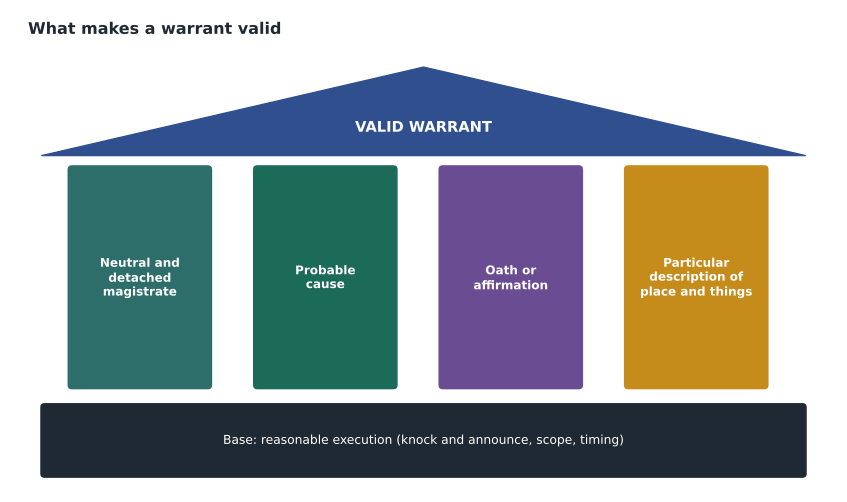
A valid warrant has four requirements: it must be issued by a neutral and detached magistrate, be based on probable cause, be supported by oath or affirmation, and particularly describe the place to be searched and the things to be seized. Officers must then execute it reasonably.
The neutral and detached magistrate
The issuing official need not be a judge or a lawyer, but must be neutral and capable of determining probable cause. Shadwick v. City of Tampa, 407 U.S. 345 (1972), upheld warrants issued by municipal court clerks for ordinance violations. But in Coolidge v. New Hampshire, 403 U.S. 443 (1971), a warrant issued by the state attorney general, who was directing the investigation, was invalid. In Connally v. Georgia, 429 U.S. 245 (1977), a justice of the peace paid a fee for each warrant issued but nothing for warrants denied was not neutral. A magistrate who joins the search party abandons the judicial role, as in Lo-Ji Sales v. New York, 442 U.S. 319 (1979). Many jurisdictions now issue warrants electronically, and judges often review them remotely; neutrality requires actual review, not a rubber stamp.
Probable cause
Probable cause for a search exists when there is a fair probability that contraband or evidence of a crime will be found in a particular place. For an arrest, it exists when the facts would lead a reasonable person to believe that the suspect has committed a crime. It is more than a hunch or reasonable suspicion and less than proof beyond a reasonable doubt or even a preponderance. In Maryland v. Pringle, 540 U.S. 366 (2003), the Court said probable cause is a practical, nontechnical concept dealing with the factual and practical considerations of everyday life, and upheld the arrest of all three occupants of a car in which cocaine was found hidden behind the back-seat armrest.
The test is objective. An officer's subjective belief is not enough if the facts do not support probable cause, and an officer's actual motive does not matter if the facts do support it, as Whren v. United States, 517 U.S. 806 (1996), held for traffic stops. Probable cause can be based on hearsay, including reports from informants, if the information is reasonably trustworthy. It must also be current: information can grow stale. Evidence of a single sale of drugs months ago may not support a search today, while evidence of a long-running operation, or of items like computer files that people keep for years, may remain fresh much longer.
Informants: from Aguilar-Spinelli to Gates
For two decades, courts evaluated informant tips under the two-pronged test of Aguilar v. Texas, 378 U.S. 108 (1964), and Spinelli v. United States, 393 U.S. 410 (1969). The affidavit had to show the informant's basis of knowledge (how the informant knew) and veracity (why the informant should be believed, through credibility or the reliability of the information). Each prong had to be satisfied independently.
Illinois v. Gates, 462 U.S. 213 (1983), replaced that test with a totality of the circumstances approach. Police in Bloomingdale, Illinois, received an anonymous letter predicting that Sue Gates would drive to Florida, that her husband Lance would fly down and drive the car back loaded with drugs, and that they had large amounts of drugs in their basement. Investigators corroborated the travel details. The Court held that basis of knowledge and veracity remain highly relevant but are not separate hurdles: a strong showing on one, or other indicia of reliability such as police corroboration of predicted future behavior, can make up for a weak showing on the other. A reviewing court gives great deference to the magistrate's determination and asks only whether the magistrate had a substantial basis for finding probable cause. Some states, including a few under their own constitutions, kept Aguilar-Spinelli.
Citizen witnesses and victims are treated as more reliable than paid informants or anonymous callers, because they have no apparent motive to lie and can be held accountable. Statements from fellow officers are also presumed reliable under the collective knowledge doctrine.
Oath and the truth of the affidavit: Franks v. Delaware
The affidavit must be sworn, and it must be true. In Franks v. Delaware, 438 U.S. 154 (1978), the Court held that a defendant may challenge the truthfulness of statements in an affidavit. To obtain a hearing, the defendant must make a substantial preliminary showing that the affiant included a false statement knowingly and intentionally, or with reckless disregard for the truth, and that the statement was necessary to the finding of probable cause. At the hearing, if the defendant proves deliberate falsity or reckless disregard by a preponderance of the evidence, the court sets the false material aside; if what remains does not establish probable cause, the warrant is void and its fruits are suppressed. Negligent or innocent mistakes do not qualify.
Most federal circuits apply Franks to material omissions as well as false statements: if the affiant deliberately or recklessly left out facts that would have defeated probable cause, the court adds the omitted facts back and asks whether probable cause still exists. The standard is demanding, and Franks hearings are granted far less often than they are requested.
| Challenge | Question | Standard and remedy |
|---|---|---|
| Lack of probable cause | Did the affidavit, on its face, give the magistrate a substantial basis for finding a fair probability? | Deferential review (Gates); even if lacking, the good-faith exception often saves the evidence (Leon), except in Westmarch under state law |
| False statement or omission | Did the affiant knowingly or recklessly include a falsehood or omit material facts? | Franks hearing on a substantial preliminary showing; excise falsehoods, add omissions; suppress if no probable cause remains |
| Particularity | Does the warrant describe the place and items so that officers have no discretion? | Facially deficient warrants are void (Groh); overbroad parts may be severed in many courts |
| Neutrality | Was the issuing officer neutral and detached? | Warrant invalid (Coolidge, Connally, Lo-Ji) |
Particularity
The warrant must particularly describe the place to be searched and the things to be seized, so that "nothing is left to the discretion of the officer executing the warrant," as Marron v. United States, 275 U.S. 192 (1927), put it. A description of a residence by street address and appearance usually suffices. A description of items as "evidence of crime" does not. In Groh v. Ramirez, 540 U.S. 551 (2004), a warrant that described the house to be searched but, in the space for items to be seized, described the house again instead of the weapons sought was so facially deficient that it was treated as no warrant at all, and the agent who prepared it was denied qualified immunity. The fact that the application listed the items did not save it, because the warrant did not incorporate the application.
Courts allow some generality where the nature of the crime makes precision impossible. Andresen v. Maryland, 427 U.S. 463 (1976), upheld a warrant listing specific documents followed by "together with other fruits, instrumentalities and evidence of crime at this time unknown," reading the catch-all phrase as limited to the specific fraud described. Many courts sever an overbroad portion of a warrant and uphold the rest.
Particularity is the central battleground for digital searches. A phone or computer holds the equivalent of a house full of papers, and a warrant authorizing a search of "all data" on a phone looks like a general warrant. Courts have generally allowed a two-step process, in which agents copy the whole device and then search it for the items described, under Federal Rule of Criminal Procedure 41(e)(2)(B). But many courts now require phone warrants to limit the search by type of data, time period or connection to the specific crime, and some magistrates impose search protocols. The tension is sharpest after Riley v. California, discussed in lesson 4, which recognized how much a phone reveals.
Executing the warrant
Officers must execute a warrant within the time it allows, usually 14 days under the federal rule, and generally in the daytime unless the warrant authorizes otherwise. They may search only places where the items described could be found: a warrant for a stolen television does not authorize opening a small jewelry box. Under Wilson v. Arkansas, 514 U.S. 927 (1995), the common-law requirement that officers knock and announce their presence before entering is part of the Fourth Amendment reasonableness inquiry, though exigent circumstances can excuse it. Richards v. Wisconsin, 520 U.S. 385 (1997), rejected a blanket exception for felony drug cases but held that a no-knock entry is justified by reasonable suspicion that knocking would be dangerous, futile or lead to destruction of evidence. United States v. Banks, 540 U.S. 31 (2003), held that waiting 15 to 20 seconds before forcing entry was reasonable in a drug case. As lesson 6 explains, Hudson v. Michigan, 547 U.S. 586 (2006), held that the exclusionary rule does not apply to knock-and-announce violations.
A warrant to search a home carries authority to detain occupants during the search, under Michigan v. Summers, 452 U.S. 692 (1981), and Muehler v. Mena, 544 U.S. 93 (2005), which upheld handcuffing an occupant for two to three hours during a search for weapons. But Bailey v. United States, 568 U.S. 186 (2013), limited Summers to the immediate vicinity of the premises. A warrant to search a place does not authorize searching every person found there; in Ybarra v. Illinois, 444 U.S. 85 (1979), a warrant to search a tavern did not justify frisking a patron without individualized suspicion. Anticipatory warrants, which take effect when a triggering condition occurs, such as delivery of a package, are valid if probable cause exists that the condition will occur and that evidence will then be found, under United States v. Grubbs, 547 U.S. 90 (2006).
The affidavit in the Riverside Salvage case
Imbert's affidavit for Pike's phone and cell-site records recited the following. A night watchman was assaulted during a burglary at Riverside Salvage and died. A passing truck driver reported that the dying watchman said three people had been there and "the big one, Devon, shoved me." The yard's camera showed three figures entering at 11:32 p.m. A records check showed that Devon Pike, 27, was a known associate of Kellan Shaw, who had sold copper at a local scrapyard two days later. Pike's phone number was among those in the tower dump. The warrant authorized a search of "all data contained on the cellular telephone of Devon Pike" and 30 days of cell-site records.
Ostrander, Pike's public defender, found something missing. The ambulance crew's report quoted Abbott as saying he "didn't get a good look at them." Imbert had the report when she wrote the affidavit and did not mention it.
Worked problem
Attacking the Pike warrant
As Pike's lawyer, identify the strongest challenges to the warrant for Pike's phone and cell-site records, and predict how a court would rule on each.
Show solution
- Probable cause: Abbott's dying statement naming "Devon" came from a citizen witness who reported it, and it was corroborated by the camera, the association with Shaw, Shaw's copper sale and the tower dump placing Pike's phone near the yard. Under Gates's totality approach, a magistrate had a substantial basis. Weak challenge.
- Franks omission: the affidavit omitted that Abbott told the ambulance crew he "didn't get a good look." The defense must show the omission was deliberate or reckless and material. Adding the omitted fact back, the affidavit still contains the specific name "Devon," the association with Shaw and the tower dump. A court would likely find probable cause remains even if the omission was reckless, so no suppression, though the omission is good impeachment material at trial.
- Particularity: "all data" on the phone, without limits by date, type of data or connection to the burglary, is the strongest challenge. Many courts would hold it overbroad. A court might sever and suppress only data outside what the affidavit justified, such as everything before the planning period or unrelated to the burglary.
- Good faith: the state will argue the officers relied reasonably on a warrant signed by a judge. But a warrant so facially overbroad that no reasonable officer could rely on it is excluded from Leon's protection, and Westmarch rejects good faith for warrants lacking probable cause, though not necessarily for particularity defects.
Answer: The probable cause and Franks challenges are likely to fail because the dying statement and corroboration survive the omitted fact. The particularity challenge to the "all data" authorization is the strongest and may lead to suppression of data beyond the scope of the probable cause, such as months of unrelated messages, while the group chat messages about the burglary and the cell-site records near the time of the crime are likely to survive.
Jordan Kimura, the Army veteran, asks whether Imbert will be punished for leaving out the ambulance report. Ambrose says that is unlikely unless the omission was deliberate, but that it hands the defense an excellent cross-examination and may lead the prosecutor to disclose it as impeachment evidence under Brady v. Maryland, the subject of lesson 10. "Detectives who omit bad facts," she says, "usually pay for it at trial rather than at the suppression hearing."
Summary and key terms
- A valid warrant requires a neutral magistrate, probable cause, oath or affirmation and particularity, and must be executed reasonably.
- Probable cause is a fair probability judged objectively under the totality of the circumstances (Gates), with great deference to the magistrate.
- Franks v. Delaware lets a defendant challenge deliberate or reckless falsehoods and, in most circuits, material omissions in an affidavit.
- Particularity forbids general warrants; Groh treats a facially deficient warrant as no warrant, and digital searches raise the hardest particularity questions.
- Execution rules include knock and announce (Wilson, Richards), detention of occupants (Summers, Bailey) and limits on searching persons present (Ybarra).
Practice problems
Work each problem on paper first, then reveal the answer to check.
How did Illinois v. Gates change the evaluation of informant tips?
Show answer
It replaced the two independent Aguilar-Spinelli prongs with a totality of the circumstances test, in which corroboration or a strong showing on one factor can offset weakness in another.
What must a defendant show to obtain a Franks hearing?
Show answer
A substantial preliminary showing that the affiant knowingly or recklessly included a false statement (or, in most circuits, omitted a material fact) that was necessary to probable cause.
Why was the warrant in Groh v. Ramirez invalid?
Show answer
It failed to describe the items to be seized at all, so it was facially deficient, and the application's list did not cure it because the warrant did not incorporate it.
May officers executing a warrant for a bar frisk every customer present?
Show answer
No. Ybarra v. Illinois requires individualized suspicion to frisk a person; a premises warrant does not authorize searching everyone there.
What happened in Bailey v. United States?
Show answer
The Court limited Summers detentions to the immediate vicinity of the premises being searched, so police could not detain an occupant who had driven about a mile away.
Lesson quiz · 5 questions
Score 60% or more to complete this lesson.
Create a free account to save your progress, take quizzes and earn a certificate.