
LAWU-203 · Lesson 7 of 12 · 23 min
Miranda
▶ Video coming soon A video version of this lesson is on the way.
Ambrose plays the first minutes of a video recording from an interview room at Brennan Falls police headquarters. Devon Pike sits at a small table in a gray sweatshirt. Detective Rachel Imbert reads from a card: "You have the right to remain silent. Anything you say can and will be used against you in a court of law. You have the right to talk to a lawyer and have him present with you while you are being questioned. If you cannot afford to hire a lawyer, one will be appointed to represent you before any questioning if you wish. Do you understand these rights?" Pike says, "Yeah." Imbert asks, "With these rights in mind, do you want to talk to me?" Pike shrugs and says, "I got nothing to hide." Ambrose pauses the video. "Fifty-eight years after Miranda," she says, "almost every interrogation in America begins like this. And most suspects talk."
Before Miranda: the voluntariness test
Before 1966, the Court judged confessions in state cases under the Due Process Clause by asking whether they were voluntary under the totality of the circumstances. Brown v. Mississippi, 297 U.S. 278 (1936), reversed the murder convictions of three Black tenant farmers who confessed after being whipped and hanged from a tree; a confession extracted by torture violates due process. Later cases found confessions involuntary because of prolonged questioning, threats, deprivation of sleep and food, or exploitation of a suspect's vulnerabilities, as in Spano v. New York, 360 U.S. 315 (1959), where a friend on the police force falsely told the suspect his job was in jeopardy.
The voluntariness test survives alongside Miranda. A confession that is involuntary cannot be used for any purpose, even impeachment, as Mincey v. Arizona, 437 U.S. 385 (1978), held for statements taken from a badly wounded man in intensive care. But Colorado v. Connelly, 479 U.S. 157 (1986), held that coercive police activity is a necessary predicate: a man who confessed because voices commanded him to, without any police coercion, did not have his due process rights violated. Arizona v. Fulminante, 499 U.S. 279 (1991), held that a credible threat of violence can make a confession involuntary; an FBI informant posing as an organized crime figure offered protection from other inmates if Fulminante told him the truth. Deception alone generally does not make a confession involuntary: in Frazier v. Cupp, 394 U.S. 731 (1969), falsely telling a suspect his accomplice had confessed did not.
Miranda v. Arizona
Miranda v. Arizona, 384 U.S. 436 (1966), consolidated four cases in which suspects were questioned in custody without being told of their rights. Ernesto Miranda confessed to kidnapping and rape after two hours of questioning in a Phoenix interview room. Chief Justice Warren's opinion described police interrogation manuals that taught isolation, psychological pressure and trickery, and concluded that custodial interrogation is inherently compelling. To protect the Fifth Amendment privilege, police must, before custodial interrogation, warn a suspect that he has the right to remain silent, that anything he says can be used against him, that he has the right to the presence of an attorney, and that if he cannot afford one, one will be appointed. Statements obtained without warnings and a valid waiver are inadmissible in the prosecution's case in chief.
Congress responded in 1968 with 18 U.S.C. section 3501, which purported to restore the voluntariness test in federal cases. Dickerson v. United States, 530 U.S. 428 (2000), held that Miranda announced a constitutional rule that Congress may not overrule by statute, and declined to overrule it because the warnings have become part of the national culture. But Vega v. Tekoh, 597 U.S. 134 (2022), held that a violation of Miranda's rules does not provide a basis for a civil suit under 42 U.S.C. section 1983; Miranda is a prophylactic rule enforced through exclusion at trial.
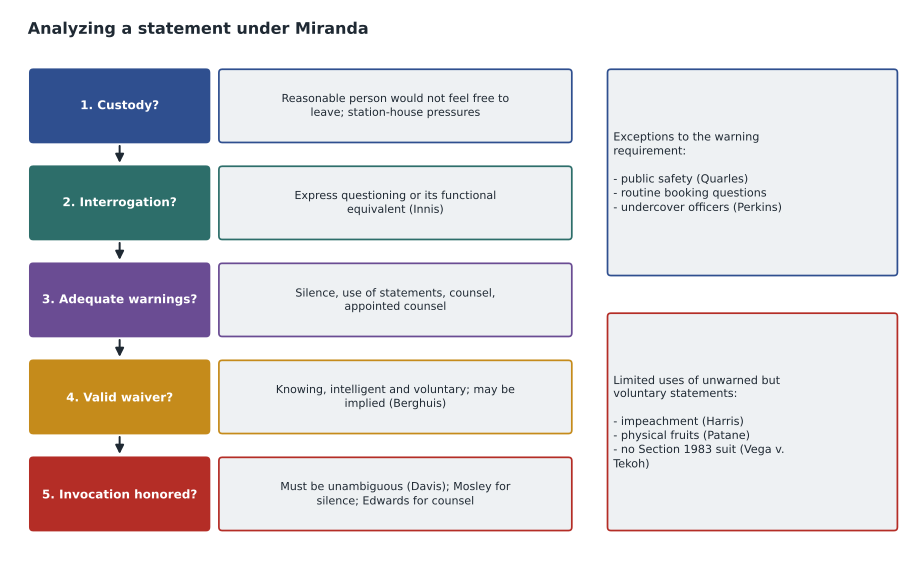
Custody
Miranda applies only to custodial interrogation. Custody exists when, in the circumstances, a reasonable person would not have felt free to terminate the interrogation and leave, and the environment presents the same inherently coercive pressures as station-house questioning. The test is objective; the officers' undisclosed views and the suspect's private thoughts are irrelevant, under Stansbury v. California, 511 U.S. 318 (1994). Factors include the location, duration and tone of questioning, statements made, physical restraints and whether the person was released afterward.
A routine traffic stop is not custody, even though the driver is seized, because it is brief, public and usually ends with the driver going on his way, under Berkemer v. McCarty, 468 U.S. 420 (1984); but once a motorist is subjected to treatment that renders him in custody for practical purposes, Miranda applies. A person who comes voluntarily to the station, is told he is not under arrest and leaves afterward is not in custody, under Oregon v. Mathiason, 429 U.S. 492 (1977). A prisoner questioned about a separate crime is not automatically in custody, under Howes v. Fields, 565 U.S. 499 (2012). A probationer required to meet with a probation officer was not in custody in Minnesota v. Murphy, 465 U.S. 420 (1984). J.D.B. v. North Carolina, 564 U.S. 261 (2011), held that a child's age, when known to the officer or objectively apparent, is relevant to the custody analysis; a thirteen-year-old removed from class and questioned in a closed conference room by police was more likely to feel unable to leave.
Interrogation
Interrogation means express questioning and its functional equivalent: any words or actions by the police that they should know are reasonably likely to elicit an incriminating response, under Rhode Island v. Innis, 446 U.S. 291 (1980). In Innis, officers transporting a robbery suspect talked to each other about the danger that a handicapped child from a nearby school might find the missing shotgun; the suspect interrupted and showed them where it was. The Court held the conversation was not interrogation because the officers had no reason to know the suspect was peculiarly susceptible to such an appeal. Volunteered statements are not the product of interrogation. Routine booking questions, such as name, address, height and date of birth, fall outside Miranda under Pennsylvania v. Muniz, 496 U.S. 582 (1990).
Warnings and waiver
The warnings need not follow Miranda's exact words if they reasonably convey the rights. Duckworth v. Eagan, 492 U.S. 195 (1989), upheld a warning that a lawyer would be appointed "if and when you go to court," and Florida v. Powell, 559 U.S. 50 (2010), upheld a warning that the suspect could talk to a lawyer before answering questions and use those rights at any time.
A waiver must be knowing, intelligent and voluntary. It need not be express. In Berghuis v. Thompkins, 560 U.S. 370 (2010), a suspect sat mostly silent through almost three hours of questioning, then answered "Yes" when asked whether he prayed to God to forgive him for shooting the victim. The Court held 5 to 4 that a suspect who has received and understood the warnings and has not invoked his rights waives the right to remain silent by making an uncoerced statement. Moran v. Burbine, 475 U.S. 412 (1986), held that a waiver was valid even though police did not tell the suspect that his sister had retained a lawyer who was trying to reach him. Connecticut v. Barrett, 479 U.S. 523 (1987), held that a suspect who said he would talk but would not give a written statement without a lawyer validly waived as to oral statements.
Invoking the rights
If a suspect invokes the right to remain silent, police must scrupulously honor it. Michigan v. Mosley, 423 U.S. 96 (1975), held that police could resume questioning about a different crime after more than two hours, a fresh set of warnings and a new waiver. If a suspect invokes the right to counsel, questioning must stop until counsel is present, unless the suspect himself initiates further communication, under Edwards v. Arizona, 451 U.S. 477 (1981). Once counsel is requested, police may not reinterrogate even after the suspect has consulted a lawyer, unless counsel is present, under Minnick v. Mississippi, 498 U.S. 146 (1990). Maryland v. Shatzer, 559 U.S. 98 (2010), created an exception: the Edwards protection ends after a break in custody of 14 days.
Invocation must be unambiguous. In Davis v. United States, 512 U.S. 452 (1994), a sailor questioned about a murder said, "Maybe I should talk to a lawyer." The Court held that this was not a clear request for counsel, that officers had no obligation to stop or to ask clarifying questions, though it called clarification good police practice. Berghuis applied the same rule to the right to remain silent: a suspect must say clearly that he wants to remain silent or does not want to talk.
| Issue | Rule | Key cases |
|---|---|---|
| Custody | Reasonable person would not feel free to leave, in a coercive environment like station-house questioning; age is relevant | Berkemer (1984); Howes (2012); J.D.B. (2011) |
| Interrogation | Express questioning or words or actions police should know are reasonably likely to elicit an incriminating response | Innis (1980) |
| Waiver | Knowing, intelligent and voluntary; may be implied by an uncoerced statement after understanding warnings | Berghuis (2010); Moran (1986) |
| Invoking silence | Must be unambiguous; police must scrupulously honor it | Mosley (1975); Berghuis |
| Invoking counsel | Must be unambiguous; questioning stops until counsel present unless suspect initiates; ends after 14-day break in custody | Edwards (1981); Davis (1994); Minnick (1990); Shatzer (2010) |
| Public safety | Questions prompted by immediate danger may precede warnings | Quarles (1984) |
| Undercover officers | No Miranda warnings required | Perkins (1990) |
Exceptions and limits
In New York v. Quarles, 467 U.S. 649 (1984), officers chased a rape suspect reportedly carrying a gun into a supermarket, frisked him, found an empty shoulder holster and asked, "Where is the gun?" before giving warnings. The Court recognized a public safety exception: questions reasonably prompted by a concern for public safety may be asked before warnings. Illinois v. Perkins, 496 U.S. 292 (1990), held that an undercover officer posing as an inmate need not give warnings, because the coercion Miranda addresses does not exist when a suspect does not know he is talking to police. Salinas v. Texas, 570 U.S. 178 (2013), held in a plurality opinion that a suspect who was not in custody and fell silent when asked a question during a voluntary interview had not invoked the privilege, so the prosecution could comment on his silence.
The remedy for a Miranda violation is limited. Unwarned but voluntary statements may be used to impeach a defendant who testifies, under Harris v. New York, 401 U.S. 222 (1971). Physical evidence found as a result of an unwarned voluntary statement is admissible, under United States v. Patane, 542 U.S. 630 (2004), where police found a gun after a suspect interrupted the warnings. A second, warned statement following an earlier unwarned one is generally admissible if both were voluntary, under Oregon v. Elstad, 470 U.S. 298 (1985). But in Missouri v. Seibert, 542 U.S. 600 (2004), the Court rejected a deliberate two-step technique in which police questioned a suspect without warnings until she confessed, then warned her and had her repeat the confession. Justice Kennedy's controlling concurrence held that when police deliberately use the two-step strategy, the warned statement must be excluded unless curative measures, such as a substantial break in time and place or an explanation that the first statement is inadmissible, are taken.
The interviews in the Riverside Salvage case
Two interviews in the file raise Miranda questions. The night after the shove, Tara Quinn's parole officer asked her to come in for an unscheduled meeting. Detective Imbert was waiting in the parole office and asked her about the night before; Quinn said she was in the car and "didn't see what happened inside." No one gave her warnings, she was not restrained, and she left after twenty minutes.
Pike's interview at headquarters lasted about ninety minutes after his arrest. After the warnings shown on the video, he talked. He said he was there, that Abbott swung his flashlight first, and that he only pushed the watchman away. About forty minutes in, after Imbert told him the group chat showed he had planned around the watchman's schedule, Pike said, "Maybe I should talk to a lawyer before I say anything else." Imbert said, "That's up to you. But this is your chance to tell your side." Pike kept talking and described where they sold the copper. Twenty minutes later he said, "I want a lawyer. I'm done." Imbert ended the interview.
Worked problem
Suppressing Pike's and Quinn's statements
Analyze (a) whether Quinn's parole office statement is admissible against her, and (b) which parts of Pike's interview are admissible in the prosecution's case in chief.
Show solution
- (a) Custody: under Minnesota v. Murphy, a required meeting with a parole or probation officer is not necessarily custody. Quinn was not restrained, the meeting was short, and she left. But a detective waiting in a closed office of the parole agency, which controls her liberty, adds pressure. Most courts would likely find no custody, so no warnings were required; the statement is admissible if voluntary.
- (b) Pike was in custody and interrogated after arrest. The warnings were adequate, and his statement "I got nothing to hide" followed by talking is a valid implied waiver under Berghuis.
- "Maybe I should talk to a lawyer before I say anything else" is close to Davis's "Maybe I should talk to a lawyer"; under Davis it is ambiguous, so Imbert could continue. Her response encouraging him to keep talking is not itself a violation, though it is not the clarification Davis called good practice.
- "I want a lawyer. I'm done" is unambiguous, and Imbert stopped, honoring Edwards.
- Voluntariness: ninety minutes, no threats or promises beyond the statement that this was his chance to tell his side; the confession appears voluntary under the due process test.
Answer: Quinn's statement is likely admissible because she was probably not in custody. Pike's statements before the clear request for a lawyer, including the description of where the copper was sold, are likely admissible because his waiver was valid and his first reference to a lawyer was ambiguous under Davis. Westmarch could require clarification of ambiguous requests under its own constitution, as a few states do, which would make the later statements vulnerable.
Jordan Kimura says Pike's "maybe" sounded clear enough to him. Ambrose says many critics agree and that research on how people actually talk to police, especially people in a position of weakness, suggests they phrase requests indirectly. "Davis puts the burden of speaking like a lawyer on people who don't have one," she says. "That's exactly why defense lawyers tell clients to say six words: I want a lawyer. I'm done."
Summary and key terms
- Confessions must be voluntary under due process; coercive police activity is required (Connelly), and involuntary statements are inadmissible for any purpose.
- Miranda requires warnings and a valid waiver before custodial interrogation; Dickerson held it constitutional, but Vega v. Tekoh bars section 1983 suits for violations.
- Custody is objective; traffic stops are not custody, and a child's age is relevant.
- Interrogation includes the functional equivalent of questioning (Innis).
- Waiver may be implied (Berghuis); invocations of silence or counsel must be unambiguous (Davis), and Edwards bars reinterrogation after a request for counsel until a 14-day break (Shatzer).
- Exceptions include public safety (Quarles) and undercover questioning (Perkins); unwarned statements may impeach, physical fruits are admissible (Patane), and deliberate two-step tactics are barred (Seibert).
Practice problems
Work each problem on paper first, then reveal the answer to check.
Why did the confession in Colorado v. Connelly not violate due process?
Show answer
There was no coercive police activity; the suspect confessed because of his mental illness, and coercive police conduct is a necessary predicate for an involuntariness finding.
What did J.D.B. v. North Carolina add to the custody test?
Show answer
A child's age, if known to the officer or objectively apparent, is relevant to whether a reasonable person would feel free to leave.
How did the suspect in Berghuis v. Thompkins waive his rights?
Show answer
By answering a question with an uncoerced statement after receiving and understanding the warnings, without having invoked his rights.
What did Maryland v. Shatzer hold?
Show answer
The Edwards bar on reinterrogation ends after a 14-day break in custody.
Are physical items found because of an unwarned statement admissible?
Show answer
Yes, if the statement was voluntary, under United States v. Patane.
Lesson quiz · 5 questions
Score 60% or more to complete this lesson.
Create a free account to save your progress, take quizzes and earn a certificate.