
LAWU-203 · Lesson 12 of 12 · 24 min
Capstone: solving a criminal procedure problem
▶ Video coming soon A video version of this lesson is on the way.
Professor Ambrose distributes the capstone problem on the last day of the course. "Everything in this problem is invented," she tells Section B, "but every issue in it has been litigated somewhere this year. Criminal procedure exams reward students who go in order. Follow the investigation from the first police contact to the verdict, and at every step ask three questions: what did the government do, what constitutional rule governs it, and if there was a violation, what is the remedy?" She gives the class ninety minutes to outline an answer and then walks through a model analysis.
The problem: State v. Varga
At 2:10 a.m. on a Thursday in March, the alarm at Halvorsen Pharmacy in the town of Pell River went off. Officers arriving four minutes later found the rear door pried open and the locked cabinet of controlled medications empty. At 2:14 a.m., a caller to 911 who gave no name said she had just seen "a gray Honda hatchback with a dented rear bumper" speed out of the alley behind the pharmacy, and gave a partial plate. The call came from a cell phone, and the 911 system recorded the number.
At 2:31 a.m., Officer Bryn Talley saw a gray Honda hatchback with a dented rear bumper and a matching partial plate on Route 9, three miles from the pharmacy, and pulled it over. The driver was Nico Varga; a passenger, Ari Kowal, sat beside him. Talley ordered both out of the car. She noticed a bulge in Varga's jacket pocket and patted him down. She felt a hard cylinder, which she squeezed and rolled between her fingers until she heard pills rattle, then removed a prescription bottle with the pharmacy's label. She arrested Varga, handcuffed him and placed him in her cruiser. Another officer then searched the car, including a backpack belonging to Kowal on the back seat and a duffel bag in the trunk, which held more pill bottles and a pry bar.
Forty minutes after the stop, officers drove June Albrecht, who lived above the pharmacy and had seen a man run down the alley under a streetlight, to Route 9. Varga stood in handcuffs between two officers beside the cruiser. An officer told Albrecht, "We think we've got him." She said, "That's him, I think. Same jacket." Earlier that night she had described the man as "medium height, dark jacket," and said she saw him for about three seconds.
At the station, Detective Omar Faraday read Varga the Miranda warnings. Varga said, "I'll talk to you, but I'm not signing anything." He then denied going to the pharmacy. After twenty minutes he said, "I want a lawyer." Faraday stopped and left. The next morning, before Varga had seen a lawyer, Faraday returned to the holding cell, said, "New day, new chance," and read the warnings again. Varga waived and admitted that he and Kowal had broken in. Officers seized Varga's phone at arrest and three days later obtained a warrant to search it for "evidence of the burglary of Halvorsen Pharmacy, including communications, photographs and location data from March 1 to the date of the burglary."
At Varga's first appearance, the judge set a high secured bond that Varga could not pay, without asking about his finances. A grand jury indicted him for burglary, possession of controlled substances, and possession with intent to distribute. During discovery, the prosecutor disclosed the 911 recording but not a police report showing that the caller's number belonged to Varga's former girlfriend, who had a restraining order against him and had told an officer a week earlier that she would "make sure he goes away." The prosecutor offered a plea to burglary with a four-year sentence, which Varga's lawyer advised him to reject because, the lawyer said, the drug charge could not be proved without the pills from his pocket; Varga rejected it and received nine years after trial. Federal prosecutors are now considering charges for the same drugs.
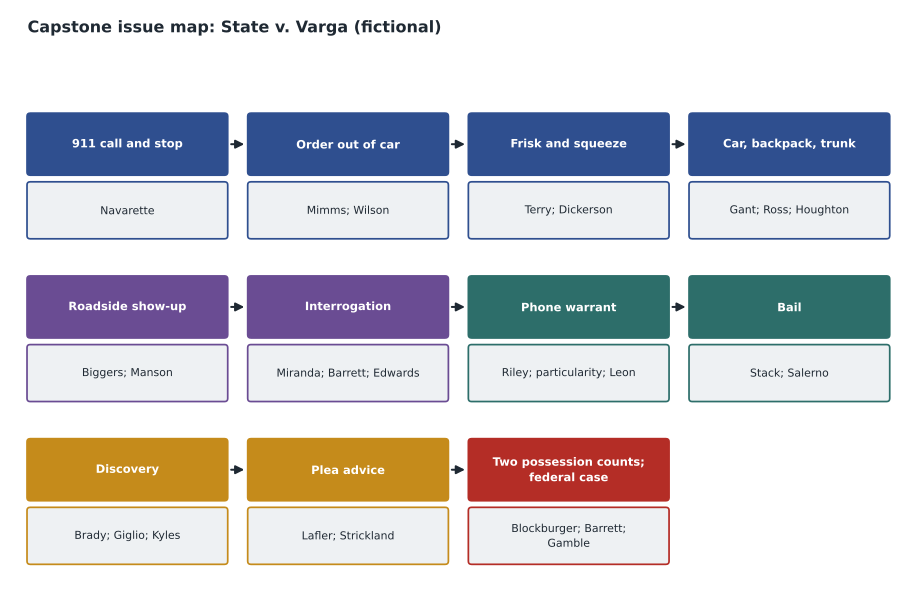
Step 1: the stop
Ambrose begins with the 911 call. An anonymous tip that merely describes a person and asserts illegality does not supply reasonable suspicion, under Florida v. J.L., 529 U.S. 266 (2000). But Navarette v. California, 572 U.S. 393 (2014), held that a 911 call reporting that a specific vehicle had just run the caller off the road was reliable enough: the caller claimed eyewitness knowledge, reported contemporaneously, and used a 911 system that can record and trace calls, which deters false reports. The Varga call has the same features: the caller said she had just seen the car, called within minutes, and used a traceable number. The car's distinctive features, its location three miles away about twenty minutes later and the alarm corroborate it. Talley had reasonable suspicion for an investigatory stop; she may even have had probable cause, though she needed only reasonable suspicion.
Ordering Varga and Kowal out of the car was permitted: officers may order the driver out during a lawful traffic stop, under Pennsylvania v. Mimms, 434 U.S. 106 (1977), and passengers too, under Maryland v. Wilson, 519 U.S. 408 (1997). A frisk requires reasonable suspicion that the person is armed and dangerous. A suspected nighttime burglary using a pry bar, a bulge in a pocket and two occupants support a frisk, though a defense lawyer would argue that burglary of medications does not imply weapons.
Step 2: the frisk and the plain feel
Terry permits a patdown for weapons only. Under Minnesota v. Dickerson, 508 U.S. 366 (1993), an officer may seize contraband felt during a lawful frisk only if its identity is immediately apparent; squeezing, sliding and manipulating an object already known not to be a weapon exceeds the frisk. Talley felt a hard cylinder, which is not a weapon, and then squeezed and rolled it until she heard pills. That is the manipulation Dickerson forbids, so the bottle's seizure was unlawful unless another doctrine saves it.
The state has two answers. First, Talley may already have had probable cause to arrest Varga before the frisk, based on the tip, the matching car and plate, the timing and the location. If so, the search was a valid search incident to arrest, because under Rawlings v. Kentucky, 448 U.S. 98 (1980), a search incident to arrest may precede the formal arrest so long as probable cause existed beforehand and the arrest follows quickly. Second, the state might argue inevitable discovery, since Varga would have been arrested and searched at booking. Ambrose tells the class that a strong answer argues both sides and predicts that the probable cause argument is the state's better one.
Step 3: the car, the backpack and the trunk
Search incident to arrest no longer justified searching the car once Varga was handcuffed in the cruiser, because under Arizona v. Gant, 556 U.S. 332 (2009), officers may search a vehicle incident to arrest only if the arrestee is unsecured and within reaching distance, or if it is reasonable to believe evidence of the offense of arrest is in the vehicle. The second Gant prong fits: it was reasonable to believe stolen medications and tools were in the car. But Gant's evidence prong covers only the passenger compartment, not the trunk.
The automobile exception does the rest. With probable cause to believe the car contained evidence of the burglary, officers could search any part of it, including the trunk and containers, under United States v. Ross, 456 U.S. 798 (1982), and California v. Acevedo, 500 U.S. 565 (1991). Wyoming v. Houghton, 526 U.S. 295 (1999), allows officers with probable cause to search a car to search a passenger's belongings that could hold the object of the search, so Kowal's backpack was within the search. If the probable cause depends on the pill bottle from the illegal frisk, however, the car search becomes fruit of the poisonous tree, and the analysis in Step 2 becomes decisive. Varga has standing to challenge the car search as the driver with permission, but under Rakas v. Illinois he cannot object to the search of Kowal's backpack.
Step 4: the show-up
A one-person show-up is inherently suggestive, but it is permitted when necessary, such as shortly after a crime, under Stovall v. Denno, 388 U.S. 293 (1967). Here the police added more suggestion: Varga in handcuffs between officers, and the statement "We think we've got him." Under Neil v. Biggers and Manson v. Brathwaite, the court asks whether the procedure was unnecessarily suggestive and, if so, whether the identification is nonetheless reliable under the totality of the circumstances. Albrecht saw the man for three seconds under a streetlight, gave a vague description, expressed uncertainty and identified the jacket rather than the face. The forty-minute delay favors reliability. Ambrose predicts a federal court would likely admit the identification and leave its weaknesses to cross-examination and jury instructions, while a state applying a stricter test, as New Jersey does under Henderson, might exclude it or require a detailed instruction.
Step 5: the interrogation
Varga's first statement, "I'll talk to you, but I'm not signing anything," was a valid oral waiver. In Connecticut v. Barrett, 479 U.S. 523 (1987), the Court upheld oral statements by a suspect who refused to give a written statement without a lawyer but agreed to talk. His denial was admissible.
"I want a lawyer" was an unambiguous invocation of the Miranda right to counsel. Under Edwards v. Arizona, 451 U.S. 477 (1981), police may not reinitiate interrogation until counsel is present, unless the suspect himself initiates further communication or there has been a break in custody of at least fourteen days, under Maryland v. Shatzer, 559 U.S. 98 (2010). Faraday reinitiated the next morning while Varga remained in custody; a fresh warning and waiver do not cure an Edwards violation. The confession must be suppressed from the prosecution's case in chief. It may still be used to impeach Varga if he testifies inconsistently and the statement was voluntary, under Harris v. New York. Any physical evidence found because of the confession would likely be admissible under United States v. Patane, because the confession was not coerced.
Step 6: the phone
Riley v. California, 573 U.S. 373 (2014), requires a warrant to search a phone, and officers properly seized it and waited for one. The warrant identified the offense and limited the search to communications, photographs and location data within a date range tied to the burglary. That is far narrower than the "all data" warrant in State v. Pike, and it probably satisfies particularity. Even if a court found it overbroad, United States v. Leon would likely save evidence found under it, because officers relied on it in good faith and it was not so facially deficient that reliance was unreasonable. If the warrant's probable cause rested on the suppressed confession, the court would excise the tainted information and ask whether the rest still established probable cause, as Murray and Franks suggest.
Step 7: bail and charging
The Eighth Amendment forbids excessive bail, and Stack v. Boyle requires bail set at an amount reasonably calculated to assure appearance. Setting an unaffordable bond without any inquiry into Varga's ability to pay operates as de facto detention without the findings that Salerno and many state statutes require for detention. Varga's lawyer should seek a prompt bail review demanding either release on conditions or a full detention hearing with findings. The indictment's charges raise no constitutional problem by themselves; prosecutors have broad charging discretion under Bordenkircher v. Hayes.
Step 8: discovery
The undisclosed report that the 911 caller was Varga's former girlfriend with a grudge is impeachment evidence favorable to Varga. Under Brady v. Maryland and Giglio v. United States, suppression violates due process if the evidence is material, meaning there is a reasonable probability of a different result. Kyles v. Whitley makes the prosecutor responsible for what the police knew. The caller did not testify, but her report supplied the reasonable suspicion for the stop, and her bias could undermine the investigation's credibility at trial and the state's account at the suppression hearing. Materiality depends on how central the stop and her description were; Ambrose says a strong answer recognizes that the evidence matters most at the suppression hearing, and that courts are divided over whether Brady applies to suppression hearings at all.
Step 9: the plea
Varga's lawyer advised him to reject a four-year offer based on a misjudgment about the suppression issue. Under Lafler v. Cooper, 566 U.S. 156 (2012), deficient advice that leads a defendant to reject a plea offer and receive a harsher sentence after trial can be ineffective assistance. But a reasonable but mistaken prediction about how a court will rule is not usually deficient performance. If the lawyer misstated the law, for example by ignoring the probable-cause and inevitable-discovery arguments, Varga could have a claim; if he made a reasonable strategic judgment, under Strickland he does not. If Varga succeeds, the remedy may include requiring the state to reoffer the plea.
Step 10: double jeopardy
Possession of controlled substances is a lesser included offense of possession with intent to distribute: every element of possession is included in the greater offense. Under Blockburger, they are the same offense, and absent clear legislative authorization for cumulative punishment, Varga may not be sentenced for both based on the same pills. The court should merge the convictions, as the Court in Barrett v. United States (2026) required when Congress had not clearly authorized two convictions for one act. Burglary is a separate offense with different elements.
A federal drug prosecution for the same pills would not violate double jeopardy under Gamble v. United States, because the federal government is a separate sovereign. The Justice Department's Petite policy may discourage it absent a substantial federal interest.
| Government action | Governing rule | Likely result |
|---|---|---|
| Stop based on 911 call | Reasonable suspicion (Navarette) | Lawful |
| Order out of car | Mimms; Wilson | Lawful |
| Squeezing the bottle | Dickerson plain feel | Exceeded frisk; may be saved by prior probable cause |
| Car, backpack, trunk | Gant; automobile exception; Houghton | Lawful if probable cause independent of the bottle |
| Roadside show-up | Biggers; Manson | Likely admitted in federal court; weaker under Henderson |
| Next-day interrogation | Edwards; Shatzer | Confession suppressed from case in chief |
| Phone warrant | Riley; particularity; Leon | Likely valid |
| Unaffordable bond | Stack; Salerno | Seek bail review and findings |
| Undisclosed caller report | Brady; Giglio; Kyles | Depends on materiality |
| Rejected plea | Lafler; Strickland | Claim only if advice was deficient |
| Two possession counts; federal charge | Blockburger; Barrett; Gamble | Merge counts; federal case allowed |
Worked problem
Exam technique: ranking the defense motions
Varga's lawyer has limited time before the suppression hearing. Which motions should she prioritize, and why?
Show solution
- Rank by impact on the state's case. The confession is the most damaging evidence and the Edwards violation is clear, so the motion to suppress it is first.
- The frisk motion is second: if the bottle and car search fall as fruit of an unlawful search, the drug charges collapse, though the state's prior-probable-cause argument is strong.
- The Brady request for all records about the 911 caller should be made immediately, because it may strengthen the suppression motions.
- The identification motion is weaker but should be filed to preserve the issue and to obtain a jury instruction.
- The bail motion should be filed at once, because every day of detention matters to the client and affects his ability to help prepare the defense.
Answer: Suppress the confession under Edwards first, then challenge the frisk and car search under Dickerson and Gant, demand the 911 caller records under Brady, challenge the show-up to preserve the issue, and seek immediate bail review.
Before dismissing the class, Ambrose returns to State v. Pike. "In that case, the investigation was good police work with a few mistakes, and some of the mistakes mattered," she says. "Most real cases look like that. Your job, whichever side you end up on, is to find the mistakes that matter and to know what the law does about them."
Summary and key terms
- Work through a criminal procedure problem chronologically, asking at each step what the government did, what rule governs it and what the remedy is.
- Reasonable suspicion from a 911 call depends on reliability factors (Navarette), and a frisk may not become a search for evidence (Dickerson).
- Gant, the automobile exception and Houghton govern car searches; standing limits who may object.
- Edwards bars police-initiated interrogation after a request for counsel until a fourteen-day break in custody.
- Discovery, bail, plea advice and double jeopardy issues are as important as search and interrogation issues on a full exam.
Practice problems
Work each problem on paper first, then reveal the answer to check.
Why did the 911 call in Varga support reasonable suspicion despite being anonymous?
Show answer
As in Navarette, the caller claimed eyewitness knowledge, reported contemporaneously and used a traceable 911 system, and police corroborated the car's details.
Why was squeezing the pill bottle a problem?
Show answer
Under Minnesota v. Dickerson, once an officer knows an object is not a weapon, manipulating it to identify it exceeds the scope of a Terry frisk.
Could officers search the trunk under Gant?
Show answer
No; Gant's evidence prong covers only the passenger compartment, but the automobile exception allows a trunk search with probable cause.
Why was the next-day confession inadmissible in the case in chief?
Show answer
Varga had invoked his right to counsel and remained in custody, so the detective's reinitiation violated Edwards; fresh warnings do not cure it.
May Varga be sentenced for both possession and possession with intent based on the same pills?
Show answer
No; possession is a lesser included offense under Blockburger, and absent clear legislative authorization the convictions should merge.
Lesson quiz · 5 questions
Score 60% or more to complete this lesson.
Create a free account to save your progress, take quizzes and earn a certificate.