
LAWU-202 · Lesson 9 of 12 · 23 min
Shareholder voting, information rights and close corporations
▶ Video coming soon A video version of this lesson is on the way.
Professor Thackeray asks Section B who in the room owns stock. About half the hands go up, mostly through retirement accounts and index funds. "Have any of you ever voted your shares?" Two hands stay up. "That is normal," she says. "Most shares in public companies are held through funds, and the funds vote. But voting is still the main source of shareholder power, and in a small company like Juniper Hill, a single vote can decide who runs the business." This lesson covers how shareholders vote, how they get information, and the special problems of corporations with only a few owners.
Shareholders have three basic rights, sometimes summarized as the rights to vote, sell and sue. Selling is how most dissatisfied public company shareholders respond, and suing is the subject of lesson 11. Voting is the right that connects shareholders to management, because shareholders elect the directors who manage the business. In small companies, where no market exists for the shares, voting and the rules protecting minority owners take on even greater importance.
Meetings, quorum and voting
Corporations must hold an annual meeting of shareholders to elect directors. Under DGCL section 211, if no annual meeting is held for thirteen months, the Court of Chancery may order one on a stockholder's or director's application, and MBCA section 7.03 provides similarly. Special meetings may be called by the board or by persons authorized in the charter or bylaws; under MBCA section 7.02, holders of at least ten percent of the votes may demand one unless the articles provide otherwise, while Delaware leaves the matter to the charter and bylaws. Shareholders may also act by written consent without a meeting, under DGCL section 228, unless the charter provides otherwise; many public companies restrict this right.
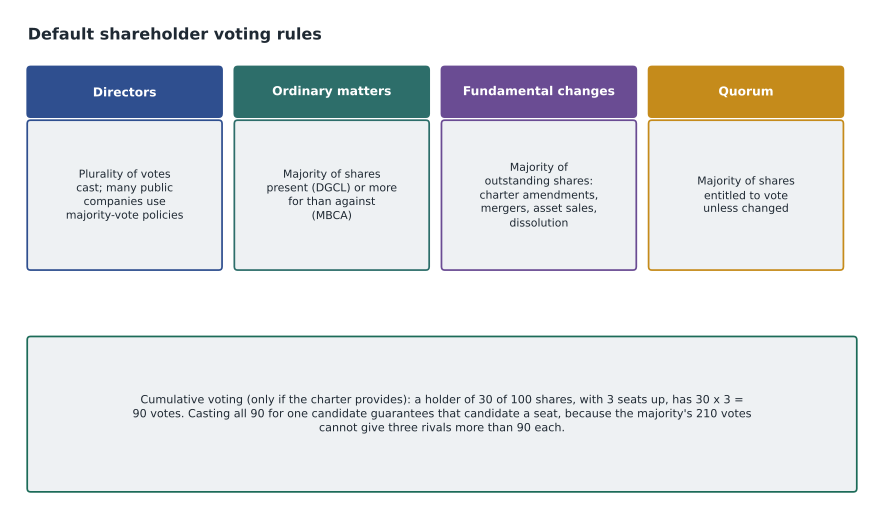
A quorum, by default a majority of the shares entitled to vote, must be present in person or by proxy for the meeting to act. Directors are elected by a plurality of the votes cast unless the charter or bylaws provide otherwise, meaning that the candidates with the most votes win, even if most shares are withheld. Most large public companies have adopted majority voting policies or bylaws, under which a director who fails to receive a majority of votes cast must offer to resign. Other matters require the affirmative vote of a majority of the shares present and entitled to vote under Delaware's default, or more votes cast for than against under the MBCA. Fundamental changes such as mergers and charter amendments require a majority of the outstanding shares entitled to vote under DGCL sections 242 and 251.
Cumulative voting lets a shareholder multiply the number of shares by the number of directors to be elected and cast all the votes for one candidate, helping minority shareholders elect at least one director. It is optional in Delaware and most states and must be provided in the charter. Staggered or classified boards, in which only a third of the directors stand for election each year, make it harder for an insurgent to take control quickly. Many large companies have declassified their boards under investor pressure, but staggered boards remain common in companies that recently went public.
Proxies and federal proxy regulation
Most shareholders vote by proxy, authorizing someone else to vote their shares. A proxy is revocable unless it states that it is irrevocable and is coupled with an interest, such as a pledge of the shares. For public companies, the federal securities laws govern proxy solicitation. Section 14(a) of the Securities Exchange Act of 1934 and the Securities and Exchange Commission's rules require companies soliciting proxies to deliver a proxy statement disclosing information about the matters to be voted on, including detailed information about executive compensation. Rule 14a-9 prohibits false or misleading statements in proxy materials, and the Supreme Court in J. I. Case Co. v. Borak, 377 U.S. 426 (1964), recognized a private right of action for violations.
Two features of the federal rules give shareholders direct influence. Under Rule 14a-8, a shareholder who meets ownership requirements may require the company to include a proposal of up to 500 words in its proxy statement, unless the proposal falls within one of the rule's grounds for exclusion, such as dealing with ordinary business operations or relating to matters not significantly related to the company's business. Most proposals are precatory, urging the board to act, and the SEC staff's views on what companies may exclude have changed several times in recent years. Under Rule 14a-19, the universal proxy rule effective for meetings after August 31, 2022, both management and dissident shareholders in a contested election must use proxy cards listing all nominees, so shareholders voting by proxy can split their votes between the two slates as they could in person.
Protecting the franchise: Schnell, Blasius and Coster
Delaware courts protect shareholders' voting rights against board manipulation. In Schnell v. Chris-Craft Industries, Inc., 285 A.2d 437 (Del. 1971), the court struck down a board's decision to move up the annual meeting date to hinder a dissident's proxy contest, declaring that inequitable action does not become permissible simply because it is legally possible. In Blasius Industries, Inc. v. Atlas Corp., 564 A.2d 651 (Del. Ch. 1988), Chancellor Allen held that a board acting for the primary purpose of thwarting a shareholder vote must demonstrate a compelling justification, even if it acts in good faith. In Coster v. UIP Companies, Inc., 300 A.3d 656 (Del. 2023), the Delaware Supreme Court folded Blasius into the enhanced scrutiny framework of Unocal, discussed in lesson 10, holding that a board interfering with a shareholder vote must show that it faced a real threat to an important corporate interest and that its response was reasonable and not preclusive or coercive.
Shareholder agreements and voting arrangements
Shareholders may agree among themselves how to vote. Delaware's section 218 validates voting trusts, in which shareholders transfer legal title to their shares to a trustee who votes them, and voting agreements, in which shareholders contract to vote together. In Ringling Brothers-Barnum and Bailey Combined Shows, Inc. v. Ringling, 53 A.2d 441 (Del. 1947), the court enforced a voting agreement between two shareholders who had agreed to submit disagreements to an arbitrator. Agreements that restrict the board's discretion raise a different problem, because directors cannot contract away their duty to manage. In West Palm Beach Firefighters' Pension Fund v. Moelis and Co., 311 A.3d 809 (Del. Ch. 2024), the Court of Chancery invalidated provisions of a stockholder agreement giving the company's founder approval rights over many board actions. Delaware responded within months by adding section 122(18), effective August 1, 2024, which authorizes corporations to enter into contracts with stockholders that restrict corporate action or require the approval of specified persons, subject to the charter and to directors' fiduciary duties in deciding to enter them.
Information rights: books and records
Shareholders who want to investigate possible wrongdoing usually begin with a demand to inspect books and records. Under DGCL section 220, a stockholder may inspect books and records for a proper purpose, meaning a purpose reasonably related to the person's interest as a stockholder, such as investigating mismanagement, valuing shares or communicating with other stockholders. A stockholder investigating wrongdoing must show a credible basis from which the court can infer possible mismanagement; in AmerisourceBergen Corp. v. Lebanon County Employees' Retirement Fund, 243 A.3d 417 (Del. 2020), the court held that the stockholder need not specify what it will do with the information or show that the wrongdoing is actionable. Courts have long encouraged plaintiffs to use section 220 before filing derivative suits.
Senate Bill 21 narrowed section 220 in 2025. It now requires the demand to be made in good faith, to describe the purpose and the records sought with reasonable particularity, and to seek records specifically related to the purpose. It defines the books and records generally available as a list of core documents, including the charter and bylaws, minutes and written consents of stockholders and the board and its committees, materials provided to the board in connection with actions taken, annual financial statements for the past three years, communications to stockholders, director and officer independence questionnaires, and certain stockholder agreements. A court may order production of other records, such as officers' emails, only if the stockholder shows a compelling need and establishes by clear and convincing evidence that the records are necessary and essential to the purpose. Texas's 2025 amendments similarly excluded most emails and text messages from inspection. MBCA section 16.02 gives shareholders a right to inspect specified records and others for a proper purpose described with reasonable particularity.
| Element | Requirement |
|---|---|
| Demand | Written, under oath, in good faith, stating a proper purpose with reasonable particularity |
| Proper purpose | Reasonably related to the person's interest as a stockholder |
| Investigating wrongdoing | Credible basis to infer possible mismanagement (AmerisourceBergen) |
| Records available | Core list: charter, bylaws, board and committee minutes and materials, three years of annual financials, stockholder communications, independence questionnaires, certain stockholder agreements |
| Other records (such as emails) | Only on a compelling need shown by clear and convincing evidence that they are necessary and essential |
| Conditions | The corporation may impose reasonable confidentiality restrictions |
Close corporations: the minority's problem
A close corporation has few shareholders, no public market for its shares, and owners who usually work in the business. The statutory model of corporate governance, with passive shareholders electing a board that appoints officers, fits these businesses poorly. A shareholder who owns a minority interest can be outvoted on every decision, removed as an officer and employee, cut off from dividends, and left holding shares that no one will buy. Thackeray calls this the freeze-out problem: the majority does not need to steal anything, because it can simply exclude the minority from all the benefits of ownership until the minority sells cheaply.
Courts and legislatures have responded in different ways. Massachusetts imposes partnership-like fiduciary duties among shareholders in close corporations. In Donahue v. Rodd Electrotype Co., 367 Mass. 578 (1975), the Supreme Judicial Court held that shareholders in a close corporation owe one another the same duty of utmost good faith and loyalty that partners owe, and that a controlling group that caused the corporation to buy back shares from a retiring family member had to offer the same opportunity to the minority shareholder. In Wilkes v. Springside Nursing Home, Inc., 370 Mass. 842 (1976), the court refined the rule: the majority may show a legitimate business purpose for its action, and the minority may then show that the purpose could have been achieved by a less harmful alternative. The court held that the majority breached its duty by removing Wilkes as a director and officer and cutting off his salary without any legitimate purpose.
Delaware takes a different approach. In Nixon v. Blackwell, 626 A.2d 1366 (Del. 1993), the Delaware Supreme Court declined to create special rules for close corporations not electing statutory close corporation status, reasoning that minority shareholders can protect themselves by contract before investing, through shareholder agreements, buy-sell provisions, employment contracts and other arrangements. Controlling stockholders in Delaware remain subject to the ordinary fiduciary duties discussed in lesson 8, but a minority shareholder who did not bargain for protection may find little help.
Oppression statutes and judicial dissolution
Many states provide a statutory remedy for oppression of minority shareholders. MBCA section 14.30(a)(2) allows a court to dissolve a corporation whose shares are not publicly traded if the directors or those in control have acted, are acting or will act in a manner that is illegal, oppressive or fraudulent, if the shareholders are deadlocked in voting power and have failed to elect directors, if the directors are deadlocked and irreparable injury is threatened, or if corporate assets are being misapplied or wasted. Under section 14.34, the corporation or the other shareholders may avoid dissolution by electing to buy the petitioner's shares at fair value. In practice, most oppression cases end in a court-ordered or negotiated buyout rather than dissolution.
Courts often define oppression by asking whether the majority defeated the minority's reasonable expectations. In In re Kemp and Beatley, Inc., 64 N.Y.2d 63 (1984), the New York Court of Appeals, applying New York Business Corporation Law section 1104-a, held that oppression arises when the majority's conduct substantially defeats expectations that, objectively viewed, were both reasonable under the circumstances and central to the petitioner's decision to join the venture. The expectations of a shareholder who invested in order to work in the business, such as continued employment and a share of the earnings, often receive protection. Courts may order a buyout, dissolution or other relief.
Planning for close corporations
Because the law's protections are uncertain, careful planning is essential. Shareholders in a close corporation commonly sign a shareholder agreement covering transfer restrictions, such as rights of first refusal and consent requirements, which DGCL section 202 permits if reasonable and noted on the certificate; buy-sell provisions requiring the corporation or other shareholders to buy a shareholder's shares on death, disability, termination of employment or retirement, at a price set by formula or appraisal; employment agreements; supermajority requirements for major decisions; and methods for breaking deadlocks. MBCA section 7.32 allows shareholders of a non-public corporation, by unanimous agreement, to vary many statutory rules, including eliminating the board or restricting its discretion, as long as the agreement is noted conspicuously on share certificates. In Galler v. Galler, 32 Ill. 2d 16 (1964), the Illinois Supreme Court enforced a shareholder agreement among two families that guaranteed dividends and board seats, recognizing that close corporations have different needs from public companies.
Worked problem
Tessa is frozen out
In Thackeray's hypothetical, Juniper Hill Foods is a Westmarch corporation with three shareholders: Lena (40 percent), Owen (40 percent) and their cousin Tessa (20 percent), who invested on the understanding that she would serve as marketing director. After a dispute, Lena and Owen vote to remove Tessa from the board, fire her as marketing director, stop paying dividends and raise their own salaries by half. They offer to buy her shares at a low price. Westmarch follows the MBCA. What can Tessa do?
Show solution
- Tessa may petition for judicial dissolution under MBCA section 14.30(a)(2), arguing that those in control have acted oppressively by defeating her reasonable expectations of employment, a board role and a return on her investment.
- Under the reasonable expectations approach of Kemp and Beatley, her expectation of serving as marketing director was central to her decision to invest and was known to the others.
- Lena and Owen (or the corporation) may elect under section 14.34 to buy her shares at fair value, which a court will determine if they cannot agree, likely without a minority discount in an oppression case.
- Tessa may also seek inspection of books and records to examine the salary increases, and may consider a derivative claim for waste or self-dealing if the salaries are excessive.
- If Westmarch followed Massachusetts law, Tessa could sue directly for breach of the close corporation duty under Donahue and Wilkes, and the majority would have to show a legitimate business purpose.
Answer: Tessa's strongest remedy is an oppression petition seeking dissolution, which will likely lead to a buyout of her 20 percent stake at fair value; the episode shows why she should have negotiated a shareholder agreement with employment and buy-sell protections when she invested.
Summary and key terms
- Shareholders elect directors at annual meetings by plurality vote unless changed; fundamental changes need a majority of outstanding shares.
- Federal proxy rules require disclosure, permit shareholder proposals under Rule 14a-8 and require universal proxy cards in contested elections.
- Delaware protects the franchise through Schnell and, after Coster v. UIP, enhanced scrutiny of board actions that interfere with votes.
- Section 218 validates voting trusts and agreements; section 122(18), added in 2024 after Moelis, permits corporate contracts with stockholders that restrict corporate action.
- Section 220 lets stockholders inspect records for a proper purpose; SB 21 limited inspection to core records absent a compelling need.
- Close corporation minorities face freeze-outs; Massachusetts imposes partnership-like duties, oppression statutes offer dissolution or buyout, and Delaware relies on contract.
Practice problems
Work each problem on paper first, then reveal the answer to check.
What did Coster v. UIP change about Blasius?
Show answer
It folded Blasius into Unocal enhanced scrutiny: a board interfering with a vote must show a real threat to an important interest and a reasonable, non-preclusive response.
What did section 122(18) authorize after Moelis?
Show answer
Contracts between the corporation and stockholders that restrict corporate action or require specified approvals, subject to the charter and directors' fiduciary duties.
What must a stockholder investigating wrongdoing show under section 220?
Show answer
A proper purpose and a credible basis from which the court can infer possible mismanagement.
What test did Wilkes v. Springside add to Donahue?
Show answer
The majority may show a legitimate business purpose, and the minority may then show a less harmful alternative could have achieved it.
Why did Nixon v. Blackwell decline to create special close corporation duties?
Show answer
Minority shareholders can protect themselves by contract before investing, through agreements and buy-sell provisions.
Lesson quiz · 5 questions
Score 60% or more to complete this lesson.
Create a free account to save your progress, take quizzes and earn a certificate.