
LAWU-202 · Lesson 11 of 12 · 23 min
Shareholder litigation
▶ Video coming soon A video version of this lesson is on the way.
"Fiduciary duties would mean nothing if no one could enforce them," Professor Thackeray tells Section B. "But who sues when directors harm the corporation? The corporation itself is controlled by the directors who are accused. That puzzle produced one of the strangest procedural devices in American law: the derivative suit, in which a shareholder sues on behalf of the corporation, against the corporation's own managers, while the corporation is named as a defendant." This lesson covers derivative and direct suits, the demand requirement, special litigation committees, and the basics of federal securities fraud litigation, which is now the largest source of shareholder lawsuits against public companies.
Direct and derivative claims
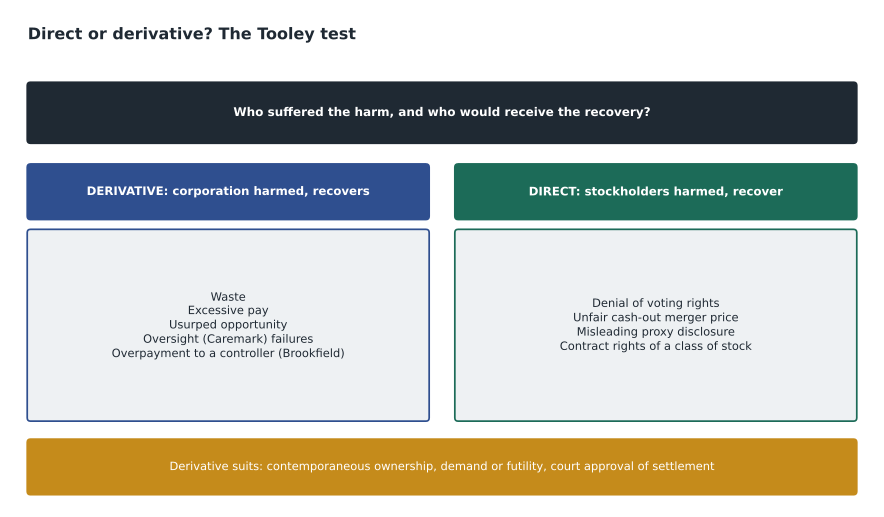
A shareholder's claim is either direct, brought for harm to the shareholder personally, or derivative, brought on behalf of the corporation for harm to the corporation. The distinction matters because derivative suits are subject to special procedural requirements and any recovery goes to the corporation, while direct claims may be brought individually or as class actions and recovery goes to the shareholders. In Tooley v. Donaldson, Lufkin and Jenrette, Inc., 845 A.2d 1031 (Del. 2004), the Delaware Supreme Court held that the test depends solely on two questions: who suffered the alleged harm, the corporation or the suing stockholders individually, and who would receive the benefit of any recovery or other remedy.
Claims that directors wasted corporate assets, took corporate opportunities, approved excessive compensation or failed to oversee compliance are derivative, because the corporation suffered the loss. Claims that stockholders were denied a vote, that a merger cashed them out at an unfair price, or that a proxy statement misled them are usually direct. In Brookfield Asset Management, Inc. v. Rosson, 261 A.3d 1251 (Del. 2021), the court held that claims that a controller's purchase of stock at an unfair price diluted the minority are derivative, overruling an earlier exception. Thackeray tells the class that classifying a claim correctly is often the first and hardest step in a corporate case.
Standing and procedural requirements
Derivative suits have their own procedural rules, found in Federal Rule of Civil Procedure 23.1, Delaware Court of Chancery Rule 23.1, and MBCA sections 7.40 to 7.47. The plaintiff must have been a shareholder at the time of the challenged transaction, the contemporaneous ownership rule, and must remain a shareholder throughout the litigation; a stockholder who loses shares in a merger generally loses standing to pursue derivative claims, as the Delaware Supreme Court held in Lewis v. Anderson, 477 A.2d 1040 (Del. 1984), subject to exceptions for fraud. The plaintiff must fairly and adequately represent the interests of the shareholders. Settlement or dismissal requires court approval after notice to shareholders, because the suit belongs to the corporation and all its shareholders.
The most important requirement is demand. Before suing derivatively, a shareholder must either make a demand on the board to bring the suit itself or plead with particularity why demand would be futile. The demand requirement respects the board's authority under section 141(a) to manage the corporation, including deciding whether to sue. If a shareholder makes a demand and the board refuses, the shareholder has conceded the board's independence, and the refusal is reviewed under the business judgment rule, as the court held in Spiegel v. Buntrock, 571 A.2d 767 (Del. 1990), so the suit usually ends. That is why plaintiffs in Delaware almost always plead futility instead.
Demand futility: from Aronson to Zuckerberg
For decades, Delaware applied two tests for demand futility. Under Aronson v. Lewis, discussed in lesson 7, demand was excused if the particularized facts created a reasonable doubt that the directors were disinterested and independent or that the challenged transaction was the product of a valid exercise of business judgment. Under Rales v. Blasband, 634 A.2d 927 (Del. 1993), which applied when the board considering the demand had not made the challenged decision, demand was excused if the facts created a reasonable doubt that the board could have properly exercised its independent and disinterested business judgment in responding to a demand.
In United Food and Commercial Workers Union v. Zuckerberg, 262 A.3d 1034 (Del. 2021), the Delaware Supreme Court adopted a single three-part test, asked director by director. Demand is futile if at least half of the directors on the board at the time the complaint is filed fail at least one of these questions: whether the director received a material personal benefit from the alleged misconduct that is the subject of the litigation demand; whether the director faces a substantial likelihood of liability on any of the claims that would be the subject of the litigation demand; and whether the director lacks independence from someone who received a material personal benefit or who would face a substantial likelihood of liability. The court explained that exculpation matters: a director protected by a section 102(b)(7) clause does not face a substantial likelihood of liability for care claims, so plaintiffs must plead facts suggesting bad faith or disloyalty.
| Question | If yes for a director | Example |
|---|---|---|
| Did the director receive a material personal benefit from the alleged misconduct? | That director cannot impartially consider a demand | A director who sold land to the company at an inflated price |
| Does the director face a substantial likelihood of liability on any claim? | That director cannot impartially consider a demand | A director who knowingly ignored red flags of illegal conduct (not mere negligence if exculpated) |
| Does the director lack independence from someone who benefited or faces substantial likelihood of liability? | That director cannot impartially consider a demand | A director whose main income comes from the interested CEO's other company |
| Do at least half the current directors fail at least one question? | Demand is excused as futile | Plaintiff may proceed without making demand |
Special litigation committees
Even after demand is excused, a board may form a special litigation committee of independent directors to investigate the claims and decide whether the suit is in the corporation's interest. In Zapata Corp. v. Maldonado, 430 A.2d 779 (Del. 1981), the Delaware Supreme Court adopted a two-step test for motions to dismiss based on a committee's recommendation. First, the court inquires into the committee's independence, good faith and the reasonableness of its investigation, with the corporation bearing the burden of proof. Second, the court may apply its own independent business judgment to decide whether the motion should be granted, considering the corporation's interests and matters of law and public policy. New York, in Auerbach v. Bennett, 47 N.Y.2d 619 (1979), gives more deference, examining only the committee's independence and the adequacy of its methods.
Delaware scrutinizes committee independence closely. In In re Oracle Corp. Derivative Litigation, 824 A.2d 917 (Del. Ch. 2003), the Court of Chancery held that a committee of two Stanford professors was not independent for purposes of investigating claims against Oracle directors and officers with substantial ties to Stanford, including large donations, reasoning that independence considers human motivations such as friendship, collegiality and institutional loyalty, not just financial ties. Committees often recommend dismissing all or most claims, but sometimes settle them or pursue them.
Settlement, fees and the economics of shareholder suits
Most derivative and merger suits settle. Settlements must be approved by the court as fair, reasonable and adequate, and plaintiffs' attorneys are paid from the recovery or, when the settlement produces only non-monetary benefits, by the corporation under the corporate benefit doctrine. Critics have long argued that many suits are driven by attorneys' fees rather than shareholder interests. In In re Trulia, Inc. Stockholder Litigation, 129 A.3d 884 (Del. Ch. 2016), the Court of Chancery announced that it would no longer approve disclosure-only settlements of merger suits unless the supplemental disclosures were plainly material, which pushed much merger litigation into federal court under the securities laws. Large fee awards have also drawn scrutiny, as in the Tesla litigation, where the Delaware Supreme Court in December 2025 replaced a fee award of about 345 million dollars with one based on counsel's hours.
Corporations and states have tried to limit shareholder suits. Forum selection provisions, discussed in lesson 5, channel claims into Delaware or federal court. Fee-shifting provisions that would make losing plaintiffs pay the company's fees are prohibited for Delaware stock corporations by section 102(f), enacted in 2015. Texas's 2025 amendments allow public companies to require that derivative plaintiffs own up to three percent of the outstanding shares. Indemnification and insurance also shape the economics: corporations may indemnify directors for expenses and many liabilities under DGCL section 145 and MBCA subchapter 8E, must indemnify directors who win on the merits, and nearly all public companies buy directors and officers liability insurance, which funds most settlements.
Federal securities fraud: Rule 10b-5
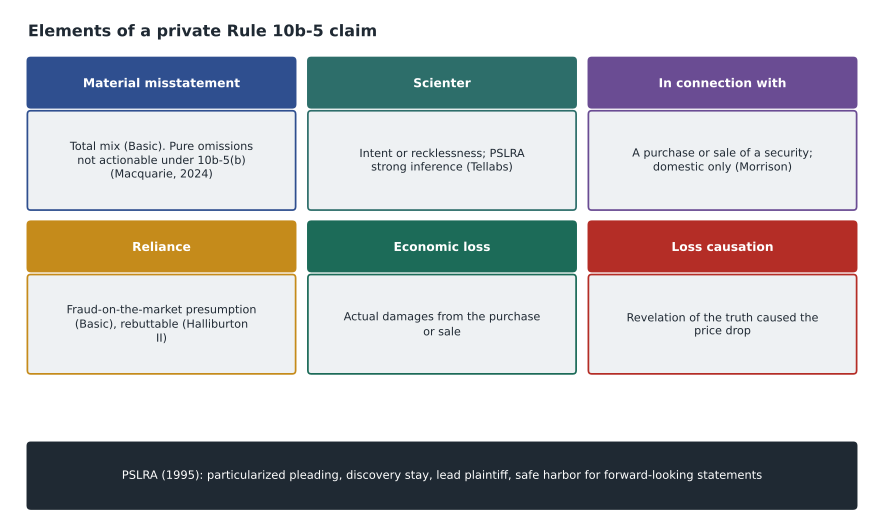
Shareholders of public companies more often sue under the federal securities laws than under state fiduciary law. Section 10(b) of the Securities Exchange Act of 1934 and SEC Rule 10b-5 prohibit, in connection with the purchase or sale of any security, employing any device, scheme or artifice to defraud, making any untrue statement of a material fact or omitting a material fact necessary to make statements made not misleading, and engaging in any act, practice or course of business that operates as a fraud. Courts have implied a private right of action. To recover, a private plaintiff must prove a material misrepresentation or omission, scienter, a connection with the purchase or sale of a security, reliance, economic loss, and loss causation.
Several Supreme Court decisions define these elements. Materiality asks whether there is a substantial likelihood that a reasonable investor would consider the information important, viewing the total mix of information, under Basic Inc. v. Levinson, 485 U.S. 224 (1988), which also adopted the fraud-on-the-market presumption of reliance: investors who buy at the market price are presumed to rely on the integrity of that price, which reflects all public material misstatements. Halliburton Co. v. Erica P. John Fund, Inc., 573 U.S. 258 (2014), retained the presumption but let defendants rebut it at class certification by showing the misstatement did not affect the stock price. In Macquarie Infrastructure Corp. v. Moab Partners, L.P., 601 U.S. 257 (2024), the Court held that pure omissions, such as failing to disclose information required by an SEC disclosure item, are not actionable under Rule 10b-5(b) unless the omission makes an affirmative statement misleading. In Morrison v. National Australia Bank Ltd., 561 U.S. 247 (2010), the Court limited section 10(b) to transactions in securities listed on domestic exchanges and domestic transactions in other securities.
Congress tightened private securities litigation in the Private Securities Litigation Reform Act of 1995. The act requires plaintiffs to plead with particularity each misleading statement and the facts giving rise to a strong inference that the defendant acted with scienter, stays discovery while a motion to dismiss is pending, provides a safe harbor for forward-looking statements accompanied by meaningful cautionary language, and directs courts to appoint a lead plaintiff, usually the investor with the largest losses. In Tellabs, Inc. v. Makor Issues and Rights, Ltd., 551 U.S. 308 (2007), the Court held that a strong inference of scienter must be cogent and at least as compelling as any opposing inference of nonfraudulent intent.
Insider trading
Rule 10b-5 also prohibits insider trading, although no statute defines it. Under the classical theory, a corporate insider who trades in the company's shares on material nonpublic information breaches a duty of trust to the shareholders on the other side of the trade, as the Court held in Chiarella v. United States, 445 U.S. 222 (1980). Under the misappropriation theory, adopted in United States v. O'Hagan, 521 U.S. 642 (1997), a person who trades on confidential information misappropriated in breach of a duty owed to the source of the information, such as a lawyer whose firm represents an acquirer, commits fraud. Tippees inherit liability when the tipper breached a duty by disclosing the information for a personal benefit and the tippee knew or should have known it, under Dirks v. SEC, 463 U.S. 646 (1983); in Salman v. United States, 580 U.S. 39 (2016), the Court held that a gift of confidential information to a trading relative or friend satisfies the personal benefit test.
Two other rules matter for insiders. Section 16(b) of the Exchange Act requires officers, directors and holders of more than ten percent of a class of registered equity to return to the company any profits from purchases and sales, or sales and purchases, within any six-month period, regardless of whether they used inside information. And Rule 10b5-1 provides an affirmative defense for trades made under a written plan adopted when the insider did not possess material nonpublic information; amendments the SEC adopted in December 2022 added cooling-off periods before trading under a new plan can begin and limited overlapping plans. Thackeray tells the class that Lena and Owen will need to learn these rules if Juniper Hill ever goes public, and that their lawyers will spend a great deal of time making sure they follow them.
Worked problem
The listeria claims, continued
Return to the lesson 7 hypothetical. Juniper Hill Foods, now public, suffered a listeria recall after its board ignored food safety. A stockholder wants to sue the directors for the losses. Separately, the company's stock fell 30 percent when the recall was announced, and investors who bought shares earlier claim the company's annual report falsely said its plants met all food safety standards. The board has nine members: three founders and senior managers who received the quality reports, and six outside directors who did not. How should the claims be brought?
Show solution
- Classify: the oversight claim seeks recovery of the corporation's recall losses, so it is derivative under Tooley; the investors' claim that they were misled when buying shares is direct and federal.
- Demand futility (Zuckerberg): the three insiders face a substantial likelihood of liability if they knowingly ignored the reports. For the six outside directors, the plaintiff must show a substantial likelihood of liability for bad faith under Marchand (no reporting system for a mission-critical risk) or lack of independence from the insiders; otherwise fewer than half the board is disabled and demand is not excused.
- If demand is excused, the board may form a special litigation committee; under Zapata, the court reviews its independence, good faith and investigation, and may apply its own business judgment.
- The securities claim: the investors must plead with particularity a material misstatement (the false food safety statement), a strong inference of scienter (managers knew of positive swabs), reliance through fraud-on-the-market, economic loss and loss causation (the price drop on the recall announcement).
Answer: The recall losses are pursued derivatively, with demand futile only if at least five of the nine directors are disabled under Zuckerberg (the six outside directors' lack of any food safety reporting may supply that under Marchand); the investors' price-drop claim is a direct federal Rule 10b-5 class action subject to the PSLRA's pleading rules.
Summary and key terms
- Tooley classifies claims by who suffered the harm and who receives the recovery; derivative claims belong to the corporation.
- Derivative plaintiffs must own shares contemporaneously and continuously, and must make demand or plead futility with particularity.
- Zuckerberg adopted a single three-part, director-by-director test for demand futility; exculpation affects whether directors face substantial likelihood of liability.
- Special litigation committees can seek dismissal under Zapata's two-step review, but Delaware scrutinizes their independence (Oracle).
- Rule 10b-5 claims require a material misstatement, scienter, connection to a securities transaction, reliance, loss and loss causation, subject to the PSLRA.
- Insider trading rests on the classical and misappropriation theories, tippee liability under Dirks and Salman, Section 16(b) and Rule 10b5-1 plans.
Practice problems
Work each problem on paper first, then reveal the answer to check.
Under Tooley, what two questions decide whether a claim is direct or derivative?
Show answer
Who suffered the alleged harm, the corporation or the stockholders individually, and who would receive the benefit of the recovery.
Why do Delaware plaintiffs rarely make a demand on the board?
Show answer
Making demand concedes the board's independence, and a refusal is reviewed under the business judgment rule (Spiegel v. Buntrock).
What are the three Zuckerberg questions?
Show answer
Whether the director received a material personal benefit, faces a substantial likelihood of liability, or lacks independence from someone who did either.
What did Macquarie v. Moab Partners hold?
Show answer
Pure omissions are not actionable under Rule 10b-5(b) unless they make an affirmative statement misleading.
What did Salman v. United States hold about the personal benefit test?
Show answer
A gift of confidential information to a trading relative or friend satisfies it.
Lesson quiz · 5 questions
Score 60% or more to complete this lesson.
Create a free account to save your progress, take quizzes and earn a certificate.