
LAWU-202 · Lesson 6 of 12 · 22 min
Limited liability and piercing the veil
▶ Video coming soon A video version of this lesson is on the way.
Professor Thackeray opens with a question for Daniel Reyes, who worked for three years as a paralegal at a plaintiffs' personal-injury firm. "When your firm sued a small corporation and won, how often did you collect?" Daniel laughs. "Not as often as we wanted. Half the time the company had no assets and the owner had moved everything into a new company." Thackeray nods. "That is the problem this lesson is about. Limited liability is the most valuable feature of the corporation and the LLC. It is also the feature most open to abuse."
Limited liability means that shareholders of a corporation, and members of an LLC, are not personally liable for the entity's debts beyond what they invested. MBCA section 6.22(b) states the rule: unless otherwise provided in the articles, a shareholder of a corporation is not personally liable for any liability of the corporation, including liabilities arising from acts of the corporation, except that a shareholder may become personally liable by reason of the shareholder's own acts or conduct. DGCL section 102(b)(6) is similar. RULLCA section 304 provides the same shield for LLC members and managers, and adds that the failure of an LLC to observe formalities is not a ground for imposing liability on members or managers.
Why the law grants limited liability
Scholars give several justifications. Limited liability encourages investment by capping each investor's risk at the amount invested, which lets people invest in businesses they cannot monitor. It makes shares freely tradable, because a share's value does not depend on the wealth of its owner. It allows investors to diversify across many companies. It reduces monitoring costs, because shareholders need not watch one another's wealth or the managers' every decision. And it shifts some business risk to creditors, who can protect themselves through interest rates, security interests, guarantees and covenants.
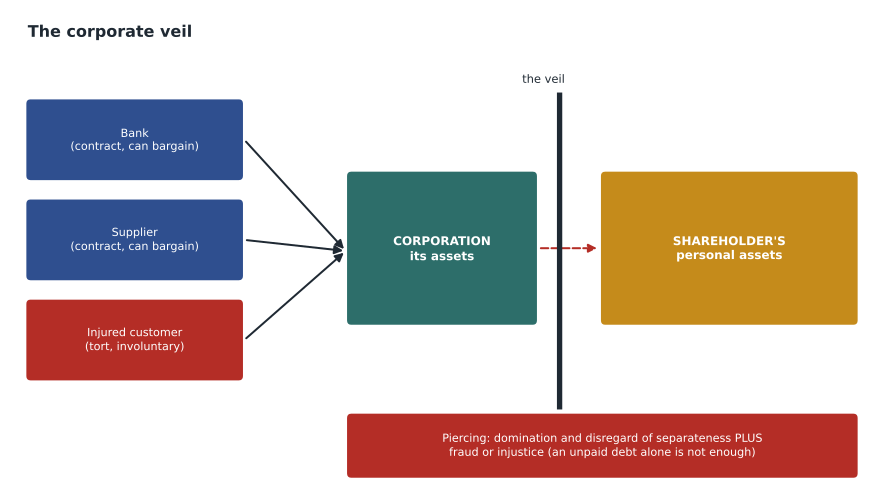
The justifications are strongest for public companies with many passive investors and contract creditors who can bargain. They are weakest for closely held companies whose owners also manage the business, and for involuntary creditors such as tort victims, who never agreed to bear the risk. That is why most veil-piercing cases involve small companies with one or a few owners, and why courts are more willing to pierce in tort cases than in contract cases, although the doctrine is notoriously unpredictable. Empirical studies of veil-piercing cases have found that courts pierce only against closely held companies and individual or parent shareholders, almost never against shareholders of public companies.
Piercing the corporate veil: the general test
Courts in every state will sometimes disregard the corporate entity and hold shareholders personally liable for the corporation's obligations, a remedy called piercing the corporate veil. There is no uniform test. Most courts require two elements, often stated as a unity of interest and ownership such that the separate personalities of the corporation and the owner no longer exist, and circumstances in which adhering to the fiction of separate existence would sanction a fraud or promote injustice. Courts use various labels, including alter ego, instrumentality and mere conduit, but the analysis usually comes to the same two questions.
For the first element, courts look at factors such as failure to observe corporate formalities, like holding meetings and keeping minutes; commingling of corporate and personal funds; treating corporate assets as the owner's own; undercapitalization; siphoning of funds by the dominant shareholder; the corporation's dependence on the owner for its operations; overlapping ownership, management, offices and employees between related companies; and holding out the corporation's credit as the owner's. No single factor is decisive, and courts emphasize that sole ownership and control, by themselves, are not enough, since every one-person corporation has them.
For the second element, courts look for some wrong beyond a creditor's inability to collect. If an unpaid debt alone were enough, every insolvent corporation would be pierced. Courts typically require that the owner used the corporate form to commit fraud, evade an existing obligation, circumvent a statute, or achieve another unjust result such as leaving creditors with an empty shell after draining its assets. In Sea-Land Services, Inc. v. Pepper Source, 941 F.2d 519 (7th Cir. 1991), the Seventh Circuit, applying Illinois law, found the first element satisfied where the owner, Gerald Marchese, ran several corporations out of one office, used corporate funds to pay personal expenses, and moved money among the companies at will, but remanded for proof of the second element, explaining that an unpaid judgment was not itself the required injustice. On remand, the district court found that Marchese had used the companies to avoid creditors and pierced the veil, and the Seventh Circuit affirmed.
Undercapitalization and tort creditors
Undercapitalization is a recurring factor, especially in tort cases. The question is whether the owners put enough money or insurance into the business to cover the risks it was reasonably expected to create. The leading illustration is Walkovszky v. Carlton, 18 N.Y.2d 414 (1966). Carlton owned ten taxicab corporations, each owning two cabs and carrying only the minimum liability insurance New York required, then 10,000 dollars per cab. The plaintiff, injured by one cab, sued Carlton personally. The New York Court of Appeals held that the complaint failed to state a claim against Carlton personally, because it alleged only that the corporations were thinly capitalized and part of a larger enterprise, not that Carlton was conducting the business in his individual capacity. The court noted that the legislature, not the courts, should decide whether the minimum insurance was adequate.
Walkovszky illustrates two theories. The first is ordinary veil piercing to reach a shareholder personally. The second is enterprise liability, which treats several commonly owned corporations as a single business, so that creditors of one can reach the assets of the others, without reaching the owner's personal assets. The court in Walkovszky suggested that enterprise liability might apply if the companies were operated as a single enterprise, which the plaintiff could plead on remand. Some states recognize enterprise liability; others, including Delaware, are skeptical of it. Courts are divided on whether undercapitalization alone can justify piercing. Most treat it as an important factor but not sufficient by itself.
| First element: domination and disregard of separateness | Second element: fraud or injustice |
|---|---|
| Failure to observe formalities (meetings, minutes, records) | Using the entity to commit fraud or misrepresentation |
| Commingling corporate and personal funds | Draining assets to leave creditors with a shell |
| Undercapitalization for foreseeable risks | Evading an existing legal obligation or statute |
| Paying personal expenses with company money | Misleading creditors about who stands behind the business |
| Shared offices, staff and accounts among affiliates | Unjust enrichment of the owner at creditors' expense |
| Owner treating company assets as personal | (An unpaid debt alone is not enough) |
Contract versus tort creditors
Many courts and commentators argue that piercing should be harder for contract creditors than for tort creditors. A contract creditor chose to deal with a limited liability entity and could have demanded a personal guarantee, collateral or a higher price. Unless the creditor was misled about the entity's finances or the owner's role, it should bear the risk it accepted. A tort victim made no such choice. Courts sometimes frame this as a question of whether the creditor was misled. In practice, the case law is inconsistent, and some studies have found that courts pierce at least as often in contract cases, perhaps because contract cases more often involve misrepresentation.
Parent and subsidiary corporations
Veil piercing also arises when a parent corporation owns a subsidiary. Owning all of a subsidiary's stock, sharing directors and officers, and filing consolidated tax returns do not by themselves justify holding the parent liable. In United States v. Bestfoods, 524 U.S. 51 (1998), the Supreme Court held that a parent corporation is not liable under the federal Superfund statute, CERCLA, for its subsidiary's pollution merely because it owns and controls the subsidiary; it can be liable derivatively if the corporate veil may be pierced under ordinary principles, or directly if it actively participated in and exercised control over the operations of the facility itself. Thackeray tells the class that Bestfoods is a good statement of the general principle: limited liability applies to corporate shareholders as well as individuals, but a parent that runs the subsidiary's operations directly may be liable for its own conduct.
Piercing in LLCs
Courts apply veil-piercing doctrine to LLCs, usually using the corporate factors. But because LLC statutes deliberately reduce formalities, many statutes, including RULLCA section 304(b), provide that the failure of an LLC to observe formalities relating to the exercise of its powers or management of its activities is not a ground for imposing liability on the members or managers. Courts therefore give less weight to missing meetings or minutes in LLC cases and focus on commingling, undercapitalization and fraud. Delaware courts have pierced LLC veils in egregious cases, applying a test that requires showing the entity was a sham existing only to serve as a vehicle for fraud or a similar injustice.
Reverse piercing and other routes to the owner
In reverse veil piercing, a creditor of the shareholder asks the court to reach the corporation's assets to satisfy the shareholder's personal debt, or the owner asks the court to disregard the entity for its own benefit. Courts are cautious about reverse piercing because it can harm the corporation's other shareholders and creditors. In Manichaean Capital, LLC v. Exela Technologies, Inc., 251 A.3d 694 (Del. Ch. 2021), the Court of Chancery recognized outsider reverse veil piercing under Delaware law in limited circumstances, listing factors for courts to consider, including the impact on innocent shareholders and creditors.
Veil piercing is not the only way to reach owners. An owner who personally guaranteed a debt is liable on the guarantee. An owner who personally committed a tort, such as fraud or negligent driving, is liable for it regardless of the entity. Fraudulent transfer law, codified in most states in the Uniform Voidable Transactions Act, lets creditors undo transfers made with intent to hinder, delay or defraud creditors, or transfers made for less than reasonably equivalent value while the debtor was insolvent. Corporate statutes limit distributions to shareholders when the corporation is insolvent, and directors who approve unlawful distributions can be personally liable under MBCA section 8.33 and DGCL section 174. Federal and state statutes sometimes impose personal liability on responsible officers for unpaid payroll taxes and certain wages. Thackeray tells the class that these targeted rules often work better for creditors than the unpredictable doctrine of veil piercing.
Worked problem
The Juniper Hill delivery companies
In Thackeray's hypothetical, Juniper Hill Foods, Inc. later forms a wholly owned subsidiary, JH Delivery LLC, to run its delivery trucks. JH Delivery has two trucks, minimal insurance and no assets except the trucks, which it leases from Juniper Hill Foods. Its bank account is often empty; Juniper Hill Foods pays its bills when needed and sweeps any surplus back. The two companies share an office, a manager and a logo, and JH Delivery has never held a meeting. A JH Delivery truck driver, speeding, injures a pedestrian, whose damages greatly exceed the subsidiary's insurance. Can the pedestrian reach Juniper Hill Foods?
Show solution
- Vicarious liability: JH Delivery is liable for its employee's negligence under respondeat superior. The question is whether the parent can be reached too.
- First element: the subsidiary appears dominated by the parent: shared office and manager, money moved back and forth, no separate finances, no assets of its own, and thin capitalization for a business with foreseeable traffic risks. Under RULLCA section 304(b), missing meetings counts for little, but commingling and undercapitalization count heavily.
- Second element: the pedestrian is an involuntary tort creditor who never chose to deal with a thinly capitalized subsidiary. Arguably the structure was designed to leave tort victims with an empty company while profits flowed to the parent, which courts may treat as an injustice beyond mere inability to pay.
- Alternatively, the pedestrian may argue direct liability if the parent controlled the delivery operations (Bestfoods), or enterprise liability if the jurisdiction recognizes it.
Answer: The pedestrian has a substantial claim to pierce JH Delivery's veil, because the parent dominated and commingled with an undercapitalized subsidiary in a way that left foreseeable tort victims without recourse, though the outcome depends on the jurisdiction's test; adequate insurance and genuine separateness would have made the shield far more secure.
Keeping the shield intact
Thackeray closes with practical advice for clients. Capitalize the business adequately for its foreseeable risks, and carry insurance. Keep separate bank accounts and never pay personal expenses from the business account. Sign contracts in the entity's name, with your title. Keep records of major decisions, even in an LLC that is not required to hold meetings. Document transactions between related companies at fair terms. Do not move assets out of a company that owes money. "Limited liability is a privilege the law grants," she says. "Courts take it away from people who treat the company as a wallet."
Summary and key terms
- Shareholders and LLC members are generally not liable for the entity's obligations beyond their investment, except for their own conduct.
- Courts pierce the veil when the owner so dominated the entity that its separateness was disregarded and respecting the entity would sanction fraud or injustice.
- Factors include commingling, undercapitalization, failure to observe formalities, siphoning and shared operations; an unpaid debt alone is not enough.
- Walkovszky v. Carlton shows the limits of piercing for thin capitalization and the alternative of enterprise liability.
- A parent is not liable for a subsidiary merely by owning it (Bestfoods), but may be liable derivatively by piercing or directly for its own operations.
- Guarantees, the owner's own torts, fraudulent transfer law and unlawful distribution statutes provide other routes to owners.
Practice problems
Work each problem on paper first, then reveal the answer to check.
Why is an unpaid judgment alone not enough to pierce the veil?
Show answer
Because otherwise every insolvent corporation would be pierced; courts require fraud or another injustice beyond the inability to collect.
What did the court decide in Walkovszky v. Carlton?
Show answer
The complaint failed to state a claim against the owner personally because it alleged only thin capitalization and a larger enterprise, not that he conducted the business individually.
How does RULLCA treat an LLC's failure to observe formalities?
Show answer
It is not a ground for imposing personal liability on members or managers.
Under Bestfoods, when may a parent be directly liable for a subsidiary's facility?
Show answer
When the parent actively participated in and exercised control over the operations of the facility itself.
Why are courts said to be more willing to pierce for tort creditors?
Show answer
Tort victims did not choose to deal with a limited liability entity and could not bargain for guarantees or higher prices.
Lesson quiz · 5 questions
Score 60% or more to complete this lesson.
Create a free account to save your progress, take quizzes and earn a certificate.