
LAWU-202 · Lesson 8 of 12 · 24 min
The duty of loyalty, conflicted transactions and controllers
▶ Video coming soon A video version of this lesson is on the way.
"The duty of care asks whether directors paid attention," Professor Thackeray tells Section B. "The duty of loyalty asks whose side they were on. When a director sells land to the company, takes a business opportunity for herself, or a controlling stockholder buys out the minority, the people deciding are not neutral. Corporate law does not forbid these transactions. Many of them are good for the company. It asks how they were approved and whether they were fair." She adds that this is the area of corporate law that changed most in 2025 and 2026, and that the class will learn the old rules and the new ones.
The duty of loyalty requires directors, officers and controlling stockholders to act in the best interests of the corporation and its stockholders rather than in their own interests. In Guth v. Loft, Inc., 5 A.2d 503 (Del. 1939), the Delaware Supreme Court described the rule as demanding that there be no conflict between duty and self-interest, and requiring an undivided and unselfish loyalty to the corporation. Loyalty claims fall into several patterns: self-dealing transactions between the corporation and a director or officer, usurping corporate opportunities, competing with the corporation, excessive executive compensation, and transactions with controlling stockholders. Because section 102(b)(7) cannot exculpate loyalty breaches, these are the claims in which directors face real damages exposure.
Interested directors and independence
A director is interested in a transaction if the director appears on both sides of it or expects to derive a personal financial benefit from it not equally shared by the stockholders. A director lacks independence if the director is beholden to an interested party or so under its influence that the director's discretion would be sterilized, for example because the interested party controls the director's employment or because of deep personal or business ties. Delaware courts assess independence on all the facts. In Delaware County Employees Retirement Fund v. Sanchez, 124 A.3d 1017 (Del. 2015), the court held that a fifty-year close friendship combined with substantial business ties raised a reasonable doubt about a director's independence. In Marchand v. Barnhill, discussed in lesson 7, the court found that a director's long relationship with the family that ran Blue Bell, including a building named after his late father, undermined his independence.
Delaware's 2025 amendments, known as Senate Bill 21, added statutory definitions. A disinterested director is one who is not a party to the transaction and has no material interest in it or material relationship with a person who is a party. For a corporation with a class of stock listed on a national securities exchange, a director whom the board has determined satisfies the exchange's independence standards is presumed to be disinterested, and the presumption can be rebutted only by substantial and particularized facts that the director has a material interest in the transaction or a material relationship with a party.
Self-dealing transactions and the safe harbor
At common law, contracts between a corporation and its directors were once voidable at the corporation's option regardless of fairness. Statutes now provide safe harbors. Delaware's section 144, before 2025, provided that a transaction with an interested director or officer would not be void or voidable solely because of the conflict if the material facts were disclosed and the transaction was approved in good faith by a majority of the disinterested directors, or by the stockholders, or if it was fair to the corporation when authorized. Delaware courts held that the statute only removed the old voidability rule; whether the directors breached their fiduciary duties was a separate question under the common law of loyalty. MBCA subchapter 8F provides a more detailed safe harbor for director conflicting interest transactions, approved by qualified directors or disinterested shareholders after required disclosure, or shown to be fair.
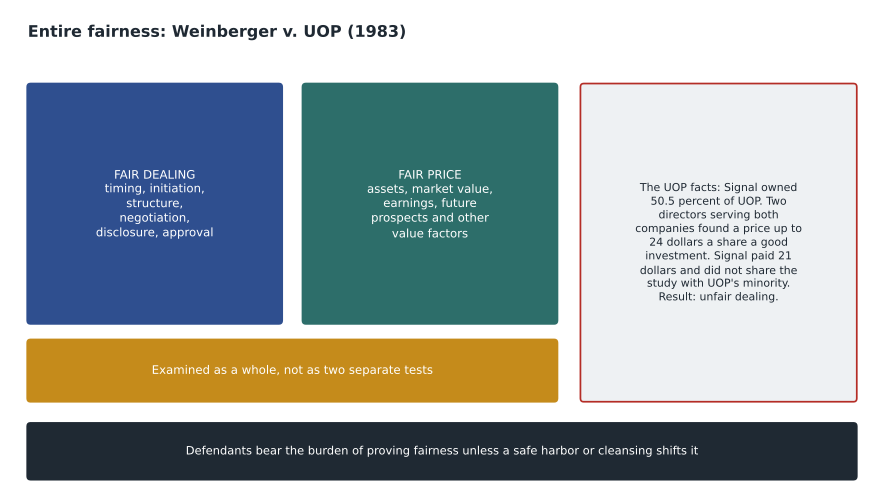
Absent valid cleansing, a transaction in which a majority of the board is interested, or in which the board is dominated by an interested party, is reviewed for entire fairness. Under Weinberger v. UOP, Inc., 457 A.2d 701 (Del. 1983), entire fairness has two aspects: fair dealing, which covers the timing, initiation, structure, negotiation, disclosure and approval of the transaction, and fair price, which concerns its economic terms. The test is not bifurcated; the court examines the transaction as a whole. In Weinberger, the minority stockholders of UOP were cashed out by its majority owner, Signal, after two directors serving both companies prepared a feasibility study showing that a higher price would still be a good investment for Signal, and Signal did not share the study with UOP's minority. The court held that the merger failed the fair dealing test.
Senate Bill 21: the new section 144
In March 2025, Delaware enacted Senate Bill 21, which rewrote section 144 to create safe harbors that protect conflicted transactions from equitable relief and damages if they follow specified procedures, displacing much of the common law described above. Under the new section 144(a), a transaction involving an interested director or officer, other than a controlling stockholder transaction, is protected if, after disclosure of the material facts, it is approved in good faith by a majority of the disinterested directors, even if they are less than a quorum, or by a committee of at least two disinterested directors; or approved or ratified by a majority of the votes cast by disinterested stockholders in an informed, uncoerced vote; or if it is fair to the corporation.
For controlling stockholder transactions other than going-private transactions, section 144(b) provides protection if the transaction is approved or recommended by a committee of at least two directors, all of whom the board has determined to be disinterested, to which the board delegated authority to negotiate and reject it; or if it is conditioned, at or before the time it is submitted to stockholders, on approval by a majority of the votes cast by disinterested stockholders and is so approved; or if it is fair. For going-private transactions, which eliminate the minority's shares, section 144(c) requires both the committee approval and the disinterested stockholder vote, with the vote condition in place at or before submission to stockholders. The statute defines a controlling stockholder as one who owns a majority of the voting power, or one who has the right to elect a majority of the board, or one who owns at least one third of the voting power and exercises managerial authority over the business. SB 21 also provides that controlling stockholders are not liable for monetary damages for breaches of the duty of care, and amended section 220, discussed in lesson 9.
SB 21 changed prior case law in several ways. Under Kahn v. M and F Worldwide Corp., 88 A.3d 635 (Del. 2014), known as MFW, a controller's going-private merger could receive business judgment review only if it was conditioned from the outset on both approval by a fully empowered independent committee and a fully informed, uncoerced vote of a majority of the minority. In In re Match Group, Inc. Derivative Litigation, 315 A.3d 446 (Del. 2024), the Delaware Supreme Court extended MFW to all controlling stockholder transactions in which the controller receives a non-ratable benefit and required every committee member to be independent. SB 21 replaced these rules: outside going-private deals, either a committee or a stockholder vote suffices; the vote condition need not be in place from the outset; and the stockholder vote counts votes cast rather than all outstanding minority shares. The amendments apply to transactions occurring before as well as after enactment, except in litigation already pending.
Opponents challenged SB 21 as unconstitutional, arguing that it stripped the Court of Chancery of its historic equity jurisdiction and that its retroactive application violated due process. On February 27, 2026, the Delaware Supreme Court, sitting en banc, unanimously rejected both arguments on questions certified from the Court of Chancery in Rutledge v. Clearway Energy Group LLC. The court held that the legislature may change the substantive law governing fiduciary claims, as it did in enacting section 102(b)(7), without removing the Court of Chancery's jurisdiction, and that applying the new standards to past transactions did not deprive the plaintiff of a vested right, because he could still challenge the transaction under the new framework.
| Transaction | Safe harbor options | Notes |
|---|---|---|
| Interested director or officer (no controller) | Majority of disinterested directors or a committee of two or more; OR majority of votes cast by disinterested stockholders; OR fairness | Disclosure of material facts required |
| Controlling stockholder, not going-private | Committee of two or more disinterested directors with authority to negotiate and reject; OR majority of votes cast by disinterested stockholders (condition set at or before submission); OR fairness | Replaced Match Group's requirement of both protections |
| Controlling stockholder going-private | BOTH the committee AND the disinterested stockholder vote; OR fairness | Condition need not be set from the outset (unlike MFW) |
| Exchange-listed director's independence | Presumed disinterested if independent under exchange rules | Rebuttable only by substantial and particularized facts |
Stockholder ratification outside the statute: Corwin
Delaware courts have also given cleansing effect to stockholder votes outside section 144. In Corwin v. KKR Financial Holdings LLC, 125 A.3d 304 (Del. 2015), the Delaware Supreme Court held that when a transaction not subject to entire fairness review, because no controlling stockholder is involved, is approved by a fully informed, uncoerced vote of the disinterested stockholders, the business judgment rule applies, and post-closing damages claims will usually be dismissed. Corwin cleansing fails if the vote was not fully informed, for example because the proxy statement omitted or misstated material facts, which is why disclosure claims now dominate merger litigation.
Corporate opportunities
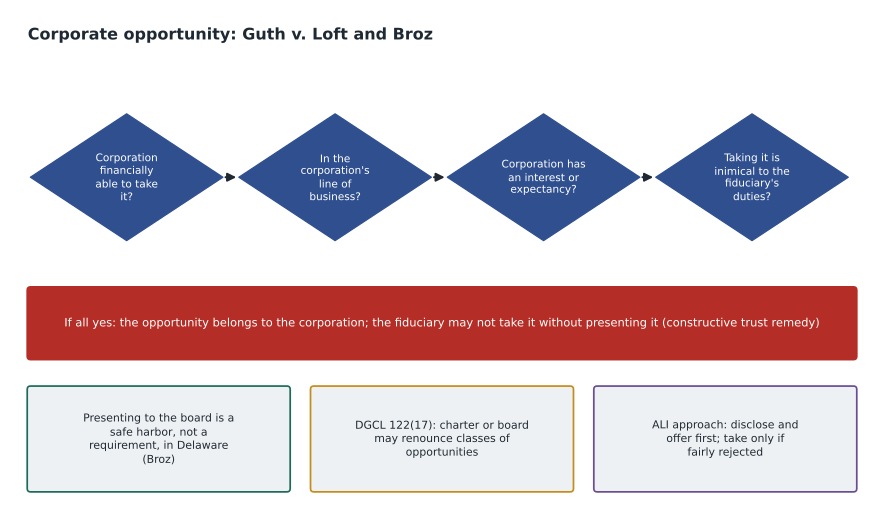
A director or officer may not take for personal benefit a business opportunity that belongs to the corporation. Under the test stated in Guth v. Loft and refined in Broz v. Cellular Information Systems, Inc., 673 A.2d 148 (Del. 1996), a fiduciary may not take an opportunity if the corporation is financially able to exploit it, the opportunity is within the corporation's line of business, the corporation has an interest or expectancy in it, and by taking it the fiduciary will be placed in a position inimical to his duties to the corporation. In Broz, a director of CIS who also owned another cellular company bought a license that CIS, then financially troubled, had no interest in pursuing; the court held that Broz did not usurp a corporate opportunity, and that presenting it formally to the board, while a safe harbor, was not required.
Delaware's section 122(17) allows a corporation, in its charter or by board action, to renounce any interest or expectancy in specified business opportunities or classes of opportunities. Venture capital and private equity investors who sit on many boards often insist on such renunciations. The ALI Principles of Corporate Governance, followed in some states, take a stricter approach, requiring the fiduciary to first offer the opportunity to the corporation and disclose the conflict, and allowing the fiduciary to take it only if the corporation rejects it fairly.
Executive compensation and the Tesla litigation
Directors setting their own pay are interested, and their decisions receive entire fairness review unless cleansed. Compensation of officers set by independent directors usually receives business judgment protection. The most important recent compensation case is the Tesla litigation. In Tornetta v. Musk, 310 A.3d 430 (Del. Ch. 2024), the Court of Chancery held that Elon Musk was Tesla's controlling stockholder for purposes of his 2018 performance award, despite owning about 22 percent of its stock, because of his dominance over the company and its board; that the award was subject to entire fairness review because the stockholder vote approving it was not fully informed; and that the defendants failed to prove it fair. The court ordered the award rescinded, and later rejected the company's argument that a 2024 stockholder vote ratified it.
On December 19, 2025, the Delaware Supreme Court reversed the rescission remedy in In re Tesla, Inc. Derivative Litigation. In a per curiam opinion, the court held that rescission was an improper remedy because it would leave Musk uncompensated for six years of work, and that the plaintiff, who had the burden of establishing entitlement to relief, was entitled only to nominal damages of one dollar. The court reinstated the 2018 award and replaced the trial court's fee award of about 345 million dollars with a fee based on counsel's hours and a multiplier. It did not decide whether the award was entirely fair or whether the 2024 vote ratified it. Thackeray tells the class that the case shows how the remedy can matter as much as the liability finding, and that it was part of the backdrop to SB 21 and the departures from Delaware discussed in lesson 1.
Controlling stockholders' duties in other states
Delaware has long held that controlling stockholders owe fiduciary duties to the minority when they exercise control. In Sinclair Oil Corp. v. Levien, 280 A.2d 717 (Del. 1971), the court held that a parent's decision to cause its subsidiary to pay large dividends, received ratably by all stockholders, was protected by the business judgment rule, while the parent's causing the subsidiary not to enforce a contract against another parent affiliate was self-dealing subject to intrinsic fairness review. Not every state follows Delaware. Nevada's 2025 amendments provide that a controlling stockholder's only duty is to refrain from unduly influencing directors or officers to breach their duties to obtain a material, non-ratable benefit, and Texas's 2025 amendments codified a protective business judgment rule. These differences are among the reasons companies have weighed reincorporation.
Worked problem
The warehouse deal
In Thackeray's hypothetical, Juniper Hill Foods, Inc., a Delaware corporation, plans to buy a refrigerated warehouse owned by Owen Marsh personally for 2.4 million dollars. Owen is a director and owns 35 percent of the voting stock; he chairs the board, runs the company day to day and picks its officers. The other directors are Lena (another family member), the outside investor's designee and two independent directors. The board forms a committee of the two independent directors, gives it authority to negotiate and to reject the deal, and the committee hires an appraiser and negotiates the price down to 2.1 million dollars before approving it. A minority stockholder sues. What standard applies?
Show solution
- Owen is interested: he is on both sides. He may also be a controlling stockholder under the amended statute, because he owns at least one third of the voting power and exercises managerial authority over the business.
- If Owen is a controller, the transaction is not going-private, so section 144(b) applies: approval by a committee of at least two disinterested directors with authority to negotiate and reject suffices, after disclosure of material facts.
- The committee members appear disinterested; if the company were exchange-listed and the board had found them independent under exchange rules, they would be presumed disinterested.
- Because the safe harbor is satisfied, the transaction is protected from equitable relief and damages unless the plaintiff shows the committee members were not in fact disinterested, the disclosure was inadequate, or the approval was not in good faith.
- Before SB 21, Match Group would have required both a committee and a majority-of-the-minority vote for business judgment review of a controller transaction.
Answer: Under amended section 144(b), the independent committee's informed, good-faith approval protects the warehouse purchase from equitable relief and damages, so the minority stockholder's claim will likely be dismissed unless the committee's independence or disclosures can be impeached.
Summary and key terms
- The duty of loyalty forbids fiduciaries from preferring their own interests; loyalty breaches cannot be exculpated.
- Conflicted transactions not properly cleansed receive entire fairness review, examining fair dealing and fair price together.
- Delaware's 2025 Senate Bill 21 rewrote section 144, creating safe harbors through disinterested director or committee approval or disinterested stockholder votes, and requiring both for controller going-private deals.
- SB 21 displaced MFW's ab initio requirement and Match Group's dual requirement, and the Delaware Supreme Court upheld it in February 2026.
- Corwin gives business judgment review to non-controller deals approved by fully informed, uncoerced disinterested stockholders.
- The corporate opportunity doctrine follows Guth and Broz; charters may renounce classes of opportunities under section 122(17).
- In December 2025 the Delaware Supreme Court reinstated Musk's 2018 Tesla award, holding rescission an improper remedy.
Practice problems
Work each problem on paper first, then reveal the answer to check.
What two aspects of entire fairness did Weinberger describe?
Show answer
Fair dealing, covering how the transaction was timed, structured, negotiated, disclosed and approved, and fair price, covering its economic terms, examined as a whole.
How did SB 21 change the rule for controller transactions that are not going-private?
Show answer
Either approval by a committee of at least two disinterested directors with authority to negotiate and reject, or a majority of votes cast by disinterested stockholders, suffices, rather than both.
What did the Delaware Supreme Court decide about SB 21 in February 2026?
Show answer
It unanimously upheld it, holding that it did not strip the Court of Chancery of equity jurisdiction and that retroactive application did not violate due process.
Why did Broz not usurp a corporate opportunity?
Show answer
CIS was financially unable and uninterested, the opportunity was not one in which CIS had an expectancy, and formal presentation to the board was not required.
On what ground did the Delaware Supreme Court reverse in the Tesla case?
Show answer
Rescission was an improper remedy that would leave Musk uncompensated for six years of work; the plaintiff received nominal damages.
Lesson quiz · 5 questions
Score 60% or more to complete this lesson.
Create a free account to save your progress, take quizzes and earn a certificate.