
LAWU-202 · Lesson 1 of 12 · 24 min
Choosing a business form
▶ Video coming soon A video version of this lesson is on the way.
Professor Vivian Thackeray opens Business Associations by writing three names on the board: Lena Marsh, Owen Marsh and Juniper Hill Creamery. "You met this family business last year in Contracts," she tells Section B, now in its second year. "Professor Ashgrove taught you about their refrigeration system and their cheddar contract. This semester we ask a different question. Who owns Juniper Hill, who runs it, who is liable for its debts, and what do the people in charge owe one another? Every one of those questions turns on the form of the business, and most small business owners never choose a form on purpose."
Thackeray spent eleven years litigating corporate cases in Wilmington, Delaware, much of it in the Court of Chancery, and then six years as general counsel of a mid-sized public company that makes packaging. She tells the class that she will teach the course through one running problem: Juniper Hill as it is today, and Juniper Hill as it might grow over the next decade in a series of hypotheticals she will label as hypotheticals. Everything about the creamery and the people in it is fictional, and so is the State of Westmarch, where she will place the business for the semester. Westmarch, she says, has adopted the main uniform acts that many real states use, so the rules we study are real rules even though the facts are invented.
Why business organization law exists
Business organization law answers a small number of questions that arise whenever people pool money, labor or ideas. Who has authority to bind the business to contracts? Who is personally liable when the business cannot pay? How are profits shared and decisions made? What duties do the people in control owe to those who are not? How does someone get out, and what happens when the founders disagree? Different business forms give different default answers, and the parties can change many of those defaults by agreement.
Economists describe these rules as responses to agency costs. When an owner hires a manager, or many investors entrust money to a board, the people in control may act in their own interest rather than the owners'. The law reduces that risk in three ways: by giving owners voting and exit rights, by imposing fiduciary duties on those in control, and by requiring disclosure. It also lowers the cost of doing business by supplying standard terms, so that every small business does not need to write a full constitution for itself. Thackeray tells the class to ask, for every rule this semester, which of those jobs the rule is doing.
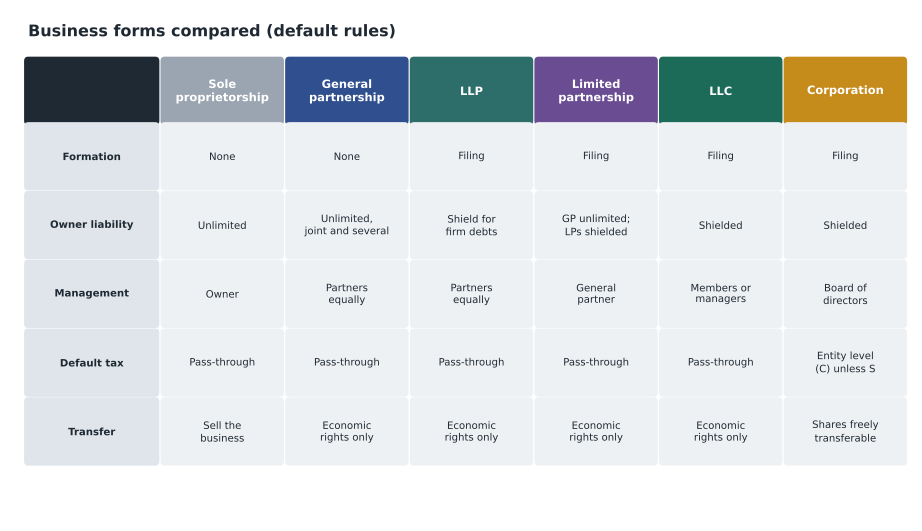
The menu of forms
The sole proprietorship is the default for one person in business alone. It requires no filing. The owner and the business are legally the same person: the owner owns the assets, signs the contracts and is personally liable for every debt and every tort committed in the business. Income is reported on the owner's personal tax return. A proprietor may operate under a trade name, which most states require to be registered as an assumed or fictitious name, but the registration does not create a separate entity.
The general partnership is the default for two or more people who carry on a business together for profit. Like the proprietorship, it can arise without any filing, and often without the partners realizing they have formed one. Under the Revised Uniform Partnership Act, which most states have adopted in some version, a partnership is an entity distinct from its partners, but each partner is jointly and severally liable for the partnership's obligations, and each partner is an agent of the partnership for ordinary business. Lesson 3 covers partnerships in detail.
The limited liability partnership is a general partnership that has filed a statement of qualification with the state. In nearly every state today, the filing gives partners a full shield: a partner is not personally liable for partnership obligations merely because of being a partner, although each partner remains liable for his or her own torts and misconduct. Law and accounting firms are the classic users. The limited partnership has at least one general partner, who manages the business and is personally liable, and one or more limited partners, who invest but traditionally do not manage. Many states now let a limited partnership register as a limited liability limited partnership, shielding the general partner too. Lesson 4 covers these entities.
The limited liability company combines a liability shield for all its members with the flexibility and tax treatment of a partnership. It is formed by filing a certificate or articles of organization, and its internal affairs are governed mainly by an operating agreement that the members write. Since the 1990s, the LLC has become the most common choice for new closely held businesses in the United States. The corporation is the oldest of the limited liability entities. It is formed by filing articles or a certificate of incorporation, is managed by or under the direction of a board of directors elected by shareholders, and is governed by a detailed statute: the Delaware General Corporation Law, the Model Business Corporation Act or a state code based on one of them.
Beyond these, there are specialized forms. Professional corporations and professional LLCs let licensed professionals incorporate while keeping personal liability for their own malpractice. Nonprofit corporations operate under separate statutes. More than forty states have adopted benefit corporation statutes, which let a for-profit corporation commit in its charter to pursue a public benefit alongside profit, and Delaware's version, the public benefit corporation, appears in subchapter XV of its corporation statute. Cooperatives, business trusts and statutory trusts exist for particular uses. Thackeray tells the class that this course concentrates on the main forms but that the same questions apply to all of them.
The questions that decide the choice
Lawyers usually compare forms along five lines. First, liability: will the owners' personal assets be exposed to the business's debts? Second, management and control: who decides, and can a minority owner block anything? Third, taxation: is the business taxed as a separate entity, or do profits and losses pass through to the owners? Fourth, transferability and exit: can an owner sell, and can an owner leave and be paid? Fifth, formality and cost: what must be filed, what records kept and what annual fees paid? A form that is ideal on one dimension may be poor on another.
Liability protection matters less than first-year students think for some businesses and more for others. A limited liability shield protects owners from the business's contract debts and from torts committed by others in the business, but an owner who personally commits a tort, signs a personal guarantee or commingles assets remains exposed. Banks lending to small businesses commonly require the owners' personal guarantees, so the shield often matters most against tort claims and unexpected liabilities. Insurance does much of the remaining work. Still, the shield is the main reason the LLC displaced the general partnership as the default for new ventures.
Taxation drives many choices. A C corporation, named for subchapter C of the Internal Revenue Code, pays federal income tax on its profits at the entity level, and shareholders pay tax again on dividends, the problem known as double taxation. The Tax Cuts and Jobs Act of 2017 set the federal corporate rate at a flat 21 percent, which made the C corporation more attractive for businesses that reinvest their earnings. An S corporation, which must meet limits on the number and type of shareholders and may have only one class of stock, passes income through to its shareholders. Partnerships and LLCs are pass-through entities by default under the Treasury's check-the-box regulations, and an LLC may elect to be taxed as a corporation. Thackeray tells the class she will leave the details to Federal Income Tax but that no client should choose a form without a tax adviser.
| Question | General partnership (RUPA) | LLC (RULLCA and Delaware) | Corporation (MBCA and DGCL) |
|---|---|---|---|
| How formed | Association to carry on as co-owners a business for profit; no filing needed | Filing articles or a certificate of organization | Filing articles or a certificate of incorporation |
| Owner liability | Joint and several for all partnership obligations | No personal liability for company obligations | No personal liability for corporate obligations |
| Who manages | Every partner equally; majority for ordinary matters | Members, unless the agreement makes it manager-managed | Board of directors; officers appointed by the board |
| Agency of owners | Each partner can bind the partnership in the ordinary course | Members are not agents merely because they are members (RULLCA) | Shareholders are not agents |
| Transfer of interest | Only economic rights transfer without consent | Only economic rights transfer without consent | Shares freely transferable unless restricted |
| Fiduciary duties | Loyalty and care, set by statute | Default duties; Delaware lets the agreement eliminate them, but not the implied covenant | Directors and officers owe loyalty and care; set by case law |
Which state's law: incorporation and the internal affairs doctrine
A business that files with a state is governed, for its internal affairs, by the law of the state where it was formed, wherever it actually operates. This is the internal affairs doctrine, which the Supreme Court recognized in Edgar v. MITE Corp., 457 U.S. 624 (1982), and CTS Corp. v. Dynamics Corp. of America, 481 U.S. 69 (1987), as serving the need for a single law on matters such as voting rights and directors' duties. Internal affairs include the relationships among the entity, its owners and its managers. External matters, such as contract and tort claims by outsiders, are governed by ordinary choice-of-law rules.
The doctrine lets a business choose its governing law by choosing where to form. A company headquartered in Ohio can incorporate in Delaware and have Delaware law govern its board's fiduciary duties. That freedom has made Delaware the leading state of incorporation for public companies. Delaware's advantages have long been described as a well-developed body of corporate case law, a specialized Court of Chancery that decides corporate disputes without juries, a legislature that updates its statute every year, and a large bar familiar with all three. Delaware remains home to roughly two thirds of the Fortune 500, and more than four in five companies that went public in 2024 chose to incorporate there.
Delaware's position has been challenged recently. After the Court of Chancery rescinded Elon Musk's 2018 Tesla pay package in 2024, Tesla's shareholders approved moving the company's incorporation to Texas, and several other companies moved to Texas or Nevada. Both states revised their statutes in 2025 to attract companies, with Texas codifying a protective business judgment rule and allowing ownership thresholds for derivative suits, and Nevada limiting the duties of controlling stockholders. Delaware responded in March 2025 with a set of amendments known as Senate Bill 21, which lesson 8 examines. Commentators disagree about how large this movement, sometimes called DExit, really is. Studies in 2025 and early 2026 counted a few dozen public companies proposing to leave Delaware, against a few that chose to enter, while most new public companies continued to choose Delaware.
Default rules and private ordering
Most business statutes are mainly sets of default rules: terms that apply unless the parties agree otherwise. A partnership agreement can change how profits are shared or how decisions are made, an operating agreement can set the managers' powers, and a corporate charter or bylaws can adjust many corporate rules. Some rules are mandatory and cannot be changed, such as a partnership's liability to third parties or a corporation's duty to hold an annual meeting for electing directors when shareholders demand it. Statutes differ in how much they leave to private ordering. Delaware's LLC Act is among the most permissive, declaring that its policy is to give maximum effect to the principle of freedom of contract.
Default rules matter most for businesses that never write an agreement. Thackeray reminds the class that Lena and Owen Marsh inherited Juniper Hill from their parents in 2015, never signed anything, and have run it ever since: Lena makes the cheese and Owen keeps the books. They file a partnership tax return prepared by their accountant. "They have a partnership," she says, "whether they know it or not, and its terms are the statute's terms. If Owen signs a contract for the creamery, Lena is personally liable. If Lena dies, the statute decides what her estate receives. That is what happens when you do not choose."
Worked problem
Advising Juniper Hill on a form
Lena and Owen Marsh ask whether they should change how Juniper Hill is organized. The creamery has 14 employees, a delivery van, a new aging room financed by a bank loan they both guaranteed, and a growing wholesale business. Lena worries about the van and about a customer becoming ill from a contaminated batch. Owen wants to bring in their cousin, Tessa Marsh, as a minority investor without giving her a vote on daily operations. They want to keep paying tax only once. What would you consider?
Show solution
- Identify the current form: two co-owners carrying on a business for profit without a filing are a general partnership, so each faces unlimited personal liability.
- Liability: an LLC or corporation would shield their personal assets from the business's torts and contract debts, but not from their own torts or the bank loan they personally guaranteed. Insurance remains important.
- Management: an LLC can give Tessa an economic interest with limited voting rights through the operating agreement; a corporation could issue nonvoting stock, though an S corporation may have only one class of stock (differences in voting rights alone are allowed).
- Taxation: an LLC taxed as a partnership, or a corporation electing S status if eligible, avoids entity-level tax. A C corporation would face double taxation on distributed profits.
- Formality: converting requires filings, transferring assets and contracts, and drafting an operating agreement that addresses exit, deadlock and death.
Answer: An LLC taxed as a partnership is likely the best fit: it shields Lena and Owen from the creamery's debts and torts other than their own, allows a custom operating agreement giving Tessa an economic stake with limited voting rights, and keeps pass-through taxation. The bank guarantee remains their personal obligation, and they should keep product liability insurance.
How this course is organized
The course moves from the simplest relationships to the most complex. Lesson 2 covers agency, the foundation of every business form, because businesses act only through people. Lessons 3 and 4 cover partnerships and the hybrid entities: limited partnerships, limited liability partnerships and LLCs. Lessons 5 and 6 turn to the corporation: forming it, its structure, and limited liability and its limits. Lessons 7 and 8 cover fiduciary duties, the heart of corporate law. Lesson 9 covers shareholders' voting and information rights and the special problems of closely held corporations. Lesson 10 covers mergers, takeovers and appraisal. Lesson 11 covers shareholder litigation and the basics of federal securities law. Lesson 12 is a capstone problem.
Business associations is also tested on the bar exam. The Multistate Essay Examination tests agency, partnership, corporations and LLCs, and the NextGen bar exam includes business associations among its foundational concepts. Thackeray tells the class that many students find this course dry until they realize it is a course about trust: who can be trusted with other people's money, and what the law does when that trust fails.
Summary and key terms
- The main forms are the sole proprietorship, general partnership, limited liability partnership, limited partnership, LLC and corporation.
- Forms differ in liability, management, taxation, transferability and formality; no form is best on every dimension.
- General partnerships and proprietorships arise without filing and expose owners to unlimited personal liability.
- The internal affairs doctrine applies the law of the state of formation to relationships among the entity, its owners and managers.
- Delaware dominates public company incorporation, but Texas and Nevada revised their statutes in 2025 to compete, and Delaware responded with Senate Bill 21.
- Most business statutes supply default rules that the parties can change by agreement, within mandatory limits.
Practice problems
Work each problem on paper first, then reveal the answer to check.
Why might the owners of an LLC still lose personal assets to a creditor of the business?
Show answer
They may have personally guaranteed the debt, personally committed a tort, or caused a court to disregard the entity, for example by commingling assets.
What does the internal affairs doctrine decide, and what does it leave to ordinary choice of law?
Show answer
It applies the state of formation's law to relationships among the entity, its owners and managers; claims by outsiders such as contract and tort plaintiffs follow ordinary choice-of-law rules.
What is double taxation?
Show answer
A C corporation pays tax on its profits, and shareholders pay tax again when those profits are distributed as dividends.
How can two people form a general partnership without intending to?
Show answer
By carrying on as co-owners a business for profit; no filing or intent to be partners is required.
What did Texas and Nevada change in 2025, and how did Delaware respond?
Show answer
Texas codified a protective business judgment rule and allowed derivative suit ownership thresholds; Nevada limited controlling stockholders' duties; Delaware enacted Senate Bill 21, revising its conflicted-transaction safe harbors and books-and-records rules.
Lesson quiz · 5 questions
Score 60% or more to complete this lesson.
Create a free account to save your progress, take quizzes and earn a certificate.