
LAWU-202 · Lesson 2 of 12 · 24 min
Agency
▶ Video coming soon A video version of this lesson is on the way.
"Juniper Hill cannot sign anything," Professor Thackeray tells Section B. "Neither can a partnership, an LLC or a corporation. Every business acts through human beings: owners, managers, employees and independent contractors. Agency law decides when what those people do counts as what the business did. It is the plumbing under every other lesson in this course." She asks how many students have ever bought something on a company credit card, signed for a delivery at work, or told a customer what their employer would do. Most hands go up. "Then you have acted as an agent," she says, "and you have bound someone else."
The main source of agency law is the common law, collected in the Restatement (Third) of Agency, published by the American Law Institute in 2006. Courts frequently cite it, and it largely continues the Restatement (Second) of 1958, which older cases follow. Agency principles apply to every business form, and partnership and LLC statutes build on them. This lesson covers four questions: when an agency relationship exists, when a principal is bound by an agent's contracts, when a principal is liable for an agent's torts, and what agents and principals owe each other.
Creating an agency relationship
Section 1.01 of the Restatement (Third) defines agency as the fiduciary relationship that arises when one person, the principal, manifests assent to another person, the agent, that the agent shall act on the principal's behalf and subject to the principal's control, and the agent manifests assent or otherwise consents so to act. Three elements matter: assent by both, action on the principal's behalf, and the principal's right to control. The parties need not call their relationship agency, need not intend the legal consequences, and need not have a contract or pay compensation. A friend who agrees to sell your car for you is your agent.
Control is the element that causes the most difficulty. The principal need not exercise control over every detail; the right to give interim instructions is enough. Courts distinguish agency from other relationships such as a buyer and seller, or a lender and borrower. In A. Gay Jenson Farms Co. v. Cargill, Inc., 309 N.W.2d 285 (Minn. 1981), the Minnesota Supreme Court held that Cargill, which financed a grain elevator and became deeply involved in its operations, had become the elevator's principal, making Cargill liable to farmers who sold grain to the failed elevator. The court relied on Cargill's constant recommendations, its right of first refusal on grain, its inspections, its correspondence on management, and its financing of the elevator's operations. Thackeray calls Cargill a warning to lenders who take over their borrowers' businesses.
Whether a worker is an employee or an independent contractor is a separate but related question. Under the Restatement (Third), an employee is an agent whose principal controls or has the right to control the manner and means of the agent's performance of work. An independent contractor may still be an agent for some purposes, such as a lawyer negotiating for a client, but the principal does not control how the work is done. The distinction matters most for tort liability, discussed below, and also for employment and tax law, which use their own tests.
When the principal is bound by contracts: actual authority
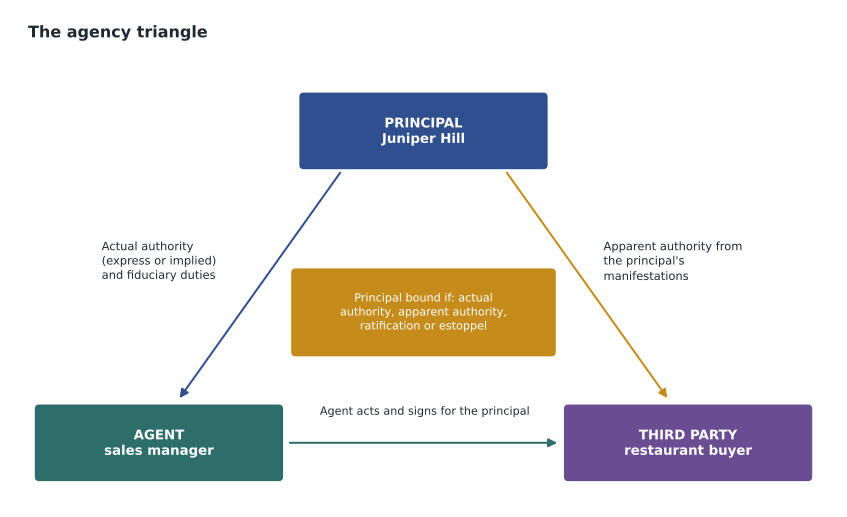
A principal is bound by an agent's contract if the agent acted with actual authority. Under section 2.01, an agent acts with actual authority when, at the time of taking action that has legal consequences for the principal, the agent reasonably believes, in accordance with the principal's manifestations to the agent, that the principal wishes the agent so to act. The focus is on the agent's reasonable understanding of what the principal communicated to the agent. Actual authority may be express, stated in words, or implied, meaning authority to do what is incidental to or reasonably necessary for the express task, or what the agent reasonably believes the principal wants from the circumstances.
Thackeray gives an example. Juniper Hill hires Rafael Ruiz as wholesale sales manager and tells him to sign up restaurants and grocers at the prices on the creamery's price sheet. Rafael has express actual authority to sign standard sales contracts. He likely also has implied actual authority to arrange delivery dates, to offer free samples, and to accept a reasonable small discount if that is common in the trade. He has no actual authority to sell the delivery van or to borrow money, because nothing in his instructions or the circumstances would lead a reasonable sales manager to believe Lena and Owen wanted that.
Apparent authority
A principal may also be bound when the agent lacked actual authority but the third party reasonably believed the agent had it. Under section 2.03, apparent authority is the power held by an agent or other actor to affect a principal's legal relations with third parties when a third party reasonably believes the actor has authority to act on behalf of the principal and that belief is traceable to the principal's manifestations. The key is that the manifestation must come from the principal, not the agent. An agent cannot create apparent authority by bragging about it.
Principals create apparent authority in many ways: by giving someone a title such as manager or treasurer, by placing someone in a position that customarily carries certain authority, by past dealings in which the principal honored the agent's acts, or by failing to correct an impression the principal knows a third party holds. Apparent authority also explains why a principal that limits an agent's authority must tell third parties who have dealt with the agent. If Juniper Hill fires Rafael but does not tell the restaurants he has been dealing with, a restaurant that signs an order with him the next week may hold the creamery to it.
Thackeray tells the class about a classic case of lingering authority. In the older line of cases on terminated agents, courts held principals liable where a third party had dealt with the agent before and had no notice of the termination. The Restatement (Third) adopts that result in section 3.11, providing that apparent authority ends when it is no longer reasonable for the third party to believe the agent continues to act with authority. Giving the third party notice, or circumstances that make continued belief unreasonable, ends it.
| Doctrine | Whose perspective | Source | Example |
|---|---|---|---|
| Express actual authority | Agent's reasonable belief | Principal's words to the agent | "Sign standard orders at list prices" |
| Implied actual authority | Agent's reasonable belief | What is incidental to the task or reasonably inferred | Setting delivery dates for those orders |
| Apparent authority | Third party's reasonable belief | Principal's manifestations to the third party | A title or past practice honoring the agent's deals |
| Ratification | Principal's later assent | Principal affirms an unauthorized act | Principal accepts the benefits knowing the facts |
| Estoppel | Third party's detrimental reliance | Principal's carelessness or failure to correct | Principal knew of the misbelief and did nothing (section 2.05) |
Ratification, estoppel and the agent's own liability
A principal who did not authorize an act may later ratify it. Under sections 4.01 to 4.08, ratification is the affirmance of a prior act done by another, which gives the act the effect it would have had if authorized at the time. A principal ratifies by manifesting assent or by conduct justifiable only on the assumption of assent, such as knowingly accepting the benefits. The principal must know the material facts, must ratify the whole transaction rather than only its favorable parts, and must ratify before the third party withdraws or circumstances change so that ratification would be unfair. Section 2.05 adds estoppel: a person who has not made a manifestation that an actor has authority may still be liable to a third party who justifiably relies to his detriment, if the person intentionally or carelessly caused the belief or failed to take reasonable steps to correct it.
Agents can also be liable themselves. An agent who contracts for a disclosed principal is ordinarily not a party to the contract. But when the principal is undisclosed, meaning the third party does not know the agent acts for anyone, or unidentified, meaning the third party knows there is a principal but not who it is, the agent is a party to the contract unless the parties agree otherwise. Under section 6.10, an agent who purports to act with authority impliedly warrants that authority, and is liable to a third party for loss caused by its absence. Thackeray tells the class that this is why careful business people sign as "Juniper Hill Creamery LLC, by Owen Marsh, Manager" rather than simply "Owen Marsh."
When the principal is liable for torts: respondeat superior
Employers are vicariously liable for torts committed by employees acting within the scope of their employment. This doctrine, respondeat superior, applies even when the employer was not at fault. Under section 7.07, an employee acts within the scope of employment when performing work assigned by the employer or engaging in a course of conduct subject to the employer's control, and does not when the conduct occurs within an independent course of conduct not intended by the employee to serve any purpose of the employer. The Restatement (Second) used a multifactor test asking whether the conduct was of the kind the employee was hired to perform, occurred substantially within authorized time and space limits, and was actuated at least in part by a purpose to serve the employer.
The hard cases involve detours, frolics and intentional torts. A delivery driver who takes a slightly longer route to pick up lunch is on a detour and usually remains within scope; a driver who abandons the route for a personal trip across the county is on a frolic and does not. Courts disagree on intentional torts. Some ask whether the tort was motivated at least in part by a purpose to serve the employer. Others ask whether the risk was characteristic of the enterprise, as Judge Friendly reasoned in Ira S. Bushey and Sons, Inc. v. United States, 398 F.2d 167 (2d Cir. 1968), where the government was held liable when a drunken sailor returning to his ship opened valves and flooded a drydock. The tendency to such conduct, the court said, was a risk the enterprise brought into the world.
A principal is generally not vicariously liable for the torts of an independent contractor, because it does not control how the work is done. But there are important exceptions. A principal remains liable for its own negligence in selecting, instructing or supervising the contractor. Some duties are nondelegable, such as a landowner's duties to invitees or the duty to take precautions in inherently dangerous activities. And a principal may be liable for a contractor's misrepresentations made with apparent authority, under section 7.08. Courts also look past labels: calling a worker an independent contractor does not make it so if the principal in fact controls the manner and means of the work.
Duties of agents and principals
An agent is a fiduciary, and the Restatement (Third) states the agent's duties in sections 8.01 to 8.12. The general fiduciary principle is that an agent must act loyally for the principal's benefit in all matters connected with the agency relationship. Specific duties of loyalty prohibit the agent from acquiring a material benefit from third parties in connection with the agency, from acting as or on behalf of an adverse party, from competing with the principal, and from using or communicating the principal's property or confidential information for the agent's own purposes or those of a third party. A principal can consent to conduct that would otherwise breach these duties, but only if the agent acts in good faith, discloses all material facts, and the transaction is fair.
Agents also owe performance duties: to act with the care, competence and diligence normally exercised by agents in similar circumstances, to act within the scope of actual authority, to comply with the principal's lawful instructions, and to provide the principal with facts the agent knows and the principal would wish to have. An agent who takes a secret commission must disgorge it, even if the principal suffered no loss. The remedies for breach include damages, disgorgement of profits, a constructive trust, and forfeiture of compensation.
A former employee may compete after leaving, but may not use the former employer's confidential information or trade secrets, and courts disagree about how far an employee may go in preparing to compete while still employed. Generally an employee may make arrangements, such as forming a company or renting space, but may not solicit the employer's customers or co-workers before leaving. Principals owe their agents duties too, mainly to indemnify them for expenses and losses incurred in authorized activity, to pay agreed compensation, and to deal with them fairly and in good faith.
Worked problem
The sales manager's side deals
Rafael Ruiz, Juniper Hill's wholesale sales manager, signs a one-year contract to supply cheese to Bistro Larue at a price twenty cents per pound below the price sheet; Juniper Hill's practice allows discounts of up to ten cents. Separately, he signs a lease for a refrigerated truck in Juniper Hill's name, and he accepts a 500-dollar gift card from a packaging supplier he recommends to Owen. Lena learns of all three. What are the creamery's obligations and remedies?
Show solution
- The Bistro Larue contract: Rafael had express authority to sign sales contracts but not at that discount, so there is no actual authority for the price. Apparent authority may exist if Juniper Hill's title for Rafael and past practice led Bistro Larue reasonably to believe he could set prices; the restaurant had no notice of the internal ten-cent limit.
- The truck lease: leasing a truck is outside a sales manager's express or implied authority, and nothing Juniper Hill told the lessor suggested he had that power. Juniper Hill is not bound unless it ratifies, for example by knowingly using the truck. Rafael may be liable to the lessor for breach of the implied warranty of authority.
- The gift card: accepting a material benefit from a third party in connection with the agency breaches the duty of loyalty; Rafael must disgorge it, and the breach may justify firing him.
- Going forward, Juniper Hill should notify customers of any limit on Rafael's authority and require written approval for discounts above policy.
Answer: Juniper Hill is probably bound to the Bistro Larue contract through apparent authority, is not bound by the truck lease unless it ratifies, and can recover the gift card's value because Rafael breached his duty of loyalty.
Agency in the business forms
Agency principles run through the rest of the course. In a general partnership, each partner is by statute an agent of the partnership for carrying on its ordinary business, as lesson 3 explains. In an LLC under the revised uniform act, members are not agents merely because they are members; authority comes from the operating agreement or ordinary agency rules. Corporate officers are agents of the corporation, appointed by the board, and their authority comes from the bylaws, board resolutions and their positions. Directors, by contrast, act as a body, and a single director has no authority to bind the corporation unless the board delegates it.
Thackeray closes with a practical point. When a business deal falls apart, the first question lawyers ask is often whether the person who signed had authority. A lawyer reviewing a significant contract for a client should ask for evidence of authority, such as a board resolution or a certificate of incumbency, and a lawyer drafting a contract should make the signature block show clearly who is signing and in what capacity.
Summary and key terms
- Agency arises from mutual assent that the agent will act for the principal and subject to its control; no contract or label is required.
- A principal is bound by contracts made with actual authority (express or implied) or apparent authority traceable to the principal's manifestations, or that it later ratifies.
- Agents of undisclosed or unidentified principals are parties to the contract, and an agent who lacks authority breaches the implied warranty of authority.
- Employers are vicariously liable for employees' torts within the scope of employment, but generally not for independent contractors' torts, subject to exceptions.
- Agents owe fiduciary duties of loyalty and performance duties; principals owe duties to indemnify and to deal fairly.
Practice problems
Work each problem on paper first, then reveal the answer to check.
Can an agent create its own apparent authority by telling a third party it has authority?
Show answer
No. Apparent authority must be traceable to the principal's manifestations to the third party.
What did A. Gay Jenson Farms v. Cargill decide?
Show answer
A creditor that exercised extensive control over a debtor's business became its principal and was liable for the debtor's obligations to third parties.
What is the difference between a detour and a frolic?
Show answer
A detour is a minor deviation that remains within the scope of employment; a frolic is an independent course of conduct for the employee's own purposes outside it.
When is an agent personally liable on a contract it signs?
Show answer
When the principal is undisclosed or unidentified, unless otherwise agreed, or when the agent lacked authority and breached the implied warranty of authority.
What remedy applies when an agent takes a secret commission?
Show answer
The agent must disgorge it to the principal even if the principal suffered no loss, and may forfeit compensation.
Lesson quiz · 5 questions
Score 60% or more to complete this lesson.
Create a free account to save your progress, take quizzes and earn a certificate.