
LAWU-202 · Lesson 7 of 12 · 22 min
Fiduciary duties
▶ Video coming soon A video version of this lesson is on the way.
Professor Thackeray tells Section B that she spent most of her Wilmington years litigating one question in a hundred different forms: did the directors do their job? "Directors are fiduciaries," she says. "They manage other people's money. The law asks two things of them: loyalty, which means putting the corporation's interests ahead of their own, and care, which means paying attention and acting on adequate information. This lesson is about care and about the doctrine that protects directors who are loyal but make mistakes: the business judgment rule. Next lesson is about loyalty."
Directors' fiduciary duties are mainly judge-made. Delaware courts developed them over more than a century of cases, and other states largely follow Delaware's framework, sometimes codified in statutes such as MBCA section 8.30, which requires directors to act in good faith and in a manner the director reasonably believes to be in the best interests of the corporation, and to discharge their duties with the care that a person in a like position would reasonably believe appropriate under similar circumstances. Officers owe the same fiduciary duties as directors under Delaware law, as the Delaware Supreme Court confirmed in Gantler v. Stephens, 965 A.2d 695 (Del. 2009).
The business judgment rule
The business judgment rule is a presumption that in making a business decision the directors of a corporation acted on an informed basis, in good faith and in the honest belief that the action taken was in the best interests of the company, in the words of Aronson v. Lewis, 473 A.2d 805 (Del. 1984). A plaintiff challenging a board decision has the burden to rebut the presumption. If the plaintiff cannot, the court will not second-guess the decision and will uphold it unless it cannot be attributed to any rational business purpose, a standard so deferential that it is almost never failed. The rule reflects several policies: courts are poor judges of business decisions, shareholders choose directors and can replace them, risk-taking benefits diversified shareholders, and good people would not serve as directors if every bad outcome led to personal liability.
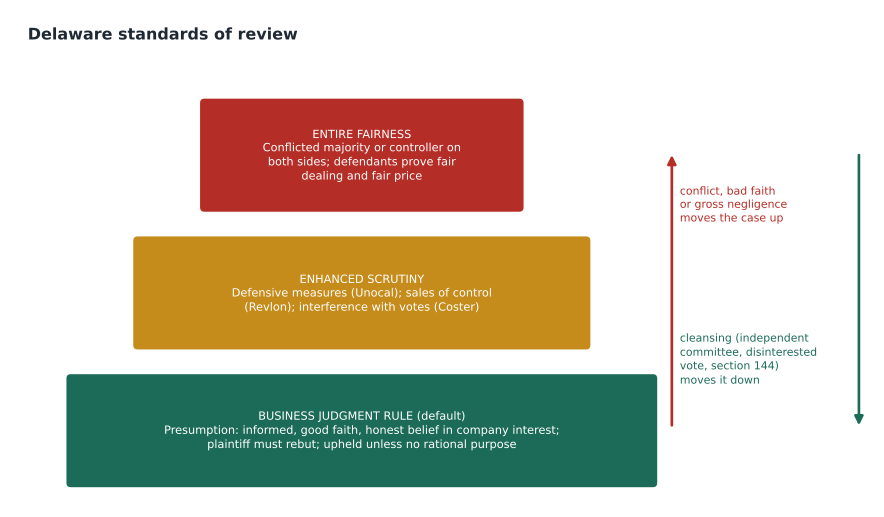
The presumption can be rebutted by showing that the directors were interested in the transaction or not independent, that they acted in bad faith, or that they were grossly negligent in failing to inform themselves. If the presumption is rebutted, the court applies a stricter standard of review, usually entire fairness, under which the defendants must prove the transaction was fair. Thackeray draws three tiers on the board: business judgment review, the default; enhanced scrutiny, applied in takeover and sale-of-control settings discussed in lesson 10; and entire fairness, applied when a majority of the board is conflicted or a controlling stockholder stands on both sides.
The rule protects decisions, not inaction. A board that never considered an issue has made no business judgment to protect, though failure-to-act claims are judged under the oversight standards discussed below. Thackeray gives the example of Kamin v. American Express Co., 383 N.Y.S.2d 807 (Sup. Ct. 1976), where shareholders challenged the board's decision to distribute shares of a stock whose value had collapsed as a dividend in kind, rather than selling them and taking a tax loss. The court dismissed the case, holding that the board had considered the alternatives and its choice was a matter of business judgment, even if the shareholders thought it unwise.
The duty of care and Smith v. Van Gorkom
Under Delaware law, the duty of care requires directors to inform themselves, before making a business decision, of all material information reasonably available to them, and the standard for breach is gross negligence. The leading case is Smith v. Van Gorkom, 488 A.2d 858 (Del. 1985). Jerome Van Gorkom, chief executive of Trans Union Corporation and near retirement, proposed a sale of the company to Jay Pritzker at 55 dollars a share, a price Van Gorkom had suggested without any valuation study. The board approved the merger at a two-hour meeting, based mainly on Van Gorkom's twenty-minute oral presentation, without seeing the merger agreement, without a valuation report and without asking how the price was set, although the price was a large premium over the market price.
The Delaware Supreme Court held that the directors were grossly negligent in failing to inform themselves and that their approval was not protected by the business judgment rule. The price premium did not cure the lack of information, the court said, and the directors could not rely on Van Gorkom's presentation because he had not made a sufficient inquiry himself. The case was remanded for a determination of the company's fair value and damages, and it later settled for an amount reported at about 23.5 million dollars, most of it paid by the buyer on the directors' behalf. Thackeray tells the class that Van Gorkom shocked the corporate world, because the directors were experienced business people who believed they had made a good deal for shareholders.
The decision had lasting effects. Boards began to hire investment bankers to give fairness opinions in every significant deal, to receive written materials well in advance of meetings, and to document their deliberations carefully. Under DGCL section 141(e), directors are fully protected in relying in good faith on the records of the corporation and on information, opinions, reports or statements presented by officers, employees, committees or experts the directors reasonably believe are within their professional competence and who were selected with reasonable care. Most importantly, the Delaware legislature responded in 1986 by enacting section 102(b)(7).
Exculpation: DGCL section 102(b)(7)
Section 102(b)(7) allows a certificate of incorporation to include a provision eliminating or limiting the personal liability of a director to the corporation or its stockholders for monetary damages for breach of fiduciary duty, except for breaches of the duty of loyalty, acts or omissions not in good faith or involving intentional misconduct or a knowing violation of law, unlawful distributions under section 174, and transactions from which the director derived an improper personal benefit. Nearly every Delaware public company has adopted such a provision, so directors today face no damages liability for pure breaches of the duty of care. Injunctions and other equitable relief remain available. MBCA section 2.02(b)(4) contains a similar authorization, and most states have adopted one.
In 2022, Delaware amended section 102(b)(7) to allow exculpation of certain senior officers, including the chief executive, president, chief financial officer, chief legal officer and other named officers, for breaches of the duty of care, but only in direct claims brought by stockholders, not in derivative claims brought on behalf of the corporation or claims by the corporation itself. Many public companies amended their charters to add officer exculpation, with stockholder approval. Because exculpation removes damages for care claims, plaintiffs who want damages must plead facts showing a breach of loyalty or bad faith, which makes the duty of good faith and oversight claims, discussed next, especially important.
| Claim | Directors | Officers (since 2022) |
|---|---|---|
| Breach of the duty of care, direct claim by stockholders | May be exculpated | May be exculpated |
| Breach of the duty of care, derivative or corporate claim | May be exculpated | May not be exculpated |
| Breach of the duty of loyalty | May not be exculpated | May not be exculpated |
| Bad faith, intentional misconduct, knowing violation of law | May not be exculpated | May not be exculpated |
| Improper personal benefit | May not be exculpated | May not be exculpated |
| Unlawful dividends or redemptions (section 174) | May not be exculpated | Not applicable |
Good faith and the Disney litigation
The Delaware courts spent the late 1990s and 2000s defining good faith. The decisive case was In re Walt Disney Co. Derivative Litigation, 906 A.2d 27 (Del. 2006), arising from Disney's hiring and firing of Michael Ovitz as president. Ovitz left after about fourteen months with a no-fault termination package worth roughly 130 million dollars. Shareholders sued, arguing that the board and compensation committee had approved his contract carelessly and that the termination was improper. After a lengthy trial, the Court of Chancery found that the directors' conduct fell short of best practices but did not breach their fiduciary duties, and the Delaware Supreme Court affirmed.
The court described a spectrum of conduct. At one end is subjective bad faith, conduct motivated by an actual intent to do harm, which is clearly a breach. In the middle is intentional dereliction of duty, a conscious disregard for one's responsibilities, which the court held is also bad faith and not exculpable. At the other end is gross negligence without malevolent intent, which is a breach of care and is exculpable under section 102(b)(7). The line between conscious disregard and gross negligence has become central to modern fiduciary litigation. In Stone v. Ritter, 911 A.2d 362 (Del. 2006), decided a few months later, the court held that good faith is not an independent fiduciary duty but a condition of the duty of loyalty: a director who fails to act in good faith breaches the duty of loyalty.
The duty of oversight: Caremark and its successors
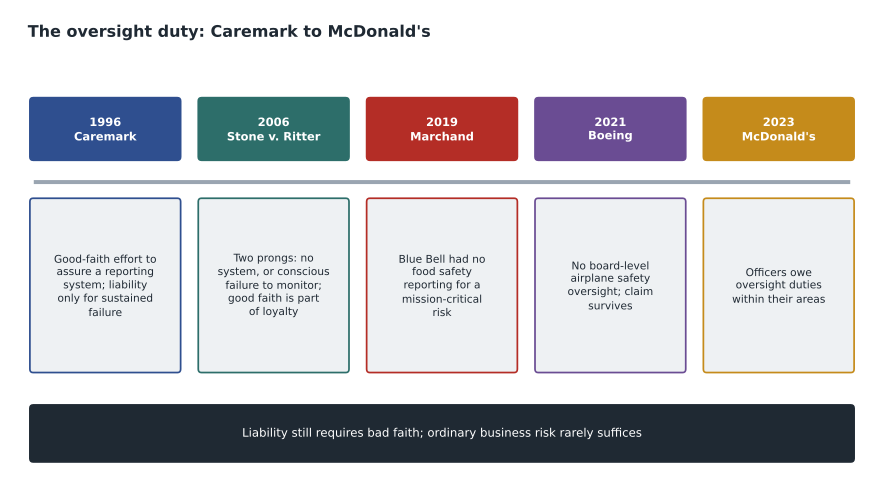
Directors must also oversee the corporation's operations and compliance with law. The foundational opinion is In re Caremark International Inc. Derivative Litigation, 698 A.2d 959 (Del. Ch. 1996), in which Chancellor Allen approved a settlement of claims arising from the company's criminal violations of health care kickback laws. Allen reasoned that directors have a duty to attempt in good faith to assure that a corporate information and reporting system exists that is adequate to allow the board to learn of compliance problems, and that only a sustained or systematic failure to exercise oversight, such as an utter failure to attempt to assure a reasonable system exists, would establish the lack of good faith that is a necessary condition to liability. He called it possibly the most difficult theory in corporation law upon which a plaintiff might hope to win a judgment.
Stone v. Ritter adopted Caremark and stated the test in two prongs. Directors are liable for failed oversight if they utterly failed to implement any reporting or information system or controls, or, having implemented such a system, consciously failed to monitor or oversee its operations, thus disabling themselves from being informed of risks or problems requiring their attention. Either way, liability requires a showing that the directors knew they were not discharging their fiduciary obligations. For many years, Caremark claims almost always failed.
That changed in Marchand v. Barnhill, 212 A.3d 805 (Del. 2019). Blue Bell Creameries, an ice cream maker, suffered a listeria outbreak in 2015 that killed three people and led to a recall, a plant shutdown and a liquidity crisis. The Delaware Supreme Court held that the shareholder complaint adequately alleged a Caremark claim, because the board had no committee overseeing food safety, no regular process for food safety reports to reach the board, and no protocol requiring management to keep the board informed, even though food safety was the most central compliance risk for a company with a single product line. The court said that a board's oversight must include a good-faith effort to put in place a reasonable reporting system for mission-critical risks.
Thackeray tells the class that Marchand has obvious lessons for Juniper Hill, another dairy. The Court of Chancery followed Marchand in later cases. In In re Boeing Co. Derivative Litigation, 2021 WL 4059934 (Del. Ch. Sept. 7, 2021), the court allowed oversight claims to proceed against Boeing's directors over the 737 MAX crashes, finding the board had no committee charged with overseeing airplane safety and relied on management's reassurances; the case later settled for a reported 237.5 million dollars paid by insurers. In In re McDonald's Corp. Stockholder Derivative Litigation, 289 A.3d 343 (Del. Ch. 2023), the court held for the first time that corporate officers owe a duty of oversight within their areas of responsibility, and allowed claims against the company's former head of human resources to proceed. Courts continue to emphasize that oversight liability remains hard to establish and that business risk, as opposed to legal compliance, is rarely enough.
Worked problem
The listeria warning
In Thackeray's hypothetical, Juniper Hill Foods, Inc. has become a corporation with a five-member board and outside investors. Its quality manager reported positive listeria swabs at the aging room in three monthly reports to the chief operating officer, who did not tell the board. The board has no food safety committee and receives only financial reports; minutes show food safety was never on the agenda. An outbreak forces a recall that costs the company millions. A shareholder sues the directors derivatively. The charter has a section 102(b)(7) clause. Will the claim survive?
Show solution
- The charter exculpates directors for duty of care breaches, so the plaintiff must allege bad faith, a breach of loyalty, to obtain damages.
- Under Caremark and Stone, the plaintiff must allege either an utter failure to implement any reporting system or a conscious failure to monitor one, with knowledge that duties were not being met.
- Under Marchand, food safety is mission-critical for a dairy. A board with no committee, no reporting protocol and no agenda time for food safety has arguably made no good-faith effort to implement a reasonable reporting system for that risk.
- The chief operating officer's failure to report may support an oversight claim against the officer, under McDonald's, within the officer's area of responsibility.
Answer: The claim likely survives a motion to dismiss under Marchand's first prong, because the board made no effort to establish reporting on the company's most central compliance risk, conduct that can be bad faith rather than mere negligence and so is not exculpated.
Summary and key terms
- Directors and officers owe fiduciary duties of care and loyalty; good faith is part of loyalty.
- The business judgment rule presumes directors acted on an informed basis, in good faith, in the company's interest; plaintiffs must rebut it.
- Smith v. Van Gorkom held directors grossly negligent for approving a merger without adequate information; Delaware responded with section 102(b)(7).
- Exculpation eliminates damages for care breaches by directors, and since 2022 for certain officers in direct claims, but never for loyalty or bad faith.
- Disney defined bad faith to include conscious disregard of duties, distinguishing it from exculpable gross negligence.
- Caremark oversight claims require bad faith; Marchand and Boeing show they can survive when boards ignore mission-critical risks.
Practice problems
Work each problem on paper first, then reveal the answer to check.
What must a plaintiff show to rebut the business judgment rule?
Show answer
That the directors were interested or not independent, acted in bad faith, or were grossly negligent in failing to inform themselves.
Why were the Trans Union directors in Smith v. Van Gorkom found to have breached their duty?
Show answer
They approved a merger at a short meeting based on an oral presentation, without the agreement, a valuation or inquiry into how the price was set.
Can a section 102(b)(7) clause protect an officer from a derivative claim for breach of the duty of care?
Show answer
No. The 2022 amendment permits officer exculpation only for direct stockholder claims.
What are the two Caremark prongs stated in Stone v. Ritter?
Show answer
An utter failure to implement any reporting system, or a conscious failure to monitor an existing system, with knowledge that duties were not being met.
Why did the claim survive in Marchand v. Barnhill?
Show answer
Blue Bell's board had no reporting system for food safety, a mission-critical risk for a single-product food company.
Lesson quiz · 5 questions
Score 60% or more to complete this lesson.
Create a free account to save your progress, take quizzes and earn a certificate.