
LAWU-202 · Lesson 12 of 12 · 22 min
Capstone: solving a business associations problem
▶ Video coming soon A video version of this lesson is on the way.
Professor Thackeray hands out the capstone problem on the last day of the course. "Everything in this problem is fictional," she reminds Section B, "but every issue in it is real. It runs across the whole semester, from agency to securities. Spot the issues, choose the governing law, apply the rules and say what you would advise. Business associations exams reward students who organize: who are the parties, what are the entities, what are the transactions, who is complaining and what do they want?" She gives the class ninety minutes to outline an answer and then walks through a model analysis.
The problem: Tamberly Provisions
Ten years ago, Maya Ellison and Ravi Chandra started a business selling prepared meals to grocery stores. For the first two years they ran it together without any written agreement, splitting profits equally, under the name Tamberly Kitchen. In the second year, Ravi signed a three-year lease for a commercial kitchen in the name "Tamberly Kitchen" without telling Maya, and Maya, when she learned of it a month later, moved the business's equipment into the kitchen.
In the third year, they formed Tamberly Provisions, Inc., a Delaware corporation, and transferred the business to it. Maya received 45 percent of the common stock, Ravi received 45 percent, and their early employee Lucia Moreno received 10 percent in exchange for agreeing to serve as operations director. There is no shareholder agreement. The board has five directors: Maya, Ravi, Lucia, and two outside directors, Edwin Haskell, a retired grocery executive who has been Ravi's close friend since college and is godfather to Ravi's daughter, and Naomi Ono, a food safety consultant with no ties to the founders. The certificate of incorporation contains a section 102(b)(7) provision covering directors and, since a 2023 amendment, officers.
Last year, three events occurred. First, Ravi, who serves as chief executive, caused the company to buy a delivery fleet from Chandra Logistics LLC, owned by Ravi's brother, for 3.2 million dollars. The board approved it 3 to 1 with Ravi abstaining; Maya voted no, and Lucia, Edwin and Naomi voted yes. The board received a one-page summary from Ravi and no appraisal; an independent appraisal obtained later valued the fleet at 2.4 million dollars. Second, Ravi learned that a national grocery chain wanted a supplier for a new line of ready-to-eat salads. He formed a separate company, Greenleaf Fresh LLC, owned entirely by himself, and won the contract. Third, after Lucia raised concerns about the fleet deal, Maya and Ravi, who rarely agree on anything anymore, both voted to remove Lucia as operations director, and the company stopped paying dividends while raising Maya's and Ravi's salaries.
Lucia asks for advice. Separately, the landlord of the original kitchen, unpaid for the last year of the lease, wants to know whom it can sue. And a customer, who became seriously ill from a salad produced at a Tamberly kitchen with known sanitation problems, asks whether she can recover from Maya and Ravi personally if the company's insurance falls short.
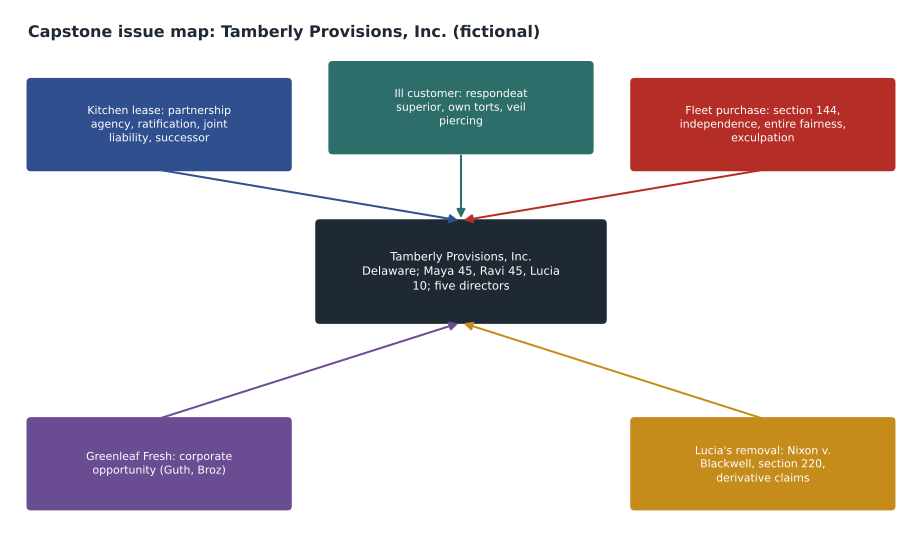
Step one: organize the parties and the law
Start by identifying the entities and the governing law. Before incorporation, Maya and Ravi were co-owners carrying on a business for profit, so Tamberly Kitchen was a general partnership, governed by the partnership law of the state where they operated, which the problem places in Westmarch, a RUPA state. After incorporation, Tamberly Provisions is a Delaware corporation, so under the internal affairs doctrine Delaware law governs the fiduciary claims about the fleet, Greenleaf and Lucia's treatment. Tort and contract claims by outsiders follow ordinary choice of law. Thackeray tells the class that the best answers state this framework in two or three sentences and then move on.
Step two: the kitchen lease
Was the partnership bound by Ravi's lease? Under RUPA section 301, each partner is an agent of the partnership, and an act apparently carrying on in the ordinary course the partnership's business binds the partnership unless the partner had no authority and the third party knew it. Leasing a kitchen for a prepared-meal business is arguably in the ordinary course, and the landlord had no notice of any limit. Even if it were outside the ordinary course, Maya ratified the lease by moving the equipment in after learning of it, conduct justifiable only on the assumption that she assented. The partnership is bound.
Who is liable? Under RUPA section 306, Maya and Ravi are jointly and severally liable for the partnership's obligations, subject to the exhaustion rule of section 307, which generally requires the landlord to pursue the partnership first. Incorporation does not erase that liability: transferring the business to the corporation did not release the partners from obligations incurred while they were partners, absent a novation with the landlord. The landlord can also argue that Tamberly Provisions, Inc. assumed the lease when it took over the business and continued operating in the kitchen, under the transfer agreement or successor liability principles. The model answer advises the landlord to sue the corporation, the partnership and both former partners.
Step three: the fleet purchase
The fleet purchase is a conflicted transaction. Ravi is interested because his brother owns the seller; a close family member's financial interest is usually treated as the director's own. Ravi abstained, but his conflict does not end the inquiry. Is Ravi a controlling stockholder? He holds 45 percent, which exceeds the one-third threshold in amended section 144, and as chief executive he exercises managerial authority, so he may qualify, which would shift the analysis to section 144(b). Either way, the question is whether the transaction was cleansed.
Under section 144(a), a transaction with an interested director is protected if approved in good faith by a majority of disinterested directors after disclosure of the material facts. Three directors voted yes: Lucia, Edwin and Naomi. Edwin has been Ravi's close friend since college and godfather to Ravi's daughter, facts that under Sanchez raise a reasonable doubt about his independence, and Lucia, an employee whose position depends on the chief executive, may also lack independence. If neither Edwin nor Lucia is disinterested, only Naomi voted yes, and she alone is not a majority of the disinterested directors when Maya, also disinterested, voted no. If Ravi is a controller, section 144(b) requires a committee of at least two disinterested directors with authority to negotiate and reject the deal, or a disinterested stockholder vote; neither occurred. Disclosure was also thin: a one-page summary and no appraisal.
Without a safe harbor, the purchase is reviewed for entire fairness, and the defendants must prove fair dealing and fair price under Weinberger. The appraisal at 2.4 million dollars against a 3.2 million-dollar price, the lack of any valuation and the summary presentation make that difficult. Ravi faces liability for the 800,000-dollar overpayment as a breach of loyalty, which section 102(b)(7) cannot exculpate. The directors who approved the deal can invoke exculpation for care claims, but if Edwin and Lucia acted to benefit Ravi rather than the company, the plaintiff may allege disloyalty or bad faith. The claim is derivative under Tooley, because the corporation overpaid.
| Issue | Rule | Likely result |
|---|---|---|
| Kitchen lease | RUPA 301 agency; ratification; RUPA 306 joint and several liability | Partnership bound; Maya and Ravi personally liable; corporation likely liable as successor or assignee |
| Fleet purchase | Amended DGCL 144; independence (Sanchez); entire fairness (Weinberger) | Safe harbor likely unavailable; entire fairness; Ravi liable for overpayment; derivative claim |
| Greenleaf Fresh | Guth and Broz corporate opportunity test | Likely usurped: same line of business, company able and interested; constructive trust |
| Lucia's removal and dividends | Delaware fiduciary duties; Nixon v. Blackwell; section 220; derivative claims | No Donahue-style duty; challenge salaries as waste or self-dealing; books and records; negotiate a buyout |
| Ill customer | Respondeat superior; officers' own torts; veil piercing | Company liable; Maya and Ravi personally liable only for their own participation, or by piercing, which is unlikely if adequately capitalized |
Step four: Greenleaf Fresh
Ravi's formation of Greenleaf Fresh raises the corporate opportunity doctrine. Under Guth v. Loft and Broz, the question is whether the company was financially able to take the salad contract, whether the contract was in its line of business, whether the company had an interest or expectancy in it, and whether Ravi's taking it placed him in a position inimical to his duties. A grocery supplier of prepared meals bidding to supply ready-to-eat salads to a grocery chain is squarely within its line of business; nothing suggests the company lacked the ability to perform; and Ravi learned of the opportunity in his role as chief executive. Ravi never presented it to the board, which was not strictly required in Delaware but would have been a safe harbor. Unless the charter renounced such opportunities under section 122(17), which the facts do not suggest, Ravi likely usurped a corporate opportunity. The remedy is a constructive trust over Greenleaf's profits or the contract itself, pursued derivatively.
Step five: Lucia's removal and the dividends
Lucia's treatment is a classic close corporation freeze-out. In Massachusetts, under Donahue and Wilkes, she could sue directly for breach of the partnership-like duty and the majority would need a legitimate business purpose. But Tamberly is a Delaware corporation, and under Nixon v. Blackwell Delaware does not recognize special duties for close corporations that have not elected statutory close corporation status. Lucia had no shareholder agreement or employment contract, so the bare removal of an officer, which the board may do, is unlikely to be actionable by itself. Delaware also has no general oppression statute, although the Court of Chancery may order dissolution in narrow circumstances such as deadlock, and Maya and Ravi's frequent disagreements may eventually produce one.
Lucia is not without remedies. She can make a section 220 demand to inspect books and records, stating a proper purpose: investigating possible mismanagement in the fleet purchase, the Greenleaf opportunity and the salary increases. After Senate Bill 21, she will receive core records such as board minutes and materials, which should include the one-page fleet summary; she will need to show a compelling need for emails. She can then bring derivative claims on the fleet purchase and Greenleaf, and may challenge the salary increases as self-dealing, because Maya and Ravi set their own pay as directors, which requires entire fairness review unless cleansed. Demand futility under Zuckerberg is promising: Ravi received benefits and faces substantial likelihood of liability, Maya received a salary increase she voted for, and Edwin likely lacks independence from Ravi, so at least three of five directors are disabled. Lucia's leverage from these claims may produce a negotiated buyout of her 10 percent stake.
Step six: the ill customer
Tamberly Provisions is liable for the contaminated salad under products liability and, through respondeat superior, for its employees' negligence. Can the customer reach Maya and Ravi personally? Shareholders are not liable for the corporation's obligations merely as shareholders. Officers and directors are personally liable for torts in which they personally participated, so if Maya or Ravi knew of the sanitation problems and directed that production continue, the customer may sue them directly. Veil piercing would require domination and disregard of separateness plus fraud or injustice; nothing in the facts suggests commingling or undercapitalization, and the company carries insurance, so piercing is unlikely. The model answer advises the customer to sue the company and to investigate the officers' personal knowledge of the sanitation problems.
The customer's illness also connects back to lesson 7. A company with known sanitation problems, a board that may lack food safety reporting, and losses from a recall could face a Caremark derivative claim under Marchand, just as Juniper Hill did in Thackeray's earlier hypothetical, and if Tamberly were public, its investors might bring a Rule 10b-5 claim if its disclosures about food safety were false.
Writing the answer
Thackeray gives the class her checklist for business associations essays. Identify the entity at each point in time and the governing law. For each transaction, name the claim, the plaintiff, the defendant and the standard of review. Apply cleansing rules carefully, because the result often turns on who voted and whether they were disinterested. Address remedies and procedure: direct or derivative, demand, exculpation, and what relief is realistic. And end with practical advice, because clients care less about which doctrine applies than about what they should do next.
She closes the course where she began, with the Marsh family. "Every problem in this capstone could have been avoided by documents that cost a few thousand dollars to draft: a partnership agreement, a shareholder agreement, an employment contract, a related-party transaction policy, and a board that asks hard questions. Business lawyers earn their living in the gaps clients leave. Your job is to close those gaps before they become lawsuits."
Worked problem
A short practice question
A Delaware corporation's chief financial officer, who owns 2 percent of the stock, negligently approves a supplier contract that costs the company 5 million dollars. The charter has a section 102(b)(7) provision covering directors and officers. A stockholder brings a derivative suit against the officer for breach of the duty of care. Will the exculpation clause protect the officer?
Show solution
- Section 102(b)(7) permits exculpation of officers for breaches of the duty of care only in direct claims by stockholders.
- This is a derivative claim on behalf of the corporation.
- Officer exculpation does not apply to derivative claims or claims by the corporation itself.
- The officer may still argue that the conduct was not grossly negligent, the Delaware standard for breach of the duty of care, and may seek indemnification or insurance.
Answer: No. Officer exculpation applies only to direct stockholder claims, so the officer remains exposed to the derivative care claim, though the plaintiff must still prove gross negligence.
Summary and key terms
- Start by identifying the entity at each stage and the governing law under the internal affairs doctrine.
- Partners are agents and jointly and severally liable; incorporation does not release them from existing partnership debts.
- Conflicted transactions turn on whether a safe harbor was satisfied by genuinely disinterested approvers after full disclosure; otherwise entire fairness applies.
- Corporate opportunities in the company's line of business, learned in a fiduciary role, belong to the corporation.
- Delaware minority shareholders lacking contracts rely on fiduciary claims, section 220 inspection and derivative suits rather than close corporation duties.
- Officers are liable for torts they personally commit; veil piercing requires domination plus fraud or injustice.
Practice problems
Work each problem on paper first, then reveal the answer to check.
Why is Edwin Haskell's vote unlikely to count as disinterested approval of the fleet purchase?
Show answer
His close friendship since college with Ravi and role as godfather to Ravi's daughter raise a reasonable doubt about his independence under Sanchez.
Could Ravi be a controlling stockholder under amended section 144?
Show answer
Yes, if he owns at least one third of the voting power and exercises managerial authority, which his 45 percent stake and chief executive role suggest.
Did Maya ratify the kitchen lease?
Show answer
Yes. Knowing of the lease, she moved the business's equipment in, conduct justifiable only on the assumption of assent.
Why can Lucia not rely on Donahue v. Rodd?
Show answer
Tamberly is a Delaware corporation, and Delaware law under Nixon v. Blackwell does not impose special close corporation duties.
What remedy fits Ravi's usurpation of the salad contract?
Show answer
A constructive trust over Greenleaf's profits or the contract, sought derivatively for the corporation.
Lesson quiz · 5 questions
Score 60% or more to complete this lesson.
Create a free account to save your progress, take quizzes and earn a certificate.