
LAWU-202 · Lesson 10 of 12 · 23 min
Mergers, takeovers and appraisal
▶ Video coming soon A video version of this lesson is on the way.
Professor Thackeray closes the door and lowers her voice for effect. "Fifteen years from now," she says, "Juniper Hill Foods is a public company. One morning a national dairy conglomerate announces it will buy every share at a big premium unless the board agrees to merge. What can the board do? Can it say no? Can it look for a better buyer? Can it adopt a defense that makes the bid impossible?" She tells Section B that this hypothetical is the setting for some of the most famous cases in corporate law, decided in a burst of takeover activity in the 1980s that still shapes how boards behave today.
This lesson covers the ways corporations combine, the votes and rights that fundamental transactions require, the special standards Delaware applies to defensive measures and sales of control, and the appraisal remedy for dissenting stockholders. These transactions are where the stakes of corporate law are highest, because a single decision can transfer control of the whole enterprise.
Ways to combine companies
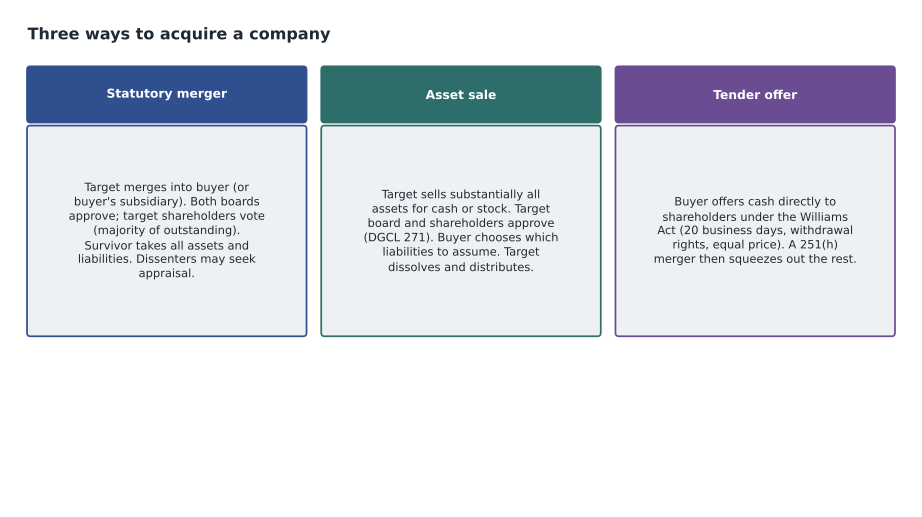
There are three basic ways to acquire a corporation. In a statutory merger, two corporations combine under a state merger statute, one survives and the other disappears, and the survivor takes all the assets and liabilities of both by operation of law. Under DGCL section 251 and MBCA chapter 11, the board of each corporation must adopt a merger agreement and, generally, the stockholders of each must approve it by a majority of the outstanding shares entitled to vote. Shareholders of the disappearing company receive the consideration stated in the agreement, which may be stock of the survivor, cash, other securities or a mix. A triangular merger uses a subsidiary of the buyer to merge with the target, so that the target becomes a subsidiary without the buyer's stockholders having to vote.
In an asset sale, the target sells all or substantially all of its assets to the buyer, usually for cash or stock, and then typically distributes the proceeds to its shareholders and dissolves. Under DGCL section 271, a sale of all or substantially all assets requires board approval and approval by a majority of the outstanding voting stock. Whether a sale involves substantially all assets is judged qualitatively and quantitatively: in Gimbel v. Signal Companies, Inc., 316 A.2d 599 (Del. Ch. 1974), the court asked whether the sale was out of the ordinary and substantially affected the existence and purpose of the corporation. The buyer in an asset sale can choose which liabilities to assume, although successor liability doctrines sometimes impose liabilities anyway.
In a stock acquisition, the buyer purchases the target's shares directly from its shareholders, often through a tender offer to all public shareholders. No target board or shareholder vote is legally required, because each shareholder decides whether to sell. Tender offers for public companies are regulated by the Williams Act of 1968, which amended the Securities Exchange Act to require disclosure and to set rules such as keeping the offer open at least twenty business days, allowing tendering shareholders to withdraw, and paying all tendering holders the same price. Under DGCL section 251(h), added in 2013, a buyer that acquires enough shares in a tender offer to approve a merger can complete a second-step merger without a stockholder vote, squeezing out the remaining shareholders at the same price.
Shareholder protections in fundamental transactions
Statutes protect shareholders in fundamental transactions in two main ways: voting rights and appraisal rights. The voting requirement gives shareholders a veto over mergers and major asset sales. Delaware does not give a vote to stockholders of a surviving corporation in a merger if its charter is not changed, each share remains outstanding, and the merger does not increase its outstanding common stock by more than twenty percent, under section 251(f). Stock exchange rules separately require shareholder approval when a listed company issues twenty percent or more of its stock in an acquisition.
Courts have debated whether transactions structured to avoid voting and appraisal rights should be treated as de facto mergers. In Farris v. Glen Alden Corp., 393 Pa. 427 (1958), the Pennsylvania Supreme Court held that an asset purchase that had the effect of a merger gave the shareholders of the purchasing corporation the rights of dissenting shareholders in a merger. Delaware rejected the doctrine in Hariton v. Arco Electronics, Inc., 188 A.2d 123 (Del. 1963), adopting the doctrine of independent legal significance: an action valid under one section of the statute is not invalid because it achieves the same result as a different section with different requirements.
Appraisal rights
Appraisal lets shareholders who dissent from certain mergers demand that the corporation pay them the fair value of their shares, as determined by a court, instead of the merger consideration. Under DGCL section 262, appraisal is available in mergers and consolidations, but not in asset sales unless the charter provides it. Under the market-out exception, appraisal is not available to holders of shares listed on a national securities exchange or held by more than 2,000 holders, unless they are required to accept something other than stock of the survivor or another listed company, cash in lieu of fractional shares, or a combination; so stockholders forced to take cash in a public company merger have appraisal rights. MBCA chapter 13 provides appraisal for a broader range of transactions, also with a market exception.
To obtain appraisal, a stockholder must not vote in favor of the merger, must deliver a written demand before the vote, must hold the shares continuously through the effective date, and must file or join a petition within 120 days after the merger. The court determines fair value exclusive of any element of value arising from the accomplishment or expectation of the merger. Since Weinberger v. UOP, Delaware courts may use any valuation technique generally accepted in the financial community. In DFC Global Corp. v. Muirfield Value Partners, 172 A.3d 346 (Del. 2017), and Dell, Inc. v. Magnetar Global Event Driven Master Fund Ltd., 177 A.3d 1 (Del. 2017), the Delaware Supreme Court emphasized that the deal price in an arm's-length transaction resulting from a robust sale process is strong evidence of fair value. In Verition Partners Master Fund Ltd. v. Aruba Networks, Inc., 210 A.3d 128 (Del. 2019), it held that deal price minus synergies was a reliable measure. These decisions have reduced appraisal litigation, and a 2016 amendment lets corporations prepay appraisal claimants to stop interest from accruing and imposes minimum ownership thresholds for public company appraisal claims.
| Situation | Standard | Leading cases |
|---|---|---|
| Ordinary merger approved by a disinterested, informed board, no controller | Business judgment rule; Corwin after a fully informed, uncoerced vote | Corwin (2015) |
| Defensive measures against a threatened takeover | Unocal enhanced scrutiny: reasonable grounds to perceive a threat and a proportionate response, not preclusive or coercive | Unocal (1985), Unitrin (1995) |
| Sale of control or breakup of the company | Revlon: board must seek the best value reasonably available | Revlon (1986), QVC (1994) |
| Board action interfering with a stockholder vote | Unocal-type review | Coster v. UIP (2023) |
| Controller squeeze-out | Entire fairness unless cleansed under section 144(c) | Weinberger (1983), MFW (2014), SB 21 (2025) |
Defensive measures: Unocal
When a hostile bidder appears, directors face an obvious conflict: a successful takeover usually costs them their seats. The Delaware Supreme Court addressed this omnipresent specter that a board may be acting primarily in its own interests in Unocal Corp. v. Mesa Petroleum Co., 493 A.2d 946 (Del. 1985). Mesa, controlled by T. Boone Pickens, made a two-tier, front-loaded tender offer for Unocal: cash for 37 percent of the shares, followed by a merger paying junk bonds of lower value for the rest. Unocal's board responded with a self-tender offer to buy back its own shares at a higher price, excluding Mesa. The court upheld the defense.
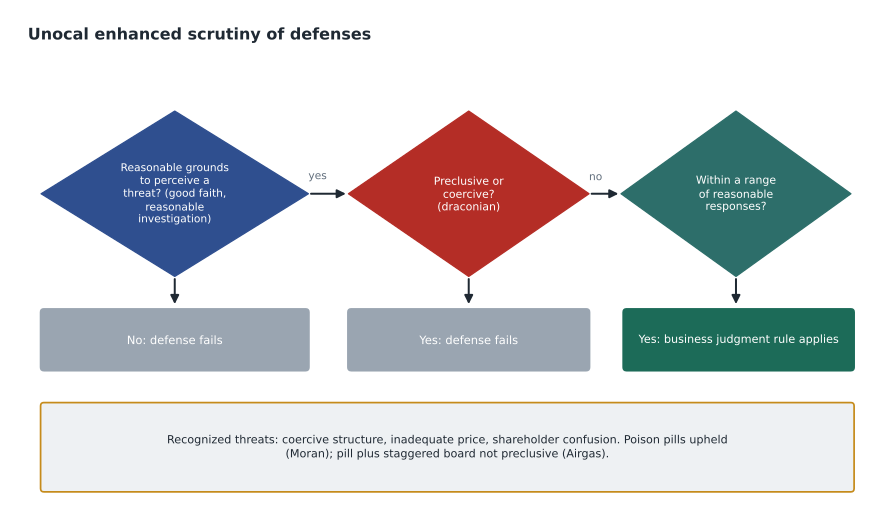
Unocal established enhanced scrutiny for defensive measures. Before the business judgment rule applies, the directors must show that they had reasonable grounds for believing that a danger to corporate policy and effectiveness existed, a showing satisfied by good faith and reasonable investigation and materially enhanced by approval of a majority of independent directors, and that the defensive measure was reasonable in relation to the threat posed. In Unitrin, Inc. v. American General Corp., 651 A.2d 1361 (Del. 1995), the court refined the second step: a defense is unreasonable if it is draconian, meaning preclusive or coercive, and otherwise must fall within a range of reasonable responses. Threats the courts have recognized include coercive offers, inadequate price and the risk that shareholders will tender out of ignorance or mistaken belief.
The most powerful defense is the shareholder rights plan, or poison pill, upheld in Moran v. Household International, Inc., 500 A.2d 1346 (Del. 1985). A rights plan gives every shareholder except an acquirer who crosses a threshold, often 10 to 20 percent, the right to buy additional shares at a steep discount, massively diluting the acquirer. The pill makes it practically impossible to buy a controlling stake without the board's consent, forcing bidders either to negotiate with the board or to replace it in a proxy contest. In Paramount Communications, Inc. v. Time Inc., 571 A.2d 1140 (Del. 1989), the court held that a board was not required to abandon a planned strategic merger and could protect it against a hostile cash offer, rejecting the argument that only coercive offers are threats. In Airgas, Inc. v. Air Products and Chemicals, Inc., 16 A.3d 48 (Del. Ch. 2011), the Court of Chancery upheld a board's refusal to redeem a pill against a fully financed all-cash offer the board considered inadequate, reasoning that the combination of a pill and a staggered board was not preclusive because the bidder could still win two proxy contests.
Sales of control: Revlon and QVC
Once a sale of the company becomes inevitable, the directors' role changes. In Revlon, Inc. v. MacAndrews and Forbes Holdings, Inc., 506 A.2d 173 (Del. 1986), Revlon's board, facing a hostile bid from Pantry Pride, negotiated a deal with a white knight, Forstmann Little, that included a lock-up option on valuable divisions and a no-shop provision, partly to protect the value of notes the company had issued earlier. The Delaware Supreme Court held that when the breakup of the company became inevitable, the directors' duty changed from the preservation of Revlon as a corporate entity to the maximization of the company's value at a sale for the stockholders' benefit. The directors became auctioneers charged with getting the best price, and could not favor one bidder to protect other constituencies such as the noteholders.
In Paramount Communications Inc. v. QVC Network Inc., 637 A.2d 34 (Del. 1994), the court held that Revlon duties also arise when a transaction would result in a change of control, such as a merger in which a public company's stockholders would become minority holders in a company controlled by one person, because the stockholders lose their control premium. Paramount's board had agreed to a merger with Viacom, controlled by Sumner Redstone, with a termination fee, a no-shop provision and a stock option lock-up, and refused to engage seriously with QVC's higher bid. The court held that the board breached its duty to seek the best value reasonably available. By contrast, in a stock-for-stock merger of two widely held companies where control remains in a fluid market, Revlon does not apply, as Time-Warner showed.
Revlon does not require an auction in every case. In Lyondell Chemical Co. v. Ryan, 970 A.2d 235 (Del. 2009), the court held that there is no single blueprint for fulfilling Revlon duties, and that directors who knowingly and completely failed to undertake their responsibilities might act in bad faith, but directors who took reasonable if imperfect steps did not. In C and J Energy Services, Inc. v. City of Miami General Employees' Retirement Trust, 107 A.3d 1049 (Del. 2014), the court confirmed that a board can satisfy Revlon by signing a deal with a market check afterward, as long as the deal protections do not prevent a superior bid from emerging. Deal protection devices such as termination fees, typically a few percent of deal value, no-shop clauses with fiduciary outs, and matching rights are usually upheld if reasonable. And after Corwin, a fully informed, uncoerced stockholder vote approving a non-controller sale will usually defeat post-closing damages claims based on Revlon.
Worked problem
The conglomerate's bid
In Thackeray's hypothetical, Juniper Hill Foods, Inc. is a public Delaware company with no controlling stockholder and a majority of independent directors. Northfield Dairy offers 40 dollars a share in cash for all shares; Juniper Hill's stock trades at 30 dollars. The board, after meeting with its bankers, believes the company's new plant will make the stock worth more within three years and adopts a rights plan with a 15 percent trigger. Northfield then raises its bid to 46 dollars. The board instead agrees to merge with Maple Creek Cheese, a private company owned by one family, in a deal in which Juniper Hill's stockholders will receive 44 dollars in cash, with a 4 percent termination fee, a no-shop clause and no fiduciary out. Stockholders sue. What standards apply?
Show solution
- Adopting the rights plan against Northfield's original offer is a defensive measure reviewed under Unocal. An inadequate price can be a cognizable threat, and a pill that leaves Northfield able to win a proxy contest is not preclusive, so the initial pill likely survives (Moran, Airgas).
- Agreeing to sell the company for cash to Maple Creek is a change of control: stockholders are cashed out and lose any future control premium. Revlon applies, and the board must seek the best value reasonably available (QVC).
- Choosing a 44-dollar cash deal over a 46-dollar cash bid, and locking it up with a no-shop clause without a fiduciary out, appears inconsistent with Revlon unless the board can show that Northfield's bid was less certain to close or otherwise less valuable.
- A court may enjoin the deal protections or the Maple Creek merger before the vote. After closing, Corwin would protect the directors from damages only if the stockholder vote was fully informed and uncoerced.
Answer: The initial pill likely survives Unocal review, but the Maple Creek deal triggers Revlon, and a board that accepts a lower cash offer and blocks the higher bidder without a fiduciary out risks an injunction; the board should seek the best value reasonably available, such as by negotiating with both bidders.
Freeze-out mergers
A controlling stockholder may eliminate the minority through a merger, a transaction often called a freeze-out or squeeze-out. Short-form mergers under DGCL section 253, available when a parent owns at least 90 percent of each class of a subsidiary's stock, require no vote by the subsidiary's board or stockholders; the minority's remedy is appraisal, absent fraud or illegality, as the court held in Glassman v. Unocal Exploration Corp., 777 A.2d 242 (Del. 2001). Long-form freeze-outs historically received entire fairness review under Weinberger and Kahn v. Lynch Communication Systems, Inc., 638 A.2d 1110 (Del. 1994), unless cleansed under MFW. Since 2025, amended section 144(c) provides a safe harbor for these going-private transactions when they are approved by both a committee of disinterested directors and a majority of the votes cast by disinterested stockholders, as lesson 8 explained.
Summary and key terms
- Companies combine by statutory merger, asset sale or stock acquisition, each with different approval requirements.
- Mergers and substantially-all asset sales require board approval and a majority of outstanding voting shares; Delaware rejects the de facto merger doctrine.
- Appraisal gives dissenters fair value in certain mergers; Delaware courts give heavy weight to deal price after a robust sale process.
- Unocal requires boards adopting defenses to show a reasonably perceived threat and a proportionate, non-preclusive, non-coercive response.
- Revlon requires boards selling control to seek the best value reasonably available; QVC extends it to changes of control.
- Short-form mergers leave the minority with appraisal; long-form freeze-outs are reviewed for entire fairness unless cleansed under amended section 144(c).
Practice problems
Work each problem on paper first, then reveal the answer to check.
Why did Delaware reject the de facto merger doctrine in Hariton v. Arco Electronics?
Show answer
Under the doctrine of independent legal significance, a transaction valid under one section of the statute is not invalid because it achieves the same result as another section.
What evidence of fair value did DFC and Dell emphasize in appraisal?
Show answer
The deal price in an arm's-length transaction resulting from a robust sale process.
What are the two steps of Unocal review?
Show answer
Reasonable grounds to perceive a threat to corporate policy, and a response reasonable in relation to the threat, which under Unitrin may not be preclusive or coercive.
When do Revlon duties arise?
Show answer
When a breakup or sale of the company becomes inevitable, or a transaction will result in a change of control, as in QVC.
What is the minority's remedy in a short-form merger?
Show answer
Appraisal, absent fraud or illegality (Glassman).
Lesson quiz · 5 questions
Score 60% or more to complete this lesson.
Create a free account to save your progress, take quizzes and earn a certificate.