
LAWU-202 · Lesson 5 of 12 · 23 min
Corporate formation
▶ Video coming soon A video version of this lesson is on the way.
Professor Thackeray begins the corporate half of the course with a hypothetical she labels as one. "Imagine it is a few years from now," she tells Section B. "Juniper Hill's cheese has won national awards. A specialty food company wants to invest several million dollars to build a second plant, and its lawyers insist on one thing: Juniper Hill must become a Delaware corporation. Why would sophisticated investors care what kind of entity they invest in, and what happens in the moment the creamery becomes a corporation?"
This lesson covers how a corporation comes into existence and how it is structured: the governing statutes, the incorporation process, the charter and bylaws, the allocation of power among shareholders, directors and officers, the corporation's powers, and what happens to contracts made before incorporation. Thackeray tells the class she will cite two statutes throughout: the Delaware General Corporation Law, the DGCL, which governs most large public companies, and the Model Business Corporation Act, the MBCA, published by the American Bar Association's Corporate Laws Committee and adopted in whole or substantial part by more than thirty states. The MBCA was comprehensively revised in 2016. Westmarch, she says, follows the MBCA.
Incorporation: the filing
A corporation comes into existence when its articles of incorporation, called the certificate of incorporation in Delaware, are filed with the secretary of state. Under MBCA section 2.03, unless a delayed effective date is specified, corporate existence begins when the articles are filed, and the secretary of state's filing is conclusive proof that the incorporators satisfied all conditions precedent, except in a proceeding by the state to cancel or revoke the incorporation. DGCL section 106 is similar. One or more incorporators sign and file the document. After filing, the incorporators or the initial directors named in the articles hold an organizational meeting to adopt bylaws, appoint officers and take other steps to start the business.
Under MBCA section 2.02, the articles must state the corporation's name, which must contain a word such as corporation, incorporated, company or limited, or an abbreviation; the number of shares the corporation is authorized to issue; the street address of its initial registered office and the name of its initial registered agent; and the name and address of each incorporator. Delaware's section 102(a) adds a statement of the nature of the business or purposes, which may simply be any lawful act or activity. The articles may also include optional provisions, such as the names of initial directors, provisions on the management of the business, limits on directors' liability, indemnification provisions, and, in Delaware, provisions eliminating or limiting the personal liability of directors and certain officers for monetary damages for breach of the duty of care, discussed in lesson 7.
Thackeray emphasizes a few practical points. The registered agent receives service of process and official notices, so it must be reliable; most companies hire a commercial agent. The authorized shares must be enough for future issuances, because increasing them requires a charter amendment approved by shareholders. And the choice of state of incorporation is a choice of governing law under the internal affairs doctrine, as lesson 1 explained. Delaware charges franchise taxes and fees, and companies that incorporate there but operate elsewhere must also register to do business as foreign corporations in the states where they operate.
The charter and the bylaws
The articles or certificate of incorporation, often called the charter, sits at the top of the corporation's internal law, below only the statute. The bylaws are the corporation's internal rules for its governance, such as the number of directors, how meetings are called, quorum requirements, officer positions and their duties, and procedures for shareholder proposals. Under MBCA section 2.06 and DGCL section 109, bylaws may contain any provision for managing the business and regulating the affairs of the corporation that is not inconsistent with law or the articles. If the bylaws conflict with the charter, the charter controls; if either conflicts with the statute, the statute controls.
Amending the charter generally requires the board to adopt a resolution and the shareholders to approve it, under DGCL section 242 and MBCA chapter 10. Bylaws are easier to change. Under DGCL section 109(a), shareholders always have the power to adopt, amend or repeal bylaws, and the charter may also confer that power on the directors, as nearly every public company's charter does. Under MBCA section 10.20, both the board and shareholders may amend bylaws unless the articles reserve the power exclusively to shareholders. Bylaws have become battlegrounds in recent decades, as shareholders and boards fight over advance notice requirements for nominations, forum selection clauses and proxy access.
Delaware has embraced forum selection provisions. In Boilermakers Local 154 Retirement Fund v. Chevron Corp., 73 A.3d 934 (Del. Ch. 2013), the Court of Chancery upheld board-adopted bylaws requiring intra-corporate disputes to be brought in Delaware. The legislature codified the result in DGCL section 115 in 2015, permitting charter or bylaw provisions requiring internal corporate claims to be brought in Delaware courts, while barring provisions that prohibit bringing such claims in Delaware. In Salzberg v. Sciabacucchi, 227 A.3d 102 (Del. 2020), the Delaware Supreme Court upheld charter provisions requiring claims under the federal Securities Act of 1933 to be brought in federal court. The 2025 amendments in Texas, mentioned in lesson 1, let Texas corporations designate the Texas Business Court as the exclusive forum.
Who runs the corporation: the statutory model
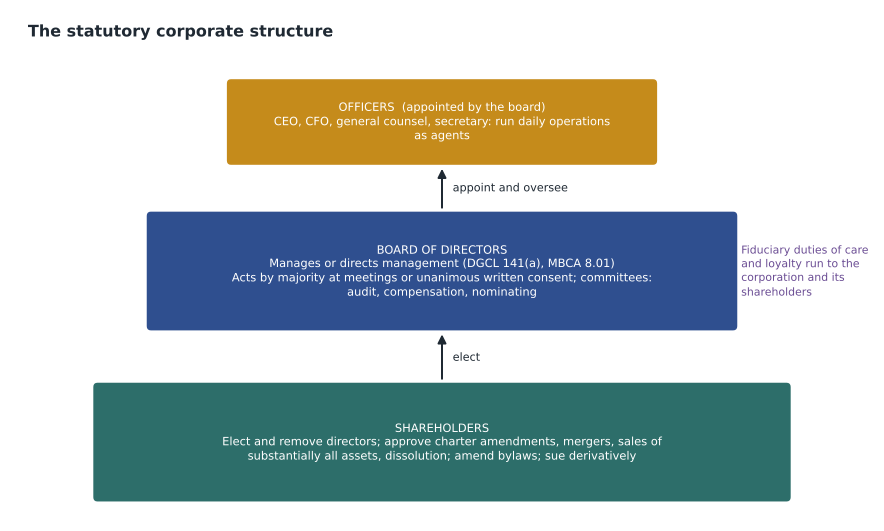
Corporate statutes allocate power among three groups. Shareholders own the corporation's stock and elect the directors, but they do not manage the business. The board of directors manages the business or directs its management. Officers, appointed by the board, run day-to-day operations as the board's agents. DGCL section 141(a) states the central principle: the business and affairs of every corporation shall be managed by or under the direction of a board of directors, except as otherwise provided in the statute or the certificate of incorporation. MBCA section 8.01(b) is to the same effect. The phrase "under the direction of" recognizes that in large companies the board oversees and delegates rather than managing directly.
Shareholders' powers are limited by statute. They elect and remove directors, approve fundamental changes such as charter amendments, mergers, sales of substantially all assets and dissolutions, amend bylaws, and vote on certain matters required by stock exchange rules or federal law, such as advisory votes on executive pay. They cannot direct the board how to run the business. In Auer v. Dressel, 306 N.Y. 427 (1954), the New York Court of Appeals recognized shareholders' power to remove directors for cause and to express their views, but the general rule remains that shareholders act through their votes, not by managing.
The board acts as a body. Under MBCA section 8.20 and DGCL section 141(b), the board acts at meetings with a quorum present, by majority vote of those present unless the charter or bylaws require more, or by unanimous written consent without a meeting under DGCL section 141(f). Individual directors have no authority to act for the corporation unless the board delegates it. The board may delegate to committees, such as audit, compensation and nominating committees, and public companies must have certain committees under stock exchange listing standards and federal law, including an audit committee of independent directors under the Sarbanes-Oxley Act of 2002.
Officers are appointed by the board. Modern statutes do not require particular officer titles; MBCA section 8.40 lets the bylaws or board create offices, requiring only that one officer be responsible for preparing minutes and authenticating records. Officers' authority comes from the bylaws, board resolutions and agency law, as lesson 2 explained. A chief executive officer has broad implied authority to bind the corporation in the ordinary course, while a vice president or treasurer has narrower authority tied to the position.
Corporate powers and the ultra vires doctrine
Under older law, a corporation could act only within the purposes stated in its charter, and an act beyond those purposes, ultra vires, was void. Modern statutes have largely abolished the doctrine. MBCA section 3.01 provides that every corporation has the purpose of engaging in any lawful business unless the articles state a more limited purpose, and section 3.02 gives corporations the same powers as an individual to do all things necessary or convenient to carry out their business. Under section 3.04, the validity of corporate action may not be challenged on the ground that the corporation lacked power to act, except in a shareholder's suit to enjoin the act, a suit by the corporation against an officer or director, or a proceeding by the state.
The old question of corporate purpose survives in a different form: whether directors must maximize profits for shareholders. Dodge v. Ford Motor Co., 204 Mich. 459 (1919), held that Henry Ford could not run his company primarily for the benefit of employees and customers at the expense of shareholders, and ordered a special dividend, while declining to interfere with Ford's business plans. But courts give directors wide latitude through the business judgment rule. In Shlensky v. Wrigley, 237 N.E.2d 776 (Ill. App. Ct. 1968), the court refused to second-guess the Chicago Cubs' decision not to install lights for night games, accepting that the directors might reasonably consider the effect on the neighborhood and long-term value. In eBay Domestic Holdings, Inc. v. Newmark, 16 A.3d 1 (Del. Ch. 2010), however, the Court of Chancery held that directors of a for-profit Delaware corporation could not adopt a poison pill whose purpose was to preserve craigslist's community-focused culture at the expense of stockholder value.
Corporations may make charitable contributions. MBCA section 3.02(13) expressly permits donations for the public welfare or for charitable, scientific or educational purposes, and Delaware courts have upheld reasonable gifts. Many states also have constituency statutes allowing directors to consider the interests of employees, customers, suppliers and communities. Delaware has no general constituency statute, but its public benefit corporation provisions, added in 2013, allow a corporation to commit in its charter to balancing stockholders' pecuniary interests with the interests of others affected by its conduct and a specific public benefit.
| Question | DGCL | MBCA |
|---|---|---|
| Formation | Certificate of incorporation filed (106) | Articles of incorporation filed (2.03) |
| Required contents | Name, registered office and agent, purpose, authorized stock, incorporator (102(a)) | Name, authorized shares, registered office and agent, incorporator (2.02(a)) |
| Management | By or under the direction of the board (141(a)) | By or under the direction of the board (8.01(b)) |
| Who may amend bylaws | Shareholders; directors if the charter confers it (109(a)) | Board and shareholders unless articles reserve to shareholders (10.20) |
| Forum selection | Permitted for internal claims; may not exclude Delaware (115) | Permitted under 2.08 |
| Ultra vires | Largely abolished (124) | Largely abolished (3.04) |
Issuing shares
The board authorizes the issuance of shares and determines the consideration. Under MBCA section 6.21, the board may authorize shares to be issued for consideration consisting of any tangible or intangible property or benefit to the corporation, including cash, promissory notes, services performed, contracts for services to be performed or other securities, and the board's determination that the consideration is adequate is conclusive as to whether the shares are validly issued and fully paid. Delaware's section 152 similarly makes the board's judgment as to the value of consideration conclusive in the absence of actual fraud. Older statutes required shares to be issued for at least their par value, a stated minimum price; today par value is mostly a formality, often set at a fraction of a cent.
Corporations may issue different classes of stock with different rights, as long as the charter describes them. Common stock carries the residual claim on the corporation's assets and earnings and usually voting rights. Preferred stock typically has priority over common stock for dividends and liquidation, and venture capital investors usually receive convertible preferred stock with protective provisions. A corporation may also issue nonvoting stock or stock with multiple votes per share, the dual-class structure used by many technology companies to keep founders in control. Thackeray tells the class that if Juniper Hill became a corporation, the outside investor would likely insist on preferred stock with rights to approve major decisions and a seat on the board.
Pre-incorporation contracts and defective incorporation
Promoters often sign contracts for a business before the corporation is formed. Under general agency principles, a nonexistent principal cannot authorize anything, so the corporation is not bound until it adopts the contract after formation, expressly or by accepting its benefits with knowledge of its terms. Adoption differs from ratification because it is effective only from the date of adoption. The promoter is personally liable on a pre-incorporation contract unless the other party agreed to look only to the corporation, and remains liable even after the corporation adopts the contract unless a novation releases the promoter. Promoters also owe fiduciary duties to the corporation and its future shareholders, especially in selling property to it.
When people believe they have formed a corporation but the filing was defective or never made, courts historically applied two doctrines. Under the de facto corporation doctrine, a corporation was treated as existing if there was a statute under which it could have been incorporated, a good-faith attempt to comply and actual use of corporate powers. Under corporation by estoppel, a party who dealt with the business as a corporation could be estopped from denying its corporate existence to hold the owners personally liable. MBCA section 2.04 now provides that all persons purporting to act as or on behalf of a corporation, knowing there was no incorporation, are jointly and severally liable for liabilities created while so acting. Courts reading the MBCA have generally held that people who did not know of the defect are not liable, and some states retain the common law doctrines.
Worked problem
A contract signed too early
In Thackeray's hypothetical, Owen Marsh signs a five-year lease for a warehouse on March 1 as "Juniper Hill Foods, Inc., by Owen Marsh, President." The articles of incorporation are not filed until April 15 because the lawyer forgot. On May 1 the new corporation's board meets, discusses the lease, and moves equipment into the warehouse. In October the corporation stops paying rent. The landlord sues the corporation and Owen. Who is liable?
Show solution
- Before April 15 the corporation did not exist, so it could not have been bound on March 1 under agency principles.
- The corporation adopted the lease on May 1 by knowingly accepting its benefits: the board discussed it and moved in. The corporation is liable on the lease from the date of adoption.
- Owen signed as a promoter for a corporation he knew had not yet been formed. Under MBCA section 2.04, a person who purports to act for a corporation knowing there was no incorporation is liable. Even under common law, a promoter remains liable on a pre-incorporation contract unless the landlord agreed to look only to the corporation or a novation released him.
- If Owen did not know the filing was delayed, a court applying MBCA section 2.04 might not hold him liable under that section, but promoter liability under the contract may still apply.
Answer: The corporation is liable because it adopted the lease; Owen is very likely also personally liable as a promoter who signed knowing no corporation existed, unless the landlord agreed to look only to the corporation or released him by novation.
Summary and key terms
- A corporation exists when its articles or certificate of incorporation are filed; the statute lists required and optional contents.
- The charter outranks the bylaws, and the statute outranks both; charter amendments need shareholder approval, while bylaws may often be amended by the board.
- The board manages or directs the business; shareholders elect directors and approve fundamental changes; officers act as the board's agents.
- Ultra vires is largely abolished, but questions of corporate purpose survive in cases like Dodge v. Ford and eBay v. Newmark.
- The board's determination of consideration for shares is conclusive in the absence of fraud; corporations may issue multiple classes of stock.
- Promoters are liable on pre-incorporation contracts unless released; corporations become bound only by adopting them.
Practice problems
Work each problem on paper first, then reveal the answer to check.
When does a corporation begin to exist under the MBCA?
Show answer
When the articles of incorporation are filed, unless a delayed effective date is specified.
Who may amend the bylaws of a Delaware corporation?
Show answer
The stockholders always may; the directors may if the certificate of incorporation confers that power.
What did eBay v. Newmark hold?
Show answer
Directors of a for-profit Delaware corporation could not adopt a poison pill to preserve a community-focused culture at the expense of stockholder value.
What is the difference between adoption and ratification of a pre-incorporation contract?
Show answer
Adoption is effective only from the date the corporation adopts the contract, because the corporation did not exist when it was made.
What did Salzberg v. Sciabacucchi uphold?
Show answer
Charter provisions requiring claims under the Securities Act of 1933 to be brought in federal court.
Lesson quiz · 5 questions
Score 60% or more to complete this lesson.
Create a free account to save your progress, take quizzes and earn a certificate.