
LAWU-202 · Lesson 3 of 12 · 24 min
Partnerships
▶ Video coming soon A video version of this lesson is on the way.
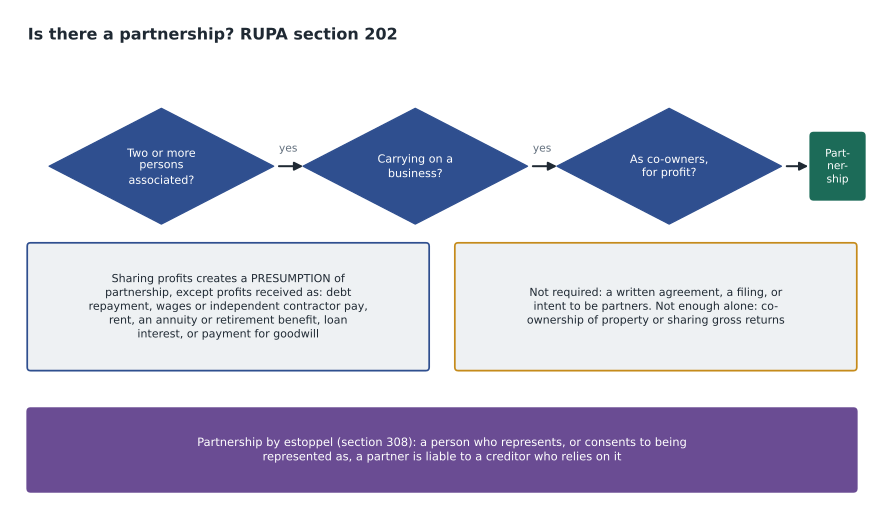
Professor Thackeray puts a single sentence on the screen: "The association of two or more persons to carry on as co-owners a business for profit forms a partnership, whether or not the persons intend to form a partnership." She tells Section B that this definition, from section 202(a) of the Revised Uniform Partnership Act, has surprised more business people than any other sentence in business law. "Lena and Owen Marsh never signed a partnership agreement," she says. "They do not need one. They are partners because of what they do, and the statute supplies their agreement."
The original Uniform Partnership Act was promulgated in 1914 and adopted in every state except Louisiana. The Revised Uniform Partnership Act, usually called RUPA, was approved in 1994 and amended in 1996 and 1997, and the Uniform Law Commission updated it again in 2013 as part of its harmonization of the uniform business entity acts. A large majority of states have adopted RUPA in some version. A few states, such as New York, still follow the 1914 Act. This lesson follows RUPA, with notes where the older Act differs. Thackeray tells the class that Westmarch has adopted RUPA as harmonized in 2013.
Formation: when are people partners?
No filing, written agreement or intent to be partners is required. What matters is whether the parties associated to carry on as co-owners a business for profit. Courts look at all the circumstances, but sharing profits is the most important evidence. Under RUPA section 202(c), a person who receives a share of the profits of a business is presumed to be a partner, unless the profits were received in payment of a debt, for services as an independent contractor or as wages, as rent, as an annuity or retirement benefit, as interest or other charge on a loan, or for the sale of the goodwill of a business. Sharing gross returns, or co-owning property, does not by itself establish a partnership.
Other evidence includes sharing losses, joint control of the business, contributing capital, holding out as partners to the public, and using the word partner. No single factor decides. In Martin v. Peyton, 246 N.Y. 213 (1927), lenders who advanced securities to a struggling brokerage firm in exchange for a share of profits, with extensive rights to information and veto power over speculative transactions, were held not to be partners, because their controls protected their loan rather than giving them management. Thackeray compares Martin with Cargill from lesson 2: lenders who take protective rights are usually safe, while lenders who start running the business may become principals or partners.
Partnership by estoppel is a separate doctrine. Under RUPA section 308, a person who represents himself, or consents to being represented, as a partner in an existing partnership or with others not partners, is liable to a person to whom the representation is made who extends credit in reliance on it. The person is not actually a partner, but is treated as one for that creditor. Thackeray gives the example of a retired father who lets his daughter's catering business list him as a partner on its letterhead so it can get credit from suppliers.
The partnership as an entity
Under the 1914 Act, a partnership was largely treated as an aggregate of its partners. RUPA section 201 declares that a partnership is an entity distinct from its partners. The partnership owns its property, which is not owned by the partners individually; it can sue and be sued in its own name; and it continues despite changes in membership when the agreement or statute so provides. A partner's interest in the partnership, called the transferable interest under the 2013 revision, consists only of the right to receive distributions. A partner may transfer that economic interest, but the transferee does not become a partner and gets no right to manage or to inspect the books without the other partners' consent.
Partners' rights among themselves: the default rules
RUPA section 401 and related sections supply default rules that apply unless the partners agree otherwise. Each partner is entitled to an equal share of the profits and is chargeable with a share of the losses in proportion to the partner's share of the profits. The default of equal sharing applies regardless of how much capital each partner contributed. Each partner has equal rights in the management and conduct of the business. A difference arising in a matter in the ordinary course of business may be decided by a majority of the partners, but an act outside the ordinary course, or an amendment of the partnership agreement, requires the consent of all partners.
No partner is entitled to compensation for services, except for reasonable compensation for winding up the business. A partner is entitled to reimbursement for payments made and indemnification for liabilities incurred in the ordinary course of business. The partnership keeps an account for each partner, crediting contributions and profits and charging distributions and losses. Partners have a right of access to the partnership's books and records and to information concerning the business. New partners may be admitted only with the consent of all the partners.
Thackeray reminds the class of the Marsh siblings. Lena works sixty hours a week making cheese; Owen works twenty hours on the books and spends the rest of his time on a farm of his own. Under the default rules, they share profits equally and neither is entitled to a salary. If Lena wants that changed, she needs Owen's agreement, because changing the profit split is an amendment requiring all partners' consent. "This is why every partnership should have a written agreement," Thackeray says. "The statute's default is equality, and equality is not always fair."
| Matter | Default rule | Section |
|---|---|---|
| Profits | Shared equally, regardless of capital contributed | 401(b) |
| Losses | Shared in proportion to profit shares | 401(b) |
| Management | Equal rights; majority for ordinary matters | 401(f), (k) |
| Extraordinary acts and amendments | Unanimous consent | 401(k) |
| Compensation | None, except reasonable pay for winding up | 401(h) |
| Admitting a partner | Unanimous consent | 401(i) |
| Transfer of interest | Transferee gets distributions only, not management | 502, 503 |
Partners as agents: binding the partnership
Under RUPA section 301, each partner is an agent of the partnership for the purpose of its business. An act of a partner, including signing an instrument in the partnership name, for apparently carrying on in the ordinary course the partnership business or business of the kind carried on by the partnership binds the partnership, unless the partner had no authority to act for the partnership in the particular matter and the person with whom the partner was dealing knew or had received notification that the partner lacked authority. An act that is not apparently in the ordinary course binds the partnership only if authorized by the other partners.
RUPA adds a public filing device. Under section 303, a partnership may file a statement of partnership authority with the state, granting or limiting partners' authority. A filed grant of authority is generally conclusive in favor of third parties who give value without knowledge to the contrary. A filed limitation on a partner's authority to transfer real property, if recorded in the real property records, is notice to the world; other limitations generally bind only those who actually know of them. Thackeray notes that few small partnerships ever file such a statement.
Partners' liability to creditors
Under RUPA section 306(a), all partners are liable jointly and severally for all obligations of the partnership, unless otherwise agreed by the claimant or provided by law. A new partner is not personally liable for obligations incurred before the person became a partner. RUPA adds an exhaustion requirement in section 307: a judgment creditor of a partner may not levy against the partner's personal assets to satisfy a partnership obligation unless a judgment on the same claim has been obtained against the partnership and a writ of execution against it has been returned unsatisfied, the partnership is in bankruptcy, the partner agreed to waive exhaustion, or a court grants permission. In practice, partners usually remain fully exposed, but creditors must normally go after the partnership first.
The liability rule is the principal reason the general partnership is now rarely chosen on purpose. A partnership may convert into a limited liability partnership by filing a statement of qualification, discussed in lesson 4, which shields partners from personal liability for partnership obligations incurred while the partnership is an LLP. That conversion does not affect debts incurred before it.
Partners' fiduciary duties
Partners owe one another and the partnership fiduciary duties. The classic statement comes from Judge Cardozo's opinion in Meinhard v. Salmon, 249 N.Y. 458 (1928). Salmon and Meinhard were joint venturers in a lease of a New York hotel, with Salmon managing. Near the end of the lease, the landlord offered Salmon alone a much larger redevelopment deal covering the hotel's site and neighboring property. Salmon took it without telling Meinhard. The court held that Salmon had breached his duty: joint adventurers, like copartners, owe one another the duty of the finest loyalty, and "not honesty alone, but the punctilio of an honor the most sensitive, is then the standard of behavior." Salmon had to share the new opportunity.
RUPA section 409 codified and limited these duties. A partner's duty of loyalty includes accounting to the partnership for any property, profit or benefit derived in the conduct of the business or from use of partnership property, including the appropriation of a partnership opportunity; refraining from dealing with the partnership as or on behalf of a party with an interest adverse to it; and refraining from competing with the partnership before its dissolution. The duty of care is limited to refraining from grossly negligent or reckless conduct, willful or intentional misconduct, or a knowing violation of law. Partners must also discharge their duties and exercise their rights consistently with the contractual obligation of good faith and fair dealing.
A partner does not violate a duty merely because the partner's conduct furthers the partner's own interest. Under section 105, the partnership agreement may not eliminate the duty of loyalty, the duty of care or the obligation of good faith, but it may, if not manifestly unreasonable, identify specific types or categories of activities that do not violate the duty of loyalty, alter the duty of care within limits, and allow the partners to authorize or ratify a specific act after full disclosure. Thackeray tells the class that this is a key difference from Delaware LLCs, where the operating agreement may eliminate fiduciary duties entirely, as lesson 4 explains.
Dissociation and dissolution
The 1914 Act treated the departure of any partner as a dissolution of the partnership, which often forced a winding up or a new partnership. RUPA separates two events. Dissociation is a partner's departure. Dissolution is the start of winding up the business. Under section 601, a partner is dissociated on giving notice of an express will to withdraw, on an event agreed to cause dissociation, on expulsion, on bankruptcy, on death, and in other listed circumstances. A partner always has the power to dissociate, but under section 602 a dissociation is wrongful if it breaches an express provision of the agreement or, in a partnership for a definite term or particular undertaking, occurs before the end of the term. A wrongfully dissociating partner is liable for damages caused.
When a partner dissociates and the partnership is not dissolved, section 701 requires the partnership to buy out the dissociated partner's interest. The buyout price is the amount that would have been distributable to the partner if, on the date of dissociation, the partnership's assets were sold at a price equal to the greater of their liquidation value or their value based on a sale of the entire business as a going concern without the partner, and the partnership was wound up as of that date. A wrongfully dissociating partner may have to wait for payment and may have damages offset against the price.
Dissolution is triggered, among other events, in a partnership at will by a partner's notice of express will to withdraw, in a partnership for a term by certain events including the expiration of the term, by the consent of all partners, by an event that makes it unlawful to continue, or by a judicial decree that the economic purpose is likely to be unreasonably frustrated or that it is not reasonably practicable to carry on the business in conformity with the agreement. After dissolution, the partnership continues only to wind up: finishing business, selling assets, paying creditors, and distributing what remains to partners according to their accounts. Under section 806, creditors, including partners who are creditors, are paid first, and then partners receive the balances in their capital accounts, with a partner who has a negative balance required to contribute to the partnership.
Worked problem
Lena wants out
Juniper Hill has no written partnership agreement. After an argument about pricing, Lena Marsh tells Owen in writing that she withdraws from the business and will start her own creamery. Juniper Hill's assets would sell for 600,000 dollars in liquidation but are worth 900,000 dollars as a going concern; it owes 300,000 dollars to the bank. Lena's and Owen's capital accounts are equal. What happens?
Show solution
- Because there is no agreement setting a term, Juniper Hill is a partnership at will. Lena's written notice of express will to withdraw dissociates her and is not wrongful.
- In a partnership at will, a partner's notice of express will to withdraw also triggers dissolution under RUPA section 801(1), so the business must be wound up unless all partners, including Lena, waive the right to winding up and continue.
- If the partners agree to continue with Owen alone, Lena is entitled to a buyout under section 701, valued at the greater of liquidation or going-concern value without her, so she would receive half of the 600,000-dollar net going-concern figure (900,000 dollars less 300,000 dollars of debt), adjusted for her account.
- Before her departure is complete, Lena owes the duty of loyalty: she must not compete with the partnership or take its customers or opportunities. Afterwards she may compete, but not with the partnership's confidential information.
- Lena remains liable for partnership debts incurred before her dissociation; she should obtain a release from the bank or an indemnity from Owen.
Answer: Lena's withdrawal from a partnership at will dissociates her and dissolves the partnership unless the partners agree to continue; if they continue, Lena should be bought out at the going-concern value net of debt (about 300,000 dollars for her half), and she stays liable on the existing bank debt unless released.
Why a written agreement matters
Thackeray closes the lesson with a list of what every partnership agreement should address: capital contributions and what happens if more money is needed; how profits and losses are shared; salaries or draws for partners who work in the business; who decides what and how deadlocks are broken; admitting new partners; restrictions on transfers; what happens on death, disability, retirement or withdrawal, including the buyout formula and how it is funded, often with life insurance; noncompetition after leaving; and dispute resolution. "The Marshes have run their family business for eleven years without one," she says. "They have been lucky. Most families are not."
Summary and key terms
- A partnership forms whenever two or more persons carry on as co-owners a business for profit; profit sharing creates a presumption of partnership with listed exceptions.
- Under RUPA a partnership is an entity, but all partners are jointly and severally liable for its obligations, subject to the exhaustion rule.
- Default rules give equal profit shares, equal management, majority rule for ordinary matters and unanimity for extraordinary ones, and no salaries.
- Each partner can bind the partnership in the apparent ordinary course unless the third party knew of a lack of authority.
- Partners owe fiduciary duties of loyalty and care, which RUPA defines and which the agreement can limit but not eliminate.
- RUPA separates dissociation from dissolution; continuing partnerships must buy out dissociated partners.
Practice problems
Work each problem on paper first, then reveal the answer to check.
Does receiving a share of profits always make someone a partner?
Show answer
No. It creates a presumption, but not if the profits were received as debt repayment, wages, rent, an annuity, loan interest or payment for goodwill.
Why were the lenders in Martin v. Peyton not partners?
Show answer
Their rights to information and to veto speculative transactions protected their loan; they did not have co-ownership or management of the business.
What did Meinhard v. Salmon hold?
Show answer
A managing co-venturer breached his duty of the finest loyalty by taking for himself, without disclosure, a renewal opportunity arising from the joint venture.
What is the difference between dissociation and dissolution under RUPA?
Show answer
Dissociation is a partner's departure; dissolution starts the winding up of the business. A dissociation does not always dissolve the partnership.
Can a RUPA partnership agreement eliminate the duty of loyalty?
Show answer
No, but it may identify specific activities that do not violate it, if not manifestly unreasonable, and allow authorization or ratification after full disclosure.
Lesson quiz · 5 questions
Score 60% or more to complete this lesson.
Create a free account to save your progress, take quizzes and earn a certificate.