
LAWU-202 · Lesson 4 of 12 · 24 min
Limited partnerships, LLPs and LLCs
▶ Video coming soon A video version of this lesson is on the way.
"For most of the twentieth century," Professor Thackeray tells Section B, "a small business that wanted limited liability had one choice: incorporate. If it wanted partnership tax treatment and partnership flexibility too, it was out of luck, unless it could use a limited partnership and find someone willing to be the general partner with unlimited liability." She draws a timeline on the board: the first limited partnership statutes in the nineteenth century, the Wyoming LLC statute of 1977, an Internal Revenue Service ruling in 1988 treating a Wyoming LLC as a partnership for tax purposes, and the Treasury's check-the-box regulations of 1997. "By the end of the 1990s every state had an LLC statute," she says, "and the LLC began to take over."
This lesson covers three hybrid entities that combine elements of partnerships and corporations: the limited partnership, the limited liability partnership and the limited liability company. Thackeray asks the class to keep in mind the decision Lena and Owen Marsh face about converting Juniper Hill, which she raised in lesson 1, and to notice how each entity handles the five questions of liability, management, taxation, transferability and formality.
The limited partnership
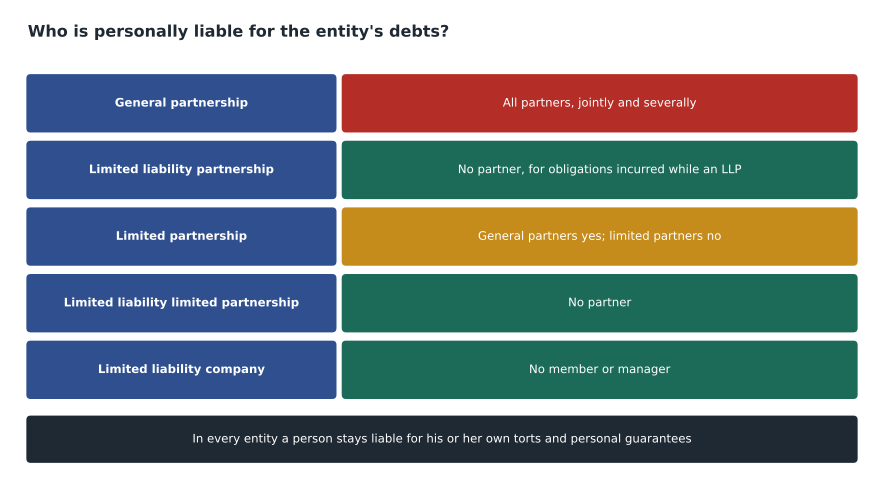
A limited partnership has at least one general partner and at least one limited partner. It is formed by filing a certificate of limited partnership with the state. The governing statute in most states is a version of the Uniform Limited Partnership Act of 2001, often called ULPA 2001 or Re-ULPA, as harmonized in 2013, or an earlier version based on the Revised Uniform Limited Partnership Act of 1976 and 1985. Delaware has its own Revised Uniform Limited Partnership Act. General partners manage the business and, absent a further shield, are personally liable for its obligations. Limited partners invest capital and share profits but are not personally liable for the partnership's obligations beyond their contributions.
Under the older acts, a limited partner who participated in the control of the business could lose the liability shield and be treated as a general partner toward creditors who reasonably believed, based on the limited partner's conduct, that the limited partner was a general partner. The 1985 act listed safe-harbor activities, such as consulting with the general partner or voting on major matters, that did not count as control. ULPA 2001 section 303 eliminated the control rule: a limited partner is not personally liable for the partnership's obligations even if the limited partner participates in management and control. Delaware's statute retains a narrower version of the control rule with extensive safe harbors.
ULPA 2001 also allows a limited partnership to elect to be a limited liability limited partnership, an LLLP, by stating so in its certificate. In an LLLP, even the general partner is not personally liable for the partnership's obligations merely because of being a general partner. Many limited partnerships achieve the same result differently: the general partner is itself a corporation or LLC, so that no individual faces unlimited liability. Limited partnerships remain common for investment funds, real estate ventures and family estate planning, where a parent acting as general partner can control assets while transferring limited partnership interests to children.
General partners owe fiduciary duties to the limited partnership and the other partners similar to those of general partners in a general partnership, and ULPA 2001 limits the agreement's power to eliminate them in the same way RUPA does. Limited partners, under ULPA 2001 section 305, do not have fiduciary duties solely by reason of being limited partners, but must act consistently with the contractual obligation of good faith and fair dealing. Delaware's statute, like its LLC statute, lets the agreement eliminate fiduciary duties entirely, subject to the implied covenant of good faith and fair dealing.
The limited liability partnership
The limited liability partnership began in Texas in 1991, after the savings and loan crisis exposed partners in law and accounting firms to personal liability for the malpractice of their colleagues. The first LLP statutes protected partners only from liability for other partners' negligence and malpractice, a partial shield. Within a few years nearly every state adopted a full shield, which RUPA section 306(c) now provides: an obligation of a partnership incurred while it is a limited liability partnership, whether arising in contract, tort or otherwise, is solely the obligation of the partnership, and a partner is not personally liable for it solely by reason of being or acting as a partner.
An existing general partnership becomes an LLP by filing a statement of qualification with the state, approved by the vote required to amend the partnership agreement, which by default is unanimous. Many states require LLPs to file annual reports, and some require professional firms to maintain malpractice insurance. The shield does not protect a partner from liability for the partner's own torts, misconduct or supervision failures, and it applies only to obligations incurred while the partnership has LLP status. Apart from liability, an LLP is a general partnership, governed by RUPA's other rules on management, fiduciary duties and dissociation.
The limited liability company: formation and the operating agreement
A limited liability company is formed by filing a certificate or articles of organization with the state, which typically states only the company's name, the address of its registered office and the name and address of its registered agent. The internal rules are in the operating agreement, which may be written, oral or implied, and which the Revised Uniform Limited Liability Company Act, RULLCA, calls the operating agreement and the Delaware Limited Liability Company Act calls the limited liability company agreement. RULLCA was promulgated in 2006 and harmonized in 2013; around twenty states have adopted it, while others, including Delaware, New York and California, have their own statutes.
Most LLC statutes are default-rule statutes. Under RULLCA section 105, the operating agreement governs relations among the members and between the members and the company, and the statute applies only to the extent the agreement does not otherwise provide. The agreement cannot, however, vary certain rules listed in section 105(c), including the company's capacity to sue and be sued, the law applicable under the internal affairs doctrine, the power of a court to decree dissolution in certain circumstances, and some rights to information. Delaware's LLC Act states in section 18-1101(b) that it is the policy of the act to give the maximum effect to the principle of freedom of contract and to the enforceability of limited liability company agreements.
Management: member-managed and manager-managed
An LLC is member-managed unless its operating agreement provides that it is manager-managed. In a member-managed LLC under RULLCA section 407, the management and conduct of the company are vested in the members, each member has equal rights, a matter in the ordinary course may be decided by a majority of the members, and an act outside the ordinary course or an amendment of the operating agreement requires the consent of all members. In a manager-managed LLC, matters in the ordinary course are decided by the managers, while extraordinary acts and amendments still require the consent of all members by default. Managers are chosen by a majority of the members and may be removed by them.
On authority to bind the company, RULLCA departed from the older approach. Many early LLC statutes made every member of a member-managed LLC an agent, mirroring partnership law. RULLCA section 301 provides that a member is not an agent of the company solely by reason of being a member. Authority instead comes from ordinary agency law, the operating agreement, and any statement of authority the company files. Delaware's act provides that, unless the agreement says otherwise, each member and manager has the authority to bind the company. Thackeray tells the class this is a trap for anyone who assumes all LLC statutes work alike.
| Matter | Member-managed | Manager-managed |
|---|---|---|
| Ordinary-course decisions | Majority of members | Manager or majority of managers |
| Acts outside ordinary course | All members | All members |
| Amending the operating agreement | All members | All members |
| Agency power of a member | Not merely by being a member | Not merely by being a member |
| Duties of loyalty and care | Owed by members | Owed by managers; members generally owe none merely as members |
| Distributions before dissolution | Equal shares among members (section 404); Delaware instead uses the agreed value of contributions | Same |
Fiduciary duties in LLCs and freedom of contract
RULLCA section 409 imposes fiduciary duties on members of a member-managed LLC, and on managers of a manager-managed LLC, using language close to RUPA's: a duty of loyalty to account for benefits, avoid adverse dealing and refrain from competition, a duty of care to refrain from grossly negligent or reckless conduct, willful or intentional misconduct or a knowing violation of law, and the contractual obligation of good faith and fair dealing. As with partnerships, the operating agreement may restrict or define these duties if not manifestly unreasonable, but under section 105 it may not eliminate the duty of loyalty, the duty of care or the obligation of good faith.
Delaware takes a different approach. Section 18-1101(c) of its LLC Act allows the limited liability company agreement to expand, restrict or eliminate a member's or manager's duties, including fiduciary duties, provided that the agreement may not eliminate the implied contractual covenant of good faith and fair dealing. Section 18-1101(e) allows the agreement to limit or eliminate liability for breach of duties, other than liability for a bad faith violation of the implied covenant. The Delaware Supreme Court has held that where the agreement is silent, default fiduciary duties apply, and the legislature amended the act in 2013 to say so expressly, after the court in Gatz Properties, LLC v. Auriga Capital Corp., 59 A.3d 1206 (Del. 2012), had declined to decide the question.
The implied covenant of good faith and fair dealing is narrow. It fills gaps in the agreement by asking what the parties would have agreed to had they thought about the issue, and it cannot override express terms. Thackeray warns the class that investors in a Delaware LLC whose agreement eliminates fiduciary duties may have only the rights the contract expressly gives them. "If you represent the minority investor," she says, "read every word. The contract is the whole deal."
Members' interests, transfers and exit
As in a partnership, a member's interest in an LLC consists of economic rights, which RULLCA calls the transferable interest, and governance rights. A member may transfer the transferable interest, but the transferee does not become a member and has no right to participate in management unless the other members consent as the agreement or statute requires. A creditor of a member may obtain a charging order against the member's transferable interest, which requires the company to pay the creditor any distributions that would otherwise go to the member. In many states, including under RULLCA section 503, a charging order is the exclusive remedy by which a judgment creditor of a member may satisfy the judgment from the member's interest.
Exit rights differ from partnerships. Under RULLCA, a member may dissociate by express will, but there is no default right to be bought out, unlike RUPA's buyout of a dissociated partner. A dissociated member keeps only the transferable interest. Most LLC statutes also make it hard to force dissolution: RULLCA section 701 allows a court to order dissolution when it is not reasonably practicable to carry on the company's activities in conformity with the certificate and the operating agreement, or when managers or controlling members have acted illegally or fraudulently or in a manner oppressive and directly harmful to the applicant. Courts may order other remedies, including a buyout, instead. Delaware permits judicial dissolution when it is not reasonably practicable to carry on the business in conformity with the agreement, which courts apply mainly in deadlock cases.
The lack of a default exit right means that minority members of LLCs, like minority shareholders in close corporations, can be locked in. Thackeray tells the class that buy-sell provisions are the most important clauses in a small LLC's operating agreement: they set when a member may or must sell, at what price, and how the price is paid.
Taxation and the choice of entity
Under the Treasury's check-the-box regulations, an unincorporated business entity with two or more members is classified as a partnership for federal tax purposes unless it elects to be taxed as a corporation, and a single-member entity is disregarded, meaning its income is reported directly by its owner, unless it elects otherwise. Corporations formed under state corporation statutes are always taxed as corporations, though eligible ones may elect S status. This flexibility is a major reason the LLC has become the default choice for closely held businesses, along with its liability shield and contractual flexibility.
Corporations still have advantages. Venture capital investors and companies planning to go public usually prefer Delaware corporations, because public markets, stock option plans, and investors' own fund documents are built around corporate stock. Corporate law is more settled and predictable than LLC law in many states. And some tax provisions, such as the exclusion for gain on qualified small business stock in section 1202 of the Internal Revenue Code, are available only to C corporation shareholders. Thackeray tells the class that start-ups often form as Delaware corporations from the beginning for these reasons, while family businesses like Juniper Hill usually choose LLCs.
Worked problem
Converting Juniper Hill to an LLC
Lena and Owen decide to convert Juniper Hill from a general partnership to a Westmarch LLC, with Tessa investing 150,000 dollars for a 20 percent economic interest without voting rights. Owen proposes that the operating agreement say the members owe no fiduciary duties to one another. Tessa's lawyer objects. Westmarch has adopted RULLCA. Who is right, and what should the agreement say?
Show solution
- Formation: they file a certificate of organization (or a statement of conversion under Westmarch's entity transactions act) and adopt a written operating agreement; the partnership's property and obligations pass to the LLC by operation of law in a statutory conversion.
- Liability: the members are not personally liable for obligations incurred by the LLC, but the conversion does not release them from the partnership's existing debts, including the guaranteed bank loan.
- Fiduciary duties: under RULLCA section 105, the operating agreement may not eliminate the duty of loyalty, the duty of care or the obligation of good faith and fair dealing, though it may restrict them and identify specific permitted activities if not manifestly unreasonable. Owen's clause would be unenforceable in Westmarch. (In Delaware, it would be allowed, subject to the implied covenant.)
- Tessa should negotiate information rights, protective votes on major decisions, tag-along rights if the Marshes sell, and a buy-sell clause, because RULLCA gives a dissociated member no default buyout.
Answer: Tessa's lawyer is right under RULLCA: the agreement cannot eliminate fiduciary duties, though it can define and restrict them. Tessa should also secure information rights, approval rights on major transactions and an exit mechanism, because the statute gives her no default buyout.
Summary and key terms
- Limited partners are shielded from the partnership's obligations; ULPA 2001 abolished the old control rule, and LLLP status can shield general partners too.
- An LLP is a general partnership that filed a statement of qualification; today nearly all states give its partners a full shield for obligations incurred while it is an LLP.
- LLCs are formed by filing and governed mainly by the operating agreement; they are member-managed unless the agreement provides for managers.
- RULLCA does not make members agents merely as members; Delaware gives each member and manager authority unless the agreement says otherwise.
- RULLCA lets the agreement restrict but not eliminate fiduciary duties; Delaware lets it eliminate them, but not the implied covenant.
- LLC members have no default buyout right, and creditors of members are usually limited to charging orders.
Practice problems
Work each problem on paper first, then reveal the answer to check.
What did ULPA 2001 change about limited partners who participate in control?
Show answer
It eliminated the control rule, so a limited partner is not personally liable even if it participates in management.
What does an LLP's full shield protect against, and what does it not?
Show answer
It protects partners from personal liability for partnership obligations incurred while it is an LLP, but not from their own torts or misconduct.
Is a member of a member-managed LLC under RULLCA an agent of the company?
Show answer
Not solely by reason of being a member; authority comes from agency law, the operating agreement or a statement of authority.
How far can a Delaware LLC agreement limit fiduciary duties?
Show answer
It may eliminate them entirely, but it may not eliminate the implied contractual covenant of good faith and fair dealing.
Why might a start-up choose a Delaware corporation rather than an LLC?
Show answer
Venture investors and public markets are built around corporate stock and option plans, corporate law is settled, and some tax benefits such as qualified small business stock apply only to C corporations.
Lesson quiz · 5 questions
Score 60% or more to complete this lesson.
Create a free account to save your progress, take quizzes and earn a certificate.