
LAWU-201 · Lesson 9 of 12 · 25 min
Lay and expert opinion
▶ Video coming soon A video version of this lesson is on the way.
Rosa Delgado's case will be won or lost on expert testimony. No one saw the battery cell fail. Whether the Kestrel Trail 750 battery pack was defectively designed, whether its battery management system should have limited charging current as cell temperature rose, and whether a third-party charger or physical damage caused the fire instead are questions a jury cannot answer without help. Delgado has retained Dr. Samuel Achterberg, an electrochemical engineer who has investigated lithium-ion battery fires for fifteen years. Kestrelwerk will call its own engineer, Dr. Anja Brenner, and an outside fire investigator. Professor Hartigan tells Section B that in modern civil litigation the most important evidentiary ruling is often whether the court lets an expert testify at all.
Lay opinion: Rule 701
The common law preferred that lay witnesses testify to facts and leave inferences to the jury, but drawing a line between fact and opinion proved impossible. A witness who says a car was "going fast" or that a person "looked drunk" is expressing an opinion that summarizes many perceptions. Rule 701 takes a practical approach. If a witness is not testifying as an expert, testimony in the form of an opinion is limited to one that is rationally based on the witness's perception, helpful to clearly understanding the witness's testimony or to determining a fact in issue, and not based on scientific, technical or other specialized knowledge within the scope of Rule 702.
The first requirement restates personal knowledge: the opinion must rest on what the witness perceived. The second excludes opinions that add nothing, such as a witness's view of how the case should come out or a conclusion the jury is equally able to draw from the facts. The third requirement, added in 2000, prevents parties from evading the reliability requirements and disclosure obligations for experts by presenting expert testimony through lay witnesses. The Advisory Committee's note distinguishes lay testimony, which results from a process of reasoning familiar in everyday life, from expert testimony, which results from a process of reasoning that can be mastered only by specialists in the field.
Ray Dunleavy can testify that Abbott "looked terrified," "was gray and sweating" and "seemed to be having trouble breathing." Those are lay opinions rationally based on what he saw. He should not testify that Abbott "was having a heart attack," because diagnosing a cardiac event requires medical knowledge; that is for the medical examiner. Courts commonly allow lay opinion on speed, distance, emotional state, sanity in some contexts, intoxication, handwriting familiar to the witness and the identity of a person in a photograph if the witness knows the person well. Business owners and officers may testify to the value of their own property or the projected profits of their business based on particularized knowledge gained from their position, a category the Advisory Committee note recognizes.
Law enforcement testimony illustrates the boundary. An officer may testify as a lay witness to what she observed at a scene. But an officer who interprets drug code words or explains how trafficking organizations operate is offering specialized knowledge and must be qualified as an expert under Rule 702, with the disclosure that requires. Courts have reversed convictions where officers gave expert testimony disguised as lay testimony, and they scrutinize dual-role witnesses who testify both to facts and as experts, requiring the jury to understand which role the witness is playing.
Expert testimony: Rule 702
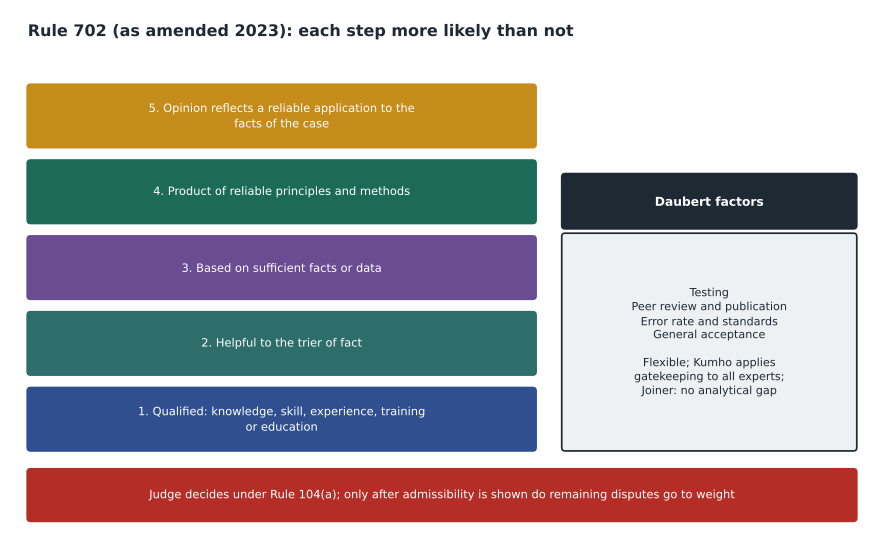
Rule 702, as amended effective December 1, 2023, provides that a witness who is qualified as an expert by knowledge, skill, experience, training or education may testify in the form of an opinion or otherwise if the proponent demonstrates to the court that it is more likely than not that: the expert's scientific, technical or other specialized knowledge will help the trier of fact to understand the evidence or to determine a fact in issue; the testimony is based on sufficient facts or data; the testimony is the product of reliable principles and methods; and the expert's opinion reflects a reliable application of the principles and methods to the facts of the case.
Frye and Daubert
For most of the twentieth century, federal and state courts followed Frye v. United States, 293 F. 1013 (D.C. Cir. 1923), which excluded testimony based on a systolic blood pressure deception test because the technique had not gained general acceptance in the particular field in which it belonged. General acceptance became the test for novel scientific evidence.
In Daubert v. Merrell Dow Pharmaceuticals, Inc., 509 U.S. 579 (1993), the Supreme Court held that the Federal Rules of Evidence superseded Frye. Rule 702 requires the trial judge to act as a gatekeeper, ensuring that any scientific testimony admitted is not only relevant but reliable. The judge must make a preliminary assessment under Rule 104(a) of whether the reasoning or methodology underlying the testimony is scientifically valid and can properly be applied to the facts in issue. The Court offered factors to guide the inquiry: whether the theory or technique can be and has been tested; whether it has been subjected to peer review and publication; its known or potential rate of error and the existence and maintenance of standards controlling its operation; and whether it has general acceptance in the relevant scientific community. The factors are flexible, and the focus must be on principles and methodology, not on the conclusions they generate.
Two later decisions completed what lawyers call the Daubert trilogy. In General Electric Co. v. Joiner, 522 U.S. 136 (1997), the Court held that appellate courts review a trial court's decision to admit or exclude expert testimony for abuse of discretion, and added that conclusions and methodology are not entirely distinct: nothing requires a court to admit opinion evidence connected to existing data only by the ipse dixit of the expert, because there may be simply too great an analytical gap between the data and the opinion. In Kumho Tire Co. v. Carmichael, 526 U.S. 137 (1999), the Court held that the gatekeeping obligation applies to all expert testimony, not only scientific testimony, including engineering and experience-based testimony such as a tire failure analyst's. The trial court may consider the Daubert factors where they are reasonable measures of reliability, but has latitude to decide how to test reliability.
Congress did not amend Rule 702 after Daubert, but the Judicial Conference did. A 2000 amendment codified the trilogy by adding the requirements that testimony be based on sufficient facts or data, be the product of reliable principles and methods, and reflect a reliable application of them to the facts. Many states have adopted Daubert, while others, including California, New York, Illinois and Pennsylvania in various forms, still apply Frye or a variant. Students must learn the standard in the jurisdiction where they practice.
The 2023 amendment
The 2023 amendment responded to a concern that many courts were applying Rule 702 too leniently. The Advisory Committee found that courts had often held that questions about the sufficiency of an expert's basis or the application of the methodology were questions of weight for the jury rather than admissibility, and that some courts had not required the proponent to establish admissibility by a preponderance. The amendment made two changes. It added language stating expressly that the proponent must demonstrate to the court that it is more likely than not that each requirement is met, confirming that Rule 104(a) applies. And it changed the last requirement from "the expert has reliably applied the principles and methods" to "the expert's opinion reflects a reliable application," emphasizing that each opinion must stay within the bounds of what the methodology can support.
The Advisory Committee's note explains that once the court has found the preponderance standard met, attacks on the testimony go to weight, and that the amendment is not intended to impose any new, specific procedures. But it states that many courts had incorrectly treated the critical questions of sufficiency of basis and application of methodology as questions of weight, and that the rule requires the judge to decide them. Since the amendment, several circuits have cited it in reversing decisions that admitted expert testimony without adequate gatekeeping, though courts continue to differ in how strictly they apply it.
Applying Rule 702 to Delgado's experts
Dr. Achterberg's opinion has three parts. First, the fire originated in the battery pack, based on burn patterns in the garage, the condition of the pack's remains and arc mapping of the wiring. Second, the initiating event was thermal runaway in a single cell, based on CT scans and disassembly of the pack's remains showing an internal short in cell 23. Third, the battery management system's design was defective because it did not reduce charging current when cell temperature exceeded the cell manufacturer's recommended limits, based on Kestrelwerk's firmware, test data produced in discovery and accelerated testing of exemplar packs in his laboratory.
Kestrelwerk will move to exclude under Rule 702. On the first two opinions, Achterberg's methods, fire origin analysis using recognized standards such as NFPA 921, the guide for fire and explosion investigations, and CT imaging and disassembly of failed cells, are widely used and tested, and his application of them appears careful; the court will likely admit them and leave disagreements to cross-examination. The third opinion is more vulnerable. Kestrelwerk will argue that Achterberg's exemplar tests used a charging profile different from the Trail 750's, that he tested only four packs, and that he did not rule out manufacturing defects in the cell as the cause of the internal short. Under the 2023 amendment, the court must decide by a preponderance whether his opinion reflects a reliable application of his method to the facts, not leave the analytical gap to the jury. If the court finds the exemplar tests do not support the conclusion that a temperature-based current limit would have prevented this fire, it may exclude that part of his opinion or limit it.
Kestrelwerk's experts face the same scrutiny. Dr. Brenner may testify about the design process and testing as a fact witness and, if properly disclosed, as an expert. If she opines that a third-party charger caused the fire, she must have a reliable basis; Delgado's habit testimony and the absence of any third-party charger in the debris will be central to the cross-examination.
The bases of expert opinion: Rule 703
Rule 703 lets an expert base an opinion on facts or data in the case that the expert has been made aware of or personally observed. If experts in the particular field would reasonably rely on those kinds of facts or data in forming an opinion on the subject, they need not be admissible for the opinion to be admitted. But if the facts or data would otherwise be inadmissible, the proponent may disclose them to the jury only if their probative value in helping the jury evaluate the opinion substantially outweighs their prejudicial effect.
Rule 703 lets experts rely on hearsay, such as interviews, reports from other investigators and published data, without putting all of it into evidence, because that is how experts in many fields work. The disclosure balance, added in 2000, prevents parties from using an expert as a conduit for inadmissible evidence. After Smith v. Arizona (2024), discussed in lesson 8, prosecutors must be especially careful: when an expert in a criminal case relays an absent analyst's statements as the basis of an opinion, those statements are offered for their truth for confrontation purposes. In civil cases the Confrontation Clause does not apply, but Rule 703's balancing test still limits disclosure.
Rule 705 allows an expert to state an opinion and give the reasons for it without first testifying to the underlying facts or data, unless the court orders otherwise, though the expert may be required to disclose them on cross-examination. In practice, lawyers usually walk the expert through the basis on direct, because juries are more persuaded by experts who explain their reasoning.
Ultimate issues: Rule 704
The common law sometimes barred witnesses from giving opinions on the ultimate issue in the case, on the theory that doing so usurped the jury's function. Rule 704(a) abolishes that rule: an opinion is not objectionable just because it embraces an ultimate issue. Achterberg may testify that the battery pack was defectively designed in the engineering sense. But other rules limit ultimate-issue opinions. An opinion that merely tells the jury what result to reach, or that states a legal conclusion using terms with specialized legal meaning, such as "the defendant was negligent" or "the product was unreasonably dangerous under Ohio law," may be excluded as unhelpful under Rules 701 and 702 or under Rule 403.
Rule 704(b), added by Congress in 1984 after John Hinckley's acquittal by reason of insanity, provides that in a criminal case an expert witness must not state an opinion about whether the defendant did or did not have a mental state or condition that constitutes an element of the crime charged or of a defense. Those matters are for the trier of fact alone. In Diaz v. United States, 602 U.S. 526 (2024), a defendant charged with knowingly transporting methamphetamine claimed she did not know the drugs were hidden in her car. A government expert testified that most couriers know they are transporting drugs. The Supreme Court held that the testimony did not violate Rule 704(b), because it was not an opinion about whether Diaz herself had the requisite knowledge; the rule bars only opinions about the defendant's own mental state, and testimony about a class of people to which the defendant may or may not belong leaves the ultimate inference to the jury.
Court-appointed experts and disclosure
Rule 706 lets the court appoint an expert witness on its own or on a party's motion. The expert must be advised of the duties, may be deposed by any party, may be called by the court or any party and may be cross-examined by any party. Courts rarely use the power, partly because of cost and partly because juries may give a court-appointed expert's views decisive weight, but some judges appoint technical advisers in complex patent, environmental or scientific cases.
Expert testimony is also governed by the rules of procedure. Federal Rule of Civil Procedure 26(a)(2) requires parties to disclose retained experts and provide detailed written reports stating all opinions, the bases and reasons for them, the facts or data considered, exhibits, qualifications, prior testimony and compensation. Federal Rule of Criminal Procedure 16, amended in 2022, requires more complete expert disclosures in criminal cases than it did before, including a complete statement of all opinions and the bases and reasons for them, the witness's qualifications and a list of prior testimony. A party that fails to disclose risks having the expert excluded.
| Feature | Lay opinion (Rule 701) | Expert opinion (Rule 702) |
|---|---|---|
| Basis | Witness's own perception | Specialized knowledge; may rely on facts not personally observed (Rule 703) |
| Reasoning | Familiar in everyday life | Mastered only by specialists |
| Gatekeeping | Rationally based and helpful | Qualification, helpfulness, sufficient basis, reliable methods, reliable application, each more likely than not |
| Disclosure | No special disclosure | Civil Rule 26(a)(2) report; Criminal Rule 16 disclosure |
| Examples | Abbott looked terrified; the car was going about 50 | Cause of death; thermal runaway in cell 23; drug trafficking practices |
Worked problem
A Rule 702 challenge
Kestrelwerk moves to exclude Dr. Achterberg's third opinion, that a temperature-based charging limit would have prevented the fire, arguing that his exemplar tests used a different charging profile and only four packs. Delgado responds that these criticisms go to weight. How should the court approach the motion after the 2023 amendment?
Show solution
- Under Rule 104(a) and the amended Rule 702, Delgado as proponent must show it is more likely than not that the opinion rests on sufficient facts or data, uses reliable methods and reflects a reliable application of them to this case.
- The court cannot treat the sufficiency of the basis or the fit between tests and conclusion as merely questions of weight; the 2023 amendment rejects that approach.
- The court examines whether the different charging profile undermines the inference to the Trail 750, whether four packs are enough given the failure mode, and whether Achterberg considered alternative causes such as a manufacturing defect in the cell (Joiner's analytical gap).
- If the method is reliable but the application overreaches, the court may limit the opinion, for example allowing testimony that the design lacked a common safety feature but excluding the claim that the feature would have prevented this particular fire.
- Once admissibility is shown, remaining disputes go to cross-examination and contrary evidence.
Answer: The court must decide by a preponderance whether the opinion reliably follows from the tests; if the gap is too great, it should exclude or narrow the opinion rather than leave the question to the jury.
Summary and key terms
- Rule 701 allows lay opinions rationally based on perception and helpful, but not based on specialized knowledge.
- Rule 702 requires the proponent to show more likely than not that the expert is qualified, the testimony helpful, the basis sufficient, the methods reliable and the opinion a reliable application of them (2023 amendment).
- Daubert made the judge a gatekeeper; Joiner set abuse-of-discretion review and recognized analytical gaps; Kumho extended gatekeeping to all experts; some states still use Frye.
- Rule 703 lets experts rely on inadmissible facts experts reasonably use, but disclosure to the jury requires probative value substantially outweighing prejudice.
- Rule 704(a) permits ultimate-issue opinions, but legal conclusions may be unhelpful; Rule 704(b) bars opinions on a criminal defendant's mental state, though Diaz (2024) allows testimony about what most people in a class know.
- Rule 706 permits court-appointed experts; Civil Rule 26 and Criminal Rule 16 govern expert disclosure.
Practice problems
Work each problem on paper first, then reveal the answer to check.
Why should Dunleavy not testify that Abbott was having a heart attack?
Show answer
A diagnosis requires specialized medical knowledge, so it is not proper lay opinion under Rule 701(c).
What two things did the 2023 amendment to Rule 702 do?
Show answer
It made explicit that the proponent must show each requirement more likely than not, and it required that the opinion reflect a reliable application of the methods to the facts.
What did Kumho Tire add to Daubert?
Show answer
The gatekeeping obligation applies to all expert testimony, including technical and experience-based testimony.
What did Diaz v. United States hold about Rule 704(b)?
Show answer
An expert's testimony that most couriers know they carry drugs is not an opinion about the defendant's own mental state, so it does not violate Rule 704(b).
Under Rule 703, when may inadmissible basis facts be disclosed to the jury?
Show answer
Only if their probative value in helping the jury evaluate the opinion substantially outweighs their prejudicial effect.
Lesson quiz · 5 questions
Score 60% or more to complete this lesson.
Create a free account to save your progress, take quizzes and earn a certificate.