
LAWU-201 · Lesson 3 of 12 · 25 min
Character evidence
▶ Video coming soon A video version of this lesson is on the way.
Professor Hartigan writes one sentence on the board: "He did it before, so he probably did it again." She asks Section B whether the inference is logical. Daniel Reyes, who spent three years as a paralegal, says it often is: people do have habits and tendencies, and repeat offenders exist. Hannah Lindqvist says that is exactly the problem. "If the inference is logical, why does the law forbid it?" Hartigan's answer is the subject of this lesson. Evidence law bars the propensity inference not because it has no probative value, but because jurors tend to give it too much, to punish people for who they are rather than what they did, and to convict on a weaker case because the defendant seems like a bad person.
The propensity rule: Rule 404(a)(1)
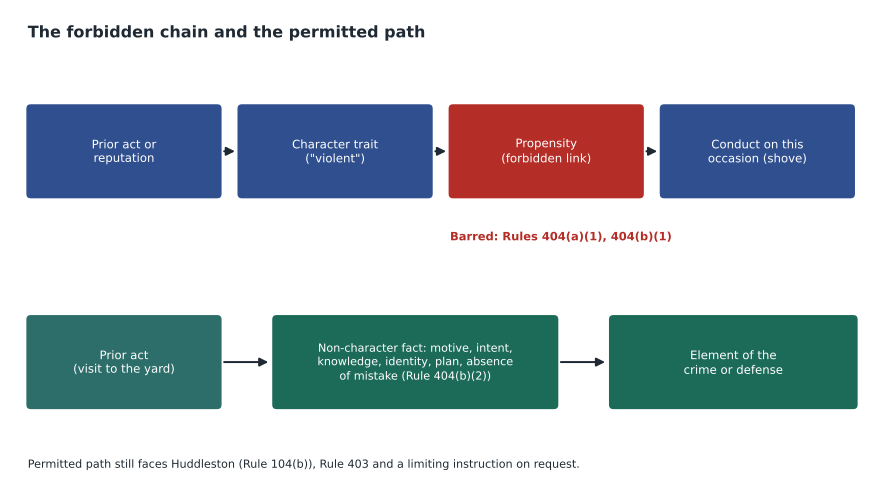
Rule 404(a)(1) states the basic rule. Evidence of a person's character or character trait is not admissible to prove that on a particular occasion the person acted in accordance with the character or trait. The rule bars a specific chain of reasoning: from evidence of the person's character, to an inference about the person's propensity, to an inference about conduct on the occasion in question. It does not bar character evidence offered for other purposes, and it does not bar evidence of specific acts offered to prove something other than propensity.
The Supreme Court explained the rationale in Michelson v. United States, 335 U.S. 469 (1948). The inquiry into a defendant's character is not rejected because it is irrelevant; on the contrary, it is said to weigh too much with the jury and to so overpersuade them as to prejudge one with a bad general record and deny him a fair opportunity to defend against a particular charge. The rule also avoids mini-trials about collateral events and protects people from being forced to defend their whole lives.
Character means a person's general disposition or a specific trait, such as honesty, peacefulness, violence or carefulness. It is different from habit, a regular response to a specific situation, which Rule 406 treats very differently and which lesson 4 covers. It is also different from evidence of a person's knowledge, skill or intent, which may be proved by specific acts without any propensity reasoning.
The exceptions in criminal cases: Rule 404(a)(2)
In criminal cases, Rule 404(a)(2) lets the defendant open a door the prosecution may not open first. Under Rule 404(a)(2)(A), a defendant may offer evidence of the defendant's pertinent trait, and if the evidence is admitted, the prosecutor may offer evidence to rebut it. This is sometimes called the mercy rule: a defendant whose liberty is at stake may ask the jury to consider that he is not the kind of person who would commit the crime. The trait must be pertinent to the charge. In a fraud case, honesty is pertinent; in an assault case, peacefulness is pertinent; general law-abidingness is usually considered pertinent to any charge.
Under Rule 404(a)(2)(B), subject to the limits of Rule 412 in sexual assault cases, a defendant may offer evidence of an alleged victim's pertinent trait, and if the evidence is admitted, the prosecutor may offer evidence to rebut it and offer evidence of the defendant's same trait. That last clause, added in 2000, means a defendant who attacks the victim's character for violence opens the door to evidence of his own character for violence. Under Rule 404(a)(2)(C), in a homicide case, the prosecutor may offer evidence of the alleged victim's trait for peacefulness to rebut evidence that the victim was the first aggressor, even if the defense offered no character evidence at all.
Hartigan applies the rules to Pike. Pike told police that Abbott swung his flashlight first and that he shoved Abbott to protect himself. If Pike calls a witness to testify that Abbott had a reputation as a hothead who picked fights with trespassers, that is evidence of the victim's pertinent trait for violence, admissible under Rule 404(a)(2)(B). The prosecution may then rebut with evidence that Abbott was peaceful and may offer evidence that Pike himself has a violent character. Even if Pike offers no character evidence but simply testifies that Abbott attacked first, Rule 404(a)(2)(C) allows the prosecution to offer Abbott's character for peacefulness, because this is a homicide case and the defense has claimed Abbott was the first aggressor.
Rule 404(a)(3) adds that evidence of a witness's character may be admitted under Rules 607, 608 and 609. Character for truthfulness, offered to impeach or support a witness, follows its own rules, which lesson 5 covers.
Character in civil cases
The exceptions in Rule 404(a)(2) apply only in criminal cases. In a civil case, a party may not offer character evidence to prove conduct on a particular occasion, even if the case involves conduct that is criminal, such as a civil assault or fraud claim. Some courts once allowed it in civil cases with criminal overtones, but the 2006 amendment to Rule 404(a) made clear that the exceptions are limited to criminal cases. Rule 415 is an exception for civil cases involving sexual assault or child molestation, covered in lesson 4.
When character is an element
Sometimes character is not offered to prove conduct but is itself an element of a claim, charge or defense. In a defamation case where the defendant called the plaintiff a thief and pleads truth, the plaintiff's character for theft is directly at issue. In a negligent entrustment case, the competence and character of the person entrusted with a car or a gun is an element. In a child custody dispute, a parent's character may bear directly on the child's best interests. In an entrapment defense, the defendant's predisposition is at issue. Rule 404(a)(1) does not apply because the evidence is not offered to prove action in conformity; Rule 405(b) allows proof by specific instances of conduct.
Methods of proof: Rule 405
When character evidence is admissible, Rule 405 controls how it may be proved. Under Rule 405(a), character may be proved by testimony about the person's reputation or by testimony in the form of an opinion. On cross-examination of the character witness, the court may allow an inquiry into relevant specific instances of the person's conduct. Under Rule 405(b), when character is an essential element of a charge, claim or defense, it may also be proved by relevant specific instances of conduct.
The restriction to reputation and opinion on direct reflects the risk that specific acts will take over the trial and inflame the jury. The permission to ask about specific instances on cross reflects the need to test the character witness. In Michelson, the defendant's character witnesses testified to his reputation for honesty, and the prosecutor asked whether they had heard that he had been arrested for receiving stolen goods twenty-seven years earlier. The Court upheld the question. A reputation witness's knowledge of what is said about the defendant can be tested by asking whether the witness has heard of things the community would have discussed.
Courts impose safeguards on such cross-examination. The questioner must have a good faith basis for believing the incident occurred, the incident must be relevant to the trait the witness addressed, and the court should instruct the jury that the questions are not evidence that the event happened but only test the witness's knowledge or opinion. The form traditionally differs by type of witness: reputation witnesses are asked "Have you heard," and opinion witnesses are asked "Did you know," though modern courts care less about the wording than about good faith and relevance.
| Situation | Reputation | Opinion | Specific instances |
|---|---|---|---|
| Character offered under Rule 404(a)(2) to prove conduct | Yes, on direct | Yes, on direct | Only on cross-examination of the character witness |
| Character is an essential element of a claim, charge or defense | Yes | Yes | Yes, Rule 405(b) |
| Character for truthfulness to impeach a witness | Yes, Rule 608(a) | Yes, Rule 608(a) | Only on cross, if probative of truthfulness, and no extrinsic evidence, Rule 608(b) |
| Civil case, character to prove conduct | No | No | No (except Rule 415) |
Other crimes, wrongs or acts: Rule 404(b)
Rule 404(b)(1) applies the propensity ban to specific acts: evidence of any other crime, wrong or act is not admissible to prove a person's character in order to show that on a particular occasion the person acted in accordance with the character. Rule 404(b)(2) permits the evidence for another purpose, such as proving motive, opportunity, intent, preparation, plan, knowledge, identity, absence of mistake or lack of accident. Students often memorize the list with the acronym MIMIC (motive, intent, absence of mistake, identity, common plan) but the rule's list is illustrative, not exclusive. The key question is always whether the evidence proves the non-character purpose through a chain of reasoning that does not depend on propensity.
Rule 404(b) applies to acts of any person, not only defendants, and in civil as well as criminal cases. It covers acts that are not crimes, such as prior complaints or bad business practices, and acts that occurred after the act in question. Under Huddleston v. United States, 485 U.S. 681 (1988), the court admits the evidence if a jury could reasonably find by a preponderance that the act occurred; the defendant need not have been convicted, and acquittal of the other act does not bar its use, as Dowling v. United States, 493 U.S. 342 (1990), held.
Huddleston also described the protections that surround other-acts evidence: the evidence must be offered for a proper purpose under Rule 404(b), it must be relevant under Rule 402 as enforced through Rule 104(b), the court must make a Rule 403 determination, and on request the court must give a limiting instruction under Rule 105. Rule 403 does most of the work, because other-acts evidence almost always carries a risk that the jury will use it for propensity despite the instruction.
The 2020 notice amendment
Rule 404(b)(3), as amended in 2020, requires the prosecutor in a criminal case to provide reasonable notice of any such evidence the prosecutor intends to offer at trial, so the defendant has a fair opportunity to meet it; to articulate in the notice the permitted purpose for which the prosecutor intends to offer the evidence and the reasoning that supports the purpose; and to do so in writing before trial, or in any form during trial if the court, for good cause, excuses lack of pretrial notice. The requirement to state the reasoning was designed to force prosecutors to explain the non-propensity chain of inferences rather than simply reciting the list. The amendment also eliminated the former requirement that the defendant request notice before the prosecution had to give it, and moved the notice provision into a new subdivision, Rule 404(b)(3).
Working through the purposes
Motive evidence shows why the defendant would commit the crime. Pike's text messages showing that he owed money to a landlord explain why he would steal copper. Intent evidence shows the defendant's state of mind; it is most persuasive when the defendant claims innocent intent, such as a defendant charged with possession with intent to distribute who claims the drugs were for personal use. Knowledge evidence shows the defendant knew a fact, such as how to strip copper wire or that goods were stolen. Absence of mistake or accident rebuts a claim that harm happened innocently, often through the doctrine of chances: one child's death in a parent's care may be an accident, but three deaths in identical circumstances become objectively improbable as coincidence.
Identity evidence proves who committed the crime, usually through a modus operandi so distinctive that it functions like a signature. Courts require more than similarity of a general type; two burglaries committed at night through a window prove little, but two burglaries in which the burglar cut the same unusual pattern in the glass and left the same object behind may prove identity. Plan evidence shows that the charged act was part of a larger scheme, such as stealing a key in order to burglarize a building. Opportunity evidence shows the defendant had access or ability to commit the crime.
Courts also admit evidence of acts that are intrinsic to the charged offense or inextricably intertwined with it, reasoning that Rule 404(b) does not apply to acts that are part of the crime itself or necessary to tell a coherent story. Several circuits have criticized the inextricably intertwined doctrine as an end run around Rule 404(b) and have narrowed it to acts that directly prove the charged offense or were performed contemporaneously with it and facilitated its commission. Hartigan tells the class that this is an area where they must check the law of the circuit or state where they practice.
Applying Rule 404(b) to Pike
The Westmarch prosecutor has three items of other-acts evidence against Pike. First, eighteen months before the Riverside Salvage incident, Pike was convicted of misdemeanor assault for shoving a bouncer outside a bar. Second, four weeks before the incident, Pike visited Riverside Salvage posing as a customer and asked an employee when the night watchman came on shift. Third, the group chat shows that Pike stole and sold catalytic converters with Kellan Shaw the previous spring.
The bar shove is classic propensity evidence: it suggests Pike is violent and therefore shoved Abbott. Unless Pike opens the door by claiming he is a peaceful person or attacking Abbott's character for violence, it is inadmissible under Rule 404(b)(1). The prosecution might try to argue intent or absence of accident if Pike claims the shove was accidental, but Pike claims self-defense, not accident, so the argument is weak and the Rule 403 danger is high. The visit to Riverside Salvage is not really character evidence at all; it shows preparation, plan and knowledge of the watchman's schedule, all directly relevant to the burglary and to the felony murder theory. The catalytic converter thefts are closer: they may show the existence and nature of the partnership between Pike and Shaw and Pike's knowledge of how to sell stolen metal, but they also invite propensity reasoning. A careful judge might admit a limited description of the prior thefts to explain the relationship, or exclude them under Rule 403 if the group chat already establishes the partnership.
Doors opening and closing
Character evidence is often a matter of tactics as much as law. A defense lawyer who calls a character witness to say the defendant is peaceful gives the prosecution the right to cross-examine that witness about specific acts and to call rebuttal witnesses. A defendant who testifies puts his own character for truthfulness in issue, opening him to impeachment with prior convictions and dishonest acts under Rules 608 and 609. A defendant who attacks the victim's character exposes his own. Hartigan tells the class that the best criminal defense lawyers she saw as a judge often chose not to offer character evidence at all, because the cost of the cross-examination outweighed the benefit.
Worked problem
Analyzing other-acts evidence
In Delgado's case, Whitcomb wants to offer evidence that Kestrelwerk's quality-control manager falsified test records for a different product in 2022, to show that Kestrelwerk probably falsified the Trail 750's thermal test records too. Kestrelwerk objects. How should the court analyze the objection?
Show solution
- Rule 404(b) applies in civil cases and to acts of any person or entity, including a corporation acting through its employees.
- The stated inference, that Kestrelwerk falsified records before and therefore did so again, is propensity reasoning barred by Rule 404(b)(1).
- Whitcomb should look for a non-propensity purpose: for example, if the same manager signed the Trail 750 records using the same unusual method, the evidence might show a plan or knowledge; if Kestrelwerk claims its testing system made falsification impossible, the prior incident might rebut that claim.
- If a proper purpose exists, the court applies Rule 104(b) (could a jury find the falsification occurred?), Rule 403, and gives a limiting instruction on request.
- Without a specific non-propensity link, the court should exclude the evidence.
Answer: As offered, the evidence is barred propensity reasoning. It becomes admissible only if Whitcomb identifies a non-propensity purpose, such as rebutting a specific claim, and it survives Rule 403.
Summary and key terms
- Rules 404(a)(1) and 404(b)(1) bar character evidence and other acts offered to prove conduct in conformity with character.
- In criminal cases, a defendant may offer his own pertinent trait and the victim's pertinent trait, opening the door to rebuttal and, for the victim's trait, to evidence of the defendant's same trait; in homicide cases, a first-aggressor claim opens the victim's peacefulness.
- The criminal-case exceptions do not apply in civil cases.
- Rule 405 limits proof to reputation and opinion, with specific instances allowed on cross or when character is an element.
- Rule 404(b)(2) permits other acts for non-propensity purposes such as motive, intent, knowledge, identity, plan and absence of mistake, subject to Huddleston, Rule 403 and Rule 105.
- The 2020 amendment requires written pretrial notice from prosecutors stating the permitted purpose and the reasoning supporting it.
Practice problems
Work each problem on paper first, then reveal the answer to check.
Why does the law exclude propensity evidence even though it may be logically relevant?
Show answer
Jurors tend to overvalue it, punish people for who they are and convict on weaker proof, as Michelson explained.
Pike calls a witness who testifies that Abbott was known as a hothead. What may the prosecution do?
Show answer
Rebut with evidence of Abbott's peacefulness and offer evidence of Pike's own character for violence, under Rule 404(a)(2)(B).
When may character be proved by specific instances of conduct on direct examination?
Show answer
When character is an essential element of a charge, claim or defense, under Rule 405(b).
What must a prosecutor's Rule 404(b) notice include after the 2020 amendment?
Show answer
The permitted purpose and the reasoning supporting it, in writing before trial unless excused for good cause.
Why is Pike's visit to Riverside Salvage not really propensity evidence?
Show answer
It shows preparation, plan and knowledge of the watchman's schedule directly, without reasoning from his character.
Lesson quiz · 5 questions
Score 60% or more to complete this lesson.
Create a free account to save your progress, take quizzes and earn a certificate.