
LAWU-201 · Lesson 6 of 12 · 25 min
Hearsay and exceptions: the definition and Rule 801(d)
▶ Video coming soon A video version of this lesson is on the way.
"Hearsay is the rule everyone has heard of and almost no one understands," Professor Hartigan says. "Television lawyers shout it whenever a witness mentions another person. Real lawyers know that most out-of-court words are not hearsay at all." She writes the definition on the board and tells Section B they will spend three classes on it. This lesson covers what hearsay is, what it is not, and the statements Rule 801(d) declares not to be hearsay even though they fit the basic definition. Lesson 7 covers the exceptions, and lesson 8 covers the constitutional overlay of the Confrontation Clause.
Why hearsay is excluded
The rule against hearsay exists because of the conditions under which testimony is ordinarily given. A witness at trial testifies under oath, in the presence of the jury, which can observe her demeanor, and subject to cross-examination, which tests her perception, memory, sincerity and narration. Those four testimonial capacities are the sources of error in any account of an event. A person who made a statement outside court did so without an oath, outside the jury's view and without cross-examination, so the jury cannot test any of the four. When a witness repeats that statement in court, the person whose credibility matters, the declarant, is not the person on the stand.
The rule is not absolute, and its exceptions reflect a judgment that some out-of-court statements are reliable enough, or necessary enough, to admit despite these concerns. Scholars have criticized the rule as overcomplicated, and some legal systems allow hearsay freely and leave its weight to the factfinder. But the Federal Rules keep the traditional structure: a broad definition, a general rule of exclusion in Rule 802, and a long list of exemptions and exceptions.
The definition: Rule 801(a) to (c)
Rule 801(c) defines hearsay as a statement that the declarant does not make while testifying at the current trial or hearing, and that a party offers in evidence to prove the truth of the matter asserted in the statement. Rule 801(a) defines a statement as a person's oral assertion, written assertion or nonverbal conduct, if the person intended it as an assertion. Rule 801(b) defines the declarant as the person who made the statement. Rule 802 makes hearsay inadmissible unless a federal statute, the Federal Rules of Evidence or other rules prescribed by the Supreme Court provide otherwise.
Hartigan breaks the definition into four questions, which the class will use for every piece of evidence. First, is there a statement, meaning an assertion by a person? Second, was it made other than while testifying at the current trial or hearing? Third, is it offered to prove the truth of the matter it asserts? Fourth, if the answer to all three is yes, does Rule 801(d) exclude it from the definition? If it is hearsay, the next question is whether an exception in Rules 803, 804 or 807 applies.
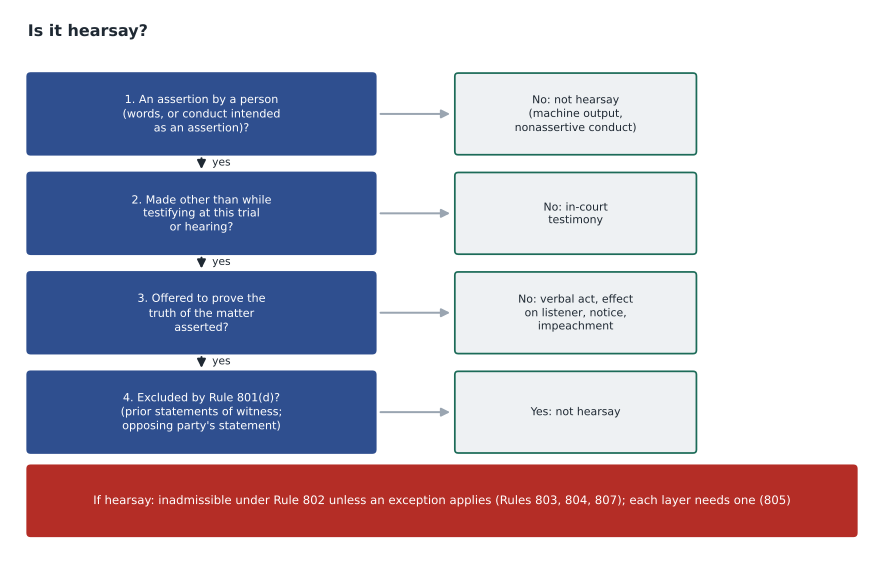
Statements and assertions
Only assertions are statements. An assertion is a communication intended to convey that something is true. Questions, commands and exclamations generally are not assertions, though courts sometimes find that a question contains an implicit assertion the speaker intended to communicate. Nonverbal conduct is a statement only if the person intended it as an assertion. A person who points at a suspect in a lineup when asked who robbed her is making an assertion by conduct. A person who opens an umbrella is not intending to assert that it is raining, so her conduct is not a statement under Rule 801(a), even if a party offers it to prove rain.
That treatment of nonassertive conduct departs from the common law. In the famous English case Wright v. Doe d. Tatham (1837), the court treated letters written to a testator as if he were sane as hearsay when offered to prove his sanity, because the letters implied the writers' belief in his competence. The Advisory Committee rejected that approach for nonassertive conduct, reasoning that a person who does not intend to assert anything is less likely to be insincere. Courts are divided on how to treat implied assertions in words, such as a caller who asks for a drug dealer by name, offered to prove that the phone's owner sells drugs. Many federal courts hold that such words are not hearsay unless the speaker intended to assert the implied fact.
Only people make statements. The output of a machine or an animal is not a statement under Rule 801, because neither a radar gun nor a drug-sniffing dog is a person intending to assert anything. A thermal log generated automatically by Kestrelwerk's test chamber is not hearsay, though it must be authenticated and shown to be reliable. A report typed by a technician summarizing the log is a statement and may be hearsay. As machine-generated evidence becomes more important, the Advisory Committee has considered a new Rule 707 that would apply expert-reliability standards to some machine output offered without an expert; as of late 2026 it remains under consideration and is not in effect.
Offered for the truth: the key question
Most out-of-court words that come up at trial are not offered for their truth, and so are not hearsay. Learning to identify the non-truth purposes is the most valuable skill in this part of the course. The common categories are worth memorizing.
Verbal acts, also called legally operative words, are words that have legal significance in themselves, regardless of whether they are true. The words of an offer and acceptance that form a contract, a threat that constitutes extortion, a defamatory statement in a defamation suit, and the words of a gift are offered because they were said, not to prove what they assert. When Kellan Shaw messaged a friend offering him a share of the copper to help carry it, the message is the solicitation itself.
Effect on the listener is a second category. Words may be offered to show that the listener heard them and acted or believed accordingly. Evidence that a teenage tractor driver told Felix Merriwether the rut had returned, in the Coldbrook problem from last year, would be offered to show Felix had notice, not to prove the rut was deep. In Delgado's case, a customer complaint emailed to Kestrelwerk in 2025 saying the Trail 750 battery was getting hot during charging is admissible to show that Kestrelwerk had notice of a possible problem, even if the court would not admit it to prove the battery actually overheated. The jury must be instructed on the limited purpose.
Impeachment is a third category. A witness's prior inconsistent statement offered only to show that the witness said different things at different times is not offered for its truth. Circumstantial evidence of the declarant's state of mind is a fourth category: a statement such as "I am the Pope," offered to show the speaker was not sane, proves its point by being false. Words offered to show the declarant's knowledge, or to identify an object or place, can fall into this category as well. In each case, the question is whether the proponent needs the jury to believe the assertion. If not, the statement is not hearsay.
| Purpose | Example | Why not hearsay |
|---|---|---|
| Verbal act | Shaw's message offering a share of the copper | The words themselves are the solicitation |
| Effect on listener or notice | A 2025 customer email saying the battery got hot | Offered to show Kestrelwerk was told, not that the battery overheated |
| Impeachment | Quinn's statement that she saw nothing | Offered to show inconsistency, not its truth |
| Declarant's state of mind (circumstantial) | "I'm going to be rich after tonight" | Shows plan or motive by the fact it was said |
| Machine output | The test chamber's automatic log | No person made an assertion |
Prior statements of a testifying witness: Rule 801(d)(1)
Rule 801(d)(1) excludes from hearsay three kinds of prior statements by a declarant who testifies and is subject to cross-examination about the prior statement. Because the declarant is on the stand, the jury can observe her and the opponent can cross-examine her about both the statement and the events, which reduces the hearsay dangers.
Rule 801(d)(1)(A) currently covers a prior statement that is inconsistent with the declarant's testimony and was given under penalty of perjury at a trial, hearing or other proceeding or in a deposition. A grand jury transcript qualifies; a statement to police or a friend does not. Such statements may be used as substantive evidence, not just to impeach. In April 2026, the Supreme Court adopted an amendment, effective December 1, 2026, that removes the oath and proceeding requirements. Under the amended rule, any prior inconsistent statement of a witness who testifies and is subject to cross-examination about it will be admissible as substantive evidence. The Advisory Committee reasoned that cross-examination at trial is the key safeguard and that the line between impeachment and substantive use confused juries. The amendment applies to proceedings commenced after December 1, 2026 and, insofar as just and practicable, to pending cases. Under the amended rule, Quinn's earlier statement to police that she "didn't see what happened inside" could be argued as substantive evidence that she did not see the shove.
Rule 801(d)(1)(B) covers a prior statement that is consistent with the declarant's testimony and is offered to rebut an express or implied charge that the declarant recently fabricated it or acted from a recent improper influence or motive, or to rehabilitate the declarant's credibility as a witness when attacked on another ground. In Tome v. United States, 513 U.S. 150 (1995), the Supreme Court held that a consistent statement offered to rebut a charge of fabrication or improper motive is admissible only if it was made before the alleged fabrication, influence or motive arose. The 2014 amendment added clause (ii) to allow consistent statements to rehabilitate a witness attacked on other grounds, such as faulty memory or inconsistency, but only when the statement actually rehabilitates on that ground. For Quinn, statements she made before she was offered a plea deal would rebut a charge that the deal motivated her testimony; statements made after the deal would not.
Rule 801(d)(1)(C) covers a statement that identifies a person as someone the declarant perceived earlier, such as an identification at a lineup or from a photo array. The rule reflects the view that an identification made soon after the event is often more reliable than one made in a courtroom months later. In United States v. Owens, 484 U.S. 554 (1988), the Court held that the declarant is subject to cross-examination even if he cannot remember the basis for the identification, so long as he testifies and responds willingly to questions.
Opposing party's statements: Rule 801(d)(2)
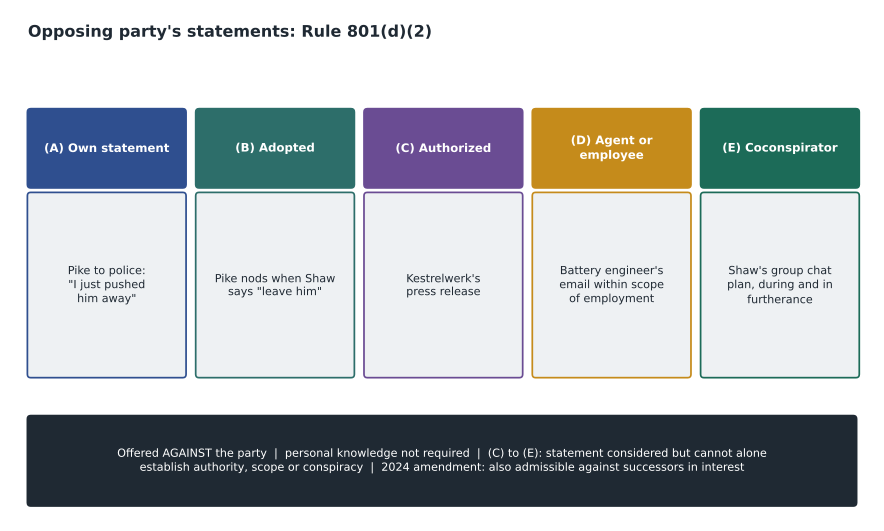
Rule 801(d)(2) excludes from hearsay a statement offered against an opposing party that falls into one of five categories. These were traditionally called admissions, but the restyled rules use "opposing party's statement" because the statement need not admit anything or be against interest when made. The justification is not reliability but the adversary system: a party can hardly complain that it did not have a chance to cross-examine itself, and it can take the stand to explain.
Rule 801(d)(2)(A) covers a statement made by the party in an individual or representative capacity. Anything Pike said, offered by the prosecution against Pike, qualifies: his statement to police that he "just pushed him away," his messages in the group chat and his remark to a cousin a week later. Personal knowledge is not required. The statement must be offered against the party who made it; Pike cannot offer his own exculpatory statements under this rule.
Rule 801(d)(2)(B) covers a statement the party manifested that it adopted or believed to be true. Adoption can be express, by conduct or by silence. Adoption by silence applies when a statement was made in the party's presence, the party heard and understood it, the party could have responded, and a reasonable person would have denied it if untrue. In criminal cases, silence after arrest and Miranda warnings cannot be used this way, under Doyle v. Ohio, 426 U.S. 610 (1976).
Rule 801(d)(2)(C) covers a statement by a person the party authorized to make a statement on the subject, such as a company spokesperson. Rule 801(d)(2)(D) covers a statement by the party's agent or employee on a matter within the scope of that relationship and while it existed. The employee need not be authorized to speak; it is enough that the subject is within the scope of employment. An email from a Kestrelwerk battery engineer to a colleague in 2025 saying "we're pushing these cells harder than the datasheet allows" is admissible against Kestrelwerk under (D). In Mahlandt v. Wild Canid Survival and Research Center, Inc., 588 F.2d 626 (8th Cir. 1978), the court admitted an employee's note stating that a wolf had bitten a child, against both the employee and the employer, without requiring personal knowledge.
Rule 801(d)(2)(E) covers a statement by the party's coconspirator during and in furtherance of the conspiracy. The proponent must show by a preponderance that a conspiracy existed, that the declarant and the party were members, and that the statement was made during and in furtherance of it. Under Bourjaily v. United States, 483 U.S. 171 (1987), the court may consider the statement itself in deciding these questions, and the rule's text now says the statement must be considered but does not by itself establish the authority, scope of employment or conspiracy; some independent evidence is required. Statements that merely narrate past events, or that are made after the conspiracy ends, such as a confession after arrest, do not qualify. Shaw's messages in the group chat planning the copper run are coconspirator statements admissible against Pike. Quinn's confession to police after the arrests is not.
The December 1, 2024 amendment to Rule 801(d)(2) added that if a party's claim, defense or potential liability is directly derived from a declarant or the declarant's principal, a statement that would be admissible against the declarant or principal under the rule is also admissible against the party. The amendment resolved a split over successors in interest, such as an estate suing on behalf of a decedent or an assignee suing on an assigned claim. If Abbott's estate sued Riverside Salvage, statements Abbott made that would have been admissible against him are admissible against the estate.
Putting the pieces together
Hartigan gives the class a set of statements from the Pike file to classify. Pike's text to Shaw the morning after, "we never talk about last night," offered by the prosecution, is Pike's own statement under Rule 801(d)(2)(A), and also arguably a statement showing consciousness of guilt. Shaw's message during planning, "DP says the watchman is old and slow, no worries," contains two layers: Shaw's statement, which is a coconspirator statement, and Pike's embedded statement, which is Pike's own statement. Each layer must be admissible, a requirement of Rule 805 that lesson 7 discusses. Quinn's statement to police that Pike shoved Abbott is hearsay if offered through the officer against Pike, because it is not Pike's statement and was not made in furtherance of the conspiracy; if Quinn testifies, it may be admissible only under Rule 801(d)(1) or to rehabilitate her.
Worked problem
Is it hearsay?
In Delgado's case, Whitcomb offers four items: (1) a Ridgeline salesperson's statement to Delgado when she bought the bike, "Kestrel batteries run a little hot but they're fine"; (2) the 2025 customer email to Kestrelwerk complaining of heat during charging; (3) Kestrelwerk's automatic thermal log for her battery; (4) Delgado's neighbor's statement to a firefighter that "the fire started at the bike." Classify each.
Show solution
- (1) The salesperson was Ridgeline's employee speaking on a matter within the scope of employment, so the statement is admissible against Ridgeline under Rule 801(d)(2)(D) for its truth. It is not admissible against Kestrelwerk on that basis, since the salesperson was not Kestrelwerk's agent; the court should give a limiting instruction.
- (2) Offered to show notice, the customer email is not hearsay. Offered to prove the battery actually overheated, it is hearsay and needs an exception.
- (3) The automatic log is machine output, not a statement by a person, so it is not hearsay; it still must be authenticated and shown reliable.
- (4) The neighbor's statement, offered to prove the fire started at the bike, is hearsay unless an exception applies, perhaps excited utterance or present sense impression if made during or immediately after the event.
Answer: Party statement against Ridgeline only; notice (non-hearsay) or hearsay depending on purpose; not hearsay; hearsay needing an exception.
Summary and key terms
- Hearsay is excluded because the declarant's perception, memory, sincerity and narration cannot be tested by oath, demeanor and cross-examination.
- Ask four questions: an assertion by a person? made outside this trial? offered for its truth? excluded by Rule 801(d)?
- Nonassertive conduct and machine output are not statements; proposed Rule 707 on machine-generated evidence is not in effect.
- Verbal acts, effect on the listener, notice, impeachment and circumstantial state of mind are common non-hearsay purposes.
- Rule 801(d)(1) covers a testifying witness's prior inconsistent statements under oath (broadened to all prior inconsistent statements from December 1, 2026), prior consistent statements (Tome's pre-motive rule) and identifications.
- Rule 801(d)(2) covers a party's own, adopted, authorized, agent and coconspirator statements offered against it; the 2024 amendment extends it to successors in interest.
Practice problems
Work each problem on paper first, then reveal the answer to check.
Why is the Kestrelwerk test chamber's automatic log not hearsay?
Show answer
It is machine output, not an assertion by a person.
What is the timing rule from Tome v. United States?
Show answer
A prior consistent statement offered to rebut a charge of recent fabrication or improper motive must have been made before the motive arose.
How will the December 1, 2026 amendment change Rule 801(d)(1)(A)?
Show answer
It removes the oath and proceeding requirements, so any prior inconsistent statement of a witness subject to cross-examination about it is admissible substantively.
Why is Quinn's post-arrest confession not admissible against Pike as a coconspirator statement?
Show answer
It was made after the conspiracy ended and was not in furtherance of it.
What must a court find to admit a coconspirator statement, and may it consider the statement itself?
Show answer
By a preponderance, a conspiracy including the declarant and the party and a statement made during and in furtherance; the court must consider the statement but it alone cannot establish the conspiracy.
Lesson quiz · 5 questions
Score 60% or more to complete this lesson.
Create a free account to save your progress, take quizzes and earn a certificate.