
LAWU-201 · Lesson 2 of 12 · 26 min
Relevance
▶ Video coming soon A video version of this lesson is on the way.
"Relevance is the first gate," Professor Hartigan says, "and it is a low one. Most evidence walks through it. The real fights happen at the gates behind it." She opens the Delgado binder. Rosa Delgado's e-bike battery caught fire in her garage in March 2026. Her lawyer, Ana Whitcomb, wants the jury to hear about four things: two earlier fires involving Kestrel Trail 750 batteries reported by other owners, Kestrelwerk's 2024 recall of an earlier battery model, a firmware update Kestrelwerk pushed to Trail 750 bikes in June 2026, three months after the fire, and a letter in which Kestrelwerk's insurer offered to pay her medical bills. Kestrelwerk's lawyer, Gregory Hale, will object to all four. This lesson works through each one.
The definition: Rules 401 and 402
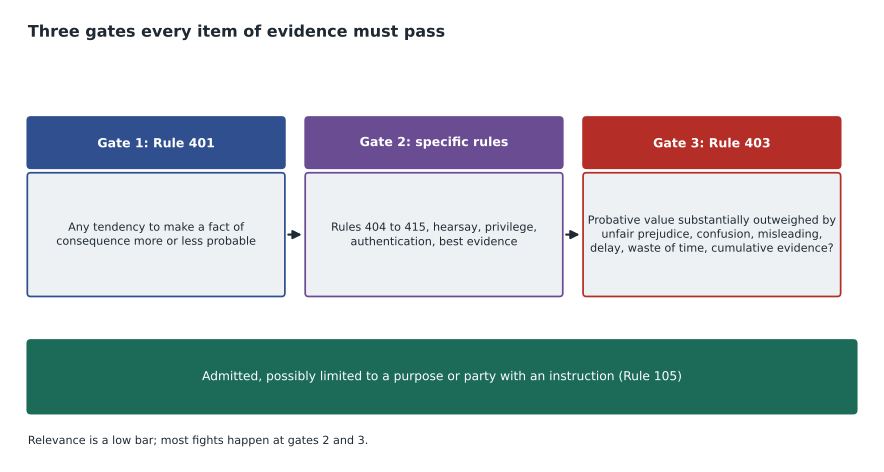
Rule 401 defines relevant evidence broadly. Evidence is relevant if it has any tendency to make a fact more or less probable than it would be without the evidence, and the fact is of consequence in determining the action. The test has two parts. The first is probative value: does the evidence move the needle at all? The second is materiality: does the fact it bears on matter under the substantive law, the pleadings and the charges?
The standard is deliberately generous. The Advisory Committee's note explains that a brick is not a wall: an item of evidence need not prove a fact by itself, or even make it more probable than not, to be relevant. It need only make the fact somewhat more or less probable. Evidence that the Trail 750 battery used cells from a supplier whose cells failed in other products has some tendency to make a defect more probable, even if it falls far short of proving one.
Rule 402 states the consequences. Relevant evidence is admissible unless the Constitution, a federal statute, the Federal Rules of Evidence or other rules prescribed by the Supreme Court provide otherwise. Irrelevant evidence is not admissible. The structure matters: relevance is necessary but not sufficient. Most of the rest of this course is about the exceptions that keep relevant evidence out.
Materiality depends on substantive law. In Delgado's strict liability design defect claim under Ohio law, the jury must decide whether the battery was defective and whether the defect caused her injuries; Kestrelwerk's care in designing the battery may matter less than it would in a negligence claim. In Pike's homicide prosecution, whether Abbott had heart disease is of consequence to causation, even though the Westmarch code makes Pike take his victim as he finds him, because the jury must still find that the shove caused the death. Evidence is never relevant in the abstract; it is relevant to a particular proposition in a particular case.
Facts of consequence include background facts and facts bearing on the credibility of witnesses. The Advisory Committee's note says that evidence offered as background, such as charts, photographs, views of real estate and murder weapons, is universally offered and admitted as an aid to understanding. Evidence that a witness is biased or has a poor memory is relevant because the credibility of the witness affects how probable the facts she describes are.
Rule 403: the judge's balance
Rule 403 lets the court exclude relevant evidence if its probative value is substantially outweighed by a danger of one or more of the following: unfair prejudice, confusing the issues, misleading the jury, undue delay, wasting time or needlessly presenting cumulative evidence. Three features of the text deserve attention. First, the court "may" exclude: the rule gives discretion, and appellate courts review Rule 403 rulings for abuse of discretion. Second, the balance is tilted toward admission, because the dangers must substantially outweigh probative value. Third, the prejudice that counts is unfair prejudice.
All good evidence is prejudicial to the party it hurts. Unfair prejudice, the Advisory Committee's note explains, means an undue tendency to suggest decision on an improper basis, commonly, though not necessarily, an emotional one. Gruesome photographs, evidence of a defendant's unrelated bad acts, and evidence that invites the jury to punish a party for something other than the claim at issue are the classic examples. Hartigan tells the class that in the Pike trial, autopsy photographs of Abbott's injuries are probative of the force of the fall and the cause of death. They are also disturbing. The judge will likely admit one or two that show the injuries clearly and exclude the rest as cumulative and unfairly prejudicial.
In applying Rule 403, courts consider the evidence's actual probative value in context, including the availability of other evidence on the same point, and the effectiveness of a limiting instruction. The Advisory Committee's note says the court should consider the probable effectiveness or lack of effectiveness of a limiting instruction and the availability of other means of proof.
Old Chief and the value of narrative
The Supreme Court's leading Rule 403 case is Old Chief v. United States, 519 U.S. 172 (1997). Johnny Lynn Old Chief was charged with being a felon in possession of a firearm. He offered to stipulate that he had a prior felony conviction, but the prosecution insisted on proving the name and nature of the prior offense, which was assault causing serious bodily injury. The Court held that the trial court abused its discretion by rejecting the stipulation. When the only purpose of the evidence is to prove the defendant's legal status as a felon, the name of the prior offense adds nothing of value and creates a serious risk that the jury will reason from the defendant's past violence to his guilt.
Old Chief also announced a limit on its own holding that is equally important. As a general rule, the Court said, the prosecution is entitled to prove its case by evidence of its own choice, and a defendant may not stipulate or admit his way out of the full evidentiary force of the case. Evidence has force beyond its logical value: it tells a story, satisfies jurors' expectations about what proof should look like, and supports the moral reasoning that leads to a verdict. The felon-status element was special because it was abstract and unrelated to the events of the crime. In the Pike trial, Pike cannot stipulate that Abbott died and thereby keep out testimony about how he was found.
Due process and unfairly prejudicial evidence
In rare cases, admitting prejudicial evidence can violate the Constitution itself. In Andrew v. White (2025), a per curiam decision, the Supreme Court held that it was clearly established, for purposes of federal habeas review, that the Due Process Clause forbids the introduction of evidence so unduly prejudicial that it renders a trial fundamentally unfair, citing Payne v. Tennessee, 501 U.S. 808 (1991). The case involved a woman convicted of murdering her husband after the prosecution introduced extensive evidence about her sex life and her skills as a mother, which the Court described as largely irrelevant. The Court remanded for the lower court to decide whether the error was prejudicial. Andrew does not federalize ordinary Rule 403 questions, but it confirms an outer constitutional limit.
Similar incidents and other accidents
Whitcomb wants to prove two earlier fires involving Trail 750 batteries. Evidence of other accidents or incidents involving the same product can be relevant to show that a dangerous condition existed, that the defendant had notice of it, or that the defect caused the plaintiff's injury. Courts generally require the proponent to show that the other incidents occurred under substantially similar circumstances, because dissimilar incidents have little probative value and can mislead the jury. The required similarity is greater when the evidence is offered to prove a defect or causation than when it is offered only to show notice, because notice requires only that the defendant was made aware of a danger.
The two earlier Trail 750 fires happened while the batteries were charging, as Delgado's did. One involved a battery that had been dropped from a car rack, and the other involved a charger from a third-party seller. Hale will argue those differences destroy the similarity. Whitcomb will argue that the core circumstance, a fire during ordinary charging, is the same, and that the differences go to weight. A judge might admit the first incident for notice only, with a limiting instruction, and admit the second for all purposes if an expert testifies that the charger difference is immaterial to the failure mode. Evidence of the absence of other accidents is treated the same way: a defendant may sometimes prove that thousands of identical batteries have charged without incident, if the conditions were similar and the records are reliable.
Policy-based exclusions: Rules 407 to 411
Rules 407 through 411 exclude categories of relevant evidence for reasons of policy. Each excludes evidence when offered for a particular purpose, usually to prove fault or liability, and each allows it for other purposes. Learning the excluded purpose and the permitted purposes for each rule is essential.
| Rule | Evidence | Not admissible to prove | May be admitted for |
|---|---|---|---|
| 407 | Measures taken after an injury or harm that would have made it less likely to occur | Negligence, culpable conduct, a product or design defect, or the need for a warning | Impeachment; ownership, control or feasibility of precautions, if disputed |
| 408 | Offers to compromise a disputed claim and statements made in negotiations | The validity or amount of the disputed claim, or to impeach by prior inconsistent statement or contradiction | Bias or prejudice of a witness, negating undue delay, proving obstruction; some criminal uses of statements to public officials |
| 409 | Offers or payments of medical or similar expenses | Liability for the injury | Other purposes; accompanying statements are not excluded |
| 410 | Withdrawn guilty pleas, nolo pleas, plea discussions with a prosecutor | Against the defendant who made the plea or participated in the discussions | Completeness; perjury prosecutions for statements under oath with counsel present |
| 411 | Liability insurance or its absence | Whether the person acted negligently or wrongfully | Bias, agency, ownership or control |
Rule 407: subsequent remedial measures
Kestrelwerk's June 2026 firmware update changed how the Trail 750's battery management system limits charging current when cell temperature rises. Whitcomb wants to show that Kestrelwerk fixed the problem after the fire. Rule 407 says that when measures are taken that would have made an earlier injury or harm less likely to occur, evidence of the subsequent measures is not admissible to prove negligence, culpable conduct, a defect in a product or its design, or a need for a warning or instruction. The rule rests mainly on policy: the law should not discourage people from making things safer by treating repairs as admissions. It also rests on relevance concerns, since a repair may reflect only hindsight or extra caution.
A 1997 amendment made clear that Rule 407 applies in products liability cases, resolving a split among the circuits. The rule applies only to measures taken after the event that caused the injury. Kestrelwerk's 2024 recall of an earlier battery model came before Delgado's fire, so Rule 407 does not bar it, though it must still be relevant and survive Rule 403. The June 2026 firmware update came after the fire, so Rule 407 bars it as proof of a defect.
Rule 407 allows subsequent measures for other purposes, such as impeachment or, if disputed, proving ownership, control or the feasibility of precautionary measures. The feasibility exception is the most litigated. If Kestrelwerk argues that a temperature-based current limit was not technically feasible in 2025, it opens the door to the update. Most courts read "if disputed" strictly: the defendant must actually contest feasibility, and a defendant that concedes feasibility can keep the measure out. Impeachment is also read narrowly, because almost any remedial measure contradicts a defendant's claim that its product was safe; courts generally require a more specific contradiction, such as testimony that the design was the safest possible.
Rule 408: compromise offers and negotiations
Rule 408 protects settlement negotiations. Evidence of furnishing, promising or offering, or accepting or offering to accept, a valuable consideration to compromise a disputed claim, and conduct or statements made during compromise negotiations, are not admissible to prove or disprove the validity or amount of a disputed claim or to impeach by a prior inconsistent statement or contradiction. The rule applies only when there is a dispute about validity or amount; an admission of an undisputed debt made while negotiating the time of payment is not protected. Statements made in negotiations are protected along with the offers themselves, a change from the common law, which protected only offers and encouraged parties to speak hypothetically.
Rule 408 permits the evidence for other purposes, such as proving a witness's bias or prejudice, negating a contention of undue delay, or proving an effort to obstruct a criminal investigation or prosecution. In criminal cases, Rule 408(a)(2) allows statements made during negotiations with a public office in the exercise of its regulatory, investigative or enforcement authority, a provision aimed at statements made to agencies such as the Securities and Exchange Commission.
Rule 409: paying medical expenses
Rule 409 excludes evidence of furnishing, promising to pay or offering to pay medical, hospital or similar expenses resulting from an injury, when offered to prove liability. The rule encourages humanitarian assistance. Unlike Rule 408, Rule 409 does not protect accompanying statements. If the insurer's letter to Delgado offered to pay her medical bills and added "we recognize the battery should not have overheated," the offer is excluded but the statement is not, unless the letter was part of compromise negotiations over a disputed claim, in which case Rule 408 may protect both.
Rule 410: pleas and plea discussions
Rule 410 protects criminal defendants who plead or negotiate. Evidence of a guilty plea that was later withdrawn, a nolo contendere plea, statements made during plea proceedings about either, and statements made during plea discussions with an attorney for the prosecuting authority that did not result in a guilty plea or resulted in a later-withdrawn guilty plea, are not admissible against the defendant who made the plea or participated in the discussions. Statements to police officers generally are not covered unless the officer was acting with the prosecutor's authority.
The protection can be waived. In United States v. Mezzanatto, 513 U.S. 196 (1995), the Supreme Court held that a defendant may knowingly and voluntarily agree that his plea-discussion statements can be used to impeach him if he testifies inconsistently at trial. Many prosecutors' offices now require such waivers, sometimes broader ones, as a condition of proffer sessions. If Tara Quinn's lawyer negotiated with the Westmarch prosecutor about a deal in exchange for testimony against Pike, Rule 410 protects Quinn's statements from use against Quinn, but not necessarily from use against Pike, because the rule protects only the defendant who made them.
Rule 411: liability insurance
Rule 411 excludes evidence that a person was or was not insured against liability when offered to prove that the person acted negligently or otherwise wrongfully. Jurors might decide cases on the basis of who can pay, and insurance has little logical bearing on care. The rule permits insurance evidence for other purposes, such as proving a witness's bias or prejudice, agency, ownership or control. If Kestrelwerk calls an investigator who works for its insurer, Whitcomb may bring out the employment to show bias. In practice, lawyers spend a surprising amount of time keeping the word "insurance" out of jury selection and testimony.
Back to Delgado
Hartigan summarizes the likely rulings. The earlier Trail 750 fires are relevant and probably admissible for notice, and perhaps for defect if similarity is shown. The 2024 recall predates the fire, so Rule 407 does not apply, but its relevance depends on whether the earlier model shared the relevant design; the judge will weigh that under Rule 403. The June 2026 firmware update is excluded as proof of a defect unless Kestrelwerk disputes feasibility or opens the door to impeachment. The insurer's offer to pay medical bills is excluded under Rule 409 as proof of liability. "Notice what happened," she says. "Every piece of evidence passed Rule 401 easily. The arguments were all about what came after."
Worked problem
Applying Rule 407 and the feasibility exception
At trial, Kestrelwerk's engineer testifies on cross-examination that a temperature-based current limit "would have reduced range to the point that the bike would not have been marketable in 2025." Whitcomb then asks to introduce the June 2026 firmware update, which added exactly such a limit. Kestrelwerk objects under Rule 407. How should the court rule?
Show solution
- The update is a subsequent remedial measure: it was taken after the March 2026 fire and would have made the fire less likely.
- Rule 407 bars it to prove a defect or need for a warning.
- But Rule 407 allows it to prove the feasibility of precautionary measures, if disputed, and for impeachment.
- The engineer's testimony that the limit would have made the bike unmarketable arguably disputes feasibility and makes a specific claim the update contradicts.
- The court should consider Rule 403 and give a limiting instruction under Rule 105 telling the jury it may consider the update only on feasibility or the engineer's credibility, not as proof of a defect.
Answer: The court will probably admit the update for the limited purpose of rebutting the feasibility claim or impeaching the engineer, with a limiting instruction.
Summary and key terms
- Rule 401 defines relevance broadly: any tendency to make a fact of consequence more or less probable.
- Rule 402 makes relevant evidence admissible unless another rule excludes it, and irrelevant evidence inadmissible.
- Rule 403 allows exclusion only when probative value is substantially outweighed by unfair prejudice and related dangers; rulings are reviewed for abuse of discretion.
- Old Chief requires accepting a stipulation to abstract felon status but generally lets the prosecution prove its case with its chosen evidence; Andrew v. White confirms a due process limit on unduly prejudicial evidence.
- Other incidents require substantial similarity, with a lower bar when offered only to show notice.
- Rules 407 to 411 exclude remedial measures, compromise, medical payments, pleas and insurance for specified purposes, while allowing other uses.
Practice problems
Work each problem on paper first, then reveal the answer to check.
Why does the 2024 recall fall outside Rule 407 in Delgado's case?
Show answer
Rule 407 covers only measures taken after the event that caused the injury, and the recall came before the March 2026 fire.
What did Old Chief hold, and what limit did it state?
Show answer
The court abused its discretion by rejecting a stipulation to felon status; but generally the prosecution may prove its case by evidence of its own choice.
How does Rule 409 differ from Rule 408 regarding accompanying statements?
Show answer
Rule 408 protects statements made in compromise negotiations; Rule 409 does not protect statements accompanying an offer to pay medical expenses.
When may insurance evidence be admitted?
Show answer
For purposes other than proving negligence, such as a witness's bias, agency, ownership or control.
What did Mezzanatto allow?
Show answer
A defendant may knowingly and voluntarily waive Rule 410 protection, for example by agreeing that proffer statements may be used for impeachment.
Lesson quiz · 5 questions
Score 60% or more to complete this lesson.
Create a free account to save your progress, take quizzes and earn a certificate.