
LAWU-201 · Lesson 1 of 12 · 28 min
How evidence law works: the rules, objections and the judge's role
▶ Video coming soon A video version of this lesson is on the way.
Professor Lucinda Hartigan walks into the first class of the second-year fall carrying two binders. One is labeled State v. Pike; the other, Delgado v. Ridgeline and Kestrelwerk. "You met both of these cases last year," she tells Section B. "In Criminal Law you decided what Devon Pike might be guilty of. In Civil Procedure you followed Rosa Delgado's lawsuit to the edge of trial. This semester we go into the courtroom. Knowing the law of homicide or products liability does not win a case. A party wins by proving facts, and evidence law decides which facts a jury is allowed to hear and how."
Hartigan spent nine years as a state trial judge before joining the Larkhaven faculty, and before that she tried cases as a federal public defender. She tells the class that she has ruled on thousands of objections, most of them in a few seconds, standing at the bench while a witness waited. "Evidence is the one course where you must know the rules cold," she says, "because in trial nobody gives you time to look them up." The two binders will run through the whole course. Both cases are entirely fictional teaching problems, and for the semester Westmarch, the fictional state where Pike will be tried, has adopted evidence rules identical to the Federal Rules of Evidence.
What evidence law is for
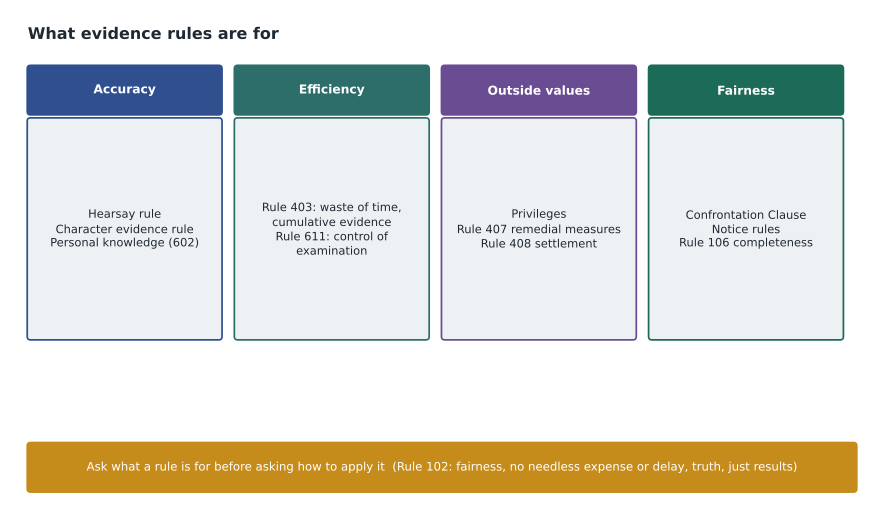
Evidence law serves several purposes at once, and many rules make sense only when you know which purpose they serve. Some rules aim at accuracy: they exclude evidence that is unreliable, such as most hearsay, or evidence that jurors are likely to overvalue, such as a defendant's bad character. Some rules aim at efficiency, letting a judge cut off evidence that wastes time. Some protect relationships and values unrelated to truth-finding, such as the attorney-client privilege and the rule that excludes offers to settle. And some protect fairness to the parties, such as the rule requiring a witness to have personal knowledge or the Confrontation Clause's guarantee that a criminal defendant can cross-examine the witnesses against him.
Rule 102 states the goals in general terms. The rules should be construed to administer every proceeding fairly, eliminate unjustifiable expense and delay, and promote the development of evidence law, to the end of ascertaining the truth and securing a just determination. Hartigan asks the class to keep that rule in mind whenever a provision seems ambiguous. A reading that serves those ends is usually the right one.
Where the rules come from
The Federal Rules of Evidence were enacted by Congress in 1975, after the Supreme Court had drafted and approved them and Congress revised them in a long legislative process. They govern proceedings in federal courts, and Rule 1101 lists where they apply and where they do not. They do not apply, for example, to grand jury proceedings, sentencing, bail hearings or the judge's own preliminary determinations under Rule 104(a), except for privileges, which apply at every stage.
The rules are amended through the Rules Enabling Act process. The Judicial Conference's Advisory Committee on Evidence Rules proposes changes, the public comments, the Standing Committee and the Judicial Conference approve them, and the Supreme Court transmits them to Congress by May 1. If Congress does not act, the amendments take effect the following December 1. The rules were restyled in 2011 to make them easier to read without changing their meaning. Recent amendments matter to this course: Rule 702 on expert testimony was amended in 2023, and on December 1, 2024 a new Rule 107 on illustrative aids took effect along with changes to Rules 613(b), 801(d)(2), 804(b)(3) and 1006. A further amendment to Rule 801(d)(1)(A), adopted by the Supreme Court in April 2026, takes effect on December 1, 2026. We will study each one in its place.
Most states have adopted evidence codes modeled on the Federal Rules, often with variations, and a few states, notably California, have their own codes with different structures. State courts follow state evidence law, and federal courts sitting in diversity follow the Federal Rules, except that Rule 501 and Rule 601 look to state law on privilege and competency when state law supplies the rule of decision. Rosa Delgado's case, which Kestrelwerk removed to federal court, will be tried under the Federal Rules, with Ohio privilege law for her state-law claims.
The Advisory Committee's notes accompany each rule and its amendments. They are not law, but courts rely on them heavily to interpret the rules, and you should read them when a rule's meaning is unclear. Hartigan tells the class that the notes to Rules 403, 404, 702 and 803 are as important as the rules themselves.
How evidence gets in: the anatomy of a trial
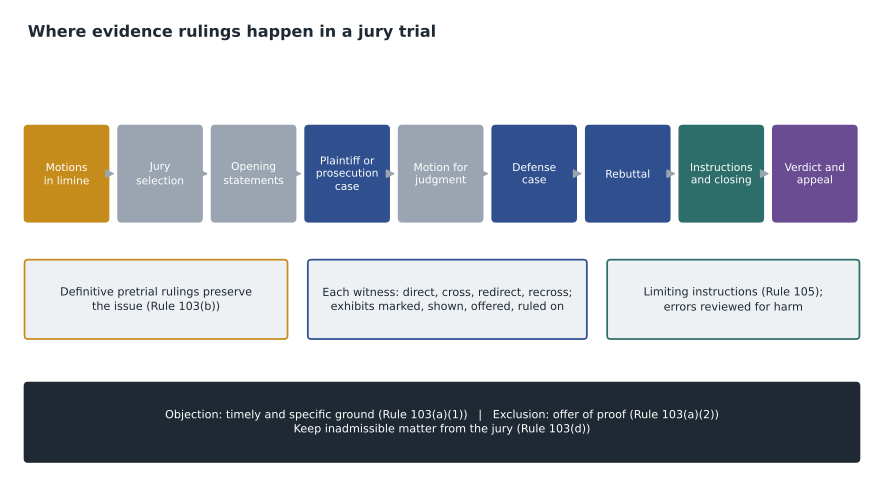
Evidence comes in through witnesses and exhibits. Witnesses testify on direct examination by the party who called them and on cross-examination by the opponent, followed by redirect and recross, all under the court's control. Rule 611(a) gives the judge reasonable control over the mode and order of examining witnesses and presenting evidence, to make the procedures effective for determining the truth, avoid wasting time and protect witnesses from harassment or undue embarrassment. Rule 611(b) limits cross-examination to the subject matter of the direct and matters affecting credibility, although the court may allow inquiry into additional matters as if on direct. Rule 611(c) says leading questions should not be used on direct except as necessary to develop testimony, but are ordinarily allowed on cross and when a party calls a hostile witness, an adverse party or a witness identified with an adverse party.
Exhibits, which may be documents, photographs, videos, physical objects or electronic records, must be authenticated before they are admitted, a subject for lesson 11. The usual sequence is to have the exhibit marked for identification, show it to opposing counsel, lay a foundation through a witness, offer it, allow the opponent to object, and obtain a ruling. Once admitted, an exhibit becomes evidence the jury may consider; until then, it is only an item marked for identification.
Rule 107, effective December 1, 2024, addresses illustrative aids such as charts, models and animations used to help the jury understand evidence or argument. The court may allow an illustrative aid if its utility in helping the trier of fact understand is not substantially outweighed by the danger of unfair prejudice, confusing the issues, misleading the jury, undue delay or wasting time. An illustrative aid is not evidence and must not go to the jury room unless all parties consent or the court orders otherwise for good cause, and the court must give a limiting instruction on request. Rule 1006 summaries, by contrast, are evidence, and the 2024 amendment clarified that a summary of voluminous records may be admitted whether or not the underlying records have been admitted.
Objections and offers of proof: Rule 103
Evidence law is enforced by the parties. The judge rarely excludes evidence on her own; a party must object, and an error in admitting or excluding evidence can be a ground for reversal only if it affects a substantial right and the party preserved it. Rule 103(a)(1) requires a party claiming error in admitting evidence to timely object or move to strike on the record and to state the specific ground, unless it was apparent from the context. Rule 103(a)(2) requires a party claiming error in excluding evidence to inform the court of its substance by an offer of proof, unless the substance was apparent from the context.
"Timely" means as soon as the ground becomes apparent, usually after the question and before the answer. An objection made after the witness answers, if the question itself revealed the problem, may be too late, though a motion to strike can sometimes rescue it. "Specific" means stating the rule: "Objection, hearsay" or "Objection, 403" rather than simply "Objection." A general objection that is overruled preserves nothing on appeal unless the ground was obvious. A specific objection on the wrong ground generally preserves only the ground stated.
An offer of proof tells the judge, and the appellate court, what the excluded evidence would have been. It can take the form of a lawyer's summary, a question-and-answer session with the witness outside the jury's hearing, or a written statement. Without it, the appellate court cannot tell whether the exclusion mattered. Hartigan tells the class about a case she reviewed as a young clerk in which the trial judge excluded a defense witness and the lawyer never said what the witness would have testified to. "The appeal ended in one paragraph," she says. "Whatever that witness knew died with the record."
Rule 103(b) provides that once the court rules definitively on the record, before or at trial, a party need not renew an objection or offer of proof to preserve a claim of error. This matters most for motions in limine, pretrial motions asking the court to rule on evidence in advance. If the ruling is definitive, the issue is preserved. If the judge says she will wait to see how the evidence comes in, the party must object again at trial. The Supreme Court held in Luce v. United States, 469 U.S. 38 (1984), that a defendant who does not testify cannot challenge on appeal a ruling that his prior conviction would be admissible to impeach him, because the court cannot evaluate the ruling without his testimony, and in Ohler v. United States, 529 U.S. 753 (2000), that a defendant who preemptively introduces his own prior conviction on direct cannot claim error in the in limine ruling.
Rule 103(d) requires the court, to the extent practicable, to conduct a jury trial so that inadmissible evidence is not suggested to the jury by any means. That is why many evidentiary arguments happen at sidebar or with the jury out of the room. Rule 103(e) preserves the appellate court's power to notice plain error affecting a substantial right even if it was not properly preserved, but plain-error review is demanding and rarely succeeds.
Harmless error
Even a preserved evidentiary error does not require reversal unless it affected a substantial right. Rule 103(a) and the harmless error statute, 28 U.S.C. section 2111, direct courts to disregard errors that do not affect substantial rights. For nonconstitutional errors in criminal cases, the Supreme Court in Kotteakos v. United States, 328 U.S. 750 (1946), asked whether the error had substantial and injurious effect or influence in determining the jury's verdict. For constitutional errors, such as a Confrontation Clause violation, Chapman v. California, 386 U.S. 18 (1967), requires the government to prove the error harmless beyond a reasonable doubt. Many evidentiary errors are found harmless because the other evidence was strong, which is one reason trial lawyers say evidence objections are won or lost in the trial court.
The judge and the jury: Rule 104
Rule 104 divides responsibility for preliminary questions. Under Rule 104(a), the court decides any preliminary question about whether a witness is qualified, a privilege exists or evidence is admissible, and in doing so the court is not bound by evidence rules except those on privilege. The judge decides by a preponderance of the evidence, as the Supreme Court held in Bourjaily v. United States, 483 U.S. 171 (1987), and may consider the contested evidence itself. If the question is whether a statement was made in furtherance of a conspiracy, whether a witness is an expert, or whether a declarant was unavailable, the judge decides.
Rule 104(b) covers conditional relevance. When the relevance of evidence depends on whether a fact exists, proof must be introduced sufficient to support a finding that the fact does exist, and the court may admit the evidence on condition that the proof be introduced later. Here the judge does not decide whether the fact is true; she decides only whether a reasonable jury could find it true. The jury then decides. In Huddleston v. United States, 485 U.S. 681 (1988), the Supreme Court applied this standard to evidence of a defendant's other acts: the court asks only whether the jury could reasonably find by a preponderance that the defendant committed the other act.
Hartigan uses the Pike binder to show the difference. If the prosecution offers a message from the "copper run" group chat signed "DP," whether Pike wrote it is a question of authentication, which Rule 901 treats as a 104(b)-type question: the judge asks whether there is enough evidence for a reasonable jury to find that Pike wrote it, and the jury decides if he did. But if the prosecution offers the message as a coconspirator's statement under Rule 801(d)(2)(E), whether a conspiracy existed and whether the statement furthered it are 104(a) questions for the judge.
Rule 104(c) requires hearings on the admissibility of a confession to be held outside the jury's hearing, and other preliminary questions to be heard that way when justice so requires or when a defendant who testifies on the preliminary question requests it. Rule 104(d) protects a criminal defendant who testifies on a preliminary question from cross-examination on other issues. Rule 104(e) preserves a party's right to introduce evidence before the jury that is relevant to the weight or credibility of other evidence.
| Question | Who decides | Standard |
|---|---|---|
| Is the witness qualified as an expert? | Judge, Rule 104(a) | Preponderance; evidence rules other than privilege do not bind the judge |
| Is the statement covered by a hearsay exception? | Judge, Rule 104(a) | Preponderance |
| Does a privilege apply? | Judge, Rule 104(a) | Preponderance; privilege rules apply |
| Did the defendant write the message? | Jury, after the judge applies Rule 104(b) and Rule 901 | Judge asks only whether a reasonable jury could find it |
| Did the defendant commit the other act offered under Rule 404(b)? | Jury, after the judge applies Rule 104(b) (Huddleston) | Sufficient evidence for a jury to find it by a preponderance |
Limiting instructions and completeness
Much evidence is admissible for one purpose but not another, or against one party but not another. Rule 105 requires the court, on timely request, to restrict the evidence to its proper scope and instruct the jury accordingly. A limiting instruction tells jurors, for example, that a prior conviction may be considered only on credibility and not as proof that the defendant committed the crime charged. Courts presume jurors follow such instructions, but the Supreme Court recognized an important exception in Bruton v. United States, 391 U.S. 123 (1968), holding that a limiting instruction could not cure the admission at a joint trial of a nontestifying codefendant's confession that named the defendant. Lesson 8 returns to Bruton.
Rule 106, the rule of completeness, was amended in 2023. If a party introduces all or part of a statement, an adverse party may require the introduction, at that time, of any other part, or any other statement, that in fairness ought to be considered at the same time. The 2023 amendment extended the rule to unrecorded oral statements as well as writings and recorded statements, and provided that the adverse party may make the completing statement over a hearsay objection. If the prosecution plays the part of Pike's police interview in which he admits pushing Abbott, Pike can require the jury to hear, at the same time, the next sentence in which he said Abbott swung a flashlight at him first.
Judicial notice: Rule 201
Some facts need not be proved at all. Under Rule 201, a court may judicially notice an adjudicative fact that is not subject to reasonable dispute because it is generally known within the court's territorial jurisdiction or can be accurately and readily determined from sources whose accuracy cannot reasonably be questioned. The date on which a day of the week fell, the distance between two cities or the contents of a court's own records are typical examples. In a civil case the court must instruct the jury to accept the noticed fact as conclusive; in a criminal case the court must instruct the jury that it may or may not accept the noticed fact, preserving the jury's role on every element. Rule 201 covers only adjudicative facts, the facts of the particular case, not legislative facts that courts use in deciding what the law should be.
Burdens, presumptions and the course ahead
Evidence law also includes the rules on burdens of proof and presumptions. The party with the burden of production must introduce enough evidence to avoid a directed verdict, and the party with the burden of persuasion loses if the jury is in equipoise. Rule 301 provides that in a civil case, unless a statute or the rules provide otherwise, the party against whom a presumption is directed has the burden of producing evidence to rebut it, but the burden of persuasion does not shift. Rule 302 applies state law on presumptions in civil cases when state law supplies the rule of decision. In criminal cases, presumptions against the defendant are limited by due process, because the prosecution must prove every element beyond a reasonable doubt.
Hartigan closes by drawing a map on the board. Lessons 2 through 4 cover relevance and character, the threshold questions. Lesson 5 covers witnesses and impeachment. Lessons 6 through 8 cover hearsay and the Confrontation Clause, the heart of the course. Lessons 9 through 11 cover opinion testimony, privileges and authentication. Lesson 12 puts you in the judge's chair with a trial transcript. "For every piece of evidence," she says, "ask the same questions in the same order. Is it relevant? Is it excluded by a policy rule or by Rule 403? Is it character evidence? Is it hearsay, and if so, is there an exception? Does the Confrontation Clause apply? Is it opinion, and is the witness qualified? Is it privileged? Is it authenticated, and does the best evidence rule apply? That is your checklist for the semester."
Worked problem
Preserving an objection
In State v. Pike, the prosecutor asks the truck driver who found Lou Abbott, "What did Mr. Abbott tell you about who pushed him?" Defense counsel says, "Objection." The judge overrules it, and the driver testifies that Abbott said "the big one, Devon, shoved me." On appeal, Pike argues the statement was inadmissible hearsay. What problems does the appeal face, and what should counsel have done?
Show solution
- Rule 103(a)(1) requires a timely objection stating the specific ground unless it was apparent from the context.
- A bare "Objection" did not state a ground. The appellate court may find the hearsay ground was apparent from a question asking what an out-of-court speaker said, but counsel has risked forfeiture.
- Counsel should have said "Objection, hearsay," and if the confrontation issue was in play, "and the Confrontation Clause," because a hearsay objection may not preserve a constitutional objection.
- Even if preserved, the court will ask whether an exception applies, perhaps excited utterance or dying declaration, and whether any error was harmless given other evidence that Pike pushed Abbott.
- Better still, counsel could have moved in limine to exclude the statement and obtained a definitive pretrial ruling, which Rule 103(b) would preserve without renewal.
Answer: The bare objection risks forfeiting the hearsay argument and almost certainly forfeits a Confrontation Clause argument. Counsel should object specifically and, ideally, raise the issue in limine.
Summary and key terms
- Evidence rules serve accuracy, efficiency, outside values and fairness; knowing a rule's purpose helps you apply it.
- The Federal Rules of Evidence, enacted in 1975, are amended through the Rules Enabling Act; recent changes include Rule 702 (2023), Rules 106 (2023) and 107 (2024), and Rule 801(d)(1)(A), effective December 1, 2026.
- Rule 103 requires timely, specific objections and offers of proof; a definitive pretrial ruling preserves the issue.
- Errors require reversal only if they affect substantial rights; constitutional errors must be harmless beyond a reasonable doubt.
- Under Rule 104(a), the judge decides preliminary questions by a preponderance; under Rule 104(b), the judge asks only whether a jury could find a conditional fact.
- Rule 105 limiting instructions, Rule 106 completeness, Rule 107 illustrative aids and Rule 201 judicial notice shape how evidence reaches the jury.
Practice problems
Work each problem on paper first, then reveal the answer to check.
Why might a specific objection on the wrong ground fail to preserve an issue for appeal?
Show answer
Rule 103(a)(1) generally preserves only the ground stated, so an objection on one rule does not preserve a different one unless it was apparent from the context.
Who decides whether a hearsay exception's foundation is met, and by what standard?
Show answer
The judge, under Rule 104(a), by a preponderance of the evidence.
What did Huddleston v. United States hold about other-acts evidence?
Show answer
The court asks only whether a jury could reasonably find by a preponderance that the defendant committed the other act, a Rule 104(b) inquiry.
How does the 2023 amendment to Rule 106 change the rule of completeness?
Show answer
It extends the rule to unrecorded oral statements and lets the completing statement come in over a hearsay objection.
How do judicial notice instructions differ in civil and criminal cases?
Show answer
In civil cases the jury must accept the noticed fact as conclusive; in criminal cases the jury may or may not accept it.
Lesson quiz · 5 questions
Score 60% or more to complete this lesson.
Create a free account to save your progress, take quizzes and earn a certificate.