
LAWU-201 · Lesson 12 of 12 · 27 min
Capstone: ruling on objections in a trial transcript
▶ Video coming soon A video version of this lesson is on the way.
For the last class, Professor Hartigan rearranges the room. She sits at a table at the front with a gavel she says she kept from her years on the bench, and she hands each student a transcript. "For one day, you are the judge," she tells Section B. "Below are excerpts from the second day of the trial in State v. Pike and a pretrial hearing in Delgado v. Ridgeline and Kestrelwerk. Both are entirely invented for this course. Every time a lawyer objects, stop and rule. Say whether you sustain or overrule, give the rule, and say whether you would give a limiting instruction. Then compare your rulings with the model rulings that follow."
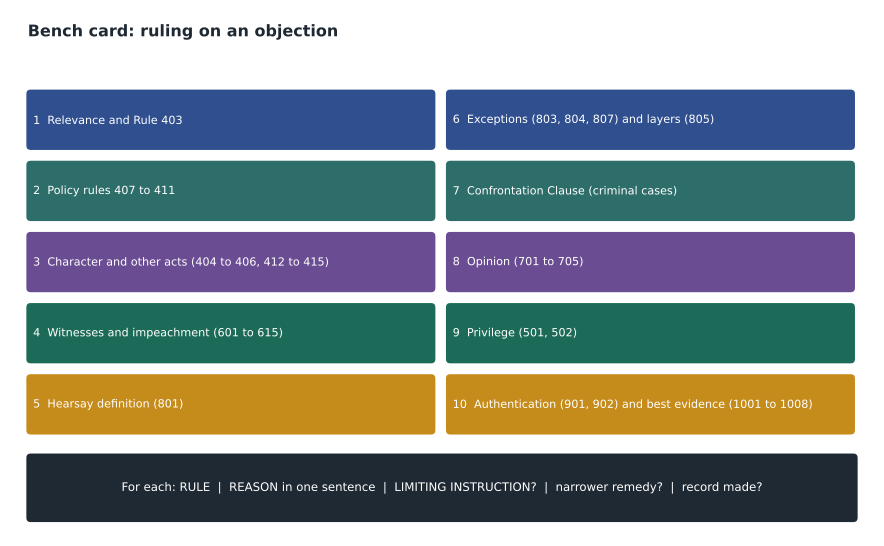
She reminds the class of the checklist from the first day: relevance and Rule 403, policy exclusions, character, hearsay and its exceptions, the Confrontation Clause, opinion, privilege, and authentication and the best evidence rule. "Most objections at trial are decided in seconds," she says. "You have more time than a trial judge, but not unlimited time. Aim for a ruling and a one-sentence reason on each." She also reminds them that in the Pike trial, the Westmarch rules of evidence are identical to the Federal Rules, and that Pike is tried alone, Shaw's and Quinn's cases having been severed.
Transcript A: State v. Pike, day two
The prosecution's first witness of the day is Ray Dunleavy, the truck driver who found Lou Abbott. Assistant District Attorney Helen Moreau conducts the direct examination. Defense counsel is Paul Ostrander, a Westmarch public defender.
MOREAU: Mr. Dunleavy, when you found the man by the pallets, what did you notice about him? DUNLEAVY: He was gray, sweating, breathing hard. He looked terrified. OSTRANDER: Objection, speculation. [Ruling 1]
MOREAU: What did he say to you? OSTRANDER: Objection, hearsay and confrontation. We renew our motion in limine. THE COURT: Counsel, approach. [After a sidebar the court notes that it denied the motion in limine before trial in a definitive ruling.] [Ruling 2] DUNLEAVY: He said, "Three of them. The big one, Devon, shoved me. I'm not going to make it, am I? Tell my sister."
MOREAU: Did you call anyone? DUNLEAVY: I called 911. MOREAU: Your Honor, the State offers Exhibit 14, the recording of the 911 call, authenticated by the custodian's certification previously filed. OSTRANDER: Objection, hearsay, foundation. [Ruling 3] [The recording is played. Dunleavy says to the dispatcher: "There's a guy here hurt bad, he says a guy named Devon pushed him, he needs an ambulance at Riverside Salvage on Canal Street."]
MOREAU: Mr. Dunleavy, in your opinion, was the man having a heart attack? OSTRANDER: Objection. [Ruling 4]
On cross-examination, Ostrander asks Dunleavy: "Isn't it true that you had two beers at the Anchor Tavern before you found Mr. Abbott?" Dunleavy says he did not. Ostrander then announces that he will call the bartender to testify that Dunleavy had two beers. MOREAU: Objection, collateral. [Ruling 5]
The prosecution next calls Detective Rachel Imbert. She testifies that she interviewed Abbott at the hospital at 1:40 a.m., after he had been stabilized and his doctors had told him his condition was stable. MOREAU: What did Mr. Abbott tell you about who pushed him? OSTRANDER: Objection, hearsay and confrontation. [Ruling 6]
MOREAU: Detective, the State offers Exhibit 22, a series of messages from the DP_Fixes account, extracted from Kellan Shaw's phone, which you supervised. Did you compare the extracted data with the screenshots in Exhibit 22? IMBERT: Yes. They match. The account used the phone number registered to Devon Pike, its profile photo is a picture of Mr. Pike's truck, and other members addressed it as Devon. OSTRANDER: Objection, authentication, hearsay. [Ruling 7]
MOREAU: Detective, what was Mr. Pike's criminal record? OSTRANDER: Objection! Mr. Pike has not testified. [Ruling 8]
MOREAU: Detective, did you speak to Mr. Shaw's friend Mateo? IMBERT: Yes. He told me Kellan Shaw told him a week after the burglary, "I cut the lock and grabbed the copper, and Devon's the one who shoved the old man." OSTRANDER: Objection, hearsay within hearsay. [Ruling 9]
The prosecution calls the current Merrin County medical examiner, Dr. Victor Lindahl. He testifies that he reviewed the autopsy report prepared by his predecessor, Dr. Irene Castellan, who has retired abroad. MOREAU: Doctor, what did Dr. Castellan find on internal examination? OSTRANDER: Objection, confrontation, Smith v. Arizona. [Ruling 10] MOREAU: Doctor, based on the autopsy photographs you reviewed yourself, what is your opinion of the cause of death? OSTRANDER: Same objection. [Ruling 11]
The defense case. Pike testifies that Abbott swung his flashlight at him first and that he pushed Abbott away to protect himself. He calls a former Riverside Salvage employee, Gus Farrell. OSTRANDER: Mr. Farrell, what was Lou Abbott's reputation at the yard for peacefulness or violence? FARRELL: People said he had a temper. He once chased a kid off the lot with a pipe. MOREAU: Objection, move to strike the second sentence. [Ruling 12] On rebuttal, the prosecution calls Abbott's sister, Ruth Abbott, to testify that he was known as a gentle man, and calls the bouncer Pike shoved eighteen months earlier to describe that incident. OSTRANDER: Objection to the bouncer. [Ruling 13]
Model rulings: Transcript A
Ruling 1, overruled. Dunleavy's statement that Abbott "looked terrified" is lay opinion under Rule 701: it is rationally based on what he saw, it helps the jury understand his description, and it requires no specialized knowledge. Courts routinely allow lay witnesses to describe another person's apparent emotional state.
Ruling 2, overruled; the objection is preserved without renewal under Rule 103(b) because the in limine ruling was definitive, though renewing it costs nothing. The statement is hearsay offered for its truth, but it is admissible as an excited utterance under Rule 803(2), because Abbott was injured, alone and frightened and still under the stress of the startling event, and as a dying declaration under Rule 804(b)(2), because Abbott is unavailable, this is a homicide prosecution, his words show he believed death imminent and the statement concerns the cause of his condition. The Confrontation Clause does not bar it, because a statement to a passing private citizen while seeking help is not testimonial (Ohio v. Clark; Davis). Pike may impeach Abbott under Rule 806 with any inconsistent statements.
Ruling 3, overruled. The recording is authenticated by the custodian's certification and by Dunleavy's recognition of his own voice; a 911 recording is often admitted through the dispatch center's records custodian. It contains two layers under Rule 805. Dunleavy's own statements describing the injured man and asking for an ambulance are present sense impressions or excited utterances, and Dunleavy is on the stand and subject to cross-examination in any event. Abbott's embedded statement naming Devon is admissible for the reasons in Ruling 2. The call is nontestimonial because its primary purpose was to obtain emergency medical help (Davis).
Ruling 4, sustained. Whether Abbott was having a heart attack requires medical expertise. Dunleavy has not been qualified as an expert, and Rule 701(c) bars lay opinion based on specialized knowledge. He may describe what he saw.
Ruling 5, overruled; the bartender may testify. Ordinarily, extrinsic evidence on a collateral matter is barred, but drinking before the observations goes to Dunleavy's capacity to perceive and remember, a recognized ground of impeachment, so it is not collateral. The court may limit the testimony under Rule 403 to whether and how much Dunleavy drank.
Ruling 6, sustained as to the Confrontation Clause, absent an exception. The hospital interview took place after Abbott had been stabilized, with the assailants long gone and no ongoing emergency, and it was aimed at identifying suspects for prosecution. The statements are testimonial under Davis and Hammon, distinguishable from Michigan v. Bryant. Abbott cannot be cross-examined, and Pike had no prior opportunity. The prosecution may argue the historical dying-declaration exception that Crawford mentioned, but the court should first decide whether Abbott still believed death imminent; Detective Imbert's own notes say the doctors told Abbott he was stable, so the foundation for Rule 804(b)(2) fails, and the constitutional question need not be reached. Forfeiture by wrongdoing does not apply, because there is no evidence Pike acted to prevent Abbott's testimony (Giles).
Ruling 7, overruled. Authentication requires only evidence sufficient for a reasonable jury to find that Pike wrote the messages (Rule 901(a)); the phone number, profile photo, how other members addressed the account and the content of the messages are ample circumstantial evidence, and the detective's comparison of the extraction with the screenshots supports the accuracy of the copies (Rules 901(b)(1), (4) and 1003). Pike's own messages are statements of a party opponent under Rule 801(d)(2)(A). Messages from other members, such as Shaw's, are admissible as coconspirator statements under Rule 801(d)(2)(E) if the court finds by a preponderance that they were made during and in furtherance of the conspiracy, considering the messages themselves and independent evidence such as the burglary. Pike may argue to the jury that others used his phone; that goes to weight.
Ruling 8, sustained. A defendant's criminal record is inadmissible to show propensity under Rule 404(a)(1) and 404(b)(1). Rule 609 applies only to impeach a witness who testifies, and Pike has not yet testified. Even if he does, his only prior conviction is a misdemeanor not involving dishonesty, which Rule 609 does not reach. The question is serious enough that the court should consider a curative instruction and, if the jury heard an answer, whether a mistrial is warranted.
Ruling 9, sustained. The testimony has two layers. Mateo's statement to the detective, offered for its truth, is hearsay with no exception; Mateo is apparently available and could be called. If Mateo testified, Shaw's statement to Mateo would need its own exception: Shaw is unavailable because he invokes the Fifth Amendment, and the part saying "I cut the lock and grabbed the copper" is against his penal interest under Rule 804(b)(3), with corroboration from the bolt cutters found in his car. But under Williamson, the court must admit only the individually self-inculpatory parts; the clause blaming Devon for the shove shifts responsibility away from Shaw and is likely inadmissible. Shaw's statement to a friend is nontestimonial, so the Confrontation Clause is not the barrier; the hearsay rule is.
Ruling 10, sustained. Under Smith v. Arizona (2024), when an expert relays an absent analyst's findings in support of the expert's own opinion, and the findings support the opinion only if true, they are offered for their truth. An autopsy report prepared in a suspected homicide, with police involvement and for use in prosecution, has a strong claim to being testimonial, and courts are divided on autopsies. Because Castellan is unavailable and Pike had no opportunity to cross-examine her, the safer ruling is to sustain the objection to Dr. Lindahl relaying her internal findings.
Ruling 11, overruled. Dr. Lindahl may give an independent opinion based on autopsy photographs he examined himself and on his own expertise, under Rules 702 and 703, so long as he does not relay Castellan's testimonial statements as the basis. The photographs themselves are not statements by a person. Pike may cross-examine Lindahl on the limits of an opinion formed without examining the body.
Ruling 12, sustained as to the second sentence. Pike's claim that Abbott was the first aggressor makes Abbott's character for violence a pertinent trait that the defense may offer under Rule 404(a)(2)(B). But Rule 405(a) limits proof on direct to reputation and opinion; the specific incident with the pipe is a specific instance of conduct, admissible only on cross-examination of a character witness or where character is an element. The court should strike the second sentence and instruct the jury to disregard it.
Ruling 13, sustained as to the bouncer incident, overruled as to Ruth Abbott. Because the defense offered evidence of Abbott's violent character and claimed he was the first aggressor, the prosecution may rebut with evidence of Abbott's peacefulness under Rules 404(a)(2)(B) and (C) and may offer evidence of Pike's same trait for violence under Rule 404(a)(2)(B)(ii). But that evidence must also be proved by reputation or opinion under Rule 405(a), not by testimony describing a specific incident. The bouncer could testify to his opinion of Pike's character for violence only if he knows Pike well enough to have one, which a single encounter does not provide. The specific incident is inadmissible on direct; the prosecution could ask Pike's own character witnesses about it on cross if any testify.
Transcript B: Delgado, pretrial evidentiary hearing
Before trial in the federal district court in Ohio, Judge Marian Ellsworth hears several motions in limine. Whitcomb represents Delgado; Gregory Hale represents Kestrelwerk; Tom Brannigan represents Ridgeline.
Motion B1: Kestrelwerk moves to exclude evidence of its June 2026 firmware update that added a temperature-based current limit. Whitcomb responds that Kestrelwerk's design engineer will testify that such a limit would have made the bike unmarketable. [Ruling 14]
Motion B2: Kestrelwerk moves to exclude Dr. Achterberg's opinion that a temperature-based limit would have prevented this fire, on the ground that his four exemplar tests used a different charging profile. [Ruling 15]
Motion B3: Delgado moves to compel production of counsel's summary of employee interviews, which a Kestrelwerk product manager forwarded to its cell supplier, Lumacell, with a demand for reimbursement. [Ruling 16]
Motion B4: Ridgeline moves to exclude the salesperson's statement to Delgado that "Kestrel batteries run a little hot but they're fine." Kestrelwerk joins the motion. [Ruling 17]
Motion B5: Kestrelwerk moves to exclude a summary chart of 4,000 warranty claims prepared by Delgado's paralegal, arguing that the underlying claims have not been admitted. [Ruling 18]
Model rulings: Transcript B
Ruling 14, granted in part. Under Rule 407, the update, a measure taken after the fire that would have made it less likely, is inadmissible to prove a defect or the need for a warning, and the rule applies in products liability cases. If Kestrelwerk disputes feasibility at trial, as its engineer's expected testimony suggests, or makes a specific claim the update contradicts, the update may be admitted for feasibility or impeachment with a Rule 105 limiting instruction. The court should reserve final ruling until trial and require Whitcomb to approach the bench before mentioning the update.
Ruling 15, the court must decide, not defer. Under amended Rule 702, Delgado must show it is more likely than not that the opinion rests on sufficient facts and reflects a reliable application of a reliable method. The court should hold a Daubert hearing and ask whether the charging-profile difference creates an analytical gap (Joiner). A likely outcome is to admit Achterberg's opinions on origin, the cell failure and the absence of a temperature-based limit, while excluding or narrowing the claim that the limit would have prevented this particular fire unless he can show that his tests fit the Trail 750's actual charging profile.
Ruling 16, granted. Ohio law governs the attorney-client privilege for the state-law claims, and Rule 502 governs the effect of disclosure in this federal proceeding. Sending the summary to Lumacell, an outside company with adverse interests, waived privilege as to the summary and waived work product protection because it substantially increased the likelihood that an adversary would obtain it. Under Rule 502(a), the waiver does not extend to the underlying interview notes unless it was intentional and fairness requires the related material to be considered together; on this record, it does not.
Ruling 17, denied as to Ridgeline, granted as to Kestrelwerk. The salesperson was Ridgeline's employee speaking within the scope of employment, so the statement is admissible against Ridgeline under Rule 801(d)(2)(D) for its truth. It is not Kestrelwerk's statement, and absent another exception it may not be used against Kestrelwerk to prove the batteries ran hot; the court should give a limiting instruction under Rule 105. The statement may also be relevant against Kestrelwerk to show what Delgado was told, but not for its truth.
Ruling 18, denied. Rule 1006, as amended in December 2024, allows a summary of voluminous records whether or not the underlying records have been introduced, so long as they are admissible and were made available to the other parties. The warranty records are Kestrelwerk's business records and its party statements. The chart is itself evidence. Kestrelwerk may challenge its accuracy, and the court may require the paralegal or another witness to explain how it was prepared.
| Skill | Strong | Needs work |
|---|---|---|
| Issue spotting | Identifies every layer: relevance, character, hearsay and each embedded statement, confrontation, opinion, privilege, authentication | Stops at the first rule that seems to apply |
| Rule accuracy | States the rule and its elements precisely, with the right subdivision | Cites a rule loosely or mixes up related rules (608 and 609; 803 and 804) |
| Reasoning | Applies each element to the facts and explains in one or two sentences | States a conclusion without applying the elements |
| Constitutional overlay | Separates hearsay admissibility from Confrontation Clause analysis in criminal cases | Treats a hearsay exception as answering the confrontation question |
| Remedies | Considers limiting instructions, partial admission, striking, curative instructions and preservation | Rules all-or-nothing without considering narrower relief |
Looking ahead
Hartigan puts down the gavel. "You will use these rules in every trial course you take next year," she says, "and in the bar exam, where evidence is tested on both the multiple-choice and essay portions. More than that, you will use them in practice long before you see a courtroom, because evidence law shapes discovery, depositions, settlement value and what witnesses you need. A lawyer who cannot get her best evidence admitted does not have a case. A lawyer who can keep out the other side's worst evidence has a better one." She hands back the first-day checklist with one addition at the bottom: "Object specifically. Offer proof. Ask for the instruction. Make the record."
Worked problem
A final mixed problem
At Pike's trial, Pike testifies in his own defense. On cross-examination, the prosecutor asks: "Isn't it true that in 2024 you lied on an insurance claim about a stolen bicycle?" Pike denies it. The prosecutor then offers the insurer's investigator to testify that Pike's claim was false. Pike's counsel objects. Rule on the question and on the investigator.
Show solution
- Pike, by testifying, put his character for truthfulness in issue as a witness.
- Under Rule 608(b), the court may allow inquiry on cross into specific instances probative of untruthfulness, such as a false insurance claim, if the prosecutor has a good faith basis and Rule 403 is satisfied. The question is permissible.
- Pike denied it. Rule 608(b) bars extrinsic evidence of the specific instance to attack character for truthfulness, so the investigator may not testify for that purpose.
- If the false claim had resulted in a conviction for fraud, it would be admissible under Rule 609(a)(2) regardless of Rule 403, and could be proved by the record of conviction.
- The court should sustain the objection to the investigator and, on request, instruct the jury that the question itself is not evidence.
Answer: The question is allowed under Rule 608(b); the investigator's testimony is barred as extrinsic evidence of a specific instance.
Summary and key terms
- Analyze every objection in a consistent order: relevance and Rule 403, policy rules, character, witnesses, hearsay and exceptions, confrontation, opinion, privilege, authentication and best evidence.
- Abbott's statement to Dunleavy and the 911 call are admissible hearsay and nontestimonial; his statement to the detective after stabilization is testimonial and fails the dying-declaration foundation.
- Expert testimony relaying an absent examiner's testimonial findings violates confrontation after Smith, but an independent opinion based on the expert's own review may be admitted.
- Character evidence on direct is limited to reputation and opinion; specific incidents come in only on cross or when character is an element.
- In civil cases, Rule 407, Rule 702 as amended in 2023, Rule 502, Rule 801(d)(2)(D) and amended Rule 1006 resolve the key pretrial disputes.
- Good rulings consider narrower remedies, limiting and curative instructions and preservation.
Practice problems
Work each problem on paper first, then reveal the answer to check.
Why is Abbott's statement to the hospital detective treated differently from his statement to Dunleavy?
Show answer
It was made to police after the emergency had ended, to identify suspects for prosecution, so it is testimonial; the statement to Dunleavy was to a private person while seeking help.
Why may the bartender testify about Dunleavy's drinking despite the collateral matter rule?
Show answer
Drinking bears on his capacity to perceive and remember, a recognized ground of impeachment, so it is not collateral.
Why must the court parse Shaw's statement to Mateo sentence by sentence?
Show answer
Under Williamson, only individually self-inculpatory statements qualify as against interest; the blame-shifting clause does not.
How does amended Rule 1006 resolve Kestrelwerk's objection to the warranty-claims chart?
Show answer
A summary is admissible whether or not the underlying records were introduced, so long as they were made available and are admissible, and it is itself evidence.
What can the prosecutor do if Pike denies lying on an insurance claim?
Show answer
Nothing more for character purposes; Rule 608(b) bars extrinsic evidence of the specific instance.
Lesson quiz · 5 questions
Score 60% or more to complete this lesson.
Create a free account to save your progress, take quizzes and earn a certificate.