
LAWU-201 · Lesson 8 of 12 · 25 min
Confrontation Clause
▶ Video coming soon A video version of this lesson is on the way.
The Sixth Amendment provides that in all criminal prosecutions, the accused shall enjoy the right to be confronted with the witnesses against him. Professor Hartigan reads the clause aloud and tells Section B that it is only fourteen words long but has produced some of the most contested evidence decisions of the last twenty years. "Hearsay rules are about reliability," she says. "The Confrontation Clause is about procedure. It asks whether the government is trying to convict someone with testimony that was never tested by cross-examination. A statement can fit a hearsay exception perfectly and still violate the Constitution."
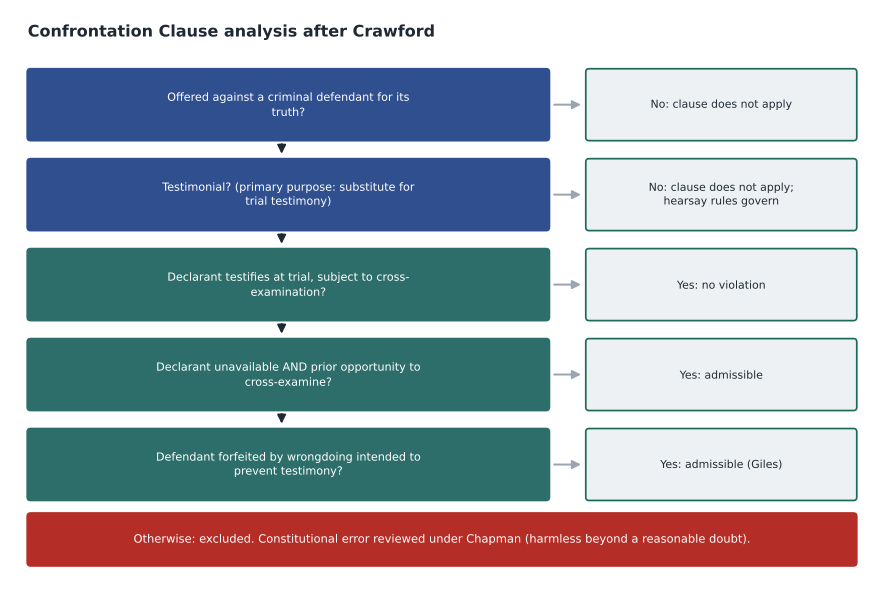
The clause applies only in criminal prosecutions and only against the accused. It does not apply in civil cases such as Delgado's, and it does not restrict what a defendant may offer. It applies in state courts through the Fourteenth Amendment, as the Supreme Court held in Pointer v. Texas, 380 U.S. 400 (1965). In State v. Pike, three pieces of evidence raise confrontation questions: Abbott's statements after the shove, the autopsy findings, and statements by Pike's codefendants.
From Roberts to Crawford
For twenty-four years, the governing test came from Ohio v. Roberts, 448 U.S. 56 (1980). Roberts held that the hearsay statement of an unavailable declarant could be admitted if it bore adequate indicia of reliability, which could be inferred if the statement fell within a firmly rooted hearsay exception or had particularized guarantees of trustworthiness. The test tied the Confrontation Clause closely to hearsay law and gave judges broad discretion to decide what was reliable.
In Crawford v. Washington, 541 U.S. 36 (2004), the Court abandoned Roberts. Michael Crawford stabbed a man he said had tried to rape his wife, Sylvia. Sylvia gave a recorded statement to police that undercut his self-defense claim, and at trial she did not testify because of the state's marital privilege. The trial court admitted her statement as reliable. Justice Scalia's opinion for the Court held that the Confrontation Clause bars admission of testimonial statements of a witness who did not appear at trial unless the witness was unavailable to testify and the defendant had had a prior opportunity for cross-examination. Reliability is not the test. "Dispensing with confrontation because testimony is obviously reliable is akin to dispensing with jury trial because a defendant is obviously guilty," the Court wrote.
Crawford drew on history. The framers, the Court said, were reacting to civil-law practices of examination in private by magistrates, used against the accused in trials such as Sir Walter Raleigh's in 1603, where the accuser's written statement was read and Raleigh's demand to face him was refused. The clause's principal concern is testimonial hearsay, statements made to government officers in the course of investigating crime, and its remedy is cross-examination.
What counts as testimonial
Crawford declined to define testimonial comprehensively but said the term covers, at a minimum, prior testimony at a preliminary hearing, before a grand jury or at a former trial, and police interrogations. Later cases supplied the test. In Davis v. Washington, 547 U.S. 813 (2006), decided with Hammon v. Indiana, the Court held that statements are nontestimonial when made in the course of police interrogation under circumstances objectively indicating that the primary purpose of the interrogation is to enable police assistance to meet an ongoing emergency. They are testimonial when the circumstances objectively indicate that there is no such ongoing emergency and that the primary purpose is to establish or prove past events potentially relevant to later criminal prosecution.
Davis applied the test to two situations. In Davis, a woman's frantic 911 call describing an assault in progress and identifying her attacker was nontestimonial: she was describing events as they happened, seeking help, and answering questions designed to resolve an emergency. In Hammon, a woman's statement to an officer in her living room, after police had separated her from her husband and the situation was calm, describing what he had done earlier, was testimonial: it was a narrative of past events given to an officer investigating a possible crime.
In Michigan v. Bryant, 562 U.S. 344 (2011), police found Anthony Covington mortally wounded in a gas station parking lot. He told them that Richard Bryant had shot him through the door of Bryant's house about half an hour earlier. Covington died hours later. The Court held his statements nontestimonial because the officers faced an ongoing emergency: an armed shooter whose location and motive were unknown, a victim with a gunshot wound, and an informal, disorganized questioning. The Court emphasized that the primary purpose inquiry is objective, looks at the statements and actions of both declarant and interrogators, and considers the formality of the encounter. Justice Scalia's dissent argued that the questioning was plainly aimed at identifying and prosecuting the shooter.
Statements to people other than law enforcement are much less likely to be testimonial. In Ohio v. Clark, 576 U.S. 237 (2015), a three-year-old boy told his preschool teachers that his mother's boyfriend had injured him. The Court held the statements nontestimonial: they were made to teachers responding to an emergency about a child's safety, not primarily to create evidence, and very young children rarely understand the criminal justice system. The Court said statements to persons other than law enforcement officers are much less likely to be testimonial, though it declined to adopt a categorical rule.
Hartigan applies the cases to Abbott. His statement to Ray Dunleavy, a passing truck driver, was made to a private person while Abbott was injured and waiting for help. It was almost certainly not made with the primary purpose of creating evidence for trial. It is nontestimonial, so the Confrontation Clause does not bar it, and its admissibility turns on the hearsay exceptions from lesson 7. Dunleavy's 911 call, describing an injured man and asking for an ambulance, is also nontestimonial. But at the hospital, a detective asked Abbott, then stabilized and lying in a treatment room, to describe the men and say who pushed him. With paramedics and police present and the assailants long gone, that questioning looks more like Hammon than Bryant. Those statements are probably testimonial.
Dying declarations
Crawford noted in a footnote that dying declarations were admitted at the time of the founding even when testimonial, and suggested that, if the exception must be accepted on historical grounds, it is sui generis. The Supreme Court has never decided the question, and many state courts have held that dying declarations are admissible even if testimonial. If Abbott's statement to the detective qualifies as a dying declaration, the prosecution will argue that the historical exception applies. The defense will argue that by the time of the detective's questioning Abbott had been stabilized and no longer believed death imminent, so the statement fails the evidentiary exception anyway.
Forensic reports
Forensic science produces a large share of the evidence in modern criminal trials, and the Court has struggled with how the Confrontation Clause applies to it. In Melendez-Diaz v. Massachusetts, 557 U.S. 305 (2009), the Court held that sworn certificates of state laboratory analysts stating that a substance was cocaine were testimonial; the analysts were witnesses the defendant had the right to confront. In Bullcoming v. New Mexico, 564 U.S. 647 (2011), the Court held that the prosecution could not introduce a blood-alcohol report through a surrogate analyst who had not performed or observed the test.
In Williams v. Illinois, 567 U.S. 50 (2012), a fractured Court upheld an expert's testimony that a DNA profile produced by an outside laboratory matched the defendant's profile, but no rationale commanded a majority. A plurality reasoned that the outside lab's report was not offered for its truth but only as the basis of the expert's opinion, and alternatively that it was not testimonial because it was not prepared to accuse a targeted individual. Justice Thomas concurred on the ground that the report lacked sufficient formality, and five Justices rejected the plurality's not-for-the-truth reasoning.
Smith v. Arizona, 602 U.S. 779 (2024), addressed the issue left open by Williams. Police found drugs in Jason Smith's possession; an analyst tested them and wrote notes and a report, but she had left the lab by trial, so the state called a substitute expert who relayed her notes and offered his own opinion that the substances were drugs. The Court, in an opinion by Justice Kagan, held that when an expert conveys an absent analyst's statements in support of the expert's opinion, and the statements support that opinion only if true, the statements are offered for their truth. The state could not evade the Confrontation Clause by calling the statements the basis of the expert's opinion. The Court remanded for the state court to decide whether the absent analyst's statements were testimonial.
Smith matters directly to Pike. The medical examiner who performed Abbott's autopsy, Dr. Irene Castellan, has retired and moved abroad. The prosecution plans to call her successor to testify, based on Castellan's autopsy report and photographs, that Abbott died of a heart attack precipitated by blunt force trauma and stress. Under Smith, to the extent the successor relays Castellan's findings and those findings support his opinion only if true, they are offered for their truth. Whether they are testimonial depends on the report's primary purpose; an autopsy in a suspected homicide, conducted with police involvement and destined for prosecution, has a strong claim to being testimonial, though courts are divided on autopsy reports. The prosecution's safest course is to have the successor review the photographs and form an independent opinion based on what he can see himself, and to avoid relaying Castellan's narrative findings.
| Case | Evidence | Holding |
|---|---|---|
| Melendez-Diaz (2009) | Sworn lab certificates identifying cocaine | Testimonial; analysts must be subject to cross-examination |
| Bullcoming (2011) | Blood-alcohol report through a surrogate analyst | Surrogate who did not perform or observe the test cannot substitute |
| Williams (2012) | Outside lab DNA profile relied on by expert | Admitted, but no majority rationale |
| Smith (2024) | Substitute expert relaying absent analyst's notes | Basis statements supporting the opinion only if true are offered for their truth; remand on testimonial question |
Codefendants' statements: Bruton
When codefendants are tried together and one has confessed, the confession is admissible against the confessing defendant as his own statement, but it is hearsay as to the others and, if made to police, testimonial. In Bruton v. United States, 391 U.S. 123 (1968), the Court held that admitting a nontestifying codefendant's confession that expressly implicated the defendant violated the Confrontation Clause, despite a limiting instruction, because the risk that the jury would use it against the defendant was too great.
Later cases defined Bruton's limits. In Richardson v. Marsh, 481 U.S. 200 (1987), the Court held that a confession redacted to eliminate any reference to the defendant, not merely her name but any reference to her existence, could be admitted with a limiting instruction even if other evidence linked the defendant to it. In Gray v. Maryland, 523 U.S. 185 (1998), the Court held that redactions that simply replace the defendant's name with a blank or the word "deleted" are so obvious that they fall within Bruton. In Samia v. United States, 599 U.S. 635 (2023), the Court held that a confession altered to refer to the defendant as "the other person" and admitted with a limiting instruction did not violate the Confrontation Clause, emphasizing the historical acceptance of limiting instructions.
If Pike and Shaw are tried together and Shaw does not testify, Shaw's confession to police stating that "Devon shoved the old man" cannot be admitted against Shaw without redaction. The prosecution might redact it to say "one of the others shoved the guard," relying on Samia, or seek separate trials. If Shaw testifies and is subject to cross-examination, Bruton does not apply, because the declarant is available for confrontation. Shaw's statement to his friend Mateo was not made to law enforcement and is likely nontestimonial, so it raises a hearsay question, not a Confrontation Clause question.
Opening the door: Hemphill
In Hemphill v. New York, 595 U.S. 140 (2022), the defendant argued at his murder trial that another man, Nicholas Morris, was the shooter. The trial court then allowed the prosecution to introduce portions of Morris's plea allocution from an earlier proceeding, in which Morris had pleaded guilty to possessing a different gun, on the theory that Hemphill had opened the door by creating a misleading impression. Morris was unavailable and had never been cross-examined. The Supreme Court held that admitting the allocution violated the Confrontation Clause. A state's opening-the-door rule cannot override the constitutional requirement of confrontation; the trial judge may not decide that the defendant's arguments made unconfronted testimonial hearsay reasonably necessary to correct a misleading impression. The Court noted that the doctrine of completeness and rules preventing misleading arguments remain available in other forms.
Exceptions to confrontation
Crawford recognized that the right to confrontation can be satisfied or forfeited. It is satisfied when the declarant testifies at trial and is subject to cross-examination, even if the declarant claims not to remember, as United States v. Owens held in a related context. It is satisfied when the declarant is unavailable and the defendant had a prior opportunity to cross-examine, such as at a preliminary hearing or deposition. It is forfeited when the defendant wrongfully procures the declarant's unavailability with the intent to prevent testimony, under Giles v. California, 554 U.S. 353 (2008). And the clause does not apply to statements offered for a purpose other than their truth, such as impeachment, though Smith limits how far that idea reaches for expert basis evidence.
Face-to-face confrontation
The clause also protects a defendant's right to face witnesses who testify. In Coy v. Iowa, 487 U.S. 1012 (1988), the Court held that placing a screen between child witnesses and the defendant violated the right to face-to-face confrontation. In Maryland v. Craig, 497 U.S. 836 (1990), the Court held that the right is not absolute and that a child witness may testify by one-way closed-circuit television if the trial court finds, after hearing evidence, that it is necessary to protect the welfare of the particular child, that the child would be traumatized by the defendant's presence and that the distress would be more than minimal. In Pitts v. Mississippi (2025), an unsigned opinion, the Court reaffirmed that such a case-specific finding of necessity is required before screening a child witness, reversed a conviction where the trial court made none, and remanded for consideration of whether the error was harmless.
Harmless error and practice
A Confrontation Clause violation is subject to harmless error review under Chapman v. California, so the prosecution must show beyond a reasonable doubt that the error did not contribute to the verdict. Defense lawyers must make specific confrontation objections, separate from hearsay objections, to preserve the issue, as lesson 1 warned. Prosecutors must plan for confrontation problems early, arranging for analysts and examiners to testify, deposing witnesses who may become unavailable, and redacting codefendants' statements.
Worked problem
Sorting Abbott's statements
Abbott made three statements: (1) to Ray Dunleavy at the scene, naming "Devon"; (2) Dunleavy relayed to the 911 dispatcher, "He says a guy named Devon pushed him, he needs an ambulance"; (3) to a detective at the hospital, after being stabilized, describing the three men and naming Devon. Pike is tried alone. Which statements does the Confrontation Clause bar?
Show solution
- Statement 1 was made to a private person while Abbott was injured and seeking help. Under Clark and Davis, it is very unlikely to be testimonial. The clause does not bar it; hearsay exceptions control.
- Statement 2 is a 911 call seeking an ambulance during an ongoing medical emergency. The embedded naming of Devon was relayed while summoning help and is likely nontestimonial under Davis and Bryant. Rule 805 requires an exception for each layer.
- Statement 3 was made to a detective after the emergency had passed, in a hospital, describing past events for an investigation. Like Hammon, it is likely testimonial. Abbott is dead and Pike never cross-examined him.
- Unless statement 3 is admissible under a historical dying declaration exception (unsettled, and doubtful if Abbott no longer believed death imminent) or Pike forfeited the right by killing Abbott to prevent testimony (not shown; Giles), the clause bars it.
Answer: The clause likely bars only the hospital statement to the detective; the statements to Dunleavy and the 911 call are nontestimonial and turn on hearsay law.
Summary and key terms
- The Confrontation Clause applies only in criminal cases, against the prosecution, and in state courts through the Fourteenth Amendment.
- Crawford (2004) replaced Roberts's reliability test: testimonial statements of absent witnesses are inadmissible unless the witness was unavailable and the defendant had a prior opportunity to cross-examine.
- Davis, Bryant and Clark define testimonial statements by objective primary purpose; ongoing emergencies and statements to private persons are usually nontestimonial.
- Melendez-Diaz and Bullcoming require forensic analysts to testify; Smith (2024) holds that an expert's relayed basis statements are offered for their truth if the opinion depends on them.
- Bruton bars a nontestifying codefendant's confession naming the defendant; Richardson, Gray and Samia (2023) govern redactions; Hemphill (2022) bars using opening-the-door rules to admit unconfronted testimonial hearsay.
- Confrontation is satisfied by trial cross-examination or prior opportunity plus unavailability, forfeited under Giles, and in-court screening of child witnesses requires case-specific necessity findings (Craig; Pitts, 2025).
Practice problems
Work each problem on paper first, then reveal the answer to check.
What test did Crawford replace, and with what?
Show answer
Ohio v. Roberts's reliability test, replaced by a categorical rule that testimonial statements of absent witnesses require unavailability and a prior opportunity for cross-examination.
Why were the statements in Michigan v. Bryant nontestimonial?
Show answer
Police were responding to an ongoing emergency involving an armed shooter at large and a seriously wounded victim, in informal circumstances.
What did Smith v. Arizona hold?
Show answer
When an expert relays an absent analyst's statements to support an opinion and the statements support it only if true, they are offered for their truth for confrontation purposes.
How did Samia v. United States treat a confession referring to "the other person"?
Show answer
Admitting it with a limiting instruction did not violate the Confrontation Clause.
Why does Shaw's statement to his friend Mateo raise no Confrontation Clause issue?
Show answer
It was made to a private friend, not to law enforcement, and was not testimonial.
Lesson quiz · 5 questions
Score 60% or more to complete this lesson.
Create a free account to save your progress, take quizzes and earn a certificate.