
LAWU-201 · Lesson 11 of 12 · 25 min
Authentication, the best evidence rule and digital evidence
▶ Video coming soon A video version of this lesson is on the way.
"Before an exhibit can prove anything, someone has to show it is what you say it is," Professor Hartigan tells Section B. She holds up a printout of a message from the "copper run" group chat, sent from an account named DP_Fixes, reading "watchman's old, takes his walk at 11, we go at 11:30." The prosecution says Devon Pike wrote it. "Anyone can type a name on an account," Hartigan says. "Anyone can print a screenshot. Authentication is the rule that makes the proponent connect the exhibit to the person or event it supposedly reflects. And in an age of editing software and synthetic media, it is becoming one of the hardest fights in the courtroom."
The authentication standard: Rule 901(a)
Rule 901(a) provides that to satisfy the requirement of authenticating or identifying an item of evidence, the proponent must produce evidence sufficient to support a finding that the item is what the proponent claims it is. The standard is low. Authentication is a matter of conditional relevance under Rule 104(b): the judge does not decide whether the exhibit is genuine, only whether a reasonable jury could find that it is. Once that threshold is met, the exhibit is admitted, and the opponent may still argue to the jury that it is fake or altered.
The requirement applies to all physical and documentary evidence, including objects, writings, photographs, recordings and electronic data. It also applies to oral statements whose source matters, such as a phone call the proponent attributes to a particular person. Authentication does not make an exhibit admissible by itself; the exhibit must also satisfy the hearsay rule, the best evidence rule and every other applicable rule. A properly authenticated letter from Pike is still subject to a hearsay analysis, though as his own statement it will likely come in under Rule 801(d)(2)(A).
Illustrations: Rule 901(b)
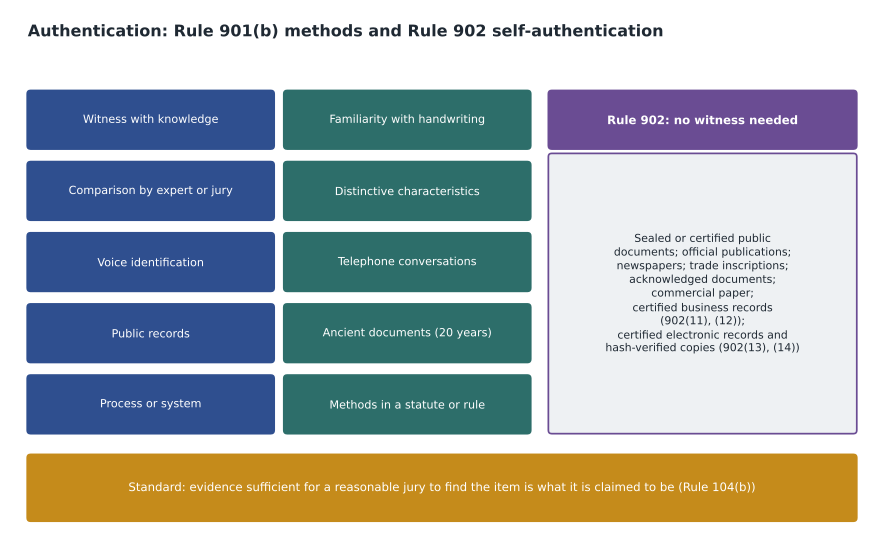
Rule 901(b) gives ten examples of evidence that satisfies the requirement, while making clear that the list is not exclusive. The most important are these. Testimony of a witness with knowledge that an item is what it is claimed to be is the most common method: a detective who seized the bolt cutters from Kellan Shaw's car can identify them. Nonexpert opinion about handwriting, based on familiarity not acquired for the litigation, can authenticate a handwritten note. A comparison by an expert witness or the trier of fact with an authenticated specimen is another method. Distinctive characteristics, meaning appearance, contents, substance, internal patterns or other distinctive characteristics taken together with all the circumstances, can authenticate an item without a witness who saw it created.
Voice identification may be made by an opinion based on hearing the voice at any time under circumstances connecting it with the alleged speaker; Tara Quinn, who has known Pike all her life, can identify his voice on a voicemail. Telephone conversations may be authenticated by evidence that a call was made to the number assigned at the time to a particular person, if circumstances such as self-identification show that the person answering was the one called. Public records may be authenticated by evidence that a document was recorded or filed in a public office as authorized by law. An ancient document or data compilation may be authenticated by showing that it is at least twenty years old, is in a condition that creates no suspicion about its authenticity and was found in a place where, if authentic, it would likely be. Evidence about a process or system may authenticate its result by showing that the process produces an accurate result, the method used for X-rays, automated logs and computer output.
Chain of custody
Fungible items, such as drugs, blood samples and battery fragments, look like many other items of the same kind and can be altered or contaminated. For such items, the proponent usually authenticates by showing a chain of custody: a record of who had the item from its seizure to trial, showing that it was not tampered with or substituted. The chain need not be perfect. Gaps generally go to weight, unless they are so serious that a reasonable jury could not find the item is what it is claimed to be. Unique items that a witness can recognize, such as a distinctive bolt cutter with Shaw's initials scratched in the handle, need no chain of custody.
In Delgado's case, the remains of the battery pack are central evidence. The fire marshal collected them, sealed them in a labeled evidence can and logged them; they were transferred to a secure storage facility, then shipped under a joint protocol to a laboratory where both sides' experts observed the CT scanning and disassembly. Each transfer was documented. Kestrelwerk cannot plausibly argue that the remains are not Delgado's battery. If the chain had a gap, such as an unexplained week in an unsecured garage, Kestrelwerk would argue that the pack might have been damaged or that the internal short Achterberg found occurred after the fire. Joint evidence-handling protocols agreed early in the case prevent such disputes and also guard against claims of spoliation, the destruction or alteration of evidence, which can lead to sanctions under Federal Rule of Civil Procedure 37(e) for electronically stored information or the court's inherent power for physical evidence.
Photographs and video
Photographs and videos are usually authenticated in one of two ways. Under the pictorial testimony theory, a witness with knowledge testifies that the image fairly and accurately depicts the scene as the witness saw it; the photographer need not testify. Under the silent witness theory, an image recorded by an automatic system, such as a surveillance camera, is authenticated by evidence about the reliability of the system, often under Rule 901(b)(9), showing how the camera works, how footage is stored and retrieved, and that it was not altered.
A Riverside Salvage security camera recorded three figures entering the yard at 11:32 p.m. No witness who was present can say the footage fairly depicts the scene, because the only people present were the burglars and Abbott. The prosecution will authenticate the video through the yard manager, who can testify about the camera system, its time stamp, how footage is recorded to a hard drive and how it was exported to the police. In Delgado's case, her neighbor's video doorbell captured smoke and a flash from her garage at 9:47 p.m. The neighbor can authenticate it as a fair depiction of what he later saw, or a technician from the doorbell company can testify about the system.
Digital evidence: emails, texts and social media
Electronic communications raise authentication problems because accounts can be hacked, shared or created in someone else's name, and screenshots can be edited. Courts have taken somewhat different approaches. A few, particularly in early cases, demanded strong proof, such as testimony from the purported author, evidence from a search of the author's device or records from the service provider. Most courts now apply the ordinary Rule 901 standard, admitting a message if circumstantial evidence would allow a reasonable jury to find that the purported author wrote it, and leaving doubts to the jury.
Circumstantial evidence of authorship can include the account name, the email address or phone number, the profile photo and personal details, the content of the message, especially details only the purported author would know, the writing style, the timing in relation to other events, replies that treat the sender as the purported author, and the author's later conduct consistent with the message. The DP_Fixes account in the group chat used Pike's phone number, displayed a photo of his truck and was the account that later sent Quinn the address of Wendell Fry's scrapyard. In the chat, other members addressed DP_Fixes as "Devon." A detective who extracted the messages from Shaw's phone using forensic software can testify about the extraction, and Quinn, a member of the chat, can testify that DP_Fixes was the account Pike used. That is ample for a reasonable jury.
Rules 902(13) and 902(14), added in 2017, allow self-authentication of certified records generated by an electronic process or system and data copied from an electronic device, storage medium or file, if authenticated by a process of digital identification such as a hash value, through a certification by a qualified person that meets the requirements of Rule 902(11) or (12). The rules save parties from calling forensic examiners merely to establish routine foundations, though the opponent may still challenge the evidence and must receive advance notice. Kestrelwerk can authenticate the firmware logs from its servers showing when the June 2026 update was pushed to Delgado's bike, or that it was not, through such a certification.
Deepfakes
Generative tools can now create realistic fake images, audio and video. Courts and rulemakers are considering whether existing rules are adequate. Some commentators argue that Rule 901's low threshold allows fabricated evidence to reach the jury and that the opponent's mere allegation of fakery could also cast doubt on genuine evidence. The Advisory Committee on Evidence Rules has studied proposals, including one that would require more of a proponent once an opponent makes a sufficient showing that an item may be fabricated, and has considered rules on machine-generated evidence. As of late 2026, no deepfake-specific amendment to Rule 901 has taken effect, and courts address these issues under existing rules, including Rule 104(a) hearings, expert testimony on detection and Rule 403. Hartigan tells the class to expect this area to change and to check the current rules whenever they handle contested digital media.
Self-authentication: Rule 902
Rule 902 lists items that require no extrinsic evidence of authenticity. They include domestic public documents that are sealed and signed; domestic public documents that are not sealed but are signed and certified by an officer with a seal; foreign public documents with appropriate certification; certified copies of public records; official publications; newspapers and periodicals; trade inscriptions and labels indicating origin, ownership or control; acknowledged documents; commercial paper and related documents; items presumed genuine under a federal statute; and certified domestic and foreign records of a regularly conducted activity under Rules 902(11) and 902(12). The business-record certification provisions allow a custodian's written declaration to establish both authenticity and the Rule 803(6) foundation, as lesson 7 discussed, if the proponent gives the adverse party reasonable written notice and makes the record and certification available for inspection.
Self-authentication only removes the need for a sponsoring witness. In criminal cases, a certification prepared for litigation may raise Confrontation Clause concerns if it does more than authenticate a record, as Melendez-Diaz suggested, though most courts hold that a certification merely authenticating an existing business record is not testimonial in the relevant sense.
The best evidence rule: Rules 1001 to 1008
The rule commonly called the best evidence rule is narrower than its name. It does not require the best evidence of every fact. Rule 1002 provides that an original writing, recording or photograph is required in order to prove its content, unless the rules or a federal statute provide otherwise. The rule applies only when a party seeks to prove the content of a writing, recording or photograph. It does not apply when a fact exists independently of a writing that happens to record it.
The distinction is crucial. If Wendell Fry testifies that he paid Shaw about 1,100 dollars for 340 pounds of copper, the rule does not apply: the payment and the weight are facts Fry perceived, and the receipt is merely one record of them. If the prosecution tries to prove what the receipt says, for example that it lists no identification, then the content of the receipt is at issue, and the original or a duplicate is required. Similarly, a witness who heard a conversation may testify to it even if it was also recorded; but a witness who only listened to the recording must use the recording to prove what was said.
Rule 1001 defines the terms broadly. Writings include letters, words, numbers or their equivalent set down in any form; recordings include sounds; photographs include photographic images in any form, including videos. For electronically stored information, an original means any printout or other output readable by sight if it accurately reflects the information. Rule 1003 makes a duplicate admissible to the same extent as the original unless a genuine question is raised about the original's authenticity or the circumstances make it unfair to admit the duplicate. Photocopies, scans and exported files are duplicates.
Rule 1004 excuses the original and permits other evidence of content if all originals are lost or destroyed, and not by the proponent acting in bad faith; an original cannot be obtained by any available judicial process; the party against whom the original would be offered had control of it, was put on notice that it would be a subject of proof, and fails to produce it; or the writing, recording or photograph is not closely related to a controlling issue. Rule 1005 allows certified or compared copies of public records. Rule 1007 allows proof of content by the testimony, deposition or written statement of the party against whom it is offered.
Rule 1006, amended effective December 1, 2024, allows the proponent to use a summary, chart or calculation to prove the content of voluminous writings, recordings or photographs that cannot be conveniently examined in court, whether or not they have been introduced into evidence. The proponent must make the underlying materials available for examination or copying by other parties at a reasonable time and place, and the court may order the proponent to produce them in court. The amendment clarified that a Rule 1006 summary is itself evidence, distinguishing it from illustrative aids under new Rule 107, which are not. In Delgado's case, Whitcomb may present a chart summarizing 4,000 warranty claims from Kestrelwerk's database showing how many involved overheating during charging, so long as the database is made available and the chart is accurate.
Rule 1008 allocates decision-making. Ordinarily the court decides whether the proponent has fulfilled the factual conditions for admitting other evidence of content. But the jury decides any issue about whether an asserted writing, recording or photograph ever existed, whether another one produced at trial is the original, or whether other evidence of content accurately reflects the content.
| Situation | Proving content? | Result |
|---|---|---|
| Fry testifies he paid about 1,100 dollars for the copper | No; the payment is an independent fact | Rule does not apply |
| Prosecution offers testimony about what Fry's receipt says | Yes | Original or duplicate required unless Rule 1004 excuses it |
| Detective describes what the yard video shows, having seen only the video | Yes | The video itself (or a duplicate) is required |
| Whitcomb summarizes 4,000 warranty claims in a chart | Yes, of voluminous records | Rule 1006 permits a summary if records are made available |
| Kestrelwerk produces a scan of a test log instead of the paper original | Yes | Duplicate admissible unless genuine authenticity question or unfairness (Rule 1003) |
Worked problem
Authenticating the group chat
The prosecution offers screenshots of messages from the DP_Fixes account, extracted from Shaw's phone. Pike objects that the prosecution cannot prove he wrote them, noting that his cousin Quinn sometimes used his phone. How should the court rule?
Show solution
- Authentication is a Rule 104(b) question: is there evidence sufficient for a reasonable jury to find that Pike wrote the messages?
- Circumstantial evidence: the account used Pike's phone number and a photo of his truck; chat members addressed DP_Fixes as Devon; a message from the account sent the address of Fry's scrapyard, where Shaw later sold the copper; the messages reflect knowledge of the watchman's schedule, matching Pike's earlier visit to Riverside Salvage.
- Quinn, a chat member, can testify that DP_Fixes was the account Pike used; the detective can testify about the forensic extraction from Shaw's phone and that the screenshots accurately reflect the data (or a Rule 902(14) certification can establish the copy).
- Pike's claim that Quinn sometimes used his phone goes to weight; the jury may consider it.
- After authentication, the messages are Pike's own statements under Rule 801(d)(2)(A), and the best evidence rule is satisfied by the extracted data or accurate printouts.
Answer: The messages are sufficiently authenticated; Pike's alternative explanation is for the jury.
Summary and key terms
- Rule 901(a) requires evidence sufficient for a reasonable jury to find an item is what it is claimed to be; the judge applies Rule 104(b).
- Rule 901(b) illustrates methods: witnesses with knowledge, handwriting, comparison, distinctive characteristics, voice identification, telephone calls, public records, ancient documents and process or system.
- Fungible items need a chain of custody; gaps usually go to weight; joint protocols prevent spoliation disputes.
- Digital messages are authenticated by circumstantial evidence; Rules 902(13) and (14) allow certification of electronic records and hash-verified copies; no deepfake-specific rule had taken effect as of late 2026.
- The best evidence rule applies only when proving the content of a writing, recording or photograph; duplicates are generally admissible; Rule 1004 excuses originals in listed circumstances.
- Amended Rule 1006 (December 2024) makes summaries of voluminous records evidence whether or not the records are admitted; Rule 1008 sends certain existence and accuracy questions to the jury.
Practice problems
Work each problem on paper first, then reveal the answer to check.
Why is authentication a Rule 104(b) question?
Show answer
The relevance of the exhibit depends on whether it is what the proponent claims, so the judge asks only whether a reasonable jury could so find.
How can the Riverside Salvage surveillance video be authenticated when no eyewitness can vouch for it?
Show answer
Under the silent witness theory, through testimony about the camera system's reliability, time stamping, storage and export (Rule 901(b)(9)).
Does the best evidence rule apply when Fry testifies about how much he paid?
Show answer
No; the payment is a fact he perceived independently of the receipt, so its content is not being proved.
What did the 2024 amendment to Rule 1006 clarify?
Show answer
A summary of voluminous records may be admitted whether or not the underlying records are in evidence, and the summary is itself evidence.
What do Rules 902(13) and 902(14) allow?
Show answer
Certification instead of live testimony to authenticate records generated by an electronic process and data copies verified by digital identification such as hash values.
Lesson quiz · 5 questions
Score 60% or more to complete this lesson.
Create a free account to save your progress, take quizzes and earn a certificate.