
LAWU-201 · Lesson 5 of 12 · 26 min
Witnesses and impeachment
▶ Video coming soon A video version of this lesson is on the way.
Tara Quinn will be the prosecution's most important witness against Devon Pike. She drove the car on the night of the Riverside Salvage burglary, and in exchange for a plea to burglary and a recommendation of probation, she has agreed to testify that Pike planned the theft, shoved Lou Abbott and told everyone to leave him. Professor Hartigan tells Section B that Pike's lawyer will spend the trial trying to make the jury disbelieve her. "Most trials are credibility contests," she says. "The rules about witnesses tell you who may testify, how they may be questioned and how their credibility may be attacked or supported. They are the rules you will use most often in practice."
Competency and personal knowledge
Rule 601 states the general rule: every person is competent to be a witness unless the rules provide otherwise. The common law disqualified many people, including parties, spouses, people convicted of crimes and people who did not believe in God. Those disqualifications are gone. Today concerns about a witness's capacity, honesty or interest go to weight, not competency. Rule 601 adds that in a civil case, state law governs competency regarding a claim or defense for which state law supplies the rule of decision, which preserves state dead man's statutes in diversity cases.
Rule 602 requires personal knowledge. A witness may testify to a matter only if evidence is introduced sufficient to support a finding that the witness has personal knowledge of the matter, and the evidence may consist of the witness's own testimony. A witness who says "I heard from the manager that the alarm was off" lacks personal knowledge that the alarm was off; she knows only what the manager said, which raises a hearsay question. Personal knowledge is a Rule 104(b) question: the judge asks only whether a reasonable jury could find that the witness perceived what she describes. Expert witnesses are exempt from the personal knowledge requirement under Rule 703.
Rule 603 requires every witness to give an oath or affirmation to testify truthfully, in a form designed to impress that duty on the witness's conscience. Rule 604 requires interpreters to be qualified and to take an oath. Rule 605 bars the presiding judge from testifying. Rule 606(a) bars jurors from testifying before the jury on which they sit.
Jurors' testimony about deliberations: Rule 606(b)
Rule 606(b) protects jury deliberations from later inquiry. During an inquiry into the validity of a verdict, a juror may not testify about any statement made or incident that occurred during deliberations, the effect of anything on any juror's vote, or any juror's mental processes concerning the verdict. A juror may testify about whether extraneous prejudicial information was improperly brought to the jury's attention, whether an outside influence was improperly brought to bear on any juror, or whether there was a mistake in entering the verdict on the form. In Tanner v. United States, 483 U.S. 107 (1987), the Supreme Court upheld the exclusion of testimony that jurors had drunk alcohol and used drugs during the trial, reasoning that other safeguards protect the defendant's right to a competent jury.
The Court recognized a constitutional exception in Pena-Rodriguez v. Colorado, 580 U.S. 206 (2017). Where a juror makes a clear statement indicating that he relied on racial stereotypes or animus to convict a criminal defendant, the Sixth Amendment requires that the no-impeachment rule give way to permit the trial court to consider the evidence and any resulting denial of the jury trial guarantee. The statement must tend to show that racial animus was a significant motivating factor in the juror's vote.
Examining witnesses
Lesson 1 introduced Rule 611's control over the mode and order of examination, the scope of cross-examination and leading questions. Two more rules complete the picture. Rule 612 governs writings used to refresh a witness's memory. If a witness uses a writing to refresh memory while testifying, the adverse party is entitled to have the writing produced at the hearing, to inspect it, to cross-examine the witness about it and to introduce in evidence any portion that relates to the witness's testimony. If the witness used the writing before testifying, the court may order the same in its discretion if justice requires. Refreshing recollection is different from the hearsay exception for recorded recollection under Rule 803(5): a refreshing document is not itself evidence unless the adverse party offers it, while a recorded recollection is read into evidence when the witness cannot remember even after reviewing it.
In Delgado's case, Kestrelwerk's thermal engineer, Dr. Anja Brenner, reviewed her laboratory notebook the night before her deposition and again on the witness stand. Rule 612 lets Whitcomb inspect the pages she used on the stand and, in the court's discretion, the pages she reviewed beforehand, which may require Kestrelwerk to produce material it would rather keep private. Lawyers preparing witnesses must decide carefully what documents to show them, because privilege and work product protection can be lost through a Rule 612 demand.
Rule 615, amended in 2023, governs excluding witnesses. At a party's request, the court must order witnesses excluded from the courtroom so they cannot hear other witnesses' testimony, and the court may do so on its own. The rule does not authorize excluding a party who is a natural person, an officer or employee designated as a party's representative, a person whose presence a party shows to be essential, or a person authorized by statute to be present. The 2023 amendment clarified that an exclusion order may also, at the court's discretion, prohibit excluded witnesses from accessing trial testimony outside the courtroom, such as through transcripts, news reports or other witnesses, and it limited an entity party to one designated representative at a time.
Impeachment: who may do it
Impeachment means attacking a witness's credibility. Rule 607 provides that any party, including the party that called the witness, may attack the witness's credibility. The common law voucher rule, under which a party vouched for its own witnesses and could not impeach them, has been abolished. A prosecutor who calls Quinn may bring out her plea deal on direct to blunt its effect on cross, and may impeach her if she unexpectedly departs from her earlier account.
Courts do impose one limit. A party may not call a witness it knows will not give useful testimony solely as a pretext to place an otherwise inadmissible prior statement before the jury under the guise of impeachment. If the prosecution knows Shaw will deny everything and calls him only to impeach him with a statement implicating Pike that would otherwise be hearsay, many courts will find the impeachment improper.
The five main lines of impeachment
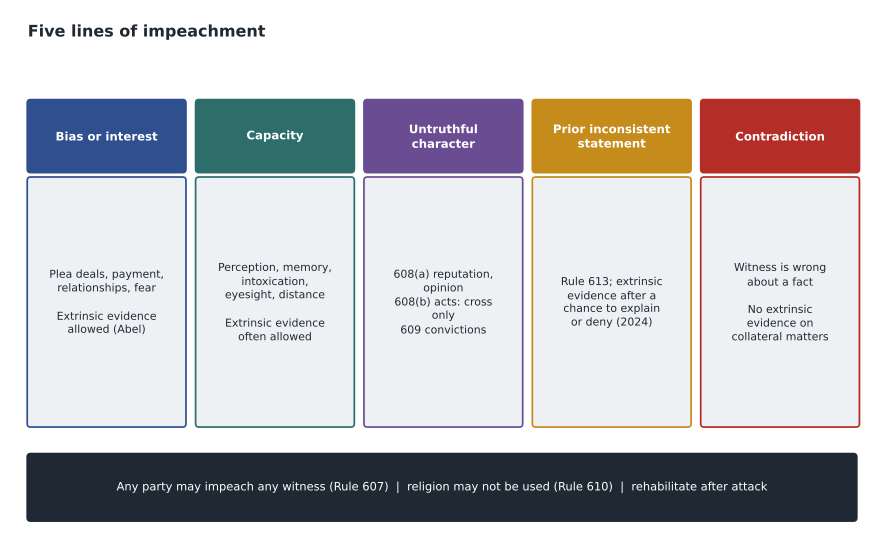
Lawyers usually group impeachment into five categories: bias or interest, defects in capacity, character for untruthfulness, prior inconsistent statements, and contradiction. Some are governed by specific rules and others by the common law, Rule 401 and Rule 403.
Bias and interest
Bias is any reason a witness might shade testimony in favor of or against a party: a relationship, a financial stake, hostility, fear or an agreement with the government. Though no rule mentions bias, the Supreme Court held in United States v. Abel, 469 U.S. 45 (1984), that it is always relevant to impeachment. In Abel, the prosecution was allowed to show that a defense witness and the defendant belonged to a secret prison organization whose members were sworn to lie for one another. Bias may be proved by cross-examination and by extrinsic evidence, meaning testimony from other witnesses or documents, though many courts require that the witness first be given an opportunity to admit or deny the facts showing bias.
In criminal cases, the Confrontation Clause protects a defendant's right to expose a prosecution witness's bias. In Davis v. Alaska, 415 U.S. 308 (1974), the Court held that a state's interest in protecting the confidentiality of juvenile records could not override the defendant's right to show that a key witness was on juvenile probation and might have feared the authorities. Pike's lawyer will certainly cross-examine Quinn about her plea agreement, the sentence she faced without it, the recommendation of probation, her parole status and her fear of being charged with felony murder herself.
Capacity
A witness's ability to perceive, remember and relate events bears on credibility. Poor eyesight, distance, darkness, stress, intoxication and the passage of time can all be explored on cross-examination and often proved by extrinsic evidence. Kellan Shaw told police he drank most of a bottle of whiskey that night. If he testifies, his intoxication bears on what he could perceive and remember. Courts are more cautious about evidence of mental illness or past drug use not tied to the events, admitting it when it affects the witness's capacity and excluding it under Rule 403 when it merely stigmatizes.
Character for truthfulness: Rule 608
Rule 608(a) allows a witness's credibility to be attacked or supported by testimony about the witness's reputation for having a character for truthfulness or untruthfulness, or by testimony in the form of an opinion about that character. Evidence of truthful character is admissible only after the witness's character for truthfulness has been attacked. A party may not bolster its own witness's credibility before an attack; an attack by evidence of bias or a prior inconsistent statement may or may not count as an attack on character for truthfulness, and courts decide case by case.
Rule 608(b) addresses specific instances. Except for criminal convictions under Rule 609, extrinsic evidence is not admissible to prove specific instances of a witness's conduct in order to attack or support the witness's character for truthfulness. But the court may, on cross-examination, allow them to be inquired into if they are probative of the character for truthfulness or untruthfulness of the witness or of another witness whose character the witness being cross-examined has testified about. The cross-examiner must take the witness's answer: if Quinn denies lying on a car loan application, Pike's lawyer cannot call the loan officer to prove she did. A good faith basis for the question is required, and Rule 403 applies.
Prior convictions: Rule 609
Rule 609 governs impeachment with criminal convictions and is among the most important rules in criminal trials, because a defendant who testifies faces impeachment with his own record. The rule distinguishes two kinds of convictions. Under Rule 609(a)(2), for any crime regardless of the punishment, the evidence must be admitted if the court can readily determine that establishing the elements of the crime required proving, or the witness admitting, a dishonest act or false statement. Perjury, fraud, embezzlement and false statements qualify; the court has no discretion to exclude them. Crimes such as theft, robbery or drug possession are generally not crimes of dishonesty under this provision, even though some courts once thought otherwise.
Under Rule 609(a)(1), for a crime punishable by death or imprisonment for more than one year, the evidence must be admitted subject to Rule 403 in a civil case or in a criminal case in which the witness is not a defendant, and must be admitted in a criminal case in which the witness is a defendant if the probative value of the evidence outweighs its prejudicial effect to that defendant. That last test is more protective than Rule 403, because the prosecution must show that probative value outweighs prejudice, not merely that prejudice does not substantially outweigh probative value. Courts commonly consider the impeachment value of the prior crime, its age, the similarity between the prior crime and the charged crime (greater similarity means greater prejudice), the importance of the defendant's testimony and the centrality of the defendant's credibility.
Rule 609(b) imposes a stricter test for old convictions. If more than ten years have passed since the witness's conviction or release from confinement, whichever is later, the evidence is admissible only if its probative value, supported by specific facts and circumstances, substantially outweighs its prejudicial effect, and the proponent gives the adverse party reasonable written notice. Rule 609(c) excludes convictions that were pardoned or annulled based on rehabilitation or innocence, and Rule 609(d) generally excludes juvenile adjudications, except that in a criminal case the court may admit a juvenile adjudication of a witness other than the defendant if an adult's conviction for the offense would be admissible and the evidence is necessary to fairly determine guilt or innocence. Rule 609(e) allows impeachment with a conviction even if an appeal is pending.
| Type of conviction | Witness | Test |
|---|---|---|
| Crime requiring proof of a dishonest act or false statement | Any witness | Must be admitted, regardless of punishment (609(a)(2)) |
| Felony (punishable by more than one year) | Witness other than a criminal defendant | Admitted subject to Rule 403 (609(a)(1)(A)) |
| Felony | Criminal defendant | Admitted if probative value outweighs prejudicial effect to the defendant (609(a)(1)(B)) |
| Misdemeanor not involving dishonesty | Any witness | Not admissible under Rule 609 |
| Any conviction more than 10 years old (from conviction or release, whichever later) | Any witness | Probative value must substantially outweigh prejudice; written notice required (609(b)) |
Pike's only prior conviction is the misdemeanor assault for shoving the bouncer. It is not punishable by more than a year and does not involve dishonesty, so it cannot be used under Rule 609 if Pike testifies. Quinn's record is different. She is on parole for a 2023 felony theft conviction. Theft is not automatically a crime of dishonesty under Rule 609(a)(2), so the court applies Rule 403 under Rule 609(a)(1)(A), and most judges would admit a recent felony against a prosecution witness. Her parole status is also admissible to show bias, because it gives her reason to please the prosecution.
Prior inconsistent statements: Rule 613
A witness who said something different before can be impeached with the earlier statement. Rule 613(a) provides that when examining a witness about the witness's prior statement, a party need not show it or disclose its contents to the witness, but must, on request, show it or disclose its contents to an adverse party's attorney. Rule 613(b), as amended effective December 1, 2024, provides that unless the court orders otherwise, extrinsic evidence of a witness's prior inconsistent statement may not be admitted until after the witness is given an opportunity to explain or deny the statement and an adverse party is given an opportunity to examine the witness about it. The amendment restored the traditional foundation requirement, which the original rule had relaxed, while giving the court discretion to depart from it. The foundation requirement does not apply to an opposing party's statement under Rule 801(d)(2).
Unless a prior inconsistent statement satisfies a hearsay exemption, it is admissible only to impeach, not as proof that the earlier version is true, and the jury should be so instructed. Lesson 6 explains Rule 801(d)(1)(A), which makes some prior inconsistent statements substantive evidence; its amendment effective December 1, 2026 will broaden it considerably.
Contradiction and the collateral matter rule
Impeachment by contradiction shows that the witness is wrong about something, suggesting she may be wrong or lying about other things. The common law collateral matter rule limits extrinsic evidence: a party may cross-examine about a collateral matter, but if the witness denies it, the party must take the answer and may not call other witnesses to prove it. A matter is not collateral if it is independently relevant to the case or to a recognized ground of impeachment such as bias or capacity. If the truck driver testifies that he was driving home from work when he found Abbott, and he was actually leaving a bar, the bar visit is not collateral, because drinking bears on his capacity to perceive.
Rehabilitation and the bar on religion
Once a witness is impeached, the party who called her may try to rehabilitate her: by evidence of good character for truthfulness after an attack on that character, by redirect examination explaining the apparent inconsistency, or, in some circumstances, by prior consistent statements under Rule 801(d)(1)(B), discussed in lesson 6. Rule 610 forbids evidence of a witness's religious beliefs or opinions to attack or support credibility, though such evidence may be admissible for other purposes, such as showing bias when the witness belongs to a church that is a party.
Worked problem
Planning the cross-examination of Tara Quinn
Quinn will testify that Pike shoved Abbott and said "leave him." In a police interview the night after the burglary, she said she was in the car and "didn't see what happened inside." She has a 2023 felony theft conviction and is on parole, and she lied on a rental application in 2024. Outline the impeachment and its limits.
Show solution
- Bias: cross-examine on the plea agreement, the felony murder exposure she avoided, the probation recommendation and her parole status; extrinsic evidence of the agreement is admissible if she denies it (Abel; Davis v. Alaska).
- Prior conviction: the felony theft is admissible against a non-defendant witness under Rule 609(a)(1)(A), subject to Rule 403; it is not automatically a crime of dishonesty under 609(a)(2).
- Specific act of dishonesty: the false rental application may be asked about on cross under Rule 608(b) if the court finds it probative of untruthfulness, but if Quinn denies it, extrinsic evidence is barred.
- Prior inconsistent statement: confront her with the police interview; under amended Rule 613(b), extrinsic evidence of the statement (such as the officer's testimony or the recording) generally comes in only after she has a chance to explain or deny it.
- Ask for a limiting instruction that the earlier statement may be used only to judge her credibility, unless a hearsay exemption makes it substantive evidence.
Answer: Pike's lawyer can use bias, the felony conviction, the rental application on cross only, and the prior inconsistent statement after laying the Rule 613(b) foundation.
Summary and key terms
- Everyone is competent to testify (Rule 601); lay witnesses need personal knowledge (Rule 602) and must take an oath (Rule 603).
- Rule 606(b) bars juror testimony about deliberations, with exceptions for outside influences and, under Pena-Rodriguez, racial animus.
- Rule 612 entitles the adverse party to see writings used to refresh memory; Rule 615, amended in 2023, governs excluding witnesses.
- Any party may impeach any witness (Rule 607) through bias, capacity, character for truthfulness, prior inconsistent statements and contradiction.
- Rule 608 allows reputation and opinion on truthfulness and specific acts only on cross without extrinsic proof; Rule 609 sets distinct tests for crimes of dishonesty, felonies, defendants and convictions over ten years old.
- Amended Rule 613(b) (December 2024) requires a chance to explain or deny before extrinsic evidence of a prior inconsistent statement, unless the court orders otherwise.
Practice problems
Work each problem on paper first, then reveal the answer to check.
Why can Pike's misdemeanor assault conviction not be used to impeach him under Rule 609?
Show answer
It was not punishable by more than one year and did not require proof of a dishonest act or false statement.
What did United States v. Abel hold?
Show answer
Evidence of bias is always relevant to impeachment, there evidence that witness and defendant belonged to an organization sworn to lie for each other.
What is the difference between Rule 609(a)(1)(A) and (B)?
Show answer
For non-defendant witnesses, felonies come in subject to Rule 403; for criminal defendants, only if probative value outweighs prejudicial effect to the defendant.
Under Rule 608(b), what happens if a witness denies a specific act of dishonesty on cross?
Show answer
The cross-examiner must take the answer; extrinsic evidence is not admissible to prove the act.
What did the December 2024 amendment to Rule 613(b) do?
Show answer
It requires that the witness have an opportunity to explain or deny before extrinsic evidence of a prior inconsistent statement is admitted, unless the court orders otherwise.
Lesson quiz · 5 questions
Score 60% or more to complete this lesson.
Create a free account to save your progress, take quizzes and earn a certificate.