
LAWU-201 · Lesson 4 of 12 · 24 min
Sexual assault cases, habit and routine practice
▶ Video coming soon A video version of this lesson is on the way.
Professor Hartigan begins with a content note. Part of today's class concerns the rules that govern evidence in sexual assault and child molestation cases. The class will discuss the rules, their history and how courts apply them, without graphic detail, and the problems use invented facts. Students who would rather read the material on their own are welcome to step out and return for the second half, which covers habit and routine practice. "These rules matter," she says, "because they are the places where Congress made its most deliberate choices about character evidence, in both directions."
The two halves of the lesson share a theme. Rules 412 through 415 make special rules for character and other acts in sexual offense cases: Rule 412 restricts evidence about the alleged victim far more tightly than Rule 404 would, while Rules 413 to 415 allow evidence of a defendant's other sexual offenses to prove propensity, something Rule 404 forbids in every other kind of case. Rule 406, by contrast, admits evidence of habit and routine practice, which looks like character evidence but rests on a different and more reliable inference.
Rule 412: the rape shield
Before the 1970s, defendants in rape prosecutions routinely introduced evidence of the complainant's sexual history, on the theory that a woman who had consented before was more likely to have consented again, and that her sexual history bore on her credibility. Both inferences rested on stereotypes, and the practice humiliated complainants and discouraged reporting. Beginning with Michigan in 1974, states adopted rape shield laws, and Congress enacted Rule 412 in 1978. The rule was rewritten in 1994 to extend it to civil cases and to all sexual misconduct, not only rape.
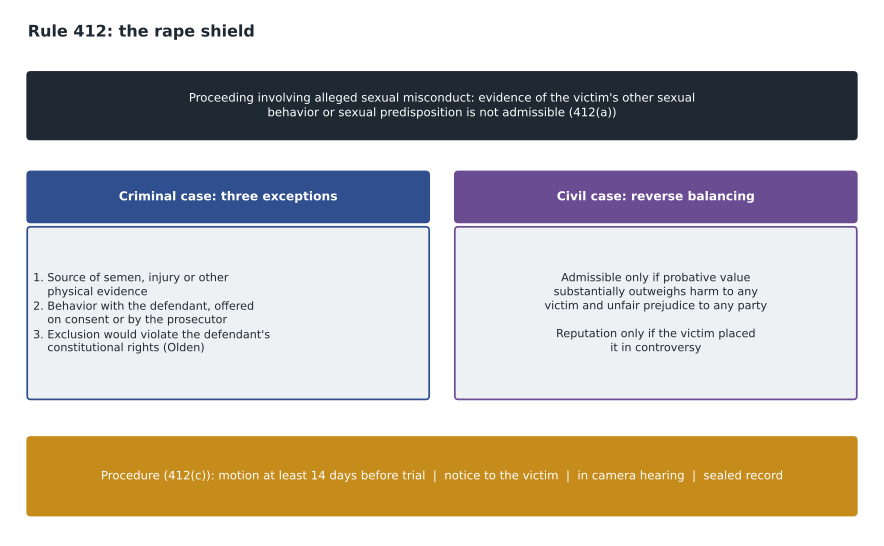
Rule 412(a) provides that in a civil or criminal proceeding involving alleged sexual misconduct, evidence offered to prove that a victim engaged in other sexual behavior, or evidence offered to prove a victim's sexual predisposition, is not admissible. The rule covers reputation, opinion and specific acts. It protects alleged victims who are witnesses and those who are not, and it applies whenever the proceeding involves alleged sexual misconduct, including civil cases such as sexual harassment claims.
The criminal exceptions
Rule 412(b)(1) allows three narrow exceptions in criminal cases. First, the court may admit evidence of specific instances of a victim's sexual behavior, if offered to prove that someone other than the defendant was the source of semen, injury or other physical evidence. Second, the court may admit evidence of specific instances of the victim's sexual behavior with the defendant, if offered by the defendant to prove consent or by the prosecutor. Third, the court may admit evidence whose exclusion would violate the defendant's constitutional rights.
The constitutional exception reflects the Sixth Amendment rights to confront witnesses and to present a defense. In Olden v. Kentucky, 488 U.S. 227 (1988) (per curiam), the Supreme Court held that a trial court violated the Confrontation Clause by barring the defendant from cross-examining the complainant about her cohabitation with another man, which was offered to show a motive to fabricate her account, not to suggest she was promiscuous. The Court reasoned that the evidence went to bias, which the jury needed to evaluate her testimony. In Michigan v. Lucas, 500 U.S. 145 (1991), by contrast, the Court held that a state could constitutionally require notice of a defendant's intent to offer evidence of a prior relationship with the complainant, and that precluding the evidence for failure to give notice was not always unconstitutional.
The civil balancing test
In civil cases, Rule 412(b)(2) reverses the usual Rule 403 presumption. The court may admit evidence offered to prove a victim's sexual behavior or predisposition only if its probative value substantially outweighs the danger of harm to any victim and of unfair prejudice to any party. The court may admit evidence of a victim's reputation only if the victim has placed it in controversy. In a workplace harassment case, for example, a defendant employer generally cannot introduce evidence of the plaintiff's dating life or clothing choices to argue that the conduct was welcome, unless a court finds that the probative value substantially outweighs the harms, a standard that is hard to meet.
Procedure
Rule 412(c) prescribes a procedure. A party intending to offer evidence under an exception must file a motion that specifically describes the evidence and states its purpose at least 14 days before trial unless the court sets a different time, serve the motion on all parties, and notify the victim or the victim's guardian or representative. Before admitting the evidence, the court must conduct an in camera hearing and give the victim and the parties a right to attend and be heard. The motion, related materials and the record of the hearing must be sealed unless the court orders otherwise.
Rules 413 to 415: propensity allowed
In 1994, as part of the Violent Crime Control and Law Enforcement Act, Congress adopted Rules 413, 414 and 415 over the objections of the Judicial Conference, which had recommended against them. Rule 413 provides that in a criminal case in which a defendant is accused of a sexual assault, the court may admit evidence that the defendant committed any other sexual assault, and the evidence may be considered on any matter to which it is relevant. Rule 414 does the same for child molestation cases. Rule 415 extends both rules to civil cases involving a claim for relief based on a party's alleged sexual assault or child molestation.
The phrase "may be considered on any matter to which it is relevant" means the jury may use the evidence for propensity, the very inference Rule 404 forbids. Congress's stated rationale was that sexual offenses often turn on credibility contests without other witnesses, that the defendant's other offenses are especially probative of a disposition to commit such crimes, and that the public interest in admitting the evidence is unusually strong. Critics responded that the empirical basis for higher recidivism was disputed, that the rules invite exactly the prejudice the propensity ban prevents, and that they allow mini-trials about old, uncharged allegations.
Courts have held that Rule 403 still applies to evidence offered under Rules 413 to 415, and many circuits require trial judges to make explicit findings. Factors courts consider include the similarity of the prior act to the charged act, the time between them, the frequency of prior acts, the presence or absence of intervening events, the reliability of the evidence that the prior act occurred, and the need for the evidence in light of other proof. Courts have generally rejected constitutional challenges to the rules on due process and equal protection grounds. The government must disclose the evidence to the defendant, including witness statements or a summary of expected testimony, at least 15 days before trial or at a later time the court allows for good cause.
As with Rule 404(b), the court decides under Rule 104(b) whether a jury could reasonably find by a preponderance that the prior act occurred; a conviction is not required. The definitions in Rules 413(d) and 414(d) refer to federal and state crimes and include conduct such as contact without consent and attempts or conspiracies to commit such acts. Many states have adopted versions of Rules 413 to 415, though some have declined, and some state courts have held propensity evidence of this kind inconsistent with their state constitutions. This is another area where students must learn the law of the jurisdiction where they practice.
| Rule | Whose character or acts | Effect | Safeguards |
|---|---|---|---|
| 404(a), 404(b) | Anyone | Propensity use barred; other purposes allowed | Rule 403; limiting instruction; notice in criminal cases |
| 412 | The alleged victim | Sexual behavior and predisposition excluded, with narrow exceptions | 14-day motion, victim notice, in camera hearing, sealing; civil reverse balancing |
| 413 | Defendant accused of sexual assault (criminal) | Other sexual assaults admissible for any relevant purpose, including propensity | 15-day disclosure; Rule 403 still applies |
| 414 | Defendant accused of child molestation (criminal) | Other child molestation admissible for any relevant purpose | 15-day disclosure; Rule 403 |
| 415 | Party in civil case based on sexual assault or child molestation | Same as Rules 413 and 414 | 15-day disclosure; Rule 403 |
Hartigan pauses before the second half and reminds the class of the broader lesson. "Rule 412 and Rules 413 to 415 point in opposite directions, and both were controversial," she says. "Whatever you think of them, you need to see how they depart from the general rule and why. When you practice in a state court, check whether your state follows them, because many do not, or do so with different limits."
Habit and routine practice: Rule 406
The second half of class moves from the most contested character rules to one of the least contested. Rule 406 provides that evidence of a person's habit or an organization's routine practice may be admitted to prove that on a particular occasion the person or organization acted in accordance with the habit or routine practice. The court may admit the evidence regardless of whether it is corroborated or whether there was an eyewitness.
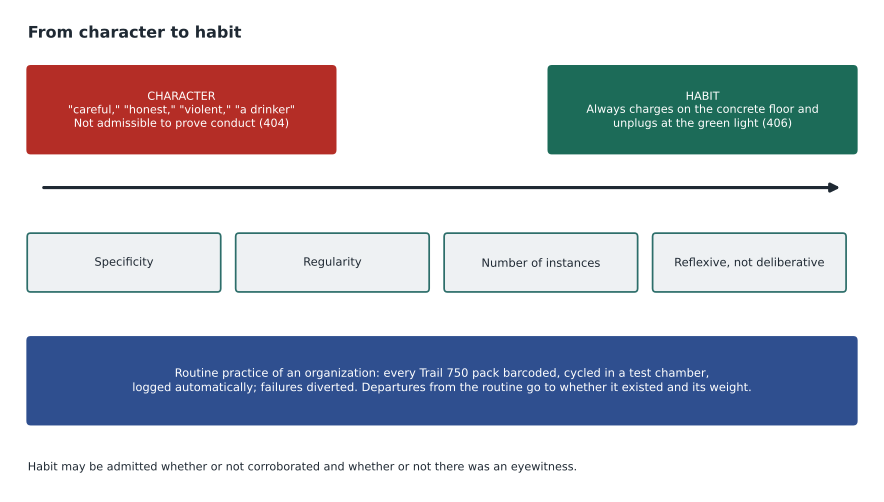
If character evidence is forbidden to prove conduct, why is habit allowed? The answer lies in the nature of habit. The Advisory Committee's note, quoting McCormick, explains that character is a generalized description of a person's disposition, such as honesty, temperance or carefulness, while habit is more specific. Habit describes a person's regular practice of meeting a particular kind of situation with a specific type of conduct, such as the habit of going down a particular stairway two stairs at a time or of giving the hand signal for a left turn. Habitual conduct is semi-automatic and therefore highly probative, and it carries little of the moral judgment that makes character evidence prejudicial.
Courts look at several factors to decide whether a practice rises to the level of habit: the specificity of the conduct, its regularity, the number of instances, and whether it is a reflexive or semi-automatic response rather than a product of deliberation. Testimony that someone is a careful driver is character evidence. Testimony that a driver always stops at a particular railroad crossing, looks both ways and rolls down the window to listen, observed by a passenger hundreds of times, is habit. Evidence that a person drinks heavily is usually character; evidence that a person drinks a six-pack every evening after work on the drive home, observed nightly for years, may be habit. Courts are often skeptical of habit claims involving behavior that requires judgment, such as how a person reacts to provocation, because such behavior varies with circumstances.
Proving a habit
Habit is usually proved by testimony from someone who has observed the conduct often enough to know it is regular, or by evidence of specific instances numerous enough to support a finding of habit. The Advisory Committee's note leaves the method of proof to the courts. A witness who saw the conduct twice cannot establish a habit; a coworker who saw it every working day for three years probably can.
Hartigan turns to the binders. In Delgado's case, Kestrelwerk wants to argue that Delgado misused the charger by leaving the battery on a carpeted surface near paint cans. Delgado will testify that she always charged the battery on the concrete floor by the garage door, unplugged it when the light turned green, and never charged it overnight. Her partner can testify that he saw her follow that routine nearly every evening for the eight months she owned the bike. That is strong habit evidence that she did the same on the night of the fire. Testimony that Delgado is "a careful, safety-minded nurse" would be character evidence, inadmissible to prove careful conduct in a civil case.
In the Pike case, a Riverside Salvage employee can testify that Lou Abbott, on every night shift for six years, walked the yard with his flashlight at about 11:00 p.m., starting at the north gate and ending at the warehouse. That routine helps establish where Abbott was and why he came upon the burglars when he did. It would not establish whether Abbott swung his flashlight in anger; that kind of judgment-laden reaction is not habit.
Routine practice of organizations
Organizations act through regular procedures, and Rule 406 treats routine practice like individual habit. Evidence that a company mails notices every Friday by placing them in a particular outgoing basket that a clerk takes to the post office each afternoon can prove that a particular notice was mailed, even if no one remembers mailing it. In Delgado's case, Kestrelwerk wants to show that every Trail 750 battery pack underwent a thermal cycling test at its factory before shipping. A production manager can testify about the routine: each pack is barcoded, placed in a test chamber for a fixed cycle, and logged automatically, and packs that fail are diverted. With testimony that the practice was followed consistently and that the system rejects untested packs, the evidence can support a finding that Delgado's pack was tested.
Whitcomb can respond that the routine was not consistently followed. Discovery showed that during a production surge in late 2025, some packs were shipped after a shortened test cycle approved by a line supervisor. Evidence of departures from a routine goes to whether a routine practice existed and to its weight. If departures were common, the court might find no routine practice at all.
Why the distinction matters
Hartigan closes by connecting the two halves. Both concern the same question, when may past conduct prove present conduct. Rule 404 answers no, because jurors overvalue character. Rule 406 answers yes for habit, because a narrow, regular, semi-automatic practice predicts behavior reliably without inviting moral judgment. Rules 413 to 415 answer yes for sexual offenses, because Congress concluded that the probative value of a pattern of such offenses justified the risk. Rule 412 answers no for alleged victims' sexual behavior, with narrow exceptions, because the inferences it invites are unfounded and the cost to victims is high. Each answer reflects a different judgment about probative value, prejudice and policy.
Worked problem
Habit or character?
In Delgado's case, Kestrelwerk offers testimony from Delgado's neighbor that Delgado "is always in a rush and cuts corners" and that he twice saw her charging the bike with a cheap charger from a hardware store. Delgado objects. Whitcomb offers her partner's testimony about her nightly charging routine. How should the court rule on each?
Show solution
- "Always in a rush and cuts corners" describes a general disposition, which is character. In a civil case, it cannot be offered to prove she acted carelessly on the night of the fire. Exclude under Rule 404(a)(1).
- Two observations of a different charger are too few to establish a habit. But they may be relevant for a non-propensity purpose: if Kestrelwerk has other evidence that a third-party charger was used on the night of the fire, the sightings tend to show she owned and used one. The court should evaluate them as specific relevant facts, not as habit.
- The partner's testimony describes a specific, regular, semi-automatic routine observed nearly every evening for months. It is habit evidence admissible under Rule 406 to show she followed the routine that night.
- Kestrelwerk may cross-examine about exceptions to the routine, which go to weight.
Answer: Exclude the neighbor's character description; treat the charger sightings as specific facts subject to relevance and Rule 403; admit the partner's habit testimony under Rule 406.
Summary and key terms
- Rule 412 bars evidence of an alleged victim's other sexual behavior or predisposition in civil and criminal sexual misconduct cases.
- Criminal exceptions cover the source of physical evidence, prior behavior with the defendant, and constitutionally required evidence (Olden); civil cases use a reverse balancing test.
- Rule 412 requires a motion at least 14 days before trial, notice to the victim, an in camera hearing and sealing.
- Rules 413 to 415 permit evidence of other sexual assaults or child molestation to be used for propensity, subject to 15-day disclosure and Rule 403.
- Rule 406 admits habit and organizational routine practice because specific, regular, semi-automatic conduct is reliable and carries little moral judgment.
- Courts distinguish habit from character by specificity, regularity, number of instances and whether the conduct is reflexive.
Practice problems
Work each problem on paper first, then reveal the answer to check.
What are the three criminal-case exceptions to Rule 412?
Show answer
Source of semen, injury or physical evidence; prior sexual behavior with the defendant offered on consent or by the prosecutor; and evidence whose exclusion would violate the defendant's constitutional rights.
How does the civil standard under Rule 412(b)(2) differ from Rule 403?
Show answer
It requires probative value to substantially outweigh harm to the victim and unfair prejudice, reversing Rule 403's presumption of admissibility.
What makes Rules 413 to 415 unusual?
Show answer
They allow evidence of other sexual offenses to be considered for propensity, which Rule 404 otherwise forbids.
Why is Delgado's nightly charging routine habit rather than character?
Show answer
It is a specific, regular, semi-automatic response to a particular situation, observed nearly every evening for months.
How can Whitcomb attack Kestrelwerk's routine testing evidence?
Show answer
By showing departures from the routine, such as shortened test cycles during the late-2025 production surge, which go to whether a routine existed and its weight.
Lesson quiz · 5 questions
Score 60% or more to complete this lesson.
Create a free account to save your progress, take quizzes and earn a certificate.