
LAWU-201 · Lesson 7 of 12 · 28 min
Hearsay exceptions under Rules 803, 804 and 807
▶ Video coming soon A video version of this lesson is on the way.
About forty minutes after Devon Pike shoved Lou Abbott onto the concrete at Riverside Salvage, a passing truck driver named Ray Dunleavy saw a flashlight beam on the ground by the open gate and stopped. He found Abbott lying beside a stack of pallets, gray and sweating. Dunleavy called 911 and, while they waited, Abbott told him: "Three of them. The big one, Devon, shoved me. I'm not going to make it, am I? Tell my sister." Abbott died at the hospital two hours later. Professor Hartigan tells Section B that this single statement will produce some of the most important rulings in the Pike trial. It is plainly hearsay if offered to prove that Devon shoved Abbott. The question is whether an exception applies, and the answer will take the class through the most important exceptions in the rules.
How the exceptions are organized
The exceptions fall into three groups. Rule 803 lists twenty-three exceptions that apply regardless of whether the declarant is available as a witness; the declarant could be called but need not be. Rule 804 lists five exceptions that apply only if the declarant is unavailable, because these statements are considered less reliable than live testimony and are admitted only out of necessity. Rule 807, the residual exception, allows a court to admit a statement not covered by any specific exception if it is supported by sufficient guarantees of trustworthiness and is more probative than other reasonably available evidence. Two more rules complete the structure: Rule 805 on hearsay within hearsay and Rule 806 on attacking a hearsay declarant's credibility.
Every exception has foundation requirements, and under Rule 104(a) the judge decides whether they are met by a preponderance of the evidence. In criminal cases, admission under a hearsay exception does not end the inquiry: if the statement is testimonial, the Confrontation Clause may bar it even if it fits an exception, a subject for lesson 8.
Spontaneous statements: Rules 803(1) and 803(2)
Rule 803(1), present sense impression, covers a statement describing or explaining an event or condition, made while or immediately after the declarant perceived it. The rationale is that near-simultaneous description leaves little time for reflection or fabrication, and the person hearing it often can check its accuracy. A 911 caller saying "a man just ran out of the warehouse carrying a bag and got into a gray car" is a classic present sense impression. The statement must describe the event and must be made very close in time, usually within seconds or a few minutes.
Rule 803(2), excited utterance, covers a statement relating to a startling event or condition, made while the declarant was under the stress of excitement that it caused. The rationale is that excitement suspends the capacity for reflective fabrication. The statement need only relate to the startling event, a broader requirement than describing it, and the time limit is not fixed: what matters is whether the declarant was still under the stress of the excitement. Courts consider the time elapsed, the nature of the event, the declarant's condition, whether the statement was spontaneous or a response to questions, and the declarant's age.
Abbott's statement to Dunleavy came about forty minutes after the shove. That is too long for a present sense impression. But Abbott had been knocked down, injured and lying alone in the dark, and when Dunleavy found him he was gray, sweating and frightened. A court could readily find he remained under the stress of the startling event when he spoke, even forty minutes later, making the statement an excited utterance. The defense will argue that Abbott had time to reflect and that the statement responded to Dunleavy's question, "What happened?" Questioning does not automatically defeat spontaneity, but it is a factor.
State of mind: Rule 803(3)
Rule 803(3) covers a statement of the declarant's then-existing state of mind, such as motive, intent or plan, or emotional, sensory or physical condition, such as mental feeling, pain or bodily health. It does not cover a statement of memory or belief offered to prove the fact remembered or believed, unless it relates to the validity or terms of the declarant's will. "My chest hurts" is admissible to prove chest pain. "I'm afraid of Devon" is admissible to prove fear. But "I'm afraid of Devon because he threatened me last week" is not admissible under Rule 803(3) to prove the threat, because the exception would otherwise swallow the hearsay rule.
Statements of intent may be offered to prove that the declarant later acted on the intent. In Mutual Life Insurance Co. v. Hillmon, 145 U.S. 285 (1892), the Supreme Court admitted letters in which a man wrote that he intended to travel with Hillmon, as evidence that he did so and that the body found was his rather than Hillmon's. The Hillmon doctrine is settled as to the declarant's own conduct. Using a declarant's statement of intent to prove what another person did, such as "I'm going to meet Devon tonight" offered to prove that Devon was there, is more controversial; the House Judiciary Committee report on Rule 803(3) said it should be limited to the declarant's own future conduct, but some courts allow it, often requiring corroboration. In Shepard v. United States, 290 U.S. 96 (1933), the Court refused to admit a dying woman's statement that her husband had poisoned her under a state of mind theory, because it looked backward to prove a past act.
Medical diagnosis or treatment: Rule 803(4)
Rule 803(4) covers a statement made for and reasonably pertinent to medical diagnosis or treatment that describes medical history, past or present symptoms or sensations, their inception, or their general cause. The rationale is that people have a strong motive to tell the truth to those treating them. The statement may be made to anyone involved in diagnosis or treatment, including nurses and paramedics, and may be made by someone other than the patient, such as a parent describing a child's symptoms. Statements made to a doctor consulted only to testify are also covered, a change from the common law.
Statements of fault or identity are usually not pertinent to diagnosis or treatment. When Delgado told the emergency room nurse, "The battery caught fire while it was charging and I grabbed it to throw it outside," the general cause of her burns is pertinent to treatment. Abbott's statement to the emergency physician that "a guy pushed me down and I hit my head" is pertinent, but his statement naming Devon would not be, because the attacker's identity does not affect treatment. Many courts make an exception in child abuse and domestic violence cases, reasoning that the identity of an abuser who lives with the patient is pertinent to treatment, including psychological treatment and safety planning.
Recorded recollection: Rule 803(5)
Rule 803(5) covers a record on a matter the witness once knew about but now cannot recall well enough to testify fully and accurately, that was made or adopted by the witness when the matter was fresh in the witness's memory, and that accurately reflects the witness's knowledge. If admitted, the record may be read into evidence but may be received as an exhibit only if offered by an adverse party. Officer notes, a written statement adopted by signature, or a list a witness wrote down soon after an event can qualify. Lesson 5 explained how this differs from refreshing recollection under Rule 612.
Business records: Rule 803(6)
Rule 803(6), records of a regularly conducted activity, is the workhorse of civil litigation. A record of an act, event, condition, opinion or diagnosis is admissible if it was made at or near the time by, or from information transmitted by, someone with knowledge; it was kept in the course of a regularly conducted activity of a business, organization, occupation or calling, whether or not for profit; making the record was a regular practice of that activity; and all these conditions are shown by the testimony of the custodian or another qualified witness, or by a certification complying with Rule 902(11) or 902(12) or a statute permitting certification. The exception does not apply if the opponent shows that the source of information or the method or circumstances of preparation indicate a lack of trustworthiness; a 2014 amendment placed that burden on the opponent.
The rationale is reliability through routine: businesses depend on accurate records and their employees have duties to record accurately. Every link in the chain must be acting in the regular course of business. If an employee records what a customer or bystander said, the outsider's statement needs its own exception, under Rule 805. Records prepared in anticipation of litigation may lack trustworthiness, as in Palmer v. Hoffman, 318 U.S. 109 (1943), where the Supreme Court excluded a railroad engineer's accident report prepared primarily for litigation rather than for running the railroad.
Wendell Fry's records of scrap purchases are business records: Fry's Metal Recovery regularly records each purchase, the weight, the price and the seller's description at the time of purchase. Kestrelwerk's production records, warranty databases and quality-control logs in Delgado's case also qualify, through a custodian's testimony or a written certification. Rule 803(7) admits evidence that a matter is not included in such records to prove that it did not occur, if the records would normally include it; Fry's lack of any recorded identification for the seller of 340 pounds of copper is admissible to show he did not record it, which matters under the scrap metal statute.
| Exception | Core foundation | Rationale |
|---|---|---|
| 803(1) Present sense impression | Describes an event, made while or immediately after perceiving it | No time to fabricate |
| 803(2) Excited utterance | Relates to a startling event, made under the stress of excitement | Excitement suspends reflection |
| 803(3) State of mind | Then-existing mental, emotional or physical condition; not memory to prove the fact remembered | Spontaneous; best evidence of the condition |
| 803(4) Medical diagnosis or treatment | Made for and reasonably pertinent to diagnosis or treatment | Motive to tell the truth |
| 803(5) Recorded recollection | Witness cannot recall; record made or adopted when fresh; accurate | Better than faded memory |
| 803(6) Business records | Regular practice, at or near the time, by a person with knowledge; custodian or certification | Routine and duty |
| 803(8) Public records | Office activities, observations under a legal duty, or civil and government-in-criminal factual findings | Official duty |
| 803(18) Learned treatises | Reliable authority, called to an expert's attention; read, not received as an exhibit | Professional scrutiny |
Public records: Rule 803(8)
Rule 803(8) covers a record or statement of a public office if it sets out the office's activities; a matter observed while under a legal duty to report, but not, in a criminal case, a matter observed by law-enforcement personnel; or, in a civil case or against the government in a criminal case, factual findings from a legally authorized investigation. As with business records, the opponent may show that the source or circumstances indicate a lack of trustworthiness. The law enforcement exclusion protects criminal defendants' confrontation rights: the prosecution cannot prove its case through police reports instead of officers' testimony.
In Beech Aircraft Corp. v. Rainey, 488 U.S. 153 (1988), the Supreme Court held that factual findings admissible under the public records exception include conclusions and opinions in an investigative report, so long as they are based on a factual investigation and satisfy the trustworthiness requirement. The fire marshal's report concluding that Delgado's fire originated at the battery pack and was caused by thermal runaway in a cell is admissible in her civil case under Rule 803(8)(A)(iii), subject to Kestrelwerk's showing of untrustworthiness. In Pike's criminal case, the investigating detective's report is not admissible against Pike under Rule 803(8)(A)(ii), though the detective may testify.
Other Rule 803 exceptions
Rule 803 contains many more exceptions, most of them for records of particular reliability: vital statistics, records of religious organizations, marriage certificates, family records, property records, statements in ancient documents, market reports and commercial publications, reputation concerning family history, boundaries or character, judgments of previous convictions in some circumstances, and judgments involving personal, family or general history or boundaries. Two deserve mention. Rule 803(18) allows statements in a learned treatise, periodical or pamphlet to be read into evidence if called to the attention of an expert witness on cross or relied on by the expert on direct, and established as a reliable authority by testimony, admission or judicial notice; the statement may be read but not received as an exhibit. Rule 803(16), ancient documents, was amended in 2017 to cover only documents prepared before January 1, 1998, because of concern that vast amounts of electronic data would otherwise become admissible simply by aging.
Unavailability: Rule 804(a)
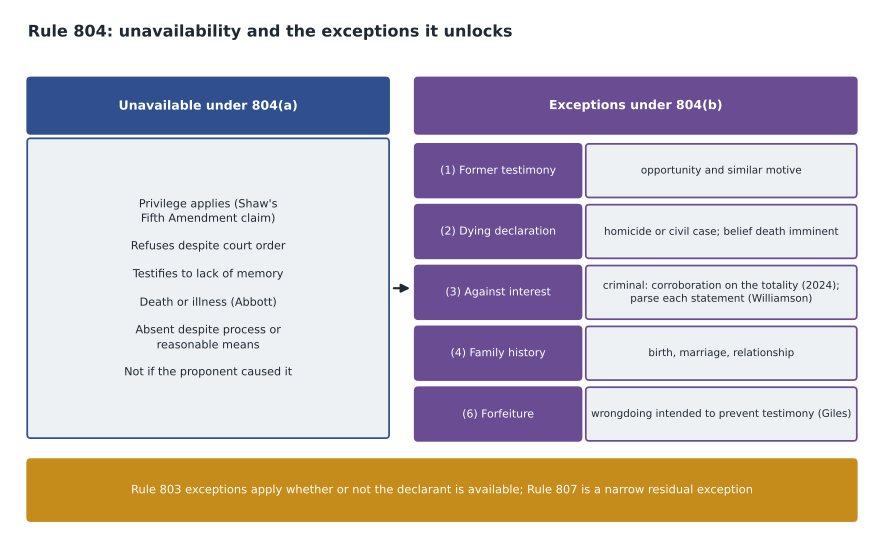
Rule 804 exceptions require that the declarant be unavailable. Under Rule 804(a), a declarant is unavailable if the declarant is exempted from testifying because the court rules that a privilege applies; refuses to testify despite a court order; testifies to not remembering the subject matter; cannot be present or testify because of death or a then-existing infirmity, physical illness or mental illness; or is absent and the proponent has not been able, by process or other reasonable means, to procure the declarant's attendance or, for certain exceptions, testimony. A declarant is not unavailable if the proponent procured or wrongfully caused the unavailability to prevent the declarant from testifying. Abbott is unavailable because he is dead. Kellan Shaw, who has not pleaded guilty and invokes his Fifth Amendment privilege, is unavailable because the court rules the privilege applies.
The Rule 804(b) exceptions
Rule 804(b)(1), former testimony, covers testimony given as a witness at a trial, hearing or lawful deposition, offered against a party who had, or in a civil case whose predecessor in interest had, an opportunity and similar motive to develop it by direct, cross or redirect examination. Testimony from a preliminary hearing or deposition can qualify; grand jury testimony usually cannot be offered against a defendant, who had no opportunity to examine. In United States v. Salerno, 505 U.S. 317 (1992), the Court held that the similar motive requirement applies even when the prosecution offers grand jury testimony of witnesses who later invoke the privilege.
Rule 804(b)(2), statement under the belief of imminent death, covers a statement that the declarant, while believing the declarant's death to be imminent, made about its cause or circumstances, but only in a prosecution for homicide or in a civil case. The traditional rationale is that a person facing death has no motive to lie. The declarant need not actually die in federal court, but must be unavailable, and the statement must concern the cause or circumstances of what the declarant believed to be impending death. Abbott's statement, "I'm not going to make it, am I? Tell my sister," strongly suggests he believed death was imminent, and the statement identifying Devon concerns the cause of his injuries. Pike is charged with homicide, so the exception is available.
Rule 804(b)(3), statement against interest, covers a statement that a reasonable person in the declarant's position would have made only if the person believed it to be true because, when made, it was so contrary to the declarant's proprietary or pecuniary interest or had so great a tendency to invalidate the declarant's claim or expose the declarant to civil or criminal liability. In a criminal case, the statement must be supported by corroborating circumstances that clearly indicate its trustworthiness, whether offered by the prosecution or the defense. The December 1, 2024 amendment requires the court, in assessing corroborating circumstances, to consider the totality of the circumstances under which the statement was made and any evidence that corroborates or contradicts it, resolving a split over whether courts could consider independent evidence.
In Williamson v. United States, 512 U.S. 594 (1994), the Supreme Court held that the exception covers only those declarations or remarks within a confession that are individually self-inculpatory, not neutral or collateral statements, and especially not statements shifting blame to others. A week after the burglary, Shaw told his friend Mateo, "I cut the lock and grabbed the copper, and Devon's the one who shoved the old man." The first part is squarely against Shaw's penal interest. The part naming Devon as the one who shoved Abbott shifts primary responsibility for the death away from Shaw and may not be against his interest at all. Under Williamson, the court must parse the statement sentence by sentence.
Rule 804(b)(4) covers statements of personal or family history. Rule 804(b)(6), forfeiture by wrongdoing, covers a statement offered against a party that wrongfully caused, or acquiesced in wrongfully causing, the declarant's unavailability as a witness, and did so intending that result. In Giles v. California, 554 U.S. 353 (2008), the Court held that the parallel Confrontation Clause doctrine requires intent to prevent the witness from testifying; killing the victim of the charged crime is not enough by itself.
Layers, impeachment and the residual exception
Rule 805 provides that hearsay within hearsay is not excluded if each part of the combined statements conforms with an exception. A hospital record stating that the patient said she was pushed contains two layers: the record, which may be a business record, and the patient's statement, which needs its own exception, such as Rule 803(4). Rule 806 lets a party attack a hearsay declarant's credibility as if the declarant had testified, including with inconsistent statements, without the usual foundation requirement. If Abbott's statement comes in, Pike may show that Abbott told the ambulance crew he "didn't get a good look at them."
Rule 807, the residual exception, was amended in 2019. A hearsay statement not admissible under Rule 803 or 804 may be admitted if it is supported by sufficient guarantees of trustworthiness, after considering the totality of circumstances under which it was made and any corroborating evidence, and it is more probative on the point for which it is offered than any other evidence the proponent can obtain through reasonable efforts. The proponent must give reasonable notice in writing, including the substance of the statement and the declarant's name, before trial or during trial if the court excuses lack of earlier notice for good cause. The 2019 amendment eliminated the requirement that the statement have guarantees equivalent to the listed exceptions and the near-miss debate about statements that narrowly fail a listed exception. Courts still use the residual exception sparingly.
Worked problem
Getting Abbott's statement in
The prosecution offers Dunleavy's testimony that Abbott said, "Three of them. The big one, Devon, shoved me. I'm not going to make it, am I? Tell my sister." Pike objects on hearsay grounds. Analyze the possible exceptions.
Show solution
- Present sense impression fails: forty minutes passed between the shove and the statement.
- Excited utterance: Abbott had been knocked down and was injured, alone and frightened; a court could find he remained under the stress of the event. Spontaneity is somewhat reduced if he responded to a question, but the finding is likely.
- Dying declaration: Abbott is unavailable (dead), the case is a homicide prosecution, his words show belief in imminent death, and the statement concerns the cause of his injuries. Likely admissible.
- Medical diagnosis does not apply; Dunleavy was not involved in treatment, and identity is not pertinent to treatment.
- Rule 806 allows Pike to impeach Abbott with his inconsistent statement to the ambulance crew. The Confrontation Clause question is separate and is addressed in lesson 8.
Answer: The statement is likely admissible as both an excited utterance and a dying declaration, subject to Pike's right to impeach Abbott's credibility and to the Confrontation Clause analysis.
Summary and key terms
- Rule 803 exceptions apply regardless of availability; Rule 804 exceptions require unavailability; Rule 807 is a narrow residual exception.
- Spontaneous statements (present sense impression, excited utterance) rely on lack of time to fabricate or stress of excitement.
- State of mind covers present conditions and intent (Hillmon) but not memory to prove the fact remembered (Shepard); medical statements must be pertinent to diagnosis or treatment.
- Business records require regular practice and timely recording by someone with knowledge; the opponent bears the burden of showing untrustworthiness; public records exclude police observations against criminal defendants (Beech Aircraft admits evaluative findings).
- Rule 804(b) covers former testimony, dying declarations, statements against interest (parsed under Williamson; corroboration judged on the totality under the 2024 amendment) and forfeiture by wrongdoing (Giles).
- Rule 805 requires an exception for each layer; Rule 806 allows impeachment of hearsay declarants; Rule 807 was liberalized in 2019 but is used sparingly.
Practice problems
Work each problem on paper first, then reveal the answer to check.
Why might Abbott's statement fail as a present sense impression but qualify as an excited utterance?
Show answer
Forty minutes is too long for a present sense impression, but he may still have been under the stress of the startling event.
What did Palmer v. Hoffman hold about business records?
Show answer
An accident report prepared primarily for litigation rather than the business's operations was not admissible as a business record.
Why is the detective's report not admissible against Pike under Rule 803(8)?
Show answer
The rule excludes matters observed by law-enforcement personnel when offered against a criminal defendant.
How does Williamson apply to Shaw's statement to Mateo?
Show answer
The court must admit only the individually self-inculpatory parts, and the part blaming Devon for the shove may not be against Shaw's interest.
What did the 2024 amendment to Rule 804(b)(3) change?
Show answer
Courts must consider the totality of the circumstances and any corroborating or contradicting evidence in assessing corroboration.
Lesson quiz · 5 questions
Score 60% or more to complete this lesson.
Create a free account to save your progress, take quizzes and earn a certificate.