
LAWU-201 · Lesson 10 of 12 · 25 min
Privileges
▶ Video coming soon A video version of this lesson is on the way.
Every other rule this semester aims, in one way or another, at helping the jury find the truth. Privileges are different. Professor Hartigan tells Section B that a privilege deliberately keeps relevant, reliable evidence away from the factfinder to protect a relationship or a value that society considers more important than the evidence in a particular case. "When you assert a privilege," she says, "you are telling the court that the truth will have to do without this piece of it. Courts take that seriously, which is why privileges are construed narrowly and lost easily."
Privileges apply at every stage of a proceeding, including grand jury proceedings, discovery and preliminary hearings, even though most other evidence rules do not, as Rule 1101(c) provides. Most privilege disputes arise in discovery, long before trial, when one side demands documents or testimony and the other refuses. In Delgado's case, the fight over Kestrelwerk's internal investigation of the fire began months before any trial date.
Where privilege law comes from: Rule 501
When Congress enacted the Federal Rules of Evidence in 1975, it rejected the specific privilege rules that the Supreme Court had approved, including nine rules defining particular privileges. In their place it enacted Rule 501, which provides that the common law, as interpreted by United States courts in the light of reason and experience, governs a claim of privilege unless the Constitution, a federal statute or rules prescribed by the Supreme Court provide otherwise. But in a civil case, state law governs privilege regarding a claim or defense for which state law supplies the rule of decision.
The result is two bodies of privilege law in federal court. In criminal cases and in civil cases arising under federal law, federal common law applies, developed case by case. In civil diversity cases, or for state-law claims under supplemental jurisdiction, the state's privilege law applies. Delgado's products liability claims arise under Ohio law, so Ohio privilege law governs Kestrelwerk's claims of attorney-client privilege, though federal law governs work product protection, which is treated as procedural under Federal Rule of Civil Procedure 26(b)(3). In Pike's state prosecution, Westmarch privilege law applies; for this course, Westmarch follows the federal common law described here.
The attorney-client privilege
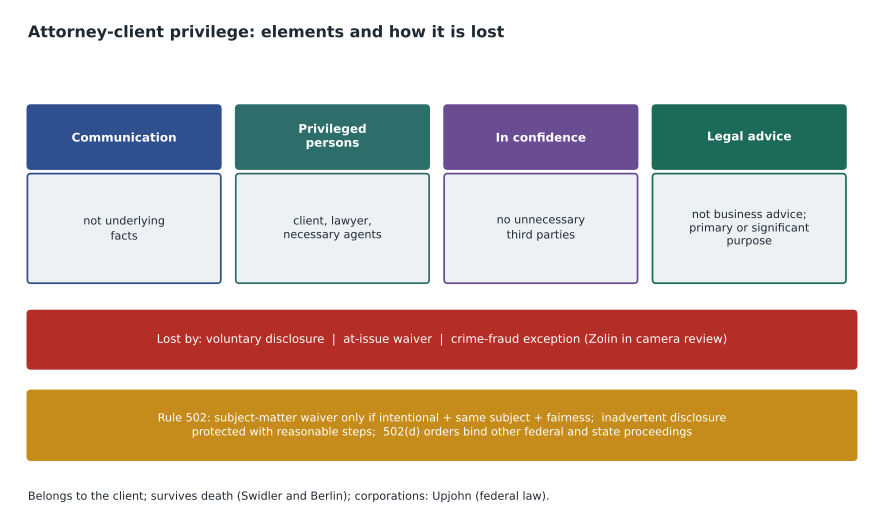
The attorney-client privilege is the oldest of the privileges for confidential communications. Its elements are commonly stated as follows: a communication, made between privileged persons (the client, the lawyer and their agents), in confidence, for the purpose of obtaining or providing legal assistance for the client. The privilege belongs to the client, who may waive it; the lawyer may assert it on the client's behalf. It protects communications, not facts: a client cannot refuse to disclose what she saw by saying she told her lawyer about it, but she cannot be forced to disclose what she told her lawyer.
The rationale is instrumental. Clients will speak candidly with lawyers only if they know their statements are protected, and candid communication allows lawyers to give sound advice, which promotes compliance with the law and the administration of justice. The privilege survives the client's death, as the Supreme Court held in Swidler and Berlin v. United States, 524 U.S. 399 (1998), refusing to compel a lawyer to disclose notes of a conversation with deputy White House counsel Vincent Foster shortly before Foster's death, because clients may care about their reputations and the interests of family and friends after death.
Confidentiality is essential. A communication made in the presence of an unnecessary third person, or later shared outside the privileged circle, is not privileged. Agents necessary to the representation, such as paralegals, interpreters and in some circumstances accountants or consultants retained by counsel to help render legal advice, do not destroy confidentiality. The communication must be for legal advice, not business advice; communications with in-house counsel are privileged only when the lawyer acts as a lawyer.
Corporations and Upjohn
When the client is a corporation, who speaks for it? Some courts once applied a control group test, protecting only communications with senior managers who could act on legal advice. In Upjohn Co. v. United States, 449 U.S. 383 (1981), the Supreme Court rejected that test for federal common law. Upjohn's general counsel had sent questionnaires to managers around the world as part of an internal investigation of questionable payments to foreign officials. The Court held the responses privileged, emphasizing that the communications were made by employees at the direction of corporate superiors to secure legal advice, concerned matters within the scope of the employees' duties, and were treated as confidential, and that the employees were aware they were being questioned so the corporation could obtain legal advice.
Upjohn produced a standard practice: the Upjohn warning, in which counsel interviewing an employee explains that counsel represents the company, not the employee, that the conversation is privileged but the privilege belongs to the company, and that the company may choose to waive it and disclose what the employee says, including to the government. States vary; some follow Upjohn and others apply a control group test or a variant. Ohio's statute and case law govern Kestrelwerk's privilege in Delgado's case, and Hartigan tells the class that the first step in any corporate privilege dispute is to identify which privilege law applies.
Dual-purpose communications
Many communications with lawyers mix legal and business advice. Courts use different tests. Many apply a primary purpose test, asking whether obtaining or providing legal advice was the primary purpose. The D.C. Circuit, in In re Kellogg Brown and Root, Inc., 756 F.3d 754 (D.C. Cir. 2014), asked whether obtaining or providing legal advice was one of the significant purposes of the communication. The Supreme Court granted review of the question in In re Grand Jury in 2022 but dismissed the case as improvidently granted in January 2023 without deciding it, leaving the circuits divided. Kestrelwerk's post-fire emails between its product safety team and in-house counsel will be classified communication by communication.
Exceptions and the crime-fraud rule
The privilege does not protect communications made to further a future or ongoing crime or fraud. The crime-fraud exception applies if the client sought or used the lawyer's services to commit or plan a crime or fraud, whether or not the lawyer knew. In United States v. Zolin, 491 U.S. 554 (1989), the Court held that a court may review allegedly privileged communications in camera to decide whether the exception applies, upon a threshold showing of a factual basis adequate to support a good faith belief by a reasonable person that review may reveal evidence establishing the exception. Other exceptions cover disputes between the lawyer and client, such as malpractice or fee claims, and communications between joint clients when they later sue each other.
Work product
The work product doctrine, recognized in Hickman v. Taylor, 329 U.S. 495 (1947), and codified for civil discovery in Federal Rule of Civil Procedure 26(b)(3), protects documents and tangible things prepared in anticipation of litigation or for trial by or for a party or its representative. Unlike the attorney-client privilege, work product protection covers materials prepared by non-lawyers, such as investigators and insurers, and covers materials containing facts as well as advice. But it is qualified: ordinary work product may be discovered if the requesting party shows substantial need and cannot, without undue hardship, obtain the substantial equivalent by other means. Opinion work product, reflecting counsel's mental impressions, conclusions, opinions or legal theories, receives nearly absolute protection.
After the fire, Kestrelwerk's legal department retained an outside engineering firm to examine the remains of Delgado's battery and two exemplar packs. The engineering firm's report was prepared in anticipation of litigation, at counsel's direction, after Whitcomb's demand letter. It is work product. Delgado can obtain the factual test data if she shows substantial need, such as that the exemplar packs were destroyed in testing and she cannot replicate the tests; she cannot obtain counsel's notes analyzing the report's implications. By contrast, Kestrelwerk's routine quality-control report on the same battery lot, prepared in the ordinary course of business, is not work product, even if it later becomes important in the litigation. Work product protection is also waived differently from the attorney-client privilege: disclosure to a third party waives it only if the disclosure substantially increases the likelihood that an adversary will obtain the material.
Waiver and Rule 502
Privileges are lost through waiver. Voluntary disclosure of a privileged communication to a third party outside the privilege waives it. A client who puts the communication at issue, for example by claiming she relied on her lawyer's advice in acting as she did, waives privilege over that advice. A party cannot use privilege as both a sword and a shield.
In 2008, Congress enacted Rule 502 to address the enormous cost of privilege review in electronic discovery and the risk that inadvertent disclosure would waive privilege broadly. Rule 502(a) limits subject-matter waiver: when a disclosure is made in a federal proceeding or to a federal agency and waives privilege, the waiver extends to undisclosed communications only if the waiver is intentional, the disclosed and undisclosed communications concern the same subject matter, and they ought in fairness to be considered together. Rule 502(b) provides that an inadvertent disclosure does not operate as a waiver if the holder took reasonable steps to prevent disclosure and promptly took reasonable steps to rectify the error, including following Civil Rule 26(b)(5)(B)'s clawback procedure.
Rule 502(d) is perhaps the most useful provision in practice. A federal court may order that privilege is not waived by disclosure connected with the litigation pending before the court, and the waiver is then also not a waiver in any other federal or state proceeding. Parties in complex cases routinely seek a Rule 502(d) order at the start of discovery, which allows them to produce documents quickly without fear of waiver. Rule 502(e) makes agreements between parties about waiver binding only on the parties unless incorporated in a court order.
Spousal privileges
Federal common law recognizes two spousal privileges. The adverse spousal testimony privilege allows a witness spouse to refuse to testify against the other spouse in a criminal case. In Trammel v. United States, 445 U.S. 40 (1980), the Supreme Court held that this privilege belongs to the witness spouse, not the defendant spouse: the witness may choose to testify, and the defendant cannot prevent it. The Court reasoned that when one spouse is willing to testify against the other, there is probably little marital harmony left for the privilege to protect. The privilege applies only during a valid marriage and covers testimony about any subject, including events before the marriage.
The marital communications privilege protects confidential communications between spouses made during a valid marriage. It survives divorce and death, and most courts hold that either spouse may assert it. It does not cover communications made in the presence of third parties, statements about joint criminal activity under the partners-in-crime exception recognized by many courts, or communications in cases where one spouse is charged with a crime against the other or their children. In the Pike case, if Pike told his wife, Simone, the morning after the burglary that "the old man went down hard and we left him," the communications privilege may protect the statement even if Simone is willing to testify. If Simone saw Pike come home with copper wire in the truck, that observation is not a communication, and the testimonial privilege belongs to her: she may testify if she chooses.
Psychotherapist-patient privilege
In Jaffee v. Redmond, 518 U.S. 1 (1996), the Supreme Court recognized a psychotherapist-patient privilege under Rule 501, protecting confidential communications between a licensed psychotherapist and patient in the course of diagnosis or treatment, and extended it to licensed clinical social workers. The case arose from a civil rights suit against a police officer who had shot and killed a man; the plaintiff sought the notes of the officer's counseling sessions with a social worker after the shooting. The Court emphasized that effective psychotherapy depends on confidence and trust, that all fifty states recognized some form of the privilege, and that a privilege subject to case-by-case balancing would be little better than no privilege at all. It left the contours of the privilege, including possible exceptions, to later cases.
Delgado has been seeing a counselor for nightmares and anxiety since the fire, and her complaint seeks damages for emotional distress. Kestrelwerk will argue that she has waived the privilege by placing her mental condition at issue. Courts are divided: some apply a broad view under which any claim for emotional distress waives the privilege, others a narrow view under which waiver occurs only if the plaintiff claims a specific psychiatric injury or intends to call the therapist, and others a middle approach. If Delgado limits her claim to garden-variety emotional distress and does not rely on her counselor's records or testimony, many courts would preserve the privilege. Because her claims arise under Ohio law, Ohio's statutory counselor privilege and its waiver rules will govern.
Other privileges
Federal courts have declined to recognize some privileges common in state law. There is no general federal physician-patient privilege, though Jaffee covers psychotherapy and medical information receives other protections. There is no federal journalist's privilege recognized by the Supreme Court; in Branzburg v. Hayes, 408 U.S. 665 (1972), the Court held that the First Amendment does not give reporters a privilege to refuse to testify before a grand jury, though some circuits recognize a qualified privilege in civil cases, and most states have shield laws. The clergy-penitent privilege is widely recognized. The government has privileges for state secrets, informants' identities, deliberative processes and law enforcement investigative files. The Fifth Amendment privilege against self-incrimination, which lets a person refuse to give compelled testimony that could incriminate him, is constitutional and is covered in criminal procedure; in civil cases, a party's invocation of it may support an adverse inference.
| Privilege | Holder | Scope | Key limits |
|---|---|---|---|
| Attorney-client | Client | Confidential communications for legal advice | Waiver; crime-fraud; at-issue; Upjohn for corporations |
| Work product | Party and attorney | Materials prepared in anticipation of litigation | Substantial need for ordinary work product; opinion work product nearly absolute |
| Adverse spousal testimony | Witness spouse (Trammel) | Any testimony against spouse in criminal case, during marriage | Witness may choose to testify |
| Marital communications | Usually either spouse | Confidential communications during marriage; survives divorce | Partners-in-crime and crimes against spouse or children |
| Psychotherapist-patient | Patient | Confidential communications for diagnosis or treatment (Jaffee) | Waiver when condition placed at issue (courts divided) |
| Fifth Amendment | Witness | Compelled testimonial self-incrimination | Adverse inference may be drawn in civil cases |
Ethics and privilege
Privilege law overlaps with but differs from a lawyer's ethical duty of confidentiality under Model Rule of Professional Conduct 1.6. The duty of confidentiality is broader, covering all information relating to the representation from any source, and applies everywhere, not just when a court seeks testimony. Privilege is an evidentiary rule that protects a narrower set of communications from compelled disclosure. A lawyer who receives a document that appears to have been inadvertently sent must, under Model Rule 4.4(b), promptly notify the sender. Hartigan tells the class that the most common way lawyers lose privilege is carelessness: copying a third party on an email, forwarding legal advice to a business partner, or producing documents without a Rule 502(d) order and a careful review.
Worked problem
Kestrelwerk's internal investigation
After the fire, Kestrelwerk's general counsel directed an internal investigation. Counsel interviewed four engineers after giving Upjohn warnings, and retained an outside engineering firm to test exemplar packs. A product manager later forwarded counsel's summary of the interviews to a battery supplier, Lumacell, to demand reimbursement. Delgado requests the interview notes, the engineering report and the summary. Analyze.
Show solution
- Identify the governing law: Ohio privilege law for the attorney-client privilege on Delgado's state-law claims; federal Rule 26(b)(3) for work product; Rule 502 for waiver in federal proceedings.
- Interview notes: communications from employees to counsel for legal advice, within the scope of their duties, kept confidential; privileged under Upjohn-type reasoning if Ohio follows it, and the notes are also opinion work product.
- Engineering report: work product prepared in anticipation of litigation; Delgado may obtain factual data only with substantial need and inability to obtain the equivalent, such as if the exemplar packs were consumed in testing.
- Forwarding the summary to Lumacell, an unaffiliated company with adverse interests, waives privilege as to the summary. Under Rule 502(a), the waiver extends to undisclosed interview notes only if intentional, on the same subject matter and in fairness they ought to be considered together.
- Work product protection may also be waived as to the summary, because disclosure to a potential adversary substantially increases the likelihood that Delgado will obtain it.
Answer: The interview notes and counsel's analysis stay protected unless fairness requires subject-matter waiver; the summary sent to Lumacell is likely discoverable; the engineering report's facts are discoverable only on a showing of substantial need.
Summary and key terms
- Privileges sacrifice relevant evidence to protect relationships and values, apply at all stages and are construed narrowly.
- Rule 501 applies federal common law in criminal and federal-question cases and state privilege law for state-law claims in civil cases.
- The attorney-client privilege protects confidential communications for legal advice; Upjohn rejected the control group test; Zolin allows in camera review for crime-fraud; the privilege survives death (Swidler and Berlin).
- Work product (Hickman; Rule 26(b)(3)) protects litigation materials, qualified for ordinary work product and nearly absolute for opinion work product.
- Rule 502 limits subject-matter waiver to intentional disclosures, protects reasonable inadvertent disclosures and authorizes binding non-waiver orders under Rule 502(d).
- Trammel gives the adverse testimony privilege to the witness spouse; the marital communications privilege survives divorce; Jaffee recognized the psychotherapist-patient privilege.
Practice problems
Work each problem on paper first, then reveal the answer to check.
Why does Ohio privilege law govern Kestrelwerk's attorney-client privilege claim in Delgado's case?
Show answer
Rule 501 applies state privilege law to claims for which state law supplies the rule of decision, and Delgado's claims arise under Ohio law.
What did Upjohn hold?
Show answer
Communications from employees to corporate counsel for legal advice, within their duties and kept confidential, are privileged under federal law, rejecting the control group test.
How does a Rule 502(d) order help parties in discovery?
Show answer
It provides that disclosure in the litigation does not waive privilege in that or any other federal or state proceeding.
Under Trammel, who holds the adverse spousal testimony privilege?
Show answer
The witness spouse, who may choose to testify against the defendant spouse.
Why might Delgado's emotional distress claim threaten her psychotherapist-patient privilege?
Show answer
Placing her mental condition at issue may waive the privilege, depending on whether the court takes a broad, narrow or middle view.
Lesson quiz · 5 questions
Score 60% or more to complete this lesson.
Create a free account to save your progress, take quizzes and earn a certificate.