
LAWU-114 · Lesson 9 of 12 · 23 min
Editing, citation and format rules
▶ Video coming soon A video version of this lesson is on the way.
Kinsella starts the ninth class by holding up two drafts of the same brief. The first is Priya Natarajan's draft of Coldbrook's charge argument: twelve pages, dense, with long paragraphs and a citation in nearly every sentence. The second is the same argument after two rounds of editing: eight pages, shorter paragraphs, the same authorities, and every fact still there. "Nothing was lost," Kinsella says. "Four pages of throat-clearing, repetition and weak sentences were removed, and the argument is stronger because of it." Priya, who is competitive, admits that the second version is better and asks how to get there faster. "Edit in layers," Kinsella says. "Do not try to fix everything at once."
Editing in layers
Experienced brief writers edit in passes, each with a different focus. The first pass is structural: do the point headings, read alone, make the argument? Are the arguments in the right order? Does each section do one job? Does anything belong somewhere else or nowhere at all? The second pass works at the level of paragraphs: does each paragraph have a topic sentence that states its point, and does every sentence in the paragraph support that point? The third pass works on sentences: is each sentence clear, direct and as short as it can be without losing meaning? The fourth pass is about words: precise verbs, no unnecessary legalese, consistent terms. The last pass is proofreading and cite-checking, done slowly, preferably on a printed copy or a different screen layout, because the eye skims familiar text.
Structural edits make the biggest difference, and writers are most reluctant to make them because they require moving or cutting work already done. Kinsella encourages the class to print the headings and the first sentence of each paragraph on a single page and read it as an outline. Gaps and repetitions become obvious. In Priya's draft, the outline showed that the same discussion of Stavros's purpose holding appeared three times, once in each section. Moving it to a single paragraph at the start of the argument saved a page and made each later section shorter and sharper.
Sentences and words
At the sentence level, the most common problems in legal writing are long sentences, passive voice that hides the actor, nominalizations that turn verbs into nouns, and subjects separated from their verbs by long phrases. "A determination was made by the trial court that the imposition of liability on Coldbrook was precluded by the Act" becomes "The trial court held that the Act barred liability." Passive voice has legitimate uses, especially when the actor is unknown or unimportant, or when the writer wants to de-emphasize the actor; Garrow's brief might write "the rut was left unfilled" to keep attention on the danger, while Coldbrook's brief might write "Felix slowed the wagon" to emphasize the owner's action. The choice should be deliberate.
At the word level, plain English persuades better than legalese. Bryan Garner, whose books on legal writing are widely used, has argued for decades that words such as "herein," "aforesaid," "said" used as an adjective, and doublets like "null and void" add nothing and distance the reader. Precise verbs ("held," "reasoned," "rejected") are better than vague ones ("dealt with," "addressed"). Consistent terms matter in legal writing in a way they do not in other prose: if the brief calls the money "donations" in one paragraph and "payments" in the next, a careful reader may wonder whether the writer means different things. Coldbrook's brief should choose "donations" and use it throughout; Garrow's might choose "payments" for the opposite reason.
Format rules and length limits
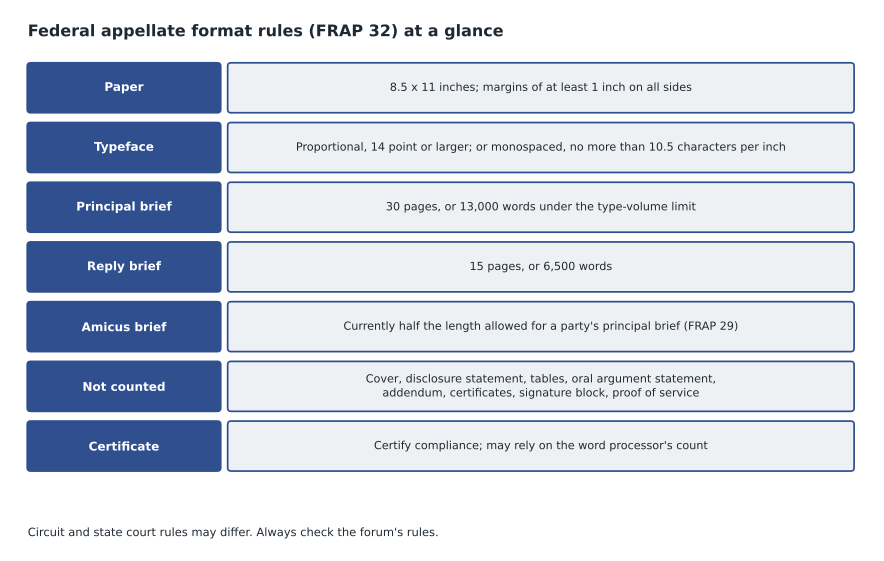
Court rules prescribe format in detail, and courts take them seriously. In the federal courts of appeals, Federal Rule of Appellate Procedure 32(a) requires briefs on 8.5 by 11 inch paper with margins of at least one inch on all four sides, in either a proportionally spaced typeface of 14 points or larger or a monospaced face of no more than 10.5 characters per inch. Case names must be italicized or underlined. Under Rule 32(a)(7), a principal brief may not exceed 30 pages, or a reply brief 15 pages, unless it complies with the type-volume limitation: 13,000 words for a principal brief and 6,500 words for a reply. Rule 32(f) excludes certain items from the count, including the cover, disclosure statement, tables of contents and authorities, statement regarding oral argument, statutory addendum, certificates of counsel, signature block and proof of service. Rule 32(g) requires a certificate of compliance, and the lawyer may rely on the word count of the word-processing system used to prepare the brief.
Trial courts and state courts have their own limits, and they vary widely, from page limits for motion memoranda in local rules to word limits for state appellate briefs. Many courts will reject or strike a noncompliant brief, and some judges simply stop reading at the limit. Lawyers sometimes try to evade limits by shrinking margins, compressing line spacing or moving argument into footnotes; courts notice, and several federal courts of appeals have criticized or struck briefs that used such tactics. Kinsella's advice is to treat the limit as a ceiling, not a target. "The best brief I ever read as a staff attorney was nine thousand words in a case where the limit was fourteen thousand," she says. "Every justice read every word."
Typography and readability
Beyond the minimums, typography affects how easily a judge reads a brief. Some courts have published guidance on readable typography; the Seventh Circuit, for example, issued suggestions for typography in briefs that encourage professional typefaces, reasonable line lengths and restraint with bold, underlining and capital letters. Matthew Butterick's book Typography for Lawyers made similar arguments to a broad audience. Common recommendations include using one emphasis style rather than combining bold, italics and underlining; avoiding long blocks of capital letters; keeping headings visually distinct; and using block quotations sparingly, because many readers skip them. Kinsella adds that many courts now accept or encourage hyperlinks to cited authorities and record documents in electronically filed briefs, which judges reading on screens appreciate.
Citation in briefs
Briefs filed in court use the citation forms in the Bluepages section of The Bluebook, which adapts the rules for practitioners: case names are italicized or underlined, and typeface conventions are simpler than those used in law reviews. The Bluebook's twenty-second edition, released in 2025, is current, and some courts require or accept other systems: the ALWD Guide to Legal Citation, the free Indigo Book, or a state's own style manual. Kinsella reminds the class that local rules sometimes prescribe citation forms, especially for the record and for the state's own reports, and that the forum's rules override The Bluebook where they differ. Consistency within a brief matters as much as conformity to any manual.
Several citation practices matter especially in briefs. Every citation to a case for a specific proposition needs a pinpoint citation to the page or paragraph where the proposition appears. Short forms ("Quill, 51 Westm. App. 2d at 306" or "Id. at 306") make repeated citations efficient once the full citation has appeared. Subsequent history, such as a later reversal or a denial of certiorari when the case is recent, must be included where The Bluebook requires it. Signals must accurately describe the relationship between the authority and the proposition, as Lesson 5 explained. Record citations must follow the court's rules and be precise enough that a clerk can find the page in seconds. And the twenty-second edition added rules addressing archived copies of web sources and the citation of output from generative artificial intelligence tools, which Lesson 10 discusses.
| Pass | Questions to ask | Typical fixes |
|---|---|---|
| Structure | Do the headings make the argument? Is the order right? Is anything repeated? | Reorder sections; cut repetition; move material to one place |
| Paragraphs | Does each paragraph have one point and a topic sentence? | Split long paragraphs; rewrite topic sentences |
| Sentences | Is each sentence clear, direct and short? | Active voice where the actor matters; remove nominalizations; bring subject and verb together |
| Words | Are terms precise and consistent? Any legalese or intensifiers? | Replace vague verbs; cut herein, said and clearly; use one term for one thing |
| Citations | Is every authority accurate, current and pinpointed? | Cite-check; update subsequent history; check signals |
| Format | Does the brief meet every rule? | Check typeface, margins, length, tables, certificate |
Cite-checking
Cite-checking means verifying every citation in a brief against the source: that the case exists, that the citation is correct, that the pinpoint page contains the cited proposition, that any quotation is exact, that the case has not been reversed, overruled or limited, and that the citation form is right. Lawyers use citators such as Westlaw's KeyCite and Lexis's Shepard's to check the current status of each authority. At many firms, a paralegal or junior lawyer cite-checks the brief, but the signing lawyer remains responsible. Kinsella tells the class that cite-checking is not clerical work: it is the last line of defense for the lawyer's credibility and, as the next lesson shows, for the lawyer's license.
Footnotes
Footnotes are a matter of judicial preference and court rule. Some judges dislike them in briefs, arguing that anything important belongs in the text and anything unimportant should be cut; others accept short footnotes for asides, such as noting that a fact is undisputed or that a related issue is not presented. Some courts count footnote words toward limits, and some specify footnote typeface. A brief that puts substantive argument in footnotes risks having the court treat the argument as forfeited, because several courts of appeals have held that arguments raised only in footnotes are not adequately presented. Kinsella's rule: no more than a few footnotes, none longer than three lines, and never an argument the client needs.
Editing under a deadline
Real briefs are written against deadlines, and editing time is the first thing a deadline squeezes. Kinsella describes the schedule she used at the firm for a summary judgment brief due in two weeks: research and outline in the first four days, a full draft by the end of the first week, structural and paragraph edits over the weekend, a partner's review on Monday, sentence and word edits on Tuesday and Wednesday, and cite-checking and format review on Thursday, leaving Friday for the unexpected. "Something unexpected always happens," she says. "The partner rewrites the preliminary statement, the client finds a new document, or the filing system goes down at four in the afternoon." Daniel says his old firm's rule was never to file on the last day if it could be avoided. Electronic filing systems in many courts accept filings until midnight on the due date, but technical problems are not always an excuse, and a lawyer who files at 11:58 p.m. has no margin for error.
Two habits help when time is short. The first is reading the brief aloud, or having software read it aloud, which catches missing words, awkward rhythms and sentences that run too long. The second is a fresh reader: a colleague who has not seen the brief and can say where she got lost. If no colleague is available, Kinsella suggests setting the draft aside overnight. "The brief you reread in the morning is a different brief from the one you finished at midnight," she says.
Workshop
The class spends its last half hour editing. Each student exchanges drafts with a partner and makes only one kind of edit per pass, initialing each change. Marcus edits Hannah's draft for consistent terms and finds that she has called the 4-H volunteer "the volunteer," "the collector" and "the attendant" in three successive paragraphs. Hannah edits Marcus's draft for sentence length and finds a single sentence of eighty-one words in his rule explanation. Jordan reads Daniel's draft for format and finds that the headings switch between bold and underlining. By the end, each draft is shorter, and each writer has a list of habits to watch. Kinsella collects the lists. "These are your personal style guides," she says. "Check every brief you ever write against them."
Worked problem
Editing a paragraph in layers
Edit this sentence from a draft of Coldbrook's brief: "It is clearly the case that, in light of the aforesaid facts, a determination should be made by this Court that the donations which were made by riders were not in the nature of a charge within the meaning of section 41-506 of the Westmarch Code, as Quill, 51 Westm. App. 2d 302, plainly held."
Show solution
- Cut intensifiers and empty openers: it is clearly the case that, plainly.
- Cut legalese: aforesaid, in the nature of.
- Convert the passive determination should be made by this Court to an active verb.
- Make Quill's role accurate: it held that a suggested donation was not a charge, not that these donations were not.
- Add a pinpoint citation and keep the statute reference short.
Answer: "The riders' donations to the 4-H club were not a 'charge' under section 41-506. In Quill, the Court of Appeals held that a donation box with a suggested contribution to a food bank was not a charge. 51 Westm. App. 2d 302, 306 (2021). The same is true here."
Summary and key terms
- Edit in layers: structure, paragraphs, sentences, words, then citations and format.
- Structural edits matter most; outline the headings and topic sentences to find gaps and repetition.
- Prefer active voice where the actor matters, precise verbs, plain English and consistent terms.
- FRAP 32 sets paper, typeface and length rules: 13,000 words for a principal brief and 6,500 for a reply, with listed items excluded and a certificate of compliance.
- Use the Bluepages (or the forum's required system) consistently, with pinpoints, short forms, subsequent history and accurate signals; the twenty-second edition is current.
- Cite-check every authority with a citator, and keep footnotes few and free of necessary argument.
Practice problems
Work each problem on paper first, then reveal the answer to check.
What is the type-volume limit for a principal brief under FRAP 32(a)(7)(B)?
Show answer
13,000 words (6,500 for a reply).
Name four items excluded from the word count under FRAP 32(f).
Show answer
Any four of: the cover, disclosure statement, tables of contents and authorities, statement regarding oral argument, statutory addendum, certificates of counsel, signature block and proof of service.
Why should a brief use one term consistently for one thing?
Show answer
A careful legal reader may assume different terms mean different things.
What risk arises from putting an argument only in a footnote?
Show answer
Some courts treat arguments raised only in footnotes as inadequately presented and forfeited.
Name two techniques for editing well under deadline pressure.
Show answer
Read the brief aloud (or have software read it) and get a fresh reader, or at least set the draft aside overnight.
When may a writer properly use passive voice in a brief?
Show answer
When the actor is unknown or unimportant, or when the writer deliberately wants to de-emphasize the actor.
Lesson quiz · 5 questions
Score 60% or more to complete this lesson.
Create a free account to save your progress, take quizzes and earn a certificate.