
LAWU-114 · Lesson 12 of 12 · 24 min
Capstone: moot court on the Coldbrook appeal
▶ Video coming soon A video version of this lesson is on the way.
For the last weeks of the semester, Kinsella turns Section B's classroom into a moot courtroom. "Everything you have learned this semester comes together in one exercise," she says. "You will write part of an appellate brief and argue the appeal before a panel. The record is the Coldbrook file. The law is the closed universe. The judges are me and two lawyers from the alumni association who have agreed to give up an evening." She explains that this capstone imagines a future that has not happened: the Coldbrook problem began with a fall in September 2026, and an appeal could not realistically be argued until long after this course ends. "So we will pretend it is two years from now," she says. "Every fact before the fall stays the same. Everything after it is my invention for teaching, and I will tell you which is which."
Moot court competitions
Moot court is a long tradition in American legal education. Most law schools run an internal competition, often for second-year students, in which competitors write an appellate brief on an assigned problem and argue it in several rounds before panels of faculty, lawyers and judges. The best competitors join a moot court board or team that represents the school in interschool competitions sponsored by bar associations, law schools and other organizations, some focused on a subject such as constitutional, environmental, international or intellectual property law. Most competitions share a format: the organizers release a problem with a closed record and often a closed universe of authorities; teams write a brief for one assigned side; and oral rounds require arguing both sides, sometimes on short notice. Scores usually combine the brief and the oral argument, and competition rules often limit outside help, such as faculty editing of the brief.
Competitors and coaches say moot court teaches what this course has tried to teach: mastering a record, choosing arguments, writing under limits and answering hard questions. It also teaches arguing a position one would not choose. Kinsella tells Section B that some of the best advocates she knows learned to argue both sides of the same problem in moot court and never stopped doing it in practice. "Before you file a brief," she says, "write the other side's brief in your head. If you cannot answer it, the judges will notice."
The imagined procedural history
Kinsella hands out a one-page procedural history, all of it invented for the capstone. Garrow sued Coldbrook Orchard in the Merrin County Superior Court, alleging negligence. Coldbrook pleaded immunity under the Recreational Use Act. After discovery, Coldbrook moved for summary judgment. The trial court granted the motion in a short written order holding, first, that the riders' donations to the 4-H club were not a "charge" under section 41-506 because no payment was required as a condition of riding, and second, that no reasonable jury could find willful failure to guard or warn under Ibarra because Felix Merriwether responded to the report of the rut by slowing the wagon and scheduling a repair. Garrow appealed to the Westmarch Court of Appeals, which, in the closed universe, reviews summary judgment and statutory interpretation de novo. Garrow's opening brief argues both points. Section B will write portions of Coldbrook's brief as appellee and argue the appeal.
Kinsella adds the record facts that discovery produced, again invented for the exercise but consistent with the fall file. The sign at the wagon read: "Hayrides free. Donations to Westmarch 4-H welcome, suggested 5 dollars." The 4-H volunteer testified that she held the bucket near the wagon steps, said "thank you" when riders put money in, and never asked anyone for money; Garrow testified that the volunteer "held the bucket out" as riders climbed aboard and that she "felt expected" to pay. The club's treasurer produced records showing all donations went to the club. Felix testified that he filled the rut with gravel in April 2026, that about September 19 the teenage driver told him the rut had "come back" and was "pretty deep," that he told the driver to slow down on that stretch, and that he planned to fill it the Monday after the weekend. The driver confirmed he slowed down. Garrow fell on Saturday, September 26.
Choosing the appellee's strategy
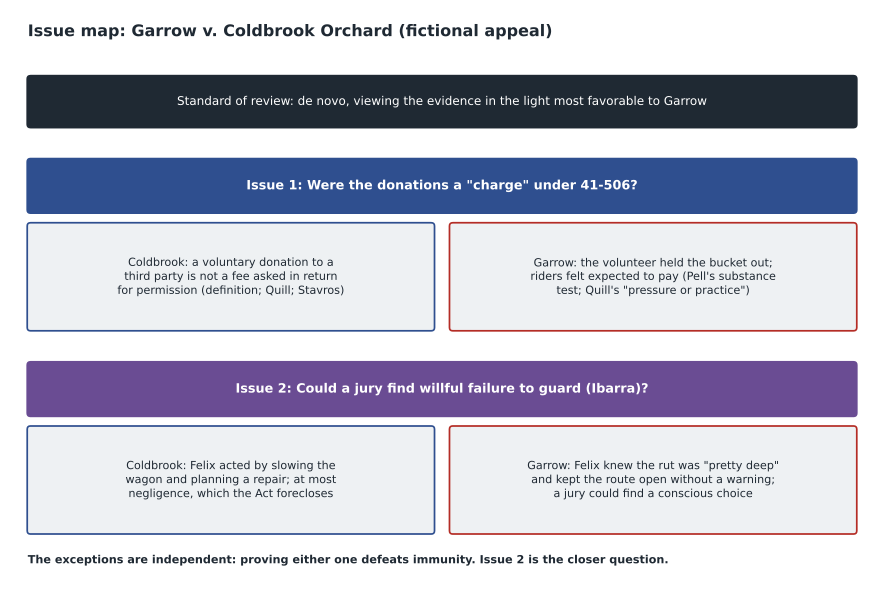
Before writing, the Coldbrook team, Priya, Marcus and Jordan, meets with Kinsella to settle strategy. The standard of review is de novo, so the appellate court will decide both questions afresh and may affirm on any ground in the record. The team agrees that the charge issue is Coldbrook's stronger ground on the law, because Quill is directly on point and the statutory definition emphasizes a price asked in return for permission. The willfulness issue is closer, because Felix admitted knowing the rut was deep, and on summary judgment the court must view that fact and Garrow's testimony favorably to her. Jordan asks whether Coldbrook should lead with charge even though Garrow's brief led with willfulness. Kinsella says yes: the statute's structure puts immunity first, the charge question is logically prior, and Coldbrook's strongest argument should come first.
The team also decides what to concede. They will concede that Felix knew the rut had returned and that it was deep, because the record shows it. They will concede that Garrow testified she felt expected to pay, because on summary judgment the court must accept her testimony. They will not concede that anyone asked her for money, because the record does not show it, and they will argue that a rider's subjective feeling of expectation cannot turn a voluntary donation into a fee that Coldbrook asked in return for permission.
Brief excerpt: statement of the issues
Priya drafts the statement of the issues using the short-premise format from Lesson 8: "1. Westmarch's Recreational Use Act withdraws immunity only if an owner charges 'the admission price or fee asked in return for invitation or permission to enter.' Coldbrook's hayride was free; a sign invited, but did not require, donations to the 4-H club; and all donations went to the club. Did the trial court correctly hold that the donations were not a charge? 2. Under Ibarra, willful failure to guard requires a conscious failure to act, and gross negligence is not enough. When Felix Merriwether learned that a rut had returned, he slowed the hayride and scheduled a repair. Did the trial court correctly hold that no reasonable jury could find willful failure to guard?"
Brief excerpt: summary of the argument
Marcus drafts the summary: "The trial court correctly granted summary judgment. First, the Act's charge exception does not apply. The statute defines a charge as a price or fee asked in return for permission to enter, and in Quill this Court held that a donation box with a suggested contribution to a charity is not a charge. Coldbrook's sign told riders the hayride was free; the 4-H club, not Coldbrook, received every dollar; and no rider was required to give anything. Ms. Garrow's testimony that she felt expected to give does not change what Coldbrook asked. Pell confirms that substance controls, and in substance these were gifts. Second, the willful exception does not apply. Ibarra requires a conscious failure to act and holds that gross negligence is not enough. Felix knew the rut had returned, but he acted: he slowed the wagon on that stretch and planned to fill the rut, as he had done in April. Whether those steps were enough is a negligence question, and the Act forecloses negligence claims. This Court should affirm."
Brief excerpt: the charge argument
Jordan drafts section I. Its main heading reads: "I. The Charge Exception Does Not Apply Because Coldbrook Asked Nothing in Return for Permission to Ride." A roadmap follows, and then subheading A: "A voluntary donation to a third party is not 'the admission price or fee asked in return for' permission to enter." The section quotes the definition, explains that the words "price," "fee" and "in return for" describe an exchange, a payment required as the condition of access, and then explains Quill: the Court of Appeals held that a corn maze's donation box with a suggested three-dollar contribution to a food bank was not a charge, because no payment was required and the money went to charity. The application tracks Quill fact by fact: a suggested amount, a charitable recipient, no requirement. It then turns to Stavros's instruction that the Act be construed to serve its purpose of encouraging free public access, arguing that treating charitable collections as charges would discourage exactly the generosity the legislature wanted.
Subheading B addresses Garrow's best facts: "The volunteer's presence and Ms. Garrow's feeling of expectation did not turn the donations into Coldbrook's charge." Jordan's draft accepts, as it must on summary judgment, that the volunteer held the bucket out and that Garrow felt expected to pay. It then argues that the statute asks what the owner asked in return for permission, not what a visitor felt, and that Quill's reference to pressure or practice describes conduct that makes payment a condition of access, such as turning away riders who do not pay, which the record does not show. It distinguishes Pell on the ground that the parking fee there was mandatory and kept by the city. Kinsella marks the draft with two suggestions: cite the record page for the volunteer's testimony every time it is characterized, and replace one "clearly" with the fact that makes the point clear.
Brief excerpt: the willfulness argument
For section II, the team writes headings and an outline rather than full text. The main heading: "II. The Willful-Failure Exception Does Not Apply Because Felix Merriwether Did Not Consciously Fail to Act." Subheadings: "A. Ibarra requires actual knowledge, knowledge that injury is probable, and a conscious failure to act; gross negligence is not enough." "B. Felix responded to the report of the rut by slowing the hayride and scheduling a repair, as he had repaired the same rut before." "C. Ms. Garrow's arguments that Felix should have done more describe negligence, which the Act forecloses." The outline notes that Coldbrook must accept that Felix knew the rut was deep, and that its argument rests on the third Ibarra element. It also notes the risk honestly: a court could conclude that keeping the route open for a week despite knowing the rut was deep raises a jury question. The team decides to say, in a sentence, that even if the court disagreed on willfulness, the charge holding alone would not support reversal, because immunity applies unless an exception is proved. Kinsella stops them there. "Read that again," she says. Hannah, listening from the other team, catches it: the two exceptions are independent, so if Garrow proves either one, immunity is lost. The sentence would misstate the law. The team deletes it.
| Criterion | Strong | Needs work |
|---|---|---|
| Issue statements | Short premises with key facts; question invites the client's answer | Abstract 'whether the court erred' questions |
| Summary of argument | States conclusion, rule and decisive facts for each issue; not just headings | Repeats headings or omits reasons |
| Point headings | Complete sentences with conclusion and reason; read alone, they argue | Topic labels or overlong headings |
| Use of authority | Explicit analogy to Quill; Pell distinguished on its reasoning; Ibarra stated accurately | Cases cited without explanation; distinctions on irrelevant facts |
| Treatment of bad facts | Felix's knowledge and Garrow's testimony accepted and answered | Bad facts omitted or disputed contrary to the summary judgment standard |
| Accuracy | Every fact cited to the record; every statement of law correct | Overstatements, missing cites, misstatements of how the exceptions work |
| Style and format | Plain, concise, consistent terms; within limits | Intensifiers, legalese, inconsistent terms |
The argument outline
Each team member prepares a one-page argument outline. Priya, who will argue for Coldbrook, writes: Opening: "May it please the court. Priya Natarajan for the appellee, Coldbrook Orchard. The trial court correctly held that the Recreational Use Act bars Ms. Garrow's claim, because Coldbrook asked nothing in return for permission to ride, and because Felix Merriwether responded to the rut rather than consciously ignoring it." Point one: the statutory definition and Quill. Point two: Ibarra's conscious-failure element and the record of Felix's response. Anticipated questions, each with a one-line answer: Would a staff member demanding money change the result? (Yes; that would be a fee asked in return.) What about Garrow's feeling of expectation? (The statute asks what the owner asked, not what a visitor felt.) Wasn't slowing down inadequate? (Perhaps, but inadequacy is negligence; Ibarra says gross negligence is not willfulness.) Isn't willfulness a jury question? (Not when the undisputed record shows the owner acted.) Concessions: Felix knew; Garrow felt expected. Closing: "This Court should affirm."
Daniel, arguing for Garrow, prepares the mirror image. He will lead with willfulness, emphasizing that on summary judgment the court must view Felix's admission in Garrow's favor and that slowing a wagon over a rut known to be deep, without filling it, closing the route or warning riders, could be found to be a conscious choice to leave a danger in place. On the charge issue, he will argue that Quill's pressure-or-practice language describes a volunteer holding the bucket out at the wagon steps, and that Pell's substance-over-labels principle shows the donation was, in practice, the price of the ride.
Argument night
On argument night, the panel is Kinsella and two alumni, a state appellate public defender and a civil litigator. Daniel argues first. Within a minute, one judge asks whether his willfulness theory would make every owner who learns of a hazard and does not fix it immediately liable. Daniel answers directly: no, an owner who closes the route or posts a warning while a repair is pending would not have consciously failed to act; Felix did neither. Priya follows. The panel presses her hardest on willfulness, as the team expected. Asked whether a jury could find that a week of continued rides over a known deep rut was a conscious choice, she concedes that a jury could find negligence, then explains why Ibarra requires more and points to the record pages showing Felix's response. In rebuttal, Daniel answers that single point.
Afterward the panel declines to announce a winner. The civil litigator says both sides argued well and that she would have found the charge issue easy and the willfulness issue genuinely close. Kinsella agrees, and tells Section B that this is the most important lesson of the year: in real cases, the honest assessment is often that one issue is strong and another is close, and the advocate's job is to make the strongest honest argument on both while never misstating the law or the record. She reminds them of the sentence the Coldbrook team almost included about the independent exceptions. "That is what careful review catches," she says. "Write boldly, then check everything."
Looking ahead
Kinsella closes the course by returning to the theme she started with in the fall: read the opinion, always. The skills of this year, research, objective analysis, persuasive writing and oral advocacy, will be used in every legal job Section B takes, from a clerkship to a public defender's office to a transactional practice where the brief is a memo to a client. Several students plan to try out for the school's moot court competition in the fall. Priya plans to compete. Daniel says he would rather try cases. Jordan says he will be satisfied if he never again writes a sentence with "clearly" in it. Kinsella says that would be a fine outcome for any lawyer.
Worked problem
Writing the rebuttal
You argued for Garrow. In her argument, Coldbrook's counsel told the panel that 'the statute asks what the owner asked, not what a visitor felt.' You have two minutes of rebuttal. Write a focused rebuttal on that point.
Show solution
- Choose one point; do not repeat the opening.
- Accept the framing where it is accurate and turn it.
- Use the record and the closed-universe authority accurately.
- End with the relief requested.
Answer: "Thank you, Your Honors. Counsel says the statute asks what Coldbrook asked, and we agree. Coldbrook asked through its practice: it placed a volunteer at the wagon steps holding the bucket out to each rider as she boarded. (Record cite.) Quill told owners that pressure or practice can turn a suggested donation into a price, and Pell told courts to look at substance. A jury could find that this practice was an ask. On that point and on willfulness, the case should go to a jury. We ask the Court to reverse and remand for trial."
Summary and key terms
- Moot court competitions combine a brief on one side with oral rounds on both sides; they teach record mastery, argument selection and answering hard questions.
- The capstone imagines a future appeal in the fictional Coldbrook case, with a trial court grant of summary judgment reviewed de novo.
- Coldbrook leads with the charge issue, its strongest and logically prior ground, and concedes Felix's knowledge and Garrow's testimony as the summary judgment standard requires.
- The brief excerpt applies the semester's skills: short-premise issue statements, a substantive summary, argumentative headings, explicit analogies and distinctions, and record citations.
- Careful review caught a misstatement about how the independent exceptions work; accuracy remains the advocate's first duty.
- Honest assessment often finds one strong issue and one close one; argue both as strongly as the law and record allow.
Practice problems
Work each problem on paper first, then reveal the answer to check.
Why does the Coldbrook team lead with the charge issue even though Garrow led with willfulness?
Show answer
It is Coldbrook's strongest ground and logically prior, since immunity must apply before the exceptions matter.
What must Coldbrook concede on summary judgment about Garrow's testimony, and why?
Show answer
That she felt expected to pay, because the court must view the evidence in the light most favorable to her.
What was wrong with the sentence the team deleted from section II?
Show answer
It implied that winning on the charge issue alone would defeat reversal, but the exceptions are independent, so proving either one defeats immunity.
What do most moot court competitions require of oral advocates?
Show answer
Arguing both sides of the problem, often on short notice.
Lesson quiz · 5 questions
Score 60% or more to complete this lesson.
Create a free account to save your progress, take quizzes and earn a certificate.