
LAWU-114 · Lesson 8 of 12 · 22 min
The appellate brief
▶ Video coming soon A video version of this lesson is on the way.
Kinsella brings a bound appellate brief to the eighth class and passes it around. It has a colored cover, a table of contents running three pages, a table of authorities running four, and an addendum of statutes at the back. "This is the most formal document most lawyers ever write," she says. "Almost everything about it is prescribed: what goes on the cover, what sections appear and in what order, how long it can be, what typeface it uses. The rules leave you freedom in exactly one place, the argument, and even there they tell you what it must contain. Learn the rules so well that you stop thinking about them. Then all your attention can go to the argument."
The required parts of an appellant's brief
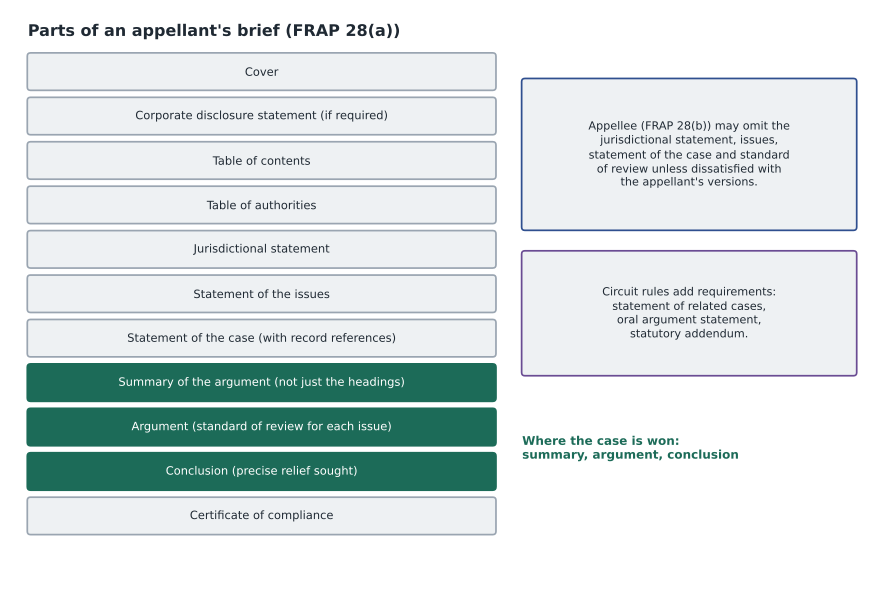
In the federal courts of appeals, Federal Rule of Appellate Procedure 28(a) lists the parts of an appellant's brief, in order. First comes a corporate disclosure statement if Rule 26.1 requires one. Then a table of contents with page references, and a table of authorities listing cases alphabetically, statutes and other authorities, with references to the pages where each is cited. Next comes a jurisdictional statement, giving the basis for the district court's subject-matter jurisdiction, the basis for the court of appeals' jurisdiction, the filing dates that establish the timeliness of the appeal, and an assertion that the appeal is from a final order or judgment or information establishing another basis for jurisdiction. Then a statement of the issues presented for review. Then a concise statement of the case, setting out the relevant facts, the procedural history and the rulings presented for review, with references to the record.
After the statement of the case come the three sections that matter most to the judges. The summary of the argument must contain a succinct, clear and accurate statement of the arguments made in the body of the brief, and the rule specifies that it must not merely repeat the argument headings. The argument must contain the appellant's contentions and the reasons for them, with citations to the authorities and parts of the record relied on, and, for each issue, a concise statement of the applicable standard of review. A short conclusion must state the precise relief sought. Finally, if Rule 32(g)(1) requires it, a certificate of compliance with the length limits. Each circuit adds its own requirements by local rule, such as a statement of related cases, a statement about oral argument or an addendum reproducing pertinent statutes, so a lawyer must read the circuit's rules alongside the Federal Rules.
The appellee's brief and the reply
Under Rule 28(b), the appellee's brief must follow the same requirements, except that it need not include a jurisdictional statement, statement of the issues, statement of the case or statement of the standard of review unless the appellee is dissatisfied with the appellant's version. In practice, appellees usually include their own statement of the case, because the facts told from the appellee's perspective are a powerful part of the defense of the judgment. Rule 28(c) allows the appellant to file a reply brief; unless the court permits, no further briefs may be filed. Rule 31(a) sets the default schedule: the appellant's brief is due within 40 days after the record is filed, the appellee's within 30 days after the appellant's brief is served, and the reply within 21 days after the appellee's brief is served, but at least 7 days before argument unless the court allows otherwise. Courts frequently modify these deadlines by order.
The record and the appendix
An appellate court decides the case on the record made below, and the brief must lead the court to it. Rule 10(a) defines the record on appeal as the original papers and exhibits filed in the district court, the transcript of proceedings and a certified copy of the docket entries. Rule 30 requires the appellant, in many circuits, to prepare an appendix containing the relevant docket entries, the relevant portions of the pleadings, charge, findings or opinion, the judgment or order in question, and other parts of the record the parties wish to bring to the court's attention. Some circuits dispense with the appendix and allow citation to the electronic record by docket number and page. Rule 28(e) governs references to the record: citations should be to the appendix pages if there is one, or to the original record in a form the court can find. Kinsella says that judges and clerks check record citations constantly, and that a brief with vague citations ("see generally the record") tells the court the writer did not do the work.
The statement of the issues
The statement of the issues, often called the questions presented, is the first substantive thing a judge reads, and it frames everything after it. A weak issue statement is abstract ("Whether the trial court erred in granting summary judgment") and tells the court nothing. A strong one states the legal question in terms of the key facts so that the answer the client wants seems natural. Bryan Garner has long advocated what he calls the deep issue: a short statement, usually under 75 words, that sets out the premises and ends with a question, often in separate sentences rather than one long "whether" clause. Kinsella shows two versions for Coldbrook as appellee.
The first: "Whether the trial court correctly held that the Recreational Use Act barred plaintiff's claim." The second: "Westmarch's Recreational Use Act immunizes owners who open land for recreation unless they charge for entry or willfully fail to guard against a known danger. Coldbrook's hayride was free; riders could donate to the 4-H club but did not have to; and when Felix Merriwether learned a rut had returned, he slowed the wagon and scheduled a repair. Did the trial court correctly hold that the Act bars Ms. Garrow's negligence claim?" Priya, who reads appellate briefs for fun, notes that the second version is longer but that a judge who reads it already knows the case. Garrow's lawyer would frame the same issue from the other side, emphasizing the volunteer and Felix's knowledge that the rut was "pretty deep."
The summary of the argument
The summary of the argument is the brief in miniature. Many judges read it first and some rely on it heavily in preparing for argument. Rule 28(a)(7) requires it to be succinct, clear and accurate and forbids merely repeating the headings, so it should explain the reasoning in a few paragraphs, often one paragraph per main argument. It should state the conclusion, the key rule and the decisive facts, and it should be written so that a reader who reads nothing else understands why the client should win. Kinsella recommends writing it last, after the argument is finished, and then revising the argument so that it delivers exactly what the summary promises.
The argument and the conclusion
The argument applies everything from earlier lessons: point headings that state conclusions, CREAC structure within sections, accurate rule statements, explicit analogies and distinctions, honest treatment of adverse authority, and a standard of review for each issue. On appeal, the argument must also engage with the decision below. An appellant must show why the trial court erred, addressing its reasoning rather than ignoring it. An appellee may defend the judgment on any ground supported by the record, even one the trial court did not reach, but the strongest appellee briefs usually defend the trial court's own reasoning first, because the appellate court is comfortable affirming a judge who got it right. The conclusion must state the precise relief: reverse and remand for trial, affirm, reverse and direct entry of judgment, or vacate and remand for further proceedings.
| Brief | Purpose | Key rules |
|---|---|---|
| Appellant's opening brief | Show the trial court erred and the error requires relief | FRAP 28(a), 32; standard of review for each issue |
| Appellee's brief | Defend the judgment, on the trial court's reasoning or any ground in the record | FRAP 28(b); may omit some sections unless dissatisfied |
| Reply brief | Answer the appellee's arguments; no new issues | FRAP 28(c); due within 21 days, at least 7 days before argument |
| Appendix | Collect the parts of the record the court needs | FRAP 30 and circuit rules |
| Amicus brief | Offer a nonparty's perspective useful to the court | FRAP 29; amendments pending |
| Supreme Court merits brief | Argue a case on which certiorari was granted | Supreme Court Rules 24 and 33 |
Writing the reply
The reply is the appellant's last word in writing, and it is often the brief judges read most closely just before argument, because it shows where the parties really disagree. A good reply does not restate the opening brief. It identifies the appellee's two or three strongest arguments and answers each directly, often under headings that name the argument being answered: "Coldbrook's reliance on Quill ignores the volunteer at the wagon steps." It points out concessions the appellee made or arguments it failed to answer. It stays within the issues already raised, because arguments first raised in a reply brief are generally treated as forfeited. And it is short; the length limit for a reply under Rule 32(a)(7)(B) is half the limit for a principal brief, and many effective replies use far less.
Kinsella warns about tone in replies. By the time the appellee's brief arrives, the appellant's lawyer may feel that the other side has mischaracterized the record or the cases, and the temptation is to say so loudly. Judges discount replies that accuse opposing counsel of misleading the court unless the accusation is clearly true and important. "If they misstated the record," she says, "quote the record. Let the judge draw the conclusion."
Amicus curiae briefs
A friend of the court, or amicus curiae, is a nonparty that files a brief to help the court, usually because it has an interest in the legal issue or expertise the parties lack. Under the current version of Federal Rule of Appellate Procedure 29(a), the United States, its officers or agencies, and states may file amicus briefs without consent or leave; others may file only by leave of court or if the brief states that all parties have consented. The rule requires disclosures about whether a party's counsel authored the brief in whole or in part and whether anyone other than the amicus contributed money intended to fund it, limits an amicus brief to half the maximum length of a party's principal brief, and sets a deadline tied to the brief of the party being supported. Amendments to Rule 29 that would expand the disclosure requirements, set a fixed word limit and say that an amicus brief that does not help the court is disfavored were transmitted to the Supreme Court in 2026; if approved, they would take effect no earlier than December 1, 2027. In the Coldbrook problem, a statewide farm bureau or parks association might file an amicus brief explaining how many landowners rely on the Act.
State appellate courts and the Supreme Court
State appellate rules follow a similar pattern but differ in details: section names, page or word limits, appendix practice, typeface rules and filing deadlines. A lawyer must read the specific court's rules for every brief. At the top of the federal system, the Supreme Court has its own rules for merits briefs in cases where it has granted review: Rule 24 prescribes the contents, which include the questions presented, a list of parties, tables, citations to the opinions below, a statement of jurisdiction, constitutional and statutory provisions involved, a statement of the case, a summary of argument, the argument and a conclusion, and Rule 33.1 sets word limits that currently allow 13,000 words for a party's opening merits brief. Supreme Court briefs are printed in booklet format with colored covers that identify which party filed them.
Reading the decision below
Kinsella ends the class with practical advice for the appellant. Read the trial court's decision three times before writing anything: once to understand it, once to identify every step of its reasoning, and once to find the step that is weakest. Then write the issue statement and point headings around that step. An appellate court reviewing a grant of summary judgment de novo will read the trial court's reasoning closely, and an appellant who addresses that reasoning head-on is more persuasive than one who writes as if the trial court had never ruled. For an appellee, the advice is reversed: find the strongest step in the trial court's reasoning and build the brief around defending it.
Worked problem
Drafting a statement of the issue for the appellant
Draft Garrow's statement of the issue on the willfulness ground for an appeal from summary judgment in the fictional Westmarch Court of Appeals, using the fictional Ibarra standard.
Show solution
- Identify the legal standard in a short premise.
- State the key facts in Garrow's favor, accurately, in a short premise.
- End with a question that invites a yes answer in Garrow's favor.
- Keep it under about 75 words and avoid a single long whether-clause.
Answer: "Under the Recreational Use Act, an owner loses immunity if it willfully fails to guard against a dangerous condition, which requires actual knowledge, knowledge that injury is probable and a conscious failure to act. A week before Ms. Garrow was hurt, Coldbrook's owner learned that a rut in the hayride route had returned and was 'pretty deep,' yet he kept the route open and did not warn riders. Could a reasonable jury find willful failure to guard?"
Summary and key terms
- FRAP 28(a) prescribes the parts of an appellant's brief in order, from the disclosure statement to the certificate of compliance; circuit rules add more.
- The appellee may omit some sections unless dissatisfied; the reply answers the appellee and raises no new issues; Rule 31 sets default deadlines.
- The record (Rule 10) and appendix (Rule 30) are the only source of facts; cite them precisely.
- Frame the issue statement in terms of the key facts, often as short premises followed by a question.
- The summary of the argument is the brief in miniature; write it last.
- Amicus practice is governed by Rule 29, with amendments pending that would take effect no earlier than December 1, 2027.
Practice problems
Work each problem on paper first, then reveal the answer to check.
Which sections may an appellee omit under FRAP 28(b)?
Show answer
The jurisdictional statement, statement of the issues, statement of the case and statement of the standard of review, unless dissatisfied with the appellant's.
What does FRAP 28(a)(7) forbid the summary of the argument from doing?
Show answer
Merely repeating the argument headings.
When is a reply brief due under FRAP 31(a)?
Show answer
Within 21 days after service of the appellee's brief, and at least 7 days before argument unless the court allows otherwise.
On what grounds may an appellee defend a judgment?
Show answer
On any ground supported by the record, though defending the trial court's own reasoning first is usually strongest.
What should a reply brief focus on?
Show answer
Answering the appellee's two or three strongest arguments directly, noting concessions, and staying within issues already raised.
Lesson quiz · 5 questions
Score 60% or more to complete this lesson.
Create a free account to save your progress, take quizzes and earn a certificate.