
LAWU-114 · Lesson 10 of 12 · 22 min
Generative AI, candor and verification
▶ Video coming soon A video version of this lesson is on the way.
In the fall, Marcus Webb tried a general-purpose chatbot on the Coldbrook hayride question and got back three cases. One was real but irrelevant; the other two did not exist. Section B has not let him forget it. Kinsella begins the tenth class by putting his screenshot back on the screen. "Marcus did the right thing," she says, to his surprise. "He checked, he found the problem and he told us. Lawyers have lost their jobs and paid sanctions because they did not do what Marcus did. This class is about writing briefs in a world where these tools exist, which means it is about your duties to the court, to your client and to yourself."
Why briefs are different
Generative AI tools can draft text, summarize documents, suggest arguments and find authorities, and the legal research platforms have built such tools into their products. Many lawyers use them productively for first drafts, summaries and brainstorming. But a brief filed in court carries the lawyer's signature, and the signature carries legal and ethical consequences. Under Federal Rule of Civil Procedure 11(b)(2), signing a paper certifies that, after a reasonable inquiry, the legal contentions are warranted by existing law or a nonfrivolous argument for changing it. A citation to a case that does not exist cannot satisfy that standard. Model Rule of Professional Conduct 3.3(a)(1) forbids knowingly making a false statement of law to a tribunal, and courts have treated fabricated citations, even those produced by software, as serious failures of the lawyer's own duties.
The core problem is that generative AI systems produce text that is fluent and plausible but not necessarily accurate. A system can produce a case name, a reporter citation, a court, a year and a quotation that all look right and are all invented. It can also misdescribe real cases, attribute a dissent's reasoning to the majority, or state a rule that sounds authoritative but is wrong for the jurisdiction. Kinsella stresses that these errors are not limited to free consumer tools; tools built for legal research reduce the risk, especially when they link to the sources they rely on, but they do not eliminate it, and the lawyer remains responsible for every word filed.
The cases that made the rules
In Mata v. Avianca, Inc., 678 F. Supp. 3d 443 (S.D.N.Y. 2023), lawyers opposing a motion to dismiss filed a brief citing judicial decisions that did not exist, generated by a chatbot. When the court and opposing counsel could not find the cases, the lawyers initially stood by them. The court imposed sanctions under Rule 11, including a monetary penalty of 5,000 dollars, and required the lawyers to send letters to their client and to each judge falsely identified as the author of a fake opinion. The court emphasized that using technology is not itself improper, but that lawyers have a gatekeeping role to ensure the accuracy of their filings.
Later cases made clear that Mata was not an isolated event. In Park v. Kim, 91 F.4th 610 (2d Cir. 2024), the Second Circuit referred a lawyer to its grievance panel after she cited a nonexistent decision in a reply brief and admitted it came from a generative AI tool; the court said that at the very least, the duties imposed by Rule 11 require attorneys to read, and thereby confirm the existence and validity of, the legal authorities on which they rely. In Johnson v. Dunn, decided in the Northern District of Alabama in July 2025, lawyers from a large firm who filed motions containing fabricated citations were disqualified from the case and publicly reprimanded, and the court referred the matter to bar authorities. Courts across the country have issued similar orders, and the sanctions have grown more severe as the risks have become well known.
Ethics guidance
On July 29, 2024, the American Bar Association issued Formal Opinion 512, its first formal opinion on lawyers' use of generative AI tools. The opinion applies existing Model Rules rather than creating new ones. Under the duty of competence in Model Rule 1.1, lawyers must understand the capabilities and limitations of the tools they use, and they may not rely uncritically on the output; the appropriate level of review depends on the tool and the task, and outputs used in court filings require careful verification. Under Model Rule 1.6, lawyers must protect confidential client information, which may require evaluating whether a tool retains or shares inputs and, in some cases, obtaining the client's informed consent before entering client information. Under Model Rule 1.4, lawyers may need to tell clients about their use of these tools in some circumstances. The opinion also addresses candor to the tribunal under Rules 3.1 and 3.3, supervision of lawyers and nonlawyers under Rules 5.1 and 5.3, and the reasonableness of fees under Rule 1.5, including the point that a lawyer billing by the hour may not charge for time saved by using a tool.
State bars and courts have issued their own guidance, which varies. Some judges, beginning soon after Mata, issued standing orders addressing AI. Judge Brantley Starr of the Northern District of Texas issued one on May 30, 2023, requiring lawyers to certify either that no portion of a filing was drafted by generative AI or that any such language was checked for accuracy by a human being. Other judges required disclosure of the specific tool used. Not every court has taken that approach: the Fifth Circuit considered and declined to adopt a proposed rule requiring an AI certification in 2024, and the Illinois Supreme Court announced a policy in December 2024 that permits the use of AI consistent with legal and ethical standards, emphasizes that lawyers are accountable for their final work product and must review AI-generated content, and does not require disclosure. Kinsella's practical advice: before filing anything, check the court's local rules and the judge's individual practices for AI requirements, because they differ from courtroom to courtroom.
Verification as a professional habit
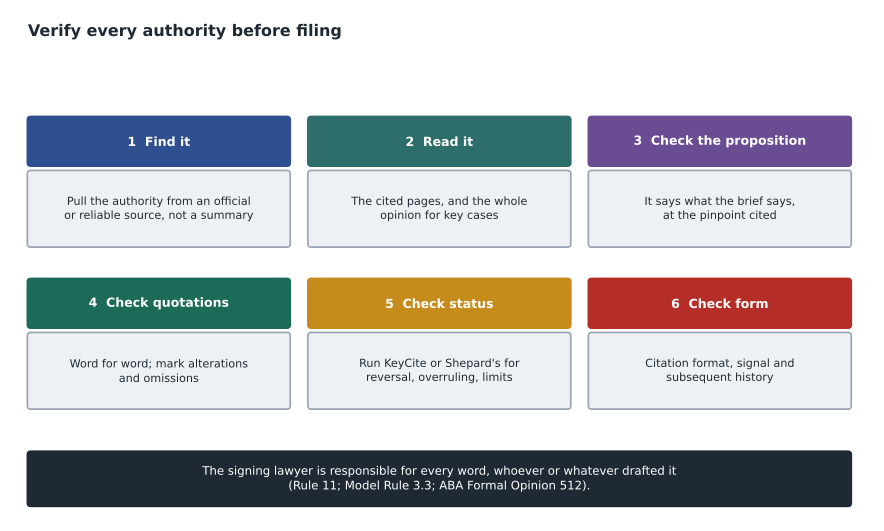
The solution is not to avoid technology but to verify everything. Kinsella gives Section B a verification protocol to apply to every authority in every brief, whatever the source. First, find the authority in an official or reliable source, not a summary or a citation in someone else's brief. Second, read it: at least the pages cited and, for any case that matters to the argument, the whole opinion. Third, confirm that it says what the brief says it says, at the pinpoint cited. Fourth, compare every quotation word for word. Fifth, run it through a citator to confirm it has not been reversed, overruled or limited. Sixth, check the citation form, signal and subsequent history. "None of this is new," she says. "These were the rules before anyone had heard of a chatbot. What is new is how easy it has become to skip them."
Verification also applies to statements of fact. A tool that summarizes a deposition may misstate testimony, conflate witnesses or invent details. Every record citation in a brief must be checked against the record itself. Daniel, who summarized depositions as a paralegal, says the most common error even in human summaries was a quotation that combined two answers into one. "If the brief quotes a witness," Kinsella says, "open the transcript and read the page."
| Duty | Source | What it requires |
|---|---|---|
| Reasonable inquiry before signing | Fed. R. Civ. P. 11(b) | Legal contentions warranted by existing law or a nonfrivolous argument; factual contentions supported |
| Candor to the tribunal | Model Rule 3.3 | No false statements of law or fact; correct false statements previously made |
| Competence | Model Rule 1.1; ABA Formal Op. 512 | Understand the tool's capabilities and limits; verify outputs used in filings |
| Confidentiality | Model Rule 1.6; ABA Formal Op. 512 | Evaluate whether the tool exposes client information; informed consent where required |
| Supervision | Model Rules 5.1 and 5.3 | Ensure lawyers and staff using tools follow these duties |
| Reasonable fees | Model Rule 1.5; ABA Formal Op. 512 | Do not bill hourly for time not actually spent |
| Court-specific rules | Local rules and standing orders | Certifications or disclosures where required |
Tasks where tools help and tasks where they hurt
Kinsella asks Section B to sort brief-writing tasks by risk. Lower-risk uses include brainstorming counterarguments the other side might raise, generating an outline the lawyer then rebuilds, suggesting plainer phrasings for a sentence the lawyer wrote, checking a draft for inconsistent terms, and summarizing a long document as a first step before reading it. Higher-risk uses include asking a tool to find authorities for a proposition, to state the law of a particular jurisdiction, to describe what a case held, or to draft the statement of facts from the record. The difference is that lower-risk uses produce material the lawyer will independently check or that does not assert facts or law, while higher-risk uses produce assertions the court will rely on. Marcus observes that the same tool can be safe or dangerous depending on whether its output goes into the brief unexamined.
Even the lower-risk uses require judgment. A tool that suggests counterarguments may miss the most important one, and a lawyer who relies on it may stop thinking for herself. A tool that rewrites sentences may change their meaning in small but legally significant ways, turning "may" into "must" or "held" into "suggested." Hannah points out that the same risks exist when a junior associate drafts a section and a partner skims it before filing. Kinsella agrees: the duties of supervision under Model Rules 5.1 and 5.3 have always required checking delegated work, and the tools are one more form of delegation.
Citing AI output
Occasionally a brief may need to cite the output of a generative AI tool itself, for example when the output is evidence in the case or when the brief discusses what such a tool produced. The twenty-second edition of The Bluebook, released in 2025, added a rule addressing citations to generative AI output that calls for preserving the output, such as by a screenshot or PDF; the rule has drawn criticism from some commentators. Citing a tool's output as authority for a proposition of law is a different matter entirely, and Kinsella is blunt about it: a brief should cite the law, not a machine's description of the law.
Confidentiality in practice
The confidentiality concern is easy to overlook. Entering a client's facts, documents or strategy into a tool may disclose them to the tool's provider, depending on the tool's terms and settings. Many firms restrict lawyers to tools whose providers contractually agree not to retain or train on inputs, and some require client consent before using any such tool on a matter. Kinsella notes that the Coldbrook file is fictional, so Section B can experiment with it freely, but that in practice they should treat client information as if a stranger were reading over their shoulder until they know otherwise.
What good use looks like
Kinsella ends with an exercise. She gives the class a two-paragraph AI-generated draft of Coldbrook's charge argument and asks them to audit it. The draft is fluent and well organized. It cites Quill correctly, but it describes Pell as holding that "any payment associated with access is a charge," which overstates Pell's narrower holding about a mandatory fee. It cites a third case, "Harrow v. Westmarch Parks Board," which is not in the closed universe and does not exist. And it describes the 4-H volunteer as "collecting a fee from each rider," which misstates the record. Jordan finds all three problems in ten minutes. "That is the job," Kinsella says. "The tool can save you time on a first draft. It cannot save you from your obligations, and it cannot be the reason you stop reading the cases."
Worked problem
Auditing a draft paragraph
A draft brief paragraph says: "As courts have consistently held, any request for payment associated with land access constitutes a charge. Pell v. City of Brennan Falls, 39 Westm. App. 2d 155 (2015); see also Harrow v. Westmarch Parks Bd., 44 Westm. App. 2d 87 (2017)." Audit it using the verification protocol and the fictional closed universe.
Show solution
- Find each authority: Pell is in the closed universe; Harrow is not and cannot be found anywhere, so it must be treated as nonexistent and removed.
- Read Pell: it held that a mandatory 8-dollar parking fee was a charge, reasoning that substance controls over labels.
- Check the proposition: Pell did not hold that any request for payment is a charge; the draft overstates it, and 'courts have consistently held' is unsupported.
- Check form: no pinpoint citation is given.
- Rewrite accurately, keeping the signal appropriate.
Answer: "A mandatory fee for access is a charge even if it is labeled something else. Pell v. City of Brennan Falls, 39 Westm. App. 2d 155, 159 (2015) (holding that a mandatory 8-dollar parking fee was a charge)." The citation to Harrow is deleted, and the lawyer should consider whether any earlier filing included it and, if so, correct the record as Model Rule 3.3(a)(1) requires.
Summary and key terms
- Signing a brief certifies a reasonable inquiry (Rule 11(b)) and carries the duty of candor (Model Rule 3.3); fabricated or misdescribed authorities violate both.
- Mata v. Avianca (S.D.N.Y. 2023), Park v. Kim (2d Cir. 2024) and Johnson v. Dunn (N.D. Ala. 2025) show escalating consequences for unverified AI output.
- ABA Formal Opinion 512 (July 29, 2024) applies the duties of competence, confidentiality, communication, candor, supervision and reasonable fees to AI use.
- Courts' approaches vary, from certification orders such as Judge Starr's (May 30, 2023) to policies like Illinois's that permit use without disclosure; check each court's rules.
- Verify every authority and every fact: find, read, check the proposition, check quotations, run a citator and check form.
- Cite the law, not a machine's description of it; protect client information when using any tool.
Practice problems
Work each problem on paper first, then reveal the answer to check.
What sanction did the court impose in Mata v. Avianca?
Show answer
Rule 11 sanctions including a 5,000-dollar penalty and letters to the client and to each judge falsely named as an author of a fake opinion.
What did Park v. Kim say Rule 11 requires at a minimum?
Show answer
That attorneys read, and thereby confirm the existence and validity of, the legal authorities on which they rely.
Name three Model Rules addressed in ABA Formal Opinion 512.
Show answer
Any three of: 1.1 competence, 1.4 communication, 1.5 fees, 1.6 confidentiality, 3.1 and 3.3 candor, and 5.1 and 5.3 supervision.
What should a lawyer do before filing in a court where a judge may have an AI standing order?
Show answer
Check the local rules and the judge's individual practices for certification or disclosure requirements.
Why is asking a tool to find authorities for a proposition a higher-risk use than asking it for plainer phrasing?
Show answer
It produces assertions of law the court will rely on, which may be invented or misdescribed, while phrasing suggestions do not assert law or facts (though they still need checking).
Lesson quiz · 5 questions
Score 60% or more to complete this lesson.
Create a free account to save your progress, take quizzes and earn a certificate.