
LAWU-114 · Lesson 6 of 12 · 23 min
The trial brief
▶ Video coming soon A video version of this lesson is on the way.
"Your first real brief will not be an appellate brief," Kinsella tells Section B. "It will be a motion memo, written in a week, for a trial judge who has three hundred other cases." She describes her first month at the litigation firm: a partner handed her a stack of deposition transcripts on a Monday and asked for a draft summary judgment brief by Friday. The brief was eighteen pages long. The judge decided the motion on the papers, without a hearing, in a four-page order that adopted two of her headings word for word. "That is the goal," she says. "Write something the judge can use."
Motions and the papers that support them
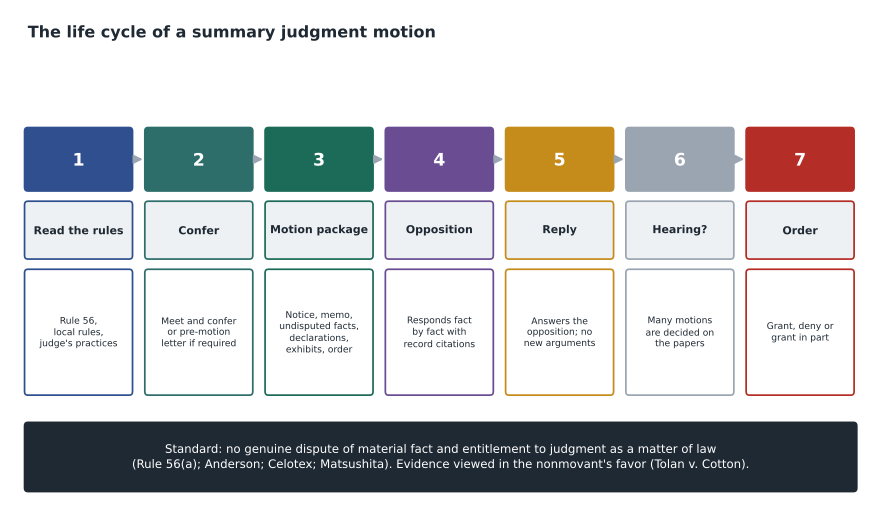
A motion is a request for a court order. In federal court, Federal Rule of Civil Procedure 7(b)(1) requires that a motion be in writing unless made during a hearing or trial, state with particularity the grounds for seeking the order, and state the relief sought. In practice, a motion package usually includes a short notice of motion, a memorandum of law (the brief), supporting declarations and exhibits, and often a proposed order. The opposing party files an opposition memorandum, and the moving party may file a reply. Many courts decide motions on the papers; Rule 78(b) allows a court to provide for submitting and deciding motions on briefs without oral hearings. State courts generally follow similar procedures under their own rules.
The trial-level brief is shaped by rules beyond the Federal Rules. Each federal district court has local rules, and many judges have individual practices posted on the court's website. These may set page or word limits for memoranda, require a pre-motion conference or letter, require the parties to meet and confer before filing, specify the format of exhibits, or require a separate statement of undisputed material facts with a summary judgment motion. Limits vary; many districts cap opening memoranda at a set number of pages, often in the range of twenty to thirty-five, or an equivalent word count, with shorter limits for replies. Kinsella tells the class that reading the local rules and the judge's individual practices is the first step in writing any motion, and that violating them is the fastest way to have a brief rejected or ignored.
The fictional Westmarch setting
For the semester's trial-brief assignment, Kinsella extends the closed universe. In her version of the file, Garrow has sued Coldbrook Orchard in the Merrin County Superior Court, a Westmarch trial court, alleging negligence. Coldbrook has answered and pleaded immunity under the Recreational Use Act. Discovery has produced depositions of Felix and Ada Merriwether, the teenage tractor driver, the 4-H volunteer and Garrow, plus photographs of the sign and the rut. The fictional Westmarch Rules of Civil Procedure track the federal rules closely, including a summary judgment rule identical to Federal Rule 56, and the Merrin County Superior Court's fictional local rule limits supporting memoranda to twenty-five pages and replies to ten, and requires a separate statement of undisputed facts. "Everything about this court is invented," Kinsella says, "but every rule I just described has a real counterpart in courts across the country."
The summary judgment standard
Summary judgment is the motion most first-year lawyers write first, and it has a precise standard. Under Federal Rule of Civil Procedure 56(a), the court shall grant summary judgment if the movant shows that there is no genuine dispute as to any material fact and the movant is entitled to judgment as a matter of law. A fact is material if it might affect the outcome of the suit under the governing law, and a dispute is genuine if the evidence is such that a reasonable jury could return a verdict for the nonmoving party, as the Supreme Court explained in Anderson v. Liberty Lobby, Inc., 477 U.S. 242 (1986). Anderson also held that the court must consider the substantive evidentiary standard, such as clear and convincing evidence, that would apply at trial.
The burdens matter. In Celotex Corp. v. Catrett, 477 U.S. 317 (1986), the Court held that a moving party that does not bear the burden of proof at trial can meet its initial burden by pointing out that the nonmoving party lacks evidence on an essential element; it need not produce evidence negating the opponent's claim. The nonmoving party must then come forward with specific facts showing a genuine issue for trial. In Matsushita Electric Industrial Co. v. Zenith Radio Corp., 475 U.S. 574 (1986), the Court added that the nonmoving party must do more than show some metaphysical doubt as to the material facts. Together, Anderson, Celotex and Matsushita, often called the summary judgment trilogy, made summary judgment a regular tool for ending cases without trial. And as Lesson 3 noted, Tolan v. Cotton, 572 U.S. 650 (2014), reminds courts that evidence is viewed in the light most favorable to the nonmovant.
Burden of proof and the immunity defense
Applying the standard to Coldbrook requires knowing who bears the burden on each issue. Kinsella tells the class to assume, for the exercise, that statutory immunity is an affirmative defense, so Coldbrook bears the burden of showing that the Act applies: that it is an owner, that Garrow entered for a recreational purpose, and that she did so without charge, if the charge question is treated as part of the defense. Garrow, as the party invoking the willful exception, would bear the burden of showing willful or malicious conduct. Section B debates who bears the burden on the charge exception, and Kinsella says the closed-universe cases do not resolve it; in a real case, a researcher would check how Westmarch courts allocate that burden, and a brief should not assume the answer without authority.
The allocation shapes the brief. On willfulness, Coldbrook can use Celotex: it can point out that Garrow lacks evidence of a conscious failure to act and require her to come forward with specific facts. On the charge question, Coldbrook should affirmatively establish the facts with declarations and deposition excerpts: the sign's wording, the 4-H club's receipt of all donations, and testimony that no rider was turned away. Kinsella notes that Felix's own testimony that he knew the rut was "pretty deep" is likely to create a genuine dispute on at least one Ibarra element, and that a candid brief must deal with it. Coldbrook's best argument is that even accepting Garrow's version of every fact, the record shows no conscious failure to act as a matter of law. Whether a court would agree is the hard question.
Structure of a memorandum in support
A typical memorandum supporting summary judgment has a predictable structure. It opens with a preliminary statement, often a page or less, that tells the court what the motion is about and why it should be granted, in plain terms. A statement of facts follows, citing the record and, where required, the separate statement of undisputed facts by paragraph number. A short section sets out the legal standard. The argument follows, under point headings. A conclusion states the precise relief requested, such as judgment in Coldbrook's favor on all claims. Courts often appreciate a table of contents and table of authorities for longer memoranda even when not required.
The preliminary statement deserves special care because many judges read it first and some read little else before a hearing. It should state the theory of the case in a few sentences. Priya's draft reads: "Westmarch's Recreational Use Act protects owners who open their land to the public without charge. Coldbrook Orchard did exactly that: its weekend hayride was free, and the only money collected was voluntary donations to the local 4-H club. Because Coldbrook did not charge for the ride, and because Felix Merriwether responded to the rut by slowing the wagon and scheduling a repair rather than consciously ignoring it, the Act bars Ms. Garrow's negligence claim." Kinsella says it is nearly perfect, except that "exactly" can go.
The opposition and the reply
The opposing party's memorandum mirrors the motion: a preliminary statement, its own statement of facts (often responding to each paragraph of the movant's statement, admitting or disputing it with record citations), the standard, the argument and a conclusion. An opposition to summary judgment must show specific facts creating a genuine dispute; under Rule 56(c)(1), it too must cite particular parts of the record. Rule 56(d) lets a nonmovant show by declaration that it cannot yet present facts essential to its opposition and ask the court to defer ruling or allow more discovery. Rule 56(e) allows the court, if a party fails to properly address another party's assertion of fact, to give an opportunity to address it, consider the fact undisputed, or grant summary judgment if the motion and materials show the movant is entitled to it.
The reply is short and focused. Its job is to answer the opposition's strongest points, not to repeat the opening memorandum or raise new arguments. Many courts refuse to consider arguments raised for the first time in a reply, because the opposing party has no chance to respond. Kinsella advises writing the reply as a list of the opposition's three or four best points, each followed by a direct answer, and ending with a one-paragraph conclusion. Daniel says the plaintiffs' firm where he worked had a rule: "If you can't say it in ten pages, the first brief failed."
| Element | Rule | Authority |
|---|---|---|
| Standard | No genuine dispute of material fact; movant entitled to judgment as a matter of law | Fed. R. Civ. P. 56(a) |
| Material fact | Might affect the outcome under the governing law | Anderson v. Liberty Lobby |
| Genuine dispute | A reasonable jury could find for the nonmovant | Anderson v. Liberty Lobby |
| Movant without trial burden | May point to the absence of evidence on an essential element | Celotex v. Catrett |
| Nonmovant's burden | Specific facts, more than metaphysical doubt | Matsushita; Fed. R. Civ. P. 56(c)(1) |
| View of evidence | Light most favorable to the nonmovant | Tolan v. Cotton |
| Declarations | Personal knowledge, admissible facts, competent declarant | Fed. R. Civ. P. 56(c)(4) |
| Facts unavailable | Nonmovant may seek deferral or discovery | Fed. R. Civ. P. 56(d) |
Other motions
Summary judgment is not the only motion. A motion to dismiss for failure to state a claim under Rule 12(b)(6) tests the complaint itself: the court accepts well-pleaded factual allegations as true and asks whether they state a plausible claim, under Bell Atlantic Corp. v. Twombly, 550 U.S. 544 (2007), and Ashcroft v. Iqbal, 556 U.S. 662 (2009). Because immunity under the Act depends on facts outside the complaint, such as the sign and the donations, Coldbrook likely could not win on a motion to dismiss unless the complaint itself pleaded those facts. Motions in limine ask the court to rule on the admissibility of evidence before trial. Discovery motions, such as motions to compel, often have strict meet-and-confer requirements. Each motion's brief follows the same basic structure, adjusted to the standard that governs it.
Writing for the trial judge
Trial judges read briefs differently than appellate judges. They have heavier dockets and less time per case, they usually work without colleagues on the same case, and they must make decisions quickly. A trial brief should therefore be shorter than the limit, front-load the conclusion, state the standard briefly without a long string of citations, and make the record easy to check, with pinpoint citations to exhibits and transcript pages. Trial judges are also bound by appellate precedent in a way that makes the controlling cases especially important: a trial judge in Merrin County must follow Ibarra and Quill, so Coldbrook's brief should show how those cases decide the motion rather than inviting the judge to make new law.
Worked problem
Drafting a legal standard section
Write the legal standard section for Coldbrook's summary judgment memorandum in the fictional Merrin County Superior Court, where the Westmarch summary judgment rule is identical to Federal Rule 56 and Westmarch courts treat the federal trilogy as persuasive.
Show solution
- State the standard in the rule's words.
- Define material and genuine, citing the leading authority the court accepts.
- Address the burdens, including the movant's ability to point to an absence of evidence.
- Acknowledge the favorable view of the evidence for the nonmovant.
- Keep it to one or two paragraphs; this section is not where the case is won.
Answer: "Summary judgment is appropriate when there is no genuine dispute as to any material fact and the movant is entitled to judgment as a matter of law. Westm. R. Civ. P. 56(a). A fact is material if it might affect the outcome under the governing law, and a dispute is genuine only if a reasonable jury could return a verdict for the nonmoving party. Anderson v. Liberty Lobby, Inc., 477 U.S. 242, 248 (1986) (persuasive authority in Westmarch). A party that does not bear the burden of proof at trial may meet its initial burden by showing that the nonmoving party lacks evidence on an essential element of its claim. Celotex Corp. v. Catrett, 477 U.S. 317, 322-25 (1986). The court views the evidence in the light most favorable to the nonmoving party. Tolan v. Cotton, 572 U.S. 650 (2014) (per curiam)."
Summary and key terms
- A motion must state its grounds with particularity and the relief sought; most motion packages include a notice, a memorandum, declarations, exhibits and a proposed order.
- Read the local rules and the judge's individual practices first; they govern length, format and procedure.
- Summary judgment requires no genuine dispute of material fact and entitlement to judgment as a matter of law (Rule 56(a); Anderson; Celotex; Matsushita).
- Know who bears the burden on each issue; it shapes how the brief uses the record.
- A memorandum usually has a preliminary statement, facts, standard, argument and conclusion; the preliminary statement should state the theory in a few sentences.
- Replies answer the opposition's best points and raise no new arguments.
Practice problems
Work each problem on paper first, then reveal the answer to check.
What three things does Rule 7(b)(1) require of a motion?
Show answer
It must be in writing (unless made at a hearing or trial), state the grounds with particularity, and state the relief sought.
What did Celotex hold about a moving party that does not bear the burden at trial?
Show answer
It can meet its initial burden by pointing out the absence of evidence on an essential element of the nonmovant's case.
Why can't Coldbrook easily win on a Rule 12(b)(6) motion?
Show answer
Immunity depends on facts outside the complaint, and a motion to dismiss tests only the pleaded allegations.
Why do courts often refuse to consider arguments first raised in a reply?
Show answer
The opposing party has no opportunity to respond to them.
What should a preliminary statement accomplish?
Show answer
State the theory of the case in a few sentences so a judge who reads nothing else understands why the motion should be granted.
Who bears the burden on the willful exception in the fictional Coldbrook problem, and how does that help Coldbrook?
Show answer
Garrow does; Coldbrook can point to the absence of evidence of a conscious failure to act and require her to come forward with specific facts.
Lesson quiz · 5 questions
Score 60% or more to complete this lesson.
Create a free account to save your progress, take quizzes and earn a certificate.