
LAWU-114 · Lesson 11 of 12 · 21 min
Oral argument
▶ Video coming soon A video version of this lesson is on the way.
Kinsella rearranges the classroom for the eleventh class. Three chairs sit behind a table at the front, a lectern faces them, and a small timer with green, yellow and red lights stands on the table. "Oral argument is the only part of an appeal where the judges talk to you," she says. "Everything else is paper. For fifteen minutes, you get to find out what is worrying them and answer it. Most lawyers waste those minutes giving a speech. You will not." Kinsella watched hundreds of arguments from the staff attorneys' seats at the state supreme court and argued several appeals herself at the firm. She says the best arguments she saw felt like conversations, and the worst felt like recitals.
When courts hear argument
Not every appeal is argued. Under Federal Rule of Appellate Procedure 34(a)(2), oral argument must be allowed in every case unless a panel of three judges who have examined the briefs and record unanimously agrees that argument is unnecessary because the appeal is frivolous, the dispositive issues have been authoritatively decided, or the facts and legal arguments are adequately presented in the briefs and record and the decisional process would not be significantly aided by argument. In practice, the federal courts of appeals decide many appeals without argument, and the share varies by circuit; many state appellate courts also decide a large portion of cases on the briefs. Parties may request argument, and some circuits ask for a statement in the brief explaining why argument would help. When argument is scheduled, the court sets the time, often fifteen minutes or less per side in the courts of appeals, and the appellant usually reserves a few minutes for rebuttal.
Rule 34(c) provides that the appellant opens and concludes the argument and that counsel must not read at length from briefs, records or authorities. The Supreme Court allows thirty minutes per side by default under its Rule 28.3, and its practices have evolved: the Court has allowed advocates a short uninterrupted opening before questions begin, and after returning to the courtroom in 2021 it added a period at the end of each advocate's time in which the justices ask questions one at a time in order of seniority. Kinsella tells the class that state supreme courts vary widely, some allowing thirty minutes, some fifteen, and some posting their argument recordings online, which makes watching real arguments easy preparation.
The purpose of argument
Oral argument rarely changes the outcome of a case, but it can, and it often shapes the opinion. Judges use argument to test the limits of each side's position, to resolve questions the briefs left open, to understand how a ruling would apply to other cases, and sometimes to persuade each other through their questions. An advocate's job is to help the judges decide: to answer their questions directly, to correct misunderstandings, and to give them the reasoning they need to write an opinion in the client's favor. Kinsella says that judges' questions are gifts, because they reveal what the court is thinking. "A question you dread is a question you can prepare for," she says. "A question you never hear is a worry you never get to answer."
Preparing
Preparation for argument begins with knowing the case better than anyone else in the room: the record, the briefs on both sides, every authority cited, and the decision below. Kinsella tells the class to reread the briefs, mark every page of the record they might need, and prepare a short notebook or folder with the key record cites, the holdings of the main cases in a sentence each, and the text of the statute. Advocates then identify the two or three points they most need the court to understand, write a short opening, and list every question they expect, especially the hardest ones, with a short answer to each.
The most important preparation is the moot court: a practice argument before colleagues playing judges, who ask the hardest questions they can think of. Experienced appellate lawyers moot important arguments several times. A good moot reveals questions the advocate did not anticipate, answers that sound weak when spoken aloud, and concessions the advocate must decide in advance whether to make. Jordan Kimura compares mooting to a rehearsal before a military briefing: "You never want the general's first question to be the first time you've heard it." Kinsella adds that advocates should not memorize a speech. They should know their points so well that they can make them in any order, because questions will scramble the order.
Structure
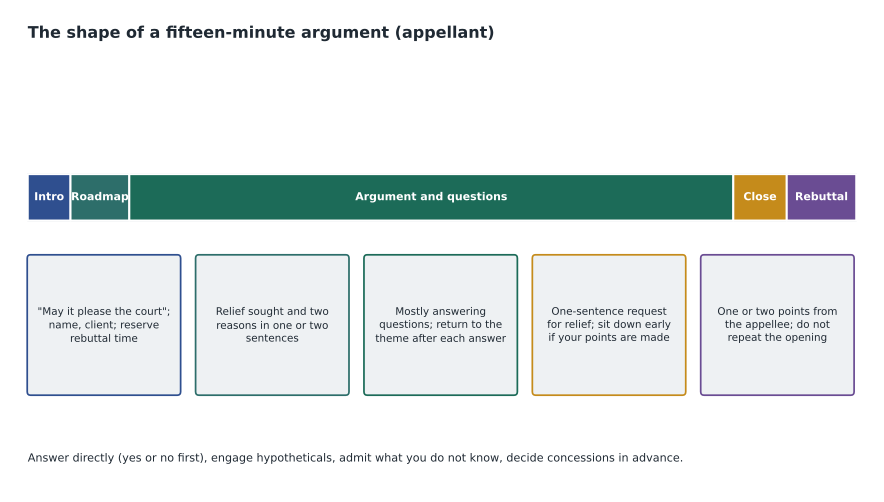
An appellate argument has a simple structure, flexible enough to survive constant interruption. The advocate begins with the traditional opening, "May it please the court," followed by her name and client, and, for the appellant, a request to reserve rebuttal time. Then comes a short roadmap: what the advocate wants the court to do and the reasons, in one or two sentences. For Coldbrook as appellee: "Your Honors, the trial court correctly held that the Recreational Use Act bars Ms. Garrow's claim, for two reasons: Coldbrook did not charge for the hayride, and the record shows no conscious failure to act." The body of the argument follows, but in practice much of it consists of answering questions. The advocate ends with a brief conclusion restating the relief requested, and sits down, early if her points are made. An appellant's rebuttal should answer one or two specific points from the appellee's argument, not repeat the opening.
Answering questions
Answering questions well is the heart of oral argument. The first rule is to answer the question asked, directly and immediately. If the question calls for yes or no, say yes or no first and then explain. "Counsel, would your rule mean that any donation box anywhere on the property is fine, even if a staff member demands money?" A bad answer evades: "Well, Your Honor, the facts of this case are different." A good answer commits and then explains: "No, Your Honor. If a staff member demanded money as a condition of riding, that would be a fee asked in return for permission, and Quill says pressure or practice can make a donation a price. But the record here shows the opposite: the sign said free and no one was turned away."
Other rules follow from the first. Listen to the whole question; do not interrupt a judge. If a question is unclear, ask politely for clarification rather than guessing. If you do not know the answer, say so and offer to file a short letter if the court wishes, rather than inventing one. When a judge poses a hypothetical, engage with it; judges use hypotheticals to test the limits of a proposed rule, and refusing to answer suggests the rule has no limits. And after answering, return to your argument with a transition that connects the answer to your theme. Marcus asks what to do if two judges ask questions at once. "Answer the one who spoke first, then turn to the other," Kinsella says. "And never tell a judge that you will get to her question later. Answer it now."
Concessions
Advocates must decide in advance what they will concede. Conceding a point that is obviously true builds credibility and lets the advocate focus on what matters. Refusing to concede the obvious makes the advocate look unreasonable and wastes time. But conceding a point that is fatal to the case, or that the client has not authorized, is a serious mistake. For Coldbrook, Kinsella suggests that counsel should be ready to concede that Felix knew about the rut, because the record shows it, while arguing that knowledge alone does not satisfy Ibarra. Counsel should not concede that the volunteer asked riders for money, because the record does not show it, and should be ready to say so with a record citation.
| Situation | Do | Avoid |
|---|---|---|
| Yes-or-no question | Answer yes or no first, then explain | Starting with a long preface |
| Hostile hypothetical | Engage with it and show where your rule draws the line | Refusing to answer or saying the case is different without explaining |
| Question you cannot answer | Say so; offer a short letter if the court wishes | Guessing or inventing an answer |
| Question about the record | Give the page and what it says | Characterizing the record from memory |
| Point you should concede | Concede it cleanly and explain why it does not matter | Fighting the obvious |
| Friendly question | Accept the help and build on it | Treating it as a trap and hedging |
| Your time expires mid-answer | Ask to finish the sentence, then conclude | Continuing at length |
Demeanor and delivery
Delivery matters less than substance, but poor delivery distracts. Advocates address the court as "Your Honor" or by title ("Judge Alvarez," "Justice Chen") and refer to opposing counsel by name or role, never by first name. They stand at the lectern, keep notes to a single page or folder, make eye contact with the judges rather than reading, and speak at a measured pace. They dress conservatively. They never interrupt a judge, argue with a judge's tone, or display frustration. When a judge appears hostile, the best response is calm engagement with the substance of the question. Kinsella tells the class that judges remember advocates who stayed courteous under pressure, and that appellate courts are small worlds where reputations travel.
Arguing for the appellee
The appellee's argument differs from the appellant's in two ways. First, the appellee speaks second, after the judges have already questioned the appellant, so the appellee's best opening often responds to what just happened: if the judges pressed the appellant hard on one point, the appellee may begin there. An appellee who delivers a prepared opening that ignores the first half of the argument misses the chance to address what is plainly on the court's mind. Second, the appellee defends a judgment, and the court's default is to affirm unless shown an error. The appellee therefore needs to show that the trial court's reasoning holds up, offer alternative grounds if the court has doubts, and avoid conceding anything that would require reversal. Kinsella tells the Coldbrook team to listen carefully during Garrow's argument and to cross out any part of their prepared remarks that the judges have already resolved in their favor.
Watching real arguments
Real arguments are the best teacher. The Supreme Court posts audio recordings and transcripts of its arguments on its website, and many federal courts of appeals and state supreme courts post audio or video of theirs. Kinsella assigns each student to listen to one full argument in a civil appeal and to note three things: the first question each judge asked, how the advocate answered the hardest question, and whether the advocate sat down before time expired. Priya chooses a state supreme court argument about a recreational use statute in another state and reports that the justices spent most of the time on hypotheticals about where the line between a donation and a fee should fall, the same question the Coldbrook problem raises.
Hot and cold benches
Some courts are known as hot benches, where judges have read the briefs closely and ask questions from the first minute. Others are cold benches, where judges ask few questions and the advocate must carry the time. An advocate should be prepared for both. For a cold bench, Kinsella suggests preparing a short affirmative presentation of the two or three main points, each with a key case and a key record fact, that can expand or contract to fill the time. For a hot bench, the same points serve as anchors to return to between questions. Priya, who has watched recorded arguments from several state supreme courts, says the hardest moment she has seen was an advocate facing a silent bench who simply sat down after four minutes. "That can be the right choice," Kinsella says, "if you have made your points. Judges rarely complain that an argument was too short."
Practice round
Kinsella ends the class with a short practice round. Hannah argues for Garrow on the willfulness issue; Kinsella, Daniel and Jordan sit as judges. Hannah's opening is clear, but two minutes in, Kinsella asks: "Counsel, Felix told the driver to slow down. Isn't that the opposite of a conscious failure to act?" Hannah pauses, then answers: "No, Your Honor. Slowing down addresses how fast the wagon hits the rut, not whether it hits it. Felix knew the rut was deep, kept the route open, and did not warn riders. A jury could find that he consciously chose not to fix a danger he knew about." Kinsella nods and asks a follow-up about Ibarra's statement that gross negligence is not enough. Afterward, the class agrees that the best moment was Hannah's direct answer, and the weakest was her closing, which ran long after the red light.
Worked problem
Preparing for the hardest question
You will argue for Coldbrook as appellee. Write a direct answer to this anticipated question from the bench: "Counsel, the driver told Felix the rut was 'pretty deep,' and Felix kept running a wagon full of people over it for a week. Why couldn't a jury call that willful?"
Show solution
- Answer the question directly: say why a jury could not, as a matter of law, find willfulness on this record.
- Concede what is true: Felix knew the rut had returned.
- State the governing standard briefly: Ibarra requires a conscious failure to act, and gross negligence is not enough.
- Point to the record facts that show action, with a page reference.
- Return to the theme.
Answer: "Because Ibarra requires a conscious failure to act, and the record shows Felix acted. We agree he knew the rut had returned. He responded the same day by telling the driver to slow down on that stretch, and he planned to fill the rut after the weekend, as he had in April. (Record cite.) A jury might think he should have done more, but Ibarra holds that even gross negligence is not willfulness. This was an owner taking steps, not an owner consciously choosing to do nothing."
Summary and key terms
- Under FRAP 34(a)(2), argument is allowed unless a panel unanimously finds it unnecessary for listed reasons; many appeals are decided on the briefs.
- Argument helps judges test positions and resolve open questions; questions reveal what the court is thinking.
- Prepare by mastering the record and authorities, listing hard questions, and mooting the argument; do not memorize a speech.
- Structure: introduction, roadmap, argument through questions, short conclusion; rebuttal answers specific points.
- Answer directly (yes or no first), engage hypotheticals, admit what you do not know and decide concessions in advance.
- Stay courteous and composed; prepare for both hot and cold benches.
Practice problems
Work each problem on paper first, then reveal the answer to check.
On what grounds may a federal court of appeals panel decide a case without argument under FRAP 34(a)(2)?
Show answer
If the panel unanimously agrees the appeal is frivolous, the dispositive issues have been authoritatively decided, or the briefs and record adequately present the case and argument would not significantly aid the decision.
How should an advocate answer a yes-or-no question?
Show answer
Answer yes or no first, then explain.
What concession should Coldbrook's counsel be prepared to make, and what should counsel refuse to concede?
Show answer
Concede that Felix knew about the rut; do not concede that the volunteer asked riders for money, because the record does not show it.
What should the appellant do in rebuttal?
Show answer
Answer one or two specific points from the appellee's argument rather than repeating the opening.
Lesson quiz · 5 questions
Score 60% or more to complete this lesson.
Create a free account to save your progress, take quizzes and earn a certificate.