
LAWU-114 · Lesson 7 of 12 · 22 min
Standards of review and preservation
▶ Video coming soon A video version of this lesson is on the way.
Kinsella opens the seventh class by asking a question that surprises Section B: "Suppose the trial judge in Merrin County ruled against Coldbrook, and you are sure she was wrong. What is the first thing you need to know before you write the appellate brief?" Priya guesses the deadline. Jordan guesses whether the order can be appealed at all. Daniel says the standard of review. "All three," Kinsella says, "and you need them in that order. Miss the deadline and there is no appeal. Appeal the wrong kind of order and the court dismisses it. Ignore the standard of review and you will argue the wrong case." She tells them that as a state supreme court staff attorney, the first line of every bench memo she wrote stated the standard of review, because it determined how much the court could do.
When an appeal is possible
In the federal system, the courts of appeals have jurisdiction over appeals from final decisions of the district courts under 28 U.S.C. section 1291. A final decision is generally one that ends the litigation on the merits and leaves nothing for the court to do but execute the judgment. The final judgment rule avoids piecemeal appeals and respects the trial court's management of the case. There are exceptions. Under 28 U.S.C. section 1292(a), certain interlocutory orders, such as orders granting or denying injunctions, are immediately appealable. Under section 1292(b), a district judge may certify an order for interlocutory appeal if it involves a controlling question of law as to which there is substantial ground for difference of opinion and an immediate appeal may materially advance the litigation, and the court of appeals may then permit the appeal. And under the collateral order doctrine, recognized in Cohen v. Beneficial Industrial Loan Corp., 337 U.S. 541 (1949), a narrow class of orders that conclusively resolve important questions separate from the merits and would be effectively unreviewable after final judgment may be appealed immediately.
These rules shape strategy. If the Merrin County court denied Coldbrook's summary judgment motion, that denial would usually not be a final decision; the case would go to trial, and Coldbrook could raise the immunity issue on appeal after judgment. In some jurisdictions, denials of certain immunities are immediately appealable because the immunity is meant to protect the defendant from the burdens of trial itself, as federal courts hold for qualified immunity of government officials. Whether a statutory immunity like Westmarch's Recreational Use Act carries that feature is a question of the jurisdiction's law; in the closed universe, Kinsella tells the class to assume it does not. If the court granted summary judgment for Coldbrook, on the other hand, that would be a final judgment, and Garrow could appeal.
The deadline
The time to appeal is short and strictly enforced. Federal Rule of Appellate Procedure 4(a)(1)(A) requires a notice of appeal in a civil case to be filed with the district clerk within 30 days after entry of the judgment or order appealed from, and Rule 4(a)(1)(B) extends that to 60 days when the United States or its officer or agency is a party. Certain post-judgment motions, such as a timely motion for a new trial or to alter or amend the judgment, postpone the time to appeal until the motion is decided. In Bowles v. Russell, 551 U.S. 205 (2007), the Supreme Court held that the statutory time limit for filing a notice of appeal in a civil case is jurisdictional, so a court cannot excuse a late filing even for good reasons; in Hamer v. Neighborhood Housing Services of Chicago, 583 U.S. 17 (2017), it clarified that time limits found only in court rules, not statutes, are mandatory claim-processing rules rather than jurisdictional ones. State deadlines vary but are similarly short. Kinsella tells the class that missed appeal deadlines are among the most common sources of malpractice claims against litigators.
Preservation and its exceptions
An appellate court generally will not consider an argument that was not raised in the trial court. The preservation rule gives the trial court a chance to correct its own errors, prevents parties from holding arguments in reserve, and ensures a record on which the appellate court can decide. Preservation requires a timely and specific objection or argument, and sometimes a ruling. A party that argued only the charge exception below could not argue for the first time on appeal that the hayride was not a recreational purpose. Courts distinguish forfeiture, the failure to make a timely assertion of a right, from waiver, the intentional relinquishment of a known right; the Supreme Court drew that line in United States v. Olano, 507 U.S. 725 (1993).
Forfeited errors may sometimes be reviewed for plain error. In criminal cases, Federal Rule of Criminal Procedure 52(b) permits review of a plain error that affects substantial rights, and Olano established a four-part test: there must be an error, it must be plain, it must affect substantial rights, and the court should exercise its discretion to correct it only if it seriously affects the fairness, integrity or public reputation of judicial proceedings. Civil courts apply plain error review far more sparingly. Waived errors generally cannot be reviewed at all. Even preserved errors do not require reversal unless they were harmful: under 28 U.S.C. section 2111, appellate courts must disregard errors that do not affect the substantial rights of the parties, and Federal Rule of Civil Procedure 61 directs the same in the trial court.
The standards of review
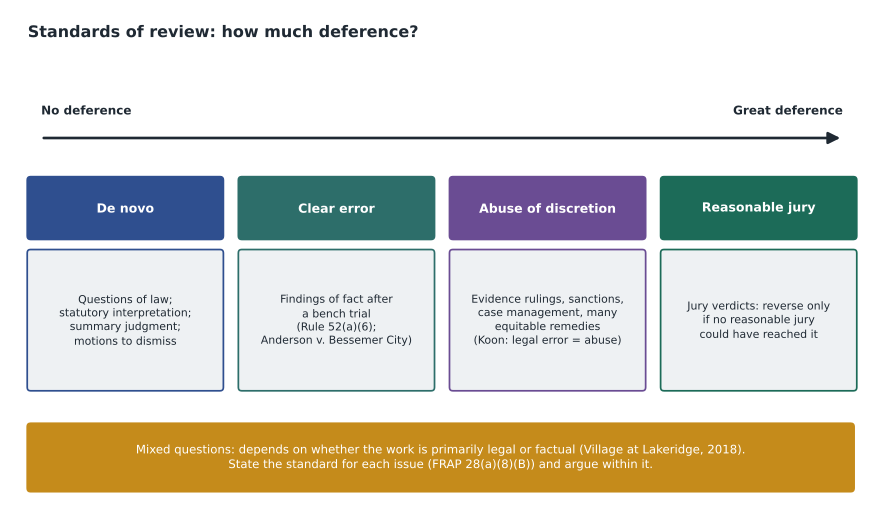
The standard of review tells the appellate court how much deference to give the decision below. The three main standards are de novo, clear error and abuse of discretion. Under de novo review, the appellate court decides the question afresh, giving no deference to the trial court. Questions of law, including the interpretation of statutes, are reviewed de novo; in Salve Regina College v. Russell, 499 U.S. 225 (1991), the Supreme Court held that federal courts of appeals must review a district court's determinations of state law de novo. Grants of summary judgment are reviewed de novo because they decide that no genuine dispute exists and that the movant is entitled to judgment as a matter of law, both legal conclusions.
Findings of fact made by a judge after a bench trial are reviewed for clear error. Federal Rule of Civil Procedure 52(a)(6) provides that findings of fact must not be set aside unless clearly erroneous, and the reviewing court must give due regard to the trial court's opportunity to judge the witnesses' credibility. In Anderson v. City of Bessemer City, 470 U.S. 564 (1985), the Supreme Court explained that if the trial court's account of the evidence is plausible in light of the record viewed in its entirety, the court of appeals may not reverse even if it would have weighed the evidence differently, and that the clear error standard applies even to findings based on documents or inferences rather than credibility. Jury verdicts receive similar or greater deference: a court may overturn a verdict only if no reasonable jury could have reached it.
Many decisions are committed to the trial court's discretion: evidentiary rulings, case-management orders, sanctions and many equitable remedies. They are reviewed for abuse of discretion. The Supreme Court applied that standard to Rule 11 sanctions in Cooter and Gell v. Hartmarx Corp., 496 U.S. 384 (1990), and explained in Koon v. United States, 518 U.S. 81 (1996), that a court by definition abuses its discretion when it makes an error of law. Abuse of discretion is the most deferential of the three standards, and arguments that a trial judge abused her discretion succeed far less often than arguments that she misread the law.
Mixed questions of law and fact fall between the categories. In U.S. Bank N.A. v. Village at Lakeridge, LLC, 583 U.S. 387 (2018), the Supreme Court held that the standard of review for a mixed question depends on whether answering it entails primarily legal or primarily factual work. If applying the rule to the facts requires developing legal principles, review is closer to de novo; if it requires immersion in case-specific factual issues, review is deferential. In the Coldbrook problem, whether a voluntary donation can ever be a charge is a legal question; whether the particular facts showed pressure or practice might be treated as more factual.
| Standard | Typical decisions | Key authority |
|---|---|---|
| De novo | Questions of law, statutory interpretation, summary judgment, dismissal for failure to state a claim | Salve Regina College v. Russell |
| Clear error | Findings of fact after a bench trial | Fed. R. Civ. P. 52(a)(6); Anderson v. City of Bessemer City |
| Abuse of discretion | Evidentiary rulings, sanctions, case management, many equitable remedies | Cooter and Gell v. Hartmarx; Koon v. United States |
| Reasonable jury | Challenges to the sufficiency of evidence for a verdict | Fed. R. Civ. P. 50 |
| Mixed questions | Depends on whether the work is primarily legal or factual | U.S. Bank v. Village at Lakeridge |
| Plain error | Forfeited errors, mainly in criminal cases | Fed. R. Crim. P. 52(b); United States v. Olano |
Arguing within the standard
Federal Rule of Appellate Procedure 28(a)(8)(B) requires the argument in an appellant's brief to include, for each issue, a concise statement of the applicable standard of review. The rule exists because the standard should shape the argument. Under de novo review, an appellant can argue that the trial court simply got the law wrong, and the appellee must defend the result on the merits; the appellate court may affirm on any ground supported by the record, even one the trial court did not rely on. Under clear error or abuse of discretion, an appellant must show more than disagreement. She must show that the finding has no support in the record, that the trial court applied the wrong legal standard, or that the ruling fell outside the range of reasonable choices. An appellant facing a deferential standard often tries to recast the issue as a question of law; an appellee tries to keep it factual.
Kinsella gives an example from the Coldbrook file. Suppose the trial court granted summary judgment for Coldbrook, finding that the donations were not a charge and that the record showed no conscious failure to act. On appeal, review is de novo, so Garrow will argue that the court misapplied Quill and Ibarra and that a jury could find willfulness. Coldbrook will defend the judgment on the merits and may offer alternative grounds. Now suppose instead the case went to a bench trial, and the judge found as a fact that the volunteer did not ask riders for money. On appeal, that finding would be reviewed for clear error, and Garrow would face a much harder task. "Same facts, same law," Kinsella says, "completely different brief."
Standards of review in state courts
State appellate courts use the same basic categories, though the names and details vary. Some state courts describe deferential review of facts as substantial evidence review; some use "manifest weight of the evidence" or other formulations. Many states, like the federal courts, review summary judgment and questions of law de novo. In the closed universe, Kinsella tells the class to assume that the fictional Westmarch Court of Appeals reviews grants of summary judgment and questions of statutory interpretation de novo, citing a fictional rule she has added to the file. In practice, a brief must cite the standard as the forum's own courts state it, using a recent decision of that court.
Exercise
Kinsella gives Section B a list of six rulings and asks them to identify the standard of review for each: the trial court's interpretation of "charge" in section 41-506, its grant of summary judgment, its refusal to allow Garrow to take a late deposition of the 4-H club's treasurer, its finding after a bench trial that Felix planned to fill the rut, its admission of a photograph of the rut over objection, and its denial of a motion for sanctions. Most of the class gets four right. Hannah catches the hardest one: the refusal to allow a late deposition is a case-management decision reviewed for abuse of discretion, but if the refusal rested on a misreading of the discovery rules, it would be an error of law and, under Koon, an abuse of discretion by definition.
Worked problem
Writing the standard of review
Draft the standard-of-review paragraph for Garrow's opening brief appealing a grant of summary judgment to Coldbrook in the fictional Westmarch Court of Appeals, assuming that court reviews summary judgment and statutory interpretation de novo.
Show solution
- Identify the ruling under review: the grant of summary judgment.
- State the standard and cite the forum's authority: de novo.
- Add the summary judgment standard the appellate court applies: viewing the evidence in the light most favorable to the nonmovant.
- Note that statutory interpretation is also reviewed de novo, because the meaning of charge is at issue.
- Keep it short; it frames, it does not argue.
Answer: "This Court reviews a grant of summary judgment de novo, applying the same standard as the trial court and viewing the evidence and all reasonable inferences in the light most favorable to Ms. Garrow, the nonmoving party. The interpretation of the Recreational Use Act, including the meaning of 'charge' in section 41-506, is a question of law also reviewed de novo." (In a real brief, each sentence would cite a recent decision of the forum court; the Westmarch authorities here are fictional.)
Summary and key terms
- Appeals generally lie only from final decisions (28 U.S.C. section 1291), with exceptions for certain interlocutory orders, certified questions and collateral orders.
- A civil notice of appeal in federal court is due within 30 days (60 if the United States is a party); the statutory deadline is jurisdictional (Bowles v. Russell).
- Arguments not raised below are generally forfeited; plain error review is limited, and harmless errors do not require reversal.
- De novo review applies to questions of law and summary judgment; clear error to findings of fact; abuse of discretion to discretionary rulings; mixed questions depend on the nature of the work (Village at Lakeridge).
- FRAP 28(a)(8)(B) requires stating the standard for each issue, and the standard should shape the argument.
Practice problems
Work each problem on paper first, then reveal the answer to check.
What three questions should a lawyer answer before writing an appellate brief?
Show answer
Whether the deadline has been met, whether the order is appealable, and what standard of review applies.
What did Bowles v. Russell hold?
Show answer
The statutory time limit for filing a civil notice of appeal is jurisdictional and cannot be excused.
Why is a grant of summary judgment reviewed de novo?
Show answer
It rests on legal conclusions that no genuine dispute exists and that the movant is entitled to judgment as a matter of law.
How does Village at Lakeridge decide the standard for mixed questions?
Show answer
By whether answering the question entails primarily legal work (closer to de novo) or primarily factual work (deferential).
Why might an appellant try to recast an issue as a question of law?
Show answer
To obtain de novo review instead of a deferential standard.
Lesson quiz · 5 questions
Score 60% or more to complete this lesson.
Create a free account to save your progress, take quizzes and earn a certificate.