
LAWU-114 · Lesson 3 of 12 · 21 min
The persuasive statement of facts
▶ Video coming soon A video version of this lesson is on the way.
"Most cases are won on the facts," Kinsella tells Section B at the start of the third class, "and most briefs waste the chance to win them." She explains that many judges read the statement of facts before anything else, because the facts tell them what the case is really about. A statement of facts that is accurate, well organized and quietly told from the client's point of view can leave the judge leaning toward a ruling before she reaches the first argument. A statement that argues, omits a key fact or misstates the record can lose the judge's trust in the first two pages.
The rules: accuracy and record citations
Every fact in a brief must be supported by the record, and court rules require writers to show where. On appeal, Federal Rule of Appellate Procedure 28(a)(6) requires the appellant's brief to include a concise statement of the case setting out the facts relevant to the issues, describing the relevant procedural history and identifying the rulings presented for review, with appropriate references to the record. In a summary judgment brief in federal court, Federal Rule of Civil Procedure 56(c)(1) requires a party asserting that a fact is or is not genuinely disputed to support the assertion by citing particular parts of materials in the record, such as depositions, documents, declarations or admissions. Many district courts' local rules go further and require a separate statement of undisputed facts in numbered paragraphs, each with a record citation. State courts have similar rules.
Accuracy is not only a rule; it is the foundation of persuasion. Kinsella tells the class that when she was a staff attorney, she checked every record citation in a sample of each brief. If the citations held up, she trusted the brief. If one did not, she checked all of them. A statement of facts that cites "Garrow Dep. 42:3-11" for a quotation that actually appears on page 44, or that describes testimony more favorably than the witness gave it, tells the court that the writer cannot be relied on. Model Rule of Professional Conduct 3.3(a)(1) forbids knowingly making a false statement of fact to a tribunal, and even an honest mistake costs credibility.
Facts, not argument
A statement of facts tells what happened; it does not argue what the facts mean. "Coldbrook did not charge for the hayride" is a legal conclusion, because whether there was a charge is the question the court must decide. "A sign at the wagon read: 'Hayrides free. Donations to Westmarch 4-H welcome, suggested 5 dollars'" is a fact. Adjectives and adverbs that characterize ("Coldbrook generously offered," "Garrow carelessly sat on the edge") also tend to read as argument. Judges notice the difference and discount the brief that blurs it. The art lies in telling facts so well that the conclusion seems obvious without being stated.
That does not mean the statement must be colorless. Writers have many legitimate tools for shaping how facts are received. Kinsella lists them on the board: what to include, what order to put it in, how much detail to give each fact, where to place the facts that hurt, how to frame the opening, and which words to choose. All of these are honest so long as every fact is accurate and no material fact is omitted.
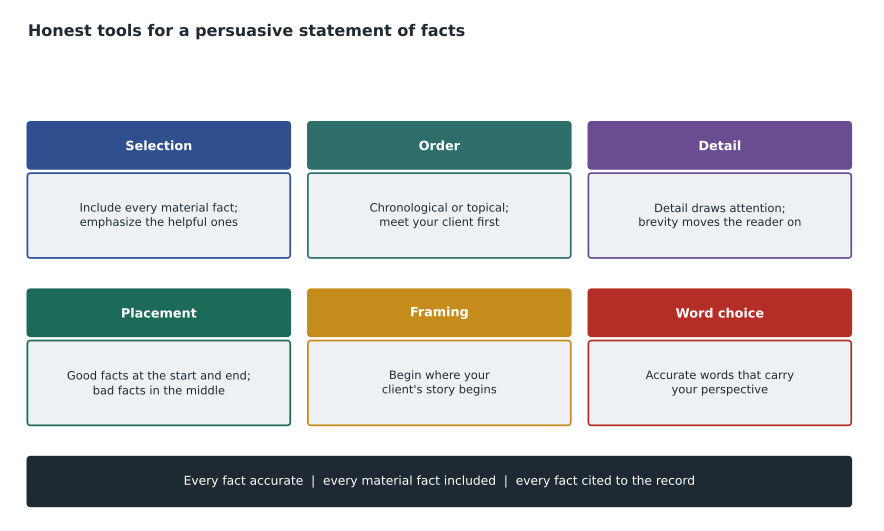
Selection and the duty to include bad facts
The writer chooses which facts to include, but the choice is constrained. Every fact the court needs to decide the issues must appear, including facts that hurt. Leaving out a material bad fact is dangerous for three reasons. The other side will supply it, usually with a remark about your omission. The judge, discovering it in the other brief, will wonder what else you left out. And in an extreme case, a misleading omission can approach a misrepresentation. For Coldbrook, two facts are bad and both must appear: the 4-H volunteer stood at the wagon steps holding a bucket, and about a week before the accident the teenage tractor driver told Felix the rut had come back and was "pretty deep."
Including a bad fact is not the same as dwelling on it. Kinsella shows how the same fact can be stated briefly, in context, without emphasis: "About a week before the accident, the tractor driver told Felix that the rut had returned. Felix told him to slow down near that stretch of the route and planned to fill the rut after the weekend." The fact is there, accurately stated, but it arrives with the response that followed it. Garrow's lawyer would write the same events differently: "A week before Ms. Garrow was hurt, Felix Merriwether learned that the rut was back and 'pretty deep.' He did not fill it, close the route or warn riders." Both versions are accurate; they differ in emphasis and in what follows the fact.
Order and framing
Most statements of facts are chronological, because readers understand stories told in time order. But chronology begins somewhere, and the starting point is a choice. Garrow's brief will likely open with Garrow: a woman who came to buy apples, climbed onto a hayride and was thrown from the wagon. Coldbrook's brief can open with the orchard: a family farm that for years has opened its grounds to the public free of charge, offering a weekend hayride and inviting donations to the local 4-H club. Neither opening is dishonest. Each frames the case so that the reader meets the client first and sees the events through the client's eyes. Topical organization, grouping facts by issue rather than by time, works better when the issues are distinct, as they are here: one group of facts about the money, another about the rut.
The procedural history belongs in the statement too, but it should be brief and factual. In a summary judgment brief, it may be a single paragraph: Garrow filed her complaint on a given date alleging negligence, Coldbrook answered and pleaded immunity under the Act, the parties completed discovery, and Coldbrook now moves for summary judgment. On appeal, it identifies the ruling under review and how the case got there.
Detail, placement and word choice
Detail controls attention. A fact described in a full sentence with specifics, such as the exact wording of the sign, the color of the bucket or the time of day, stays with the reader. A fact mentioned in a subordinate clause passes quickly. Coldbrook's statement can describe the sign in detail, quote it in full and note that it was posted at the wagon, and then mention the volunteer in a single clause. Placement works the same way. Readers remember the beginnings and ends of paragraphs and sections best, so helpful facts go there and unhelpful facts go in the middle. Kinsella warns against overdoing it: a statement that is obviously manipulated is as unpersuasive as one that argues.
Word choice matters most of all. Garrow will say she "paid five dollars to ride"; Coldbrook will say she "put five dollars in the 4-H club's donation bucket." Garrow will say the wagon "slammed into a deep rut"; Coldbrook will say the wagon wheel "dropped into a rut." Each side should choose words that are accurate and that carry its perspective without obvious slant. Quotations from the record are especially valuable because they are the witness's words, not the lawyer's. The sign's own text and Felix's testimony about telling the driver to slow down are more persuasive in quotation marks than in paraphrase.
| Fact | Garrow's framing | Coldbrook's framing |
|---|---|---|
| The money | Riders were expected to pay; Ms. Garrow paid 5 dollars to ride | Ms. Garrow placed 5 dollars in the 4-H club's donation bucket; the sign said the ride was free |
| The volunteer | A volunteer stood at the wagon steps collecting money from riders | A 4-H volunteer stood near the wagon with the club's donation bucket |
| The warning | A week earlier Felix learned the rut was back and 'pretty deep' and did nothing | When told the rut had returned, Felix told the driver to slow down and planned to fill it after the weekend |
| The accident | The wagon slammed into the rut and threw Ms. Garrow to the ground | A wagon wheel dropped into a rut and Ms. Garrow fell from the side of the wagon |
Only the record counts
A brief can tell only the facts that are in the record, and the record is defined by rule. On appeal in federal court, Federal Rule of Appellate Procedure 10(a) says the record consists of the original papers and exhibits filed in the district court, the transcript of proceedings, if any, and a certified copy of the docket entries. Facts outside that record, however true, generally cannot be considered. A lawyer who learns something new after judgment cannot add it to an appellate brief; the remedy, if any, lies in the trial court. In a trial-level motion, the record is whatever the parties have filed: deposition excerpts, declarations, exhibits and discovery responses. If Coldbrook wants the court to know that the 4-H club's records show every donation went to the club, someone must put those records in front of the court through a proper declaration.
Kinsella tells the class about the most common way new lawyers violate this rule: by describing what a witness "will" say or what "the evidence will show" in a motion that must be decided on evidence already filed. "Judges call that lawyer testimony," she says. "Your own say-so is not evidence. If you need a fact, find the page where it appears, or get a declaration from someone with personal knowledge." Rule 56(c)(4) requires that declarations used to support or oppose summary judgment be made on personal knowledge, set out facts that would be admissible in evidence and show that the declarant is competent to testify on the matters stated.
Length
A statement of facts should be as long as the issues require and no longer. In a short motion memo, the facts may take a page; in an appellate brief from a long trial, they may take ten. The test is relevance to the issues the court must decide. The Coldbrook problem involves two issues, the charge and willfulness, so the statement needs facts about the money and facts about the rut, plus enough background for the judge to understand the setting. It does not need the history of the Merriwether family or a description of every apple variety. Facts that matter to neither issue distract the reader and suggest the writer could not tell what mattered.
Point of view and the parties' names
Small choices of reference also shape perception. Many writers refer to their own client by name and to the opponent by role, or the reverse, depending on which humanizes the client. Federal Rule of Appellate Procedure 28(d) asks parties to minimize references to themselves as appellant and appellee and to use the parties' actual names or descriptive terms such as "the employee" or "the orchard." Coldbrook's brief might call the plaintiff "Ms. Garrow" and the defendant "Coldbrook" or "the Merriwethers," depending on whether the family farm or the business entity is the more sympathetic image. Kinsella advises consistency: once a name is chosen, use it throughout.
The summary judgment twist
One special constraint applies to facts in a summary judgment brief. The court must view the evidence in the light most favorable to the party opposing the motion and draw all reasonable inferences in that party's favor. The Supreme Court repeated that principle in Tolan v. Cotton, 572 U.S. 650 (2014), reversing a grant of summary judgment because the lower court had credited the moving party's version of disputed facts. For Coldbrook as the moving party, that means the statement of facts should rest on facts that are genuinely undisputed, and where the evidence conflicts, the brief must accept Garrow's version and argue that Coldbrook wins anyway. A statement that quietly adopts Coldbrook's side of a disputed fact undermines the whole motion. Marcus asks what happens if Garrow testifies that the volunteer said "five dollars a rider." "Then for this motion," Kinsella says, "we assume she said it, and we argue that a volunteer's statement does not turn a donation into Coldbrook's charge. Or we decide the charge argument is not suitable for summary judgment and rest on willfulness."
Workshop
The class ends with a workshop. Each student drafts the first paragraph of Coldbrook's statement of facts and the first paragraph of Garrow's, using only facts in the closed universe file. Hannah's Coldbrook opening reads: "Coldbrook Orchard, owned by Ada and Felix Merriwether, opens its grounds to the public without an admission fee. Visitors pick apples and pay for what they pick by the pound. On fall weekends a tractor pulls a hay wagon around the orchard, and a sign at the wagon reads: 'Hayrides free. Donations to Westmarch 4-H welcome, suggested 5 dollars.'" Kinsella marks it as a model: no adjectives, no argument, every fact supportable, and a reader who finishes it already understands why the ride was free.
Worked problem
Revising an argumentative fact statement
Revise this sentence from a draft of Coldbrook's statement of facts: "Felix Merriwether, a conscientious owner, promptly responded to the driver's report by taking every reasonable precaution, so Garrow's fall was simply an unforeseeable accident."
Show solution
- Remove characterizations that argue: conscientious, promptly, every reasonable precaution.
- Remove the legal conclusion: unforeseeable accident.
- State what Felix actually did, with dates if the record has them.
- Keep the bad fact (he knew of the rut) and place it so that the response follows it.
- Add a record citation.
Answer: "About September 19, 2026, the tractor driver told Felix that the rut had 'come back' and was 'pretty deep.' Felix told the driver to slow down on that part of the route and planned to fill the rut after the weekend. (Merriwether Dep. 31:4-22.) Felix had filled the same rut with gravel in April. (Id. at 18:9-15.)" (The deposition citations are illustrative of format.)
Summary and key terms
- Many judges read the facts first; a well-told statement can decide how the judge reads everything else.
- FRAP 28(a)(6) and Rule 56(c)(1) require record citations; many local rules require a separate statement of undisputed facts.
- State facts, not conclusions; avoid characterizing adjectives and adverbs.
- Include every material fact, including bad facts, and tell bad facts briefly and in context.
- Use selection, order, framing, detail, placement and word choice honestly to tell the client's story.
- In a summary judgment brief, the moving party must accept the nonmoving party's version of disputed facts.
Practice problems
Work each problem on paper first, then reveal the answer to check.
Why is "Coldbrook did not charge for the hayride" inappropriate in a statement of facts?
Show answer
Whether there was a charge is the legal question; the statement should give facts such as the wording of the sign.
Name three reasons to include a material bad fact.
Show answer
The other side will supply it, its omission damages credibility, and a misleading omission can approach misrepresentation.
What does FRAP 28(d) recommend about naming the parties?
Show answer
Minimize the use of appellant and appellee and use actual names or descriptive terms.
How does Tolan v. Cotton affect a moving party's statement of facts?
Show answer
The court must view the evidence in the light most favorable to the nonmoving party, so the moving party must accept the opponent's version of disputed facts.
Lesson quiz · 5 questions
Score 60% or more to complete this lesson.
Create a free account to save your progress, take quizzes and earn a certificate.