
LAWU-114 · Lesson 1 of 12 · 22 min
Persuasive writing
▶ Video coming soon A video version of this lesson is on the way.
Professor Orla Kinsella opens the spring semester of Legal Research and Writing with the same accordion file she carried all fall. "Last semester you wrote for a partner," she tells Section B. "Your job was to predict. You told Ms. Merriwether's lawyer what a Westmarch court would probably do about Tess Garrow's broken ankle, and you told her the bad news as clearly as the good. This semester you write for a judge, and your job changes. You are no longer predicting what the court will do. You are trying to get the court to do it." Kinsella spent six years as a staff attorney at a state supreme court, reading briefs and writing bench memos for the justices, and six more years at a litigation firm writing the briefs themselves. She says the two jobs taught her the same lesson from opposite ends: judges are busy, skeptical readers who reward lawyers they can trust.
She reminds the class where the fall left off. The Coldbrook Orchard problem is a closed universe: the State of Westmarch, its Recreational Use Act at Westm. Code sections 41-505 to 41-508, and four fictional cases, Stavros, Pell, Ibarra and Quill. All of it is invented for teaching, and none of it is real Westmarch law because there is no real Westmarch. In the model memo, the class predicted that Coldbrook would probably be immune from Garrow's negligence claim because the hayride was free and the donation bucket for the 4-H club was not a "charge," but that the exception for willful failure to guard or warn was the main risk, because Felix Merriwether knew the rut had come back. "For this semester," Kinsella says, "assume Garrow has sued, and that we represent the orchard. Later, some of you will switch sides. Good advocates can argue either one."
What changes when the reader is a judge
An objective memo and a persuasive brief share almost everything at the level of craft. Both state rules accurately, both apply those rules to facts, and both cite authority correctly. The difference lies in purpose and audience. A memo's reader is on your side and wants to know the risks. A brief's reader is neutral, often overworked, and has two sets of papers in front of her that say opposite things. The judge's question is not "What is the law?" but "Which side should win, and how do I write an opinion explaining why?" A good brief answers that question by giving the judge a path to a ruling, with the legal rule, the key facts and the reasons laid out so plainly that the judge could adopt them in an order.
Briefs come in several kinds, and this course covers the main ones. In a trial court, lawyers file memoranda of law supporting or opposing motions, such as a motion to dismiss or a motion for summary judgment, and sometimes trial briefs that set out a party's view of the law before a trial begins. On appeal, the appellant files an opening brief, the appellee files a response, and the appellant may file a reply. Nonparties with an interest in the issue may file amicus curiae briefs. Each kind has its own rules about length, format and content, but all of them rest on the same skills: knowing the law, mastering the record, choosing the strongest arguments and presenting them in a form the court can use. Kinsella tells the class that the first persuasive document most new lawyers write is not an appellate brief but a short motion memo, often written in a few days.
Kinsella puts two sentences on the screen. The first comes from the fall memo: "A court will probably conclude that the donation bucket was not a charge under section 41-506, although the presence of a volunteer at the wagon steps creates some risk." The second is a draft for the brief: "The Act withdraws immunity only when an owner charges for recreational use, and Coldbrook charged nothing: the hayride was free, the sign said so, and every dollar in the bucket went to the 4-H club." Priya Natarajan, who wants to be an appellate lawyer, likes the second sentence at once. Hannah Lindqvist, a former history teacher, asks whether the volunteer at the wagon steps has simply disappeared. "Good," Kinsella says. "That is exactly the right worry. The volunteer has not disappeared. We will deal with her in the argument, on our terms. What we will not do is pretend she was not there."
Advocacy within ethical limits
Persuasion in court operates inside rules of professional conduct and procedure. Model Rule of Professional Conduct 3.1 forbids asserting a claim or defense unless there is a basis in law and fact that is not frivolous, which includes a good-faith argument for extending, modifying or reversing existing law. Model Rule 3.3 requires candor toward the tribunal: a lawyer may not knowingly make a false statement of fact or law to a court, must correct a false statement of material fact or law previously made, and must disclose controlling adverse legal authority that opposing counsel has not disclosed. Model Rule 3.4 requires fairness to the opposing party. In federal court, Federal Rule of Civil Procedure 11(b) adds that by signing a paper a lawyer certifies, after a reasonable inquiry, that the legal contentions are warranted by existing law or a nonfrivolous argument for changing it and that factual contentions have or will likely have evidentiary support. Most states have adopted versions of these rules.
These rules do not make advocacy timid. They make it credible. Kinsella tells the class about a brief she read as a staff attorney in which the appellant's lawyer described a trial court finding as "unsupported by any evidence." The record contained two days of testimony supporting it. "After that," she says, "none of us believed anything else in the brief, including the parts that were right. Your credibility is the only currency you have with a court. You spend it every time you overstate." Jordan Kimura, an Army veteran, says the military has a phrase for it: once you lose trust, every report gets checked twice.
The three modes of persuasion
Lawyers still use the vocabulary Aristotle gave rhetoric more than two thousand years ago. Logos is persuasion through reasoning: the syllogism that takes a rule, applies it to the facts and reaches a conclusion. Ethos is persuasion through the speaker's character: the reader's sense that the writer is careful, fair and knows the law. Pathos is persuasion through the reader's values and emotions: the sense that a ruling would be right, not merely technically permissible. In legal writing, logos does most of the work and ethos makes logos believable. Pathos works best when it is quiet. A brief that rails at the other side or begs for sympathy usually loses the judge's trust; a brief that simply tells the facts well lets the judge feel their weight without being told to.
Daniel Reyes, who worked for three years as a paralegal at a plaintiffs' personal-injury firm, points out that Garrow's lawyer will have pathos to spare: a woman who bought apples, rode a hayride and broke her ankle because a known rut was left unfilled. Kinsella agrees. "So our answer is not to say her injury does not matter. Our answer is that the legislature made a deliberate choice: owners who open their land free of charge get immunity so that more land is open to the public, and Coldbrook is exactly the kind of owner the legislature wanted to protect. That is pathos too, the appeal to fairness and to the rule of law, and it is aimed at the judge's sense of her own role."
What judges say they want
Judges who write about briefs agree on a short list. They want brevity: a brief that is shorter than the limit and says what matters. They want the bottom line early, so they know where the writer is going before the details arrive. They want accuracy in every statement of fact and every characterization of a case, with record citations that check out. They want the writer to deal with the hardest point rather than hide it. And they want clean, plain prose. Justice Antonin Scalia and Bryan Garner made many of these points in Making Your Case: The Art of Persuading Judges (2008), a book still widely assigned. Kinsella hands out a page of quotations from judges' speeches and articles, and Marcus Webb, who has an engineering degree, notices that almost none of them mention rhetoric. "They talk about clarity the way engineers talk about tolerances," he says.
Who actually reads your brief
A brief has more than one reader. In a trial court, the judge may read it first, or a law clerk may read it and prepare a bench memo summarizing both sides. In many appellate courts, staff attorneys screen cases, and each judge's chambers prepares its own memo before argument. Kinsella describes her own routine as a staff attorney: she read the briefs in the order the judges would, starting with the summary of argument and the point headings, then the statement of facts, and only then the full argument, checking record citations as she went. "If your headings and summary do not tell the story," she says, "the person writing the memo about your case will tell it for you, in her own words, and they may not be the words you would choose."
Judges and clerks also read differently than they once did. Most federal courts and many state courts receive briefs electronically, and many judges read them on a screen or tablet, often in pieces between hearings. That changes some habits. Short paragraphs, informative headings and a clear roadmap help a reader who is scrolling and may return to the brief several times. Hyperlinks to record documents or authorities, which many courts now permit or encourage, help a reader check a citation in seconds. And because a brief is read alongside the opposing brief, the reader is constantly comparing: a writer who answers the other side's best point directly earns trust that a writer who ignores it never will.
Kinsella adds one more preference that rarely appears in the books: judges want to know what the writer is asking for. A surprising number of briefs end without saying whether the court should reverse, affirm, remand, grant the motion in part, or enter judgment. "If you do not ask for something specific," she says, "the judge has to guess, and judges do not like guessing for you."
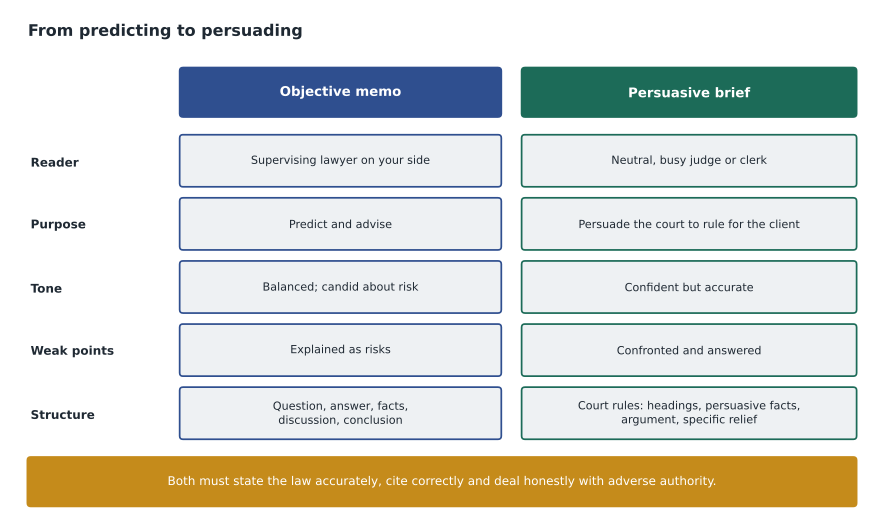
| Feature | Objective memo | Persuasive brief |
|---|---|---|
| Reader | Supervising lawyer or client on your side | Neutral judge, clerk or staff attorney |
| Purpose | Predict and advise | Persuade the court to rule for your client |
| Treatment of weaknesses | Explained fully as risks | Confronted and answered, never hidden |
| Headings | Neutral topic labels | Complete sentences stating your conclusion |
| Facts | Neutral and complete | Accurate, complete as to material facts, told from your client's perspective |
| Ending | Prediction and next steps | Specific relief requested |
| Governing rules | Office practice | Court rules, local rules and ethics rules |
A first exercise
To close the first class, Kinsella gives Section B five sentences from their fall memos and asks them to rewrite each for a brief without adding or removing any fact. Priya's first draft turns "Felix probably did not act willfully" into "Felix plainly did not act willfully." Kinsella circles "plainly." "Words like plainly, clearly and obviously tell the judge you are worried. If it were plain, you would not need to say so. Show the judge why it is true." Priya tries again: "Felix filled the rut in April, slowed the hayride when he heard it had returned, and planned to fill it again after the weekend. That is the opposite of a conscious failure to act." The second version is stronger because it is concrete, and it is honest because each fact comes from the record.
Worked problem
Turning a prediction into an argument
Rewrite this objective sentence for Coldbrook's brief without misstating anything: "Under Quill, a voluntary donation is probably not a charge, but Garrow may argue that the volunteer at the wagon steps created pressure to pay, which Quill suggested could matter."
Show solution
- Lead with the rule and your conclusion instead of the prediction: the Act's charge exception applies only to a price or fee asked in return for permission to enter.
- State the controlling authority accurately: Quill held that a donation box with a suggested amount was not a charge.
- Acknowledge the qualification honestly: Quill said the result could differ by pressure or practice.
- Answer it with facts: the sign said the ride was free, no one was turned away, and the volunteer held a bucket but did not collect from riders as they boarded.
- End with what the court should conclude.
Answer: "The Act withdraws immunity only for an admission price or fee asked in return for permission to enter, and in Quill the Court of Appeals held that a donation box with a suggested amount is not such a fee. Quill left room for a different result where pressure or practice turns a donation into a price, but nothing of the kind happened here: Coldbrook's sign said the hayride was free, the volunteer held a bucket without asking riders for money, and no rider was turned away. The donations were gifts to the 4-H club, not a charge by Coldbrook."
Summary and key terms
- A memo predicts for a reader on your side; a brief persuades a neutral judge and must give the judge a path to a ruling.
- Advocacy operates within Model Rules 3.1, 3.3 and 3.4 and, in federal court, Rule 11; these limits make a brief credible.
- Credibility is the advocate's currency: one overstatement can discredit an entire brief.
- Logos does most of the work in legal writing, ethos makes it believable, and pathos works best when it is understated.
- Judges consistently ask for brevity, an early bottom line, accuracy, candor about weaknesses, plain prose and a specific request for relief.
- Replace intensifiers with concrete facts from the record.
Practice problems
Work each problem on paper first, then reveal the answer to check.
How does the reader of a brief differ from the reader of an objective memo?
Show answer
The brief's reader is a neutral, busy judge deciding between two positions; the memo's reader is on your side and wants a candid prediction.
Which Model Rule requires disclosing controlling adverse authority the other side has not cited?
Show answer
Model Rule 3.3, candor toward the tribunal.
What does a lawyer certify under Federal Rule of Civil Procedure 11(b) by signing a brief?
Show answer
That after a reasonable inquiry the legal contentions are warranted by existing law or a nonfrivolous argument for changing it and the factual contentions have or will likely have evidentiary support.
Why does Kinsella object to the word plainly?
Show answer
It asserts strength without showing it and signals that the writer is worried; concrete facts persuade better.
Why should headings and the summary of argument tell the whole story?
Show answer
Clerks and staff attorneys often read them first and use them to summarize the case for the judge.
Lesson quiz · 5 questions
Score 60% or more to complete this lesson.
Create a free account to save your progress, take quizzes and earn a certificate.