
LAWU-114 · Lesson 2 of 12 · 21 min
Theory of the case and themes
▶ Video coming soon A video version of this lesson is on the way.
Kinsella begins the second class with a question that sounds simple: "In one sentence, why should Coldbrook win?" Section B tries. Daniel Reyes says Coldbrook should win because the Recreational Use Act gives it immunity. Hannah Lindqvist says Coldbrook should win because the hayride was free. Marcus Webb says Coldbrook should win because Felix Merriwether did not ignore the rut. Kinsella writes all three on the board. "Each of these is a piece of the answer. None of them is a theory of the case yet. A theory of the case is the story that explains why your client wins under the law and why that result is fair. It is the answer the judge can repeat to herself when she sits down to write."
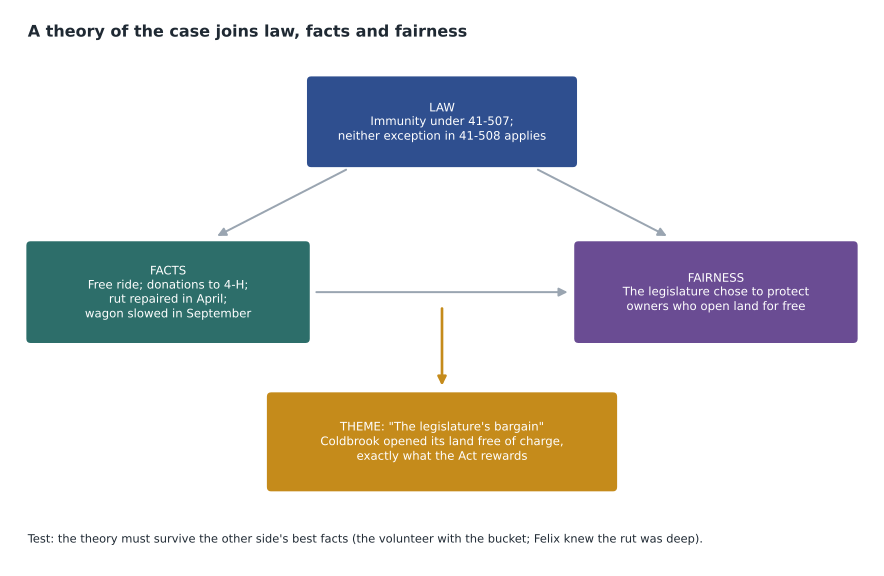
A theory of the case has two parts that must fit together. The legal theory is the rule or chain of rules that produces a win: here, that section 41-507 of the fictional Westmarch Code relieves owners who open land for recreation of any duty of care, and that neither exception in section 41-508 applies. The factual theory is the account of what happened that satisfies the legal theory: here, that Coldbrook opened its hayride to the public without charge and acted responsibly about the rut. When the two fit, the judge can rule for you without straining either the law or the facts. When they do not fit, the theory collapses under questioning.
Building the legal theory
Building the legal theory starts with the elements. Garrow must overcome the Act's grant of immunity by proving one of two exceptions: that Coldbrook charged her for the recreational use, or that Coldbrook willfully or maliciously failed to guard or warn against a dangerous condition. Coldbrook's legal theory therefore has two branches, one for each exception, and each branch rests on the cases. On the charge exception, Coldbrook relies on Quill v. Fenwick Farms, where the Westmarch Court of Appeals held that a donation box with a suggested amount for a food bank was not a charge, and on the statutory definition of charge as "the admission price or fee asked in return for invitation or permission to enter or go upon the land." On willfulness, Coldbrook relies on Ibarra v. Westmarch Department of Natural Resources, where the Westmarch Supreme Court held that willful means actual knowledge of a dangerous condition, knowledge that injury is probable, and a conscious failure to act, and that gross negligence is not enough.
A legal theory also needs a reason the rule exists. Stavros v. Kettering Timber Co., the Westmarch Supreme Court's foundational case, said the Act must be construed to serve its purpose: encouraging owners to open land to the public by relieving them of liability. That purpose gives Coldbrook something more than a technical argument. It lets the brief say that the legislature made a policy choice, that courts have honored it, and that Coldbrook's free hayride is precisely the kind of public access the legislature wanted. Kinsella calls this "the why behind the rule," and tells the class that judges are far more comfortable ruling for a party when they understand why the rule produces that result.
Building the factual theory
The factual theory selects and organizes the facts that matter under the legal theory. For the charge exception, the facts are the sign ("Hayrides free. Donations to Westmarch 4-H welcome, suggested 5 dollars"), the destination of the money (the 4-H club, not Coldbrook), the absence of any ticket or requirement, and the fact that Coldbrook made its money from apples sold by the pound, not from the ride. For willfulness, the facts are Felix's April repair with gravel, his instruction to the teenage driver to slow down when he heard about the rut in mid-September, and his plan to fill it after the weekend. The factual theory does not ignore bad facts. It explains them. The volunteer at the wagon steps holding a bucket and Felix's knowledge of the rut are part of the story; the question is how they fit.
Kinsella cautions that a factual theory must be supportable from the record. In the Coldbrook problem, the record will consist of deposition testimony, declarations, photographs of the sign and the rut, and perhaps the 4-H club's records of donations. "A theory that depends on facts you cannot prove is a wish, not a theory," she says. Jordan Kimura, who ran logistics for an Army unit, compares it to planning with the supplies you actually have rather than the ones you ordered.
Themes
A theme is a short phrase or idea that captures the theory and recurs through the brief. It is not a slogan pasted on the cover; it is the thread that ties the point headings, the facts and the argument together. Good themes are simple, memorable and true. For Coldbrook, Kinsella suggests several candidates and asks the class to test them. "Free means free" is short, but it sounds glib and invites the reply that the bucket made the ride less than free. "The legislature's bargain" is better: owners open their land without charge, and in exchange the law relieves them of liability for ordinary negligence. It frames the case as a matter of honoring a deliberate policy choice and makes the facts about the sign and the 4-H club part of a larger story.
Garrow's lawyer will have themes too. Daniel, drawing on his years at a plaintiffs' firm, offers two: "a known danger, left in place," which aims at the willfulness exception, and "you paid to ride," which aims at the charge exception. Kinsella points out that the first is much stronger than the second, because it rests on Felix's own admission that the driver told him the rut was "pretty deep." "When you write for Coldbrook," she says, "you need to know which of the other side's themes is dangerous, because that is where you spend your words."
Choosing and ordering arguments
A theory of the case also guides which arguments to make and in what order. The usual advice is to lead with your strongest argument unless logic requires a different order. For Coldbrook, logic and strength point the same way: the court should first decide whether the Act applies at all, which turns on whether Coldbrook was an owner that opened its land for a recreational purpose without charge, and only then consider the willfulness exception. Some arguments that are technically available should be left out. A student suggests arguing that a hayride is not a recreational purpose. Kinsella reminds him that section 41-506 expressly lists hayrides and agricultural sites, and that Ibarra called the statutory list illustrative. "An argument you will lose costs you more than the space it takes up. It makes the judge wonder about your judgment on everything else."
Weak arguments dilute strong ones in another way. A judge who reads seven arguments assumes none of them is decisive. A judge who reads two well-developed arguments assumes the writer has chosen carefully. Appellate judges in particular have written that the number of issues in a brief often runs inversely to the quality of the brief. Kinsella's rule of thumb is to ask, for each argument, whether a reasonable judge could rule for the client on that ground alone. If the answer is no, the argument should be cut or folded into another one as supporting reasoning.
| Question | What a good answer looks like | Coldbrook example |
|---|---|---|
| Does the law produce a win? | A rule whose elements the facts satisfy | Immunity under 41-507; neither exception in 41-508 applies |
| Do the facts support it? | Record evidence for each element | Sign, 4-H records, Felix's testimony about the repair and the slowed wagon |
| Is the result fair? | A reason the rule exists that favors the client | The Act rewards owners who open land free of charge |
| Does it handle the bad facts? | An explanation, not silence | The volunteer collected gifts for 4-H; Felix took steps when told of the rut |
| Can it be said in one sentence? | A short, repeatable statement | Coldbrook opened its hayride free, as the legislature intended, and acted responsibly about the rut |
A theory that changed the law
Kinsella gives the class a historical example of how a theory of the case is chosen and refined over time. For years, the NAACP's lawyers challenged segregated schools by arguing that the facilities for Black students were not in fact equal, accepting for the sake of argument the separate-but-equal rule of Plessy v. Ferguson, 163 U.S. 537 (1896). Cases such as Sweatt v. Painter, 339 U.S. 629 (1950), won relief by showing that a separate law school could not match the established one in intangible qualities like reputation and the chance to learn with future colleagues. By the early 1950s, Thurgood Marshall and his colleagues shifted to a direct attack: segregation itself denied equal protection, whatever the facilities. In Brown v. Board of Education, 347 U.S. 483 (1954), the Supreme Court agreed. "The facts did not change much," Kinsella says. "The theory did, and the theory was built on what the earlier cases had already established."
The lesson for a first-year brief is more modest but the same in kind. A theory should be built on the strongest ground the existing law supports, and it should be framed so that a ruling for the client looks like the natural next step from the cases the court already accepts. For Coldbrook, that means presenting the result as a straightforward application of Stavros, Quill and Ibarra, not as a bold extension of them. A court is far more willing to apply settled law than to make new law, and a brief that asks for less often gets more.
Writing the theory down
Kinsella asks each student to keep a single index card for the case. On the front goes the theory in one or two sentences; on the back go the theme, the two or three facts that matter most, and the other side's best point with a one-line answer. She tells them to revise the card as the semester goes on and to look at it before drafting each section of the brief. "If a paragraph does not serve what is on that card," she says, "ask why it is there." Marcus says it reminds him of a design specification: everything in the product should trace back to a requirement. Priya admits that her first card for Coldbrook ran to eleven lines in tiny handwriting, which Kinsella says is the usual first draft. The second draft fits in four lines, and it is much better.
Consistency across the litigation
A theory of the case should stay consistent from the first pleading to the last brief. Lawyers who change theories midstream lose credibility and sometimes lose the right to make an argument at all, because appellate courts generally refuse to consider arguments that were not raised in the trial court. For Coldbrook, that means the answer to the complaint should plead immunity under the Act as an affirmative defense, discovery should be aimed at the facts the theory needs, and the summary judgment brief should present the same theory that will later be defended on appeal. Kinsella describes a case from her firm years in which a client won summary judgment on one theory and then lost on appeal because the appellate court found the theory had shifted between the trial court and the brief.
Consistency does not mean rigidity. If discovery reveals a fact that undermines the theory, the theory must adapt. Suppose the 4-H volunteer testifies that she told riders the ride cost five dollars, or that Coldbrook received a share of the donations. Then the charge argument changes from "there was no charge at all" to "any statement by a volunteer did not reflect Coldbrook's policy," or it may have to be abandoned in favor of the willfulness argument alone. Good advocates revisit the theory at every stage and drop what the record will not support.
Telling both stories
To prepare for the drafting assignments, Kinsella splits Section B. Priya, Marcus and Jordan will draft for Coldbrook; Daniel and Hannah will draft for Garrow. Each team must write a one-paragraph theory of the case, a theme of no more than eight words, and a list of the three facts the other side will rely on most. Hannah's team produces this theory for Garrow: "The Act protects owners who open land for free, but Coldbrook expected riders to pay and left a rut it knew was dangerous in the path of a loaded wagon." Kinsella praises its economy and asks whether the two halves should be argued in that order. Daniel says no: the willfulness argument is stronger, so it should come first even though the statute lists the charge exception second.
Worked problem
Drafting a theme and a theory
Write a one-sentence theory of the case and a short theme for Coldbrook on the willfulness exception only, using the fictional Ibarra standard: actual knowledge of a dangerous condition, knowledge that injury is probable, and a conscious failure to act.
Show solution
- Identify the element Coldbrook can most credibly contest: Felix knew about the rut, so actual knowledge is hard to dispute; the strongest ground is the absence of a conscious failure to act and, secondarily, knowledge that injury was probable.
- Gather the facts that support that element: the April repair, the instruction to slow down, the plan to fill the rut after the weekend.
- Connect them to the rule's purpose: Ibarra held that even gross negligence is not willfulness.
- Write a theme that is short and true.
Answer: Theory: "Felix Merriwether did not consciously fail to act; he repaired the rut in April, slowed the wagon as soon as he learned the rut had returned, and planned to fill it again, which may have been imperfect care but is far from the willful misconduct Ibarra requires." Theme: "A careful owner, not a reckless one."
Summary and key terms
- A theory of the case joins a legal theory and a factual theory and explains why the result is fair.
- The legal theory follows the elements of the governing rule and its purpose; Stavros's purpose holding gives Coldbrook a policy argument.
- The factual theory selects record facts that satisfy the legal theory and explains the bad facts instead of ignoring them.
- A theme is a short, true, recurring idea; test themes for glibness and for the replies they invite.
- Lead with the strongest argument unless logic dictates otherwise, and cut arguments a reasonable judge would not accept on their own.
- Keep the theory consistent from pleading to appeal, but adapt it when the record changes.
Practice problems
Work each problem on paper first, then reveal the answer to check.
What are the two components of a theory of the case?
Show answer
A legal theory (the rule that produces a win) and a factual theory (the record facts that satisfy it).
Why is "free means free" a weaker theme for Coldbrook than "the legislature's bargain"?
Show answer
It sounds glib and invites the reply that the bucket made the ride less than free; the legislature's bargain frames the case around the statute's purpose.
Why should a lawyer leave out an argument that is technically available but weak?
Show answer
It costs credibility and dilutes the stronger arguments.
What risk arises if a party changes its theory between the trial court and appeal?
Show answer
The appellate court may refuse to consider arguments not raised below, and the party loses credibility.
Lesson quiz · 5 questions
Score 60% or more to complete this lesson.
Create a free account to save your progress, take quizzes and earn a certificate.