
LAWU-114 · Lesson 4 of 12 · 23 min
Point headings and argument structure
▶ Video coming soon A video version of this lesson is on the way.
Kinsella starts the fourth class by projecting the table of contents from a brief she wrote as a junior associate. The headings read: "I. The Statute. II. The Cases. III. Application. IV. Policy." Then she shows the table of contents from the same brief after a senior partner revised it: "I. The Statute of Limitations Bars the Claim Because the Plaintiff Knew of Her Injury More Than Two Years Before Filing Suit. A. The discovery rule starts the limitations period when a plaintiff knows of the injury and its cause. B. The plaintiff's own emails show she knew both by March 2019." She asks which version tells the judge how the case comes out. Section B laughs, because the answer is obvious. "The table of contents is often the first thing a judge reads," Kinsella says. "If the headings make your argument, the judge knows your case in thirty seconds."
Point headings as arguments
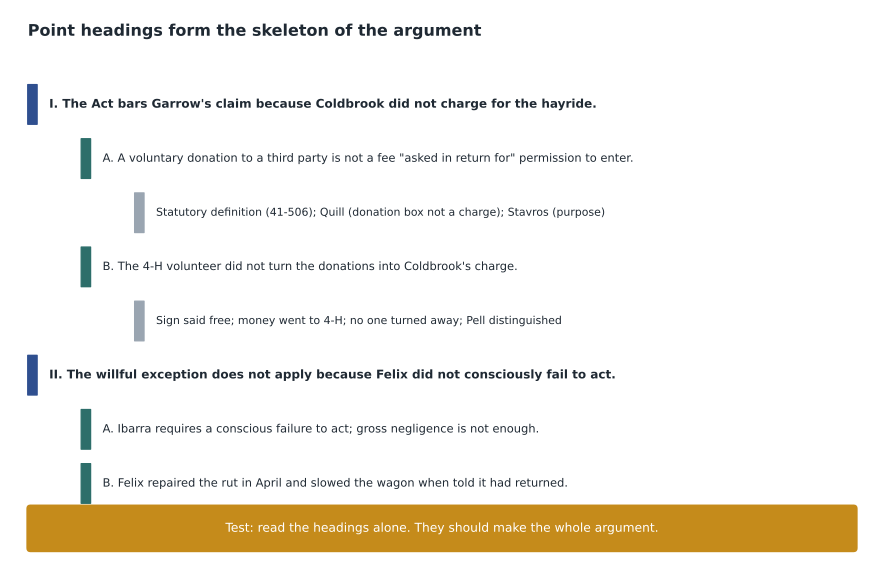
In a brief, headings are called point headings, and they do more than label topics. Each main heading is a complete sentence stating a conclusion the writer wants the court to adopt, usually combining the legal conclusion with the key reason. Subheadings break that conclusion into its supporting steps. Read in order, the headings should form an outline of the whole argument, which is why many courts require a table of contents listing them; under Federal Rule of Appellate Procedure 28(a)(2) and (3), an appellate brief must include a table of contents with page references and a table of authorities. Kinsella tells the class to draft the headings first, as a skeleton, and to test them by reading them aloud: if the headings alone persuade, the brief has a good structure.
A good point heading is specific, assertive and tied to the facts. "Coldbrook Is Immune" is too general. "The Recreational Use Act Bars Garrow's Negligence Claim Because Coldbrook Did Not Charge for the Hayride" states the conclusion and the reason. Subheadings then supply the steps: "A. A voluntary donation to a third party is not 'the admission price or fee asked in return for' permission to enter." "B. The 4-H volunteer did not turn the donations into Coldbrook's charge." Headings should not be so long that the reader loses the thread; two lines is a practical maximum for main headings, and subheadings can be shorter.
Typography helps the reader see the hierarchy. Many courts and firms use a consistent pattern: main headings in bold or capitals, subheadings in bold or italics with initial capitals, and lower levels in ordinary sentence case. The pattern matters less than consistency. Kinsella also warns against headings in all capital letters running more than a line, because blocks of capitals are hard to read, and against more than three or four levels of headings in a brief of ordinary length.
The structure within each section: CRAC and CREAC
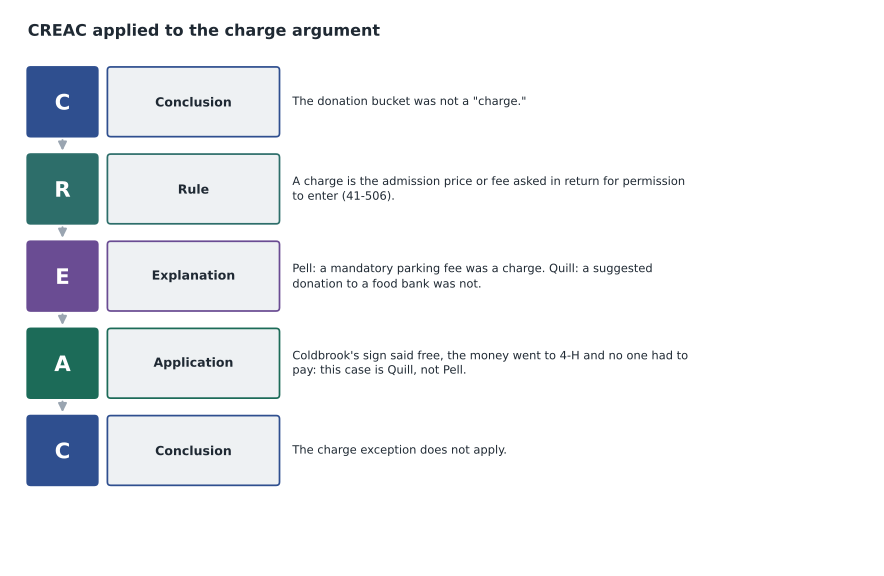
Within each section, legal writers organize arguments using a pattern that law schools teach under several acronyms. The most common for briefs is CRAC (conclusion, rule, application, conclusion) or its expanded form CREAC (conclusion, rule, explanation of the rule, application, conclusion). The fall memo used a similar structure, often taught as IRAC, which begins with the issue. In a brief, the writer begins with the conclusion rather than the issue, because the purpose is to persuade, and a reader who knows where the argument is going follows it more easily.
Each part has a job. The conclusion states what the court should hold on this point. The rule states the governing law, usually from a statute and the controlling cases, in terms that favor the client while remaining accurate. The explanation shows how courts have applied the rule, typically by describing the facts, holdings and reasoning of the most relevant cases, so the reader can see the pattern. The application connects the rule and the cases to the facts of this case, analogizing to favorable precedents and distinguishing unfavorable ones. The final conclusion repeats the point, often in a single sentence, and connects it to the next section. Kinsella calls CREAC "a default, not a cage": skilled writers vary it, but beginning writers who abandon it usually lose the reader.
Rule statements that persuade
The rule statement is where accuracy and advocacy meet most directly. A rule must be stated correctly, with citation to the authority that establishes it, but the writer chooses how to phrase it and which authority to emphasize. Coldbrook will state the charge rule in the statute's words, which emphasize a price or fee "asked in return for invitation or permission to enter," and will add Stavros's instruction that the Act be construed to serve its purpose. Garrow will emphasize Pell's holding that courts look to substance, not labels. Both are accurate. Each side leads with the part of the rule that favors it.
Rule synthesis is often necessary when no single case states the rule completely. Here, Pell and Quill together suggest a principle: a payment is a charge when it is required as a condition of access, and not when it is voluntary. Neither case says exactly that, but both holdings are consistent with it. A synthesized rule must be fair to the cases, and the writer should cite them in a way that shows the reader how the rule was derived, often with explanatory parentheticals. A synthesized rule that overstates the cases invites the other side to quote the cases and show that they say something narrower.
Roadmaps and umbrella paragraphs
When a section has several parts, a short introductory paragraph, sometimes called an umbrella or roadmap paragraph, tells the reader what is coming. Before the two subheadings on the charge exception, Coldbrook's brief might say: "The Act's charge exception does not apply for two reasons. First, the statute defines a charge as a price asked in return for permission to enter, and a voluntary donation to a third party is not such a price. Second, the presence of a 4-H volunteer holding the club's bucket did not turn those donations into Coldbrook's charge." The roadmap gives the reader a frame for the details that follow and lets a hurried judge grasp the structure immediately.
Handling counterarguments
A brief should anticipate and answer the other side's strongest arguments, but the placement matters. Most writers make their affirmative case first and then address counterarguments, rather than opening with the opponent's position and spending the first page refuting it. Opening with the other side's argument lets the opponent set the terms. Kinsella recommends framing counterarguments in the writer's own words and answering them directly: "Garrow relies on Pell, but Pell involved a mandatory fee that every visitor had to pay to park; no one at Coldbrook had to put anything in the bucket." In a response brief, of course, answering the opponent is the point, but even there the strongest responses lead with the writer's own framing of the issue.
| Weak | Problem | Stronger |
|---|---|---|
| Immunity | A topic, not an argument | The Recreational Use Act bars Garrow's claim because Coldbrook did not charge for the hayride |
| Coldbrook did not charge | Conclusion without a reason | A voluntary donation to the 4-H club is not a fee asked in return for permission to enter |
| Garrow's arguments are wrong | Defensive and vague | The 4-H volunteer's presence did not turn donations into Coldbrook's charge |
| Willfulness | A topic | The willful exception does not apply because Felix did not consciously fail to act |
| The trial court erred in granting summary judgment because the evidence shows Coldbrook was aware of the rut and also charged money for the ride, and the Act should be read narrowly | Too long and combines issues | A jury could find that Coldbrook consciously failed to address a rut it knew was dangerous |
Paragraphs and topic sentences
Structure continues below the level of headings. Each paragraph in an argument should do one job, and its first sentence should say what that job is. A topic sentence that states a point ("Quill controls this case because the donations at Coldbrook, like those at Fenwick Farms, went to a third-party charity and were not required") lets the reader understand the paragraph before reading it and lets a skimming reader follow the argument from topic sentences alone. A paragraph that begins with a citation or a fact ("In Quill, the plaintiff visited a corn maze...") makes the reader wait to learn why the case matters. Kinsella asks Section B to underline the first sentence of every paragraph in their drafts and read only the underlined sentences. "If that reads like a coherent argument," she says, "your paragraphs are doing their job."
Paragraph length matters too. Long paragraphs that combine a rule, two case descriptions and an application are hard to follow, especially on a screen. Short paragraphs that each make a single point are easier to read and easier to cite in an opinion. But a brief made entirely of two-sentence paragraphs reads like a list of assertions without reasoning. Kinsella suggests that most argument paragraphs run between four and eight sentences, with an occasional short paragraph for emphasis. A one-sentence paragraph can be powerful once or twice in a brief; used constantly, it loses its force.
Transitions and signposts
Transitions tell the reader how each idea relates to the last. Words such as "because," "therefore," "but," "moreover" and "even if" carry logical weight; they show whether a sentence supports, extends, qualifies or contradicts what came before. Signposts such as "First" and "Second" mark the steps announced in a roadmap. The "even if" transition is particularly useful in briefs, because it lets a writer present alternative arguments without seeming to doubt the first one: "Even if the volunteer's presence created some expectation of a donation, an expectation is not a fee 'asked in return for' permission to enter." Marcus notes that this is the brief-writing version of designing for failure: the argument still stands if one support gives way.
Transitions between major sections deserve special care. A brief that ends section I abruptly and launches into section II leaves the reader to work out how the two connect. A single sentence at the end of section I ("Because Coldbrook did not charge for the hayride, the Act applies; the only remaining question is whether its exception for willful conduct removes that protection") carries the reader across and reminds the judge of the overall structure.
Ordering the argument
Lesson 2 discussed choosing the strongest argument to lead. Structure adds a second consideration: logical dependency. Threshold issues usually come first, because if they are decided one way the court need not reach the others. In the Coldbrook case, the question whether the Act applies at all (owner, recreational purpose, no charge) is logically prior to the willfulness exception, which only matters once immunity attaches. Coldbrook's brief can therefore follow the statute's own order. Garrow's brief, by contrast, might lead with willfulness, her strongest point, and present the charge argument second, explaining that either ground defeats immunity. Each order is defensible; what matters is that the writer chooses deliberately and tells the reader why.
Headings also help after the brief is filed. Judges and clerks return to a brief at several points: when preparing a bench memo, before a hearing, and while drafting an opinion. On each return, the reader uses the table of contents and the headings to find the part she needs. A brief with clear headings can be navigated in seconds; a brief with vague ones forces the reader to skim pages to find a point she remembers reading. Kinsella says that in her years as a staff attorney, she could usually tell from the table of contents alone whether a brief would be easy to use.
A short exercise
Kinsella gives Section B fifteen minutes to draft point headings for Garrow's opposition to summary judgment. Daniel's main heading reads: "Summary Judgment Must Be Denied Because a Jury Could Find That Coldbrook Willfully Failed to Guard Against a Rut It Knew Was Dangerous." His subheadings: "A. Felix Merriwether knew the rut had returned and was 'pretty deep.' B. A loaded hay wagon crossing a deep rut makes injury probable. C. Telling the driver to slow down was not a substitute for filling the rut, closing the route or warning riders." Kinsella notes that the subheadings track Ibarra's three elements in order, so a judge applying Ibarra can follow along without a map. Priya points out that the third subheading concedes that Felix took a step; Kinsella says that is a strength, because it meets Coldbrook's best fact head-on.
Worked problem
Building a section from headings down
Draft a main heading, a short roadmap paragraph and two subheadings for Coldbrook's argument that the willful exception does not apply, using the fictional Ibarra standard.
Show solution
- State the conclusion and reason in the main heading.
- In the roadmap, state Ibarra's standard and preview the two reasons it is not met.
- Make each subheading a complete sentence stating one reason.
- Check that the headings, read alone, make the argument.
Answer: Main heading: "II. The Willful-Failure Exception Does Not Apply Because Felix Merriwether Did Not Consciously Fail to Act." Roadmap: "Under Ibarra, willful conduct requires actual knowledge of a dangerous condition, knowledge that injury is probable, and a conscious failure to act; gross negligence is not enough. The record does not permit a finding of willfulness for two reasons." Subheadings: "A. Felix responded to the report of the rut by slowing the hayride and scheduling a repair, which is the opposite of a conscious failure to act." "B. Even if Felix's response was inadequate, inadequate care is at most negligence, which the Act does not reach."
Summary and key terms
- Point headings are complete sentences stating conclusions and reasons; together they should form an outline of the argument.
- Draft headings first and test them by reading them alone.
- Within sections, CRAC or CREAC puts the conclusion first and explains how courts have applied the rule before applying it.
- State rules accurately but lead with the part that favors the client; synthesize rules fairly from multiple authorities.
- Use roadmap paragraphs to preview multi-part sections.
- Make the affirmative case first, then answer counterarguments in your own framing; order arguments by strength and logical dependency.
Practice problems
Work each problem on paper first, then reveal the answer to check.
What makes a point heading different from a topic heading?
Show answer
A point heading is a complete sentence that asserts a conclusion and usually the reason for it.
What does the E in CREAC stand for, and why is it useful?
Show answer
Explanation: describing how courts have applied the rule, so the reader sees the pattern before the application.
Why does a brief start each section with a conclusion rather than the issue?
Show answer
The purpose is to persuade, and a reader who knows where the argument is going follows it more easily.
Why do threshold issues usually come first?
Show answer
If they are decided one way, the court need not reach the remaining issues.
How can you test whether your topic sentences work?
Show answer
Read only the first sentence of each paragraph; together they should form a coherent argument.
What does an even-if transition let a writer do?
Show answer
Present an alternative argument without appearing to doubt the first one.
Lesson quiz · 5 questions
Score 60% or more to complete this lesson.
Create a free account to save your progress, take quizzes and earn a certificate.